
Moorish Idol (Zanclus cornutus) profile

Moorish idols are a conspicuous fish that are often encountered by divers in tropical waters but are rarely seen in temperate seas. They are very widely distributed throughout tropical oceans; and are found in the Indo-Pacific from Eastern Africa to French Polynesia and in the far eastern Pacific they occur on the California coast down to Peru.
Moorish idols also have a broad latitudinal range spanning from Southern Japan in the north to Lord Howe Island and the Kermadec Islands in the South. Within their native range, this distinctive yellow and black species is generally found in pairs or small schools on coral reefs or in lagoons from the surface to 180m depth, where they can be seen feeding on benthic invertebrates (species attached to or living on the seafloor). They are particularly partial to sponges but will also graze on seaweed, sea-squirts and crustaceans.
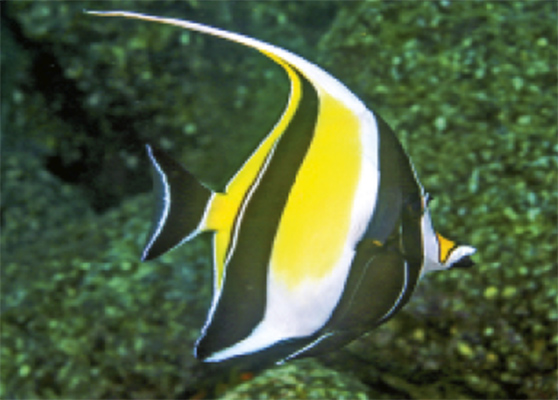
A mature moorish idol showing the distinctive sickle-shaped fin, long snout and small bony protrusions in front of the eyes.
You might be thinking ‘this is New Zealand Fishing News, so why am I reading about a species only seen on coral reefs and in Finding Nemo movies?’. Well as of last month, moorish idols are now known from New Zealand waters. A single mature individual was photographed at the Poor Knights Islands on a deep reef near a sandy slope in 25m of water. Mary Carney, an experienced Northland diver reported the sighting of this tropical fish to WhatsthatfishNZ and one of her photographs is featured in this article.
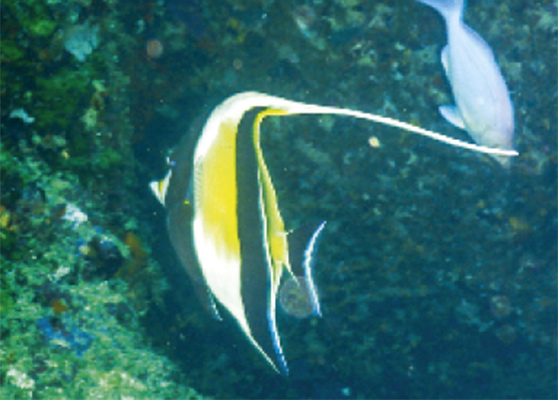
The one and only photo of a moorish idol from mainland New Zealand, Poor Knights Islands.
So how do you know if the brightly-coloured fish you spotted is a moorish idol? Moorish idols have a yellow body with large vertical black bands, but there are a number of butterflyfishes that can also superficially resemble moorish idols. In the southern part of their range moorish idols could be mistaken for lord howe coralfish, another bright yellow-and-black tropical-looking species. However, there are a number of features that set moorish idols apart from any other species. First they have a very long, white, sickle-shaped dorsal fin. The scientific name ‘Zanclus’ is derived from the Greek word for ‘sickle’, referring to the distinctive dorsal fin. Moorish idols also have a long snout with a yellow saddle across the front and there are small, bony projections in front of both eyes of adult fish, which are particularly prominent in male moorish idols.

A pair of lord howe coralfish on a deep reef at the Poor Knights Islands, the colouration of these butterflyfish is similar to that of the moorish idol and at a first glance could be confused for them. Lord howe coralfish lack the long sickle shaped fin.
The large range of this species may be explained partly by their life history strategies. Moorish idols are pelagic spawners; this means they release eggs and sperm into the water column, leaving fertilized eggs to drift away with the currents. Once the larvae hatch they will spend several months living in the water column where they grow quite large (up to 80mm) before settling onto the reef. The larvae and eggs will drift with currents far and wide and it is likely that the fish spotted at the Poor Knights Islands has arrived this way. This is an exciting new addition to our New Zealand fish fauna, but one vagrant fish sighting does not mean they are here to stay. Moorish idols may arrive in New Zealand after heatwave events or cyclones pushing warm waters south, and if winter temperatures increase they may start to overwinter here. So keep your eyes peeled and make sure you double-check that the lord howe coralfish you think you spotted was not one of these super-rare tropical visitors.
If you think you have spotted a moorish idol in New Zealand waters, send a photograph to WhatsThatFishNZ or a fish taxonomist to confirm the identity along with the location and depth where you saw it.
|
|
This article is reproduced with permission of |

Recent Forum Posts Visit Forum

Shane Jones
in Fisheries Management13 hours ago
Tzer
Far cry to the twats at Liegasea/NZSFC were proposing of 5 Tarakihi person in their submission for the central management area and this is what our...

Bluefin Tuna at the cavs.
in The Briny Bar33 hours ago
smudge
Despite my years of fishing I haven't really fished many places, my focus has always been on Auckland's west coast and out toward Great Barrier. I...

Casting gloves
in Popper and Topwater Fishing78 hours ago
Mc Tool
100 bucks for a lure 😬. Watching one of them flying over the horizon without the line attached would be " character building " for sure...
I thought Id post some nice photo's , join...
in The Briny Bar129 hours ago
Alan L
That is a very cool pic Krow.The Far North is very cool, the Far far North even cooler. Mint looking day.Alan...

Mc Tools berley mincer
in The Briny Bar136 hours ago
SaltyC
Good size, they scrap well. Got an 18kg one up in Vava'u back a few years ago fishing off squeaky Going's boat. That was quite a...

Out with the "Twelves"
in Fishing Reports190 hours ago
Pcj
I should be able to get out end of October. The nephew been out virtually every weekend over winter and has done well. It seems the...
Manukau Harbour & West Coast fishing
in Fishing Reports198 hours ago
smudge
Nice work Schecter, I think snapper may be around sooner than you think. Well I am hoping so...

Whangarei Harbour report.
in Fishing Reports630 hours ago
krow
180 +m is where I've had to be lately. A lot less low foul around these parts and some of it shallower that looks like Tarakihi...
Whangarei Harbour Scallops
in Fisheries Management740 hours ago
Pcj
Reopening WhangÄ쳌rei Harbour to recreational scallop fishingTÄ“nÄ쳌 koeFisheries New Zealand is seeking feedback from tangata whenua, stakeholders, and the public on whether WhangÄ쳌rei Harbour should be...
SNA1 Recc fishing cops the blame.
in Fisheries Management836 hours ago
Tzer
What Liegasea won’t tell you is that some of their own fisheries contractors were co-authors of this study for fear of being called hypocrites, one of...

Popular Articles

Softbait Fishing - Part 1 - gear selection
John Eichlesheim writes an article about selecting the right equipment for softbait fishing... Read More >
Softbait fishing Pt 2 - tips and tricks
Techniques, tips and tricks of softbait fishing – getting the most from your soft baits.... Read More >

Surfcasting - setting yourself up
Gary Kemsley helps sort out the necessary gear for intending surf fishers.... Read More >

Squid - How to catch them
Squid fishing is a rapidly growing aspect of fishing - Paul Senior shares some hints and tips to get started.... Read More >
Fishing Reports Visit Reports
Outer Hauraki Gulf Fishing Report 17/09/26
Spring wind the handbrake. Spring is starting to make its presence felt in the outer... Read More >
Top of the South Fishing Report - 17/09/26
Early snapper in Tasman Bay. Well, spring is finally here, and the days are getting... Read More >
Bream Bay Fishing Report - 17/09/26
Good snapper catches reported. After Tangaroa turned off the fish tap for a month or... Read More >
Bay of Islands Fishing Report - 17/09/26
Pacific bluefin tuna for the lucky few. The last fortnight has seen more fishable days... Read More >
Comments