
Minimising release mortality
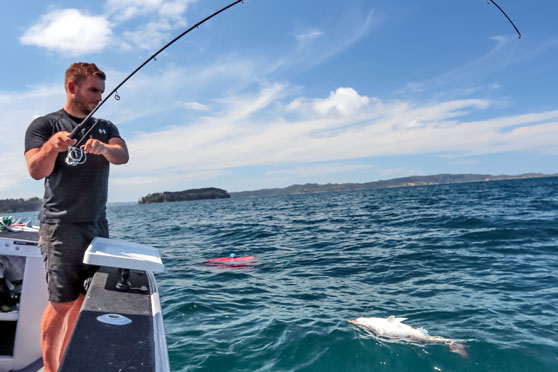
Bruce Hartill of NIWA explains release mortality and how to minimise this.
When Bruce Hartill of NIWA first started reading fishing magazines decades ago, all the articles seemed to be about trophy fishing and taking home a feed, with little mention of fish thrown back and their likely fate. How things have changed – and for the better, too!
There have been several articles discussing this issue in New Zealand Fishing News and other publications recently, and both LegaSea and the Ministry for Primary Industries have put out fish-handling guides.
As a result, there is now far greater recognition that the fish we catch and leave behind are just as important as the ones we take home. We need to look after them.
A wide range of measures have been proposed to address the two primary causes of fish dying when released: damage to body tissues caused by rapidly hauling fish up from deeper waters (barotrauma) and hook-related injuries.
Coping without pressure
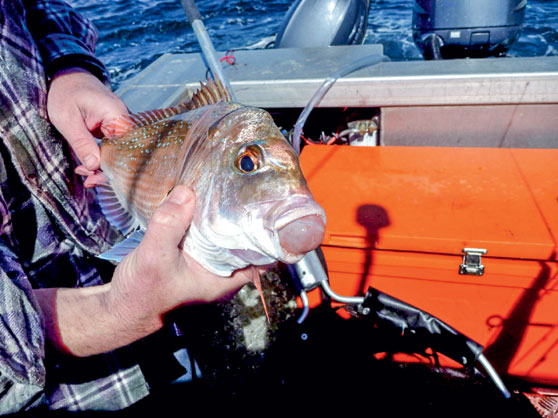
Probably the most common serious injury experienced by many fish while being rapidly pulled to the surface is when the gas in their swim bladder expands and frequently bursts. It doesn’t take much. A recent Australian study has shown a snapper’s swim bladder will probably rupture if pulled up from depths greater than 15m, but it’s not always evident this has happened. evert the stomach, causing it to balloon out the mouth, or push the hind gut out the back end. Softer tissues, such as livers and reproductive organs, may also be damaged when this occurs.
Holding-net studies suggest that most snapper with ruptured swim bladders will survive if only removed briefly from the water and they can swim back down to their capture depth. If a snapper is able to get back down, the damage caused by their rapid ascent at capture should repair itself within a few weeks. Species such as kingfish and kahawai are hardier, being better suited to rapid changes in depth.
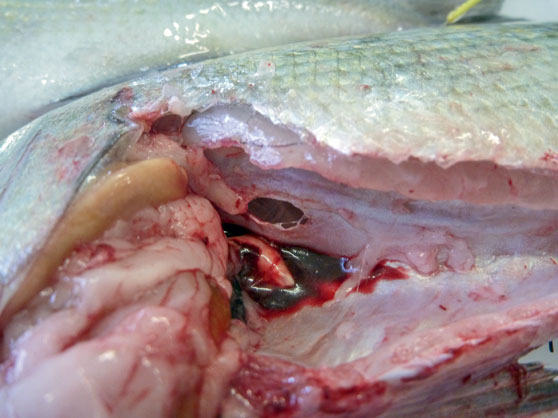
However, if you want to avoid rupturing swim bladders, you will need the patience of a saint. Unforced gas movement across a swim-bladder membrane is very slow. Pressure-tank experiments suggest it would take about 13 hours for the pressure in a snapper’s swim bladder to naturally equalise if ascending from 10 metres to the surface.
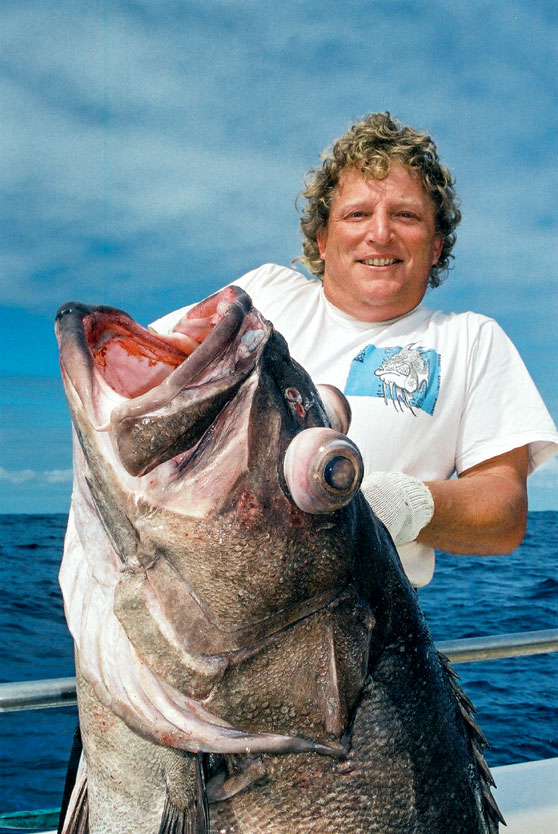
A more serious form of barotrauma can occur when fish are hauled up from depths greater than 50 metres. These circumstances can see gases bubbling out from bodily tissues, causing eyes to bulge out like a chameleon’s and the scales to bristle out instead of lying flat along the body. These fish will almost certainly die if not rapidly returned to their capture depth – and even then, the tissue damage they have sustained is potentially life threatening.
The quicker a fish is released, the better its chances of getting back down, despite the buoyant gas in its gut cavity. If a fish is lively and its gut cavity isn’t too swollen, then it will probably get back down on its own, but an exhausted fish with a swollen gut cavity will probably struggle to do so, preventing it from naturally recompressing.
You can help buoyant fish get back down by either venting the gas in their gut cavity or using a release weight to counter the buoyancy. A release weight is probably best, because venting gas takes time and sees further damage inflicted to the gut or gut cavity, which may lead to infection.
A release weight – an inverted, weighted, blunt barbless hook on a line – is pushed through your catch’s upper lip; once the fish has been lowered back down to the depth at which it was caught, it is released with a sharp tug.
If you haven’t prepared a release weight, then the only remaining option is to puncture the inflated gut cavity (although a recent international review of venting experiments found little support for this practice). If the stomach is protruding from the mouth, then it is best to prick it with an unused hook, which will be far more sterile than an old hook or rusty bait knife.
While it is possible to vent gas trapped in the gut cavity with a proper venting tool or a clean, large-gauge hypodermic needle, the needle shouldn’t be pushed too deeply into the swollen gut cavity to avoid damaging other organs.
Again, a pre-prepared release weight on a spare hand line is quicker to use, less harmful to the fish, and probably more effective than venting.
Gut hooking and infection
Most fish have reasonably robust mouths that should recover quickly if punctured by a hook, but their gills and stomachs are softer and far more vulnerable to tearing and bruising. While this damage is serious enough, internal tissues are far more prone to life threatening infections, which can take days to take its toll.
The damage caused by a ruptured swim bladder is often more obvious when fish are hauled up from much deeper waters. The sudden release of expanding gases into the gut cavity can either life-threatening infection, which can take days to take its toll. The different fates of lip- and gut-hooked fish were starkly evident during a small-scale net-holding trial undertaken by the Ministry of Fisheries in 1994. Two groups of fishers were given 4/0 hooks; one group was shown how to handle fish to give them the best chance of survival. All participating fishers were asked to cut the trace and leave the hook in if the fish was gut hooked. While there was not much difference in the survival rates of fish caught by both groups, 88% of the gut-hooked fish eventually died, but only 10% of lip-hooked fish succumbed over 15 days.
Fortunately, the incidence of gut-hooking is relatively low for snapper. In 2006-2007, Blue Water Marine Research asked anglers fishing on the northeastern coast of the North Island to record the location of the hook in any fish they caught. Of the 9,500 fish caught, 93% were hooked by the lip, 5% were foul hooked, and 2% were gut hooked.
While most fishers use baited hooks, the use of jigs and soft-plastics is gradually increasing; when lures are used, fish are rarely gut hooked.
Think small
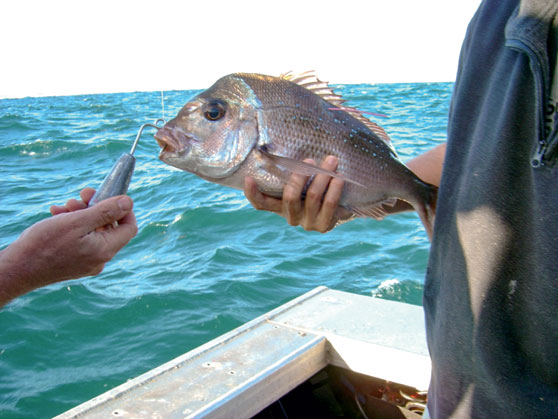
The fishing practice guides put out by LegaSea Fishcare and MPI suggest many ways of minimising barotrauma, hook damage and injuries caused by rough handling, but perhaps the best tip is to simply move on if you keep catching undersize fish.
Small fish can be a nuisance and it’s easy to forget about them when throwing them back – but think about those small fish too, because in the long term they are as important as the ones you keep.
And if the fishing is good and you are releasing keepers, think about the unseen damage your actions may be causing. While it might seem like great sport catching decent-sized fish out deep and throwing them back, these fish may end up dying. Instead, use a release weight that you have prepared beforehand, and get them back down as quickly as you can – it really is worth the effort.
|
|
This article is reproduced with permission of |

Recent Forum Posts Visit Forum

Shane Jones
in Fisheries Management21 hours ago
Tzer
Far cry to the twats at Liegasea/NZSFC were proposing of 5 Tarakihi person in their submission for the central management area and this is what our...

Bluefin Tuna at the cavs.
in The Briny Bar41 hours ago
smudge
Despite my years of fishing I haven't really fished many places, my focus has always been on Auckland's west coast and out toward Great Barrier. I...

Casting gloves
in Popper and Topwater Fishing86 hours ago
Mc Tool
100 bucks for a lure 😬. Watching one of them flying over the horizon without the line attached would be " character building " for sure...
I thought Id post some nice photo's , join...
in The Briny Bar137 hours ago
Alan L
That is a very cool pic Krow.The Far North is very cool, the Far far North even cooler. Mint looking day.Alan...

Mc Tools berley mincer
in The Briny Bar144 hours ago
SaltyC
Good size, they scrap well. Got an 18kg one up in Vava'u back a few years ago fishing off squeaky Going's boat. That was quite a...

Out with the "Twelves"
in Fishing Reports198 hours ago
Pcj
I should be able to get out end of October. The nephew been out virtually every weekend over winter and has done well. It seems the...
Manukau Harbour & West Coast fishing
in Fishing Reports206 hours ago
smudge
Nice work Schecter, I think snapper may be around sooner than you think. Well I am hoping so...

Whangarei Harbour report.
in Fishing Reports638 hours ago
krow
180 +m is where I've had to be lately. A lot less low foul around these parts and some of it shallower that looks like Tarakihi...
Whangarei Harbour Scallops
in Fisheries Management748 hours ago
Pcj
Reopening WhangÄ쳌rei Harbour to recreational scallop fishingTÄ“nÄ쳌 koeFisheries New Zealand is seeking feedback from tangata whenua, stakeholders, and the public on whether WhangÄ쳌rei Harbour should be...
SNA1 Recc fishing cops the blame.
in Fisheries Management844 hours ago
Tzer
What Liegasea won’t tell you is that some of their own fisheries contractors were co-authors of this study for fear of being called hypocrites, one of...
Popular Articles

Softbait Fishing - Part 1 - gear selection
John Eichlesheim writes an article about selecting the right equipment for softbait fishing... Read More >
Softbait fishing Pt 2 - tips and tricks
Techniques, tips and tricks of softbait fishing – getting the most from your soft baits.... Read More >

Surfcasting - setting yourself up
Gary Kemsley helps sort out the necessary gear for intending surf fishers.... Read More >

Squid - How to catch them
Squid fishing is a rapidly growing aspect of fishing - Paul Senior shares some hints and tips to get started.... Read More >
Fishing Reports Visit Reports
Outer Hauraki Gulf Fishing Report 17/09/26
Spring wind the handbrake. Spring is starting to make its presence felt in the outer... Read More >
Top of the South Fishing Report - 17/09/26
Early snapper in Tasman Bay. Well, spring is finally here, and the days are getting... Read More >
Bream Bay Fishing Report - 17/09/26
Good snapper catches reported. After Tangaroa turned off the fish tap for a month or... Read More >
Bay of Islands Fishing Report - 17/09/26
Pacific bluefin tuna for the lucky few. The last fortnight has seen more fishable days... Read More >
Comments