
Mechanical Jigging For Kingfish Part 1

Mechanical jigging is just one of many ways to target kingfish, but it’s one of Hayden Speed’s favourite styles of fishing!
You will have likely seen jigging on TV and seen how effective it can be – and also in some cases the level of strength and fitness required. Rest assured though, there is a time and a place for anyone to give jigging a go – and be successful too!
There are two different styles of jigging setups – one overhead, the other a spin style set. Both work fine and different people will have different preferences as to what works for them. One thing to consider when selecting an appropriate set is whether you plan to fish in 50m of water or 200m plus. The smaller reels are obviously much lighter and are easier to use over a longer period of time; however, the last thing you want to do is fish in 200m of water with only 150m of line on your spool.
The rod selection will obviously match the type and size of the reel selected, but as a general note the rods tend to be short in length and incredibly powerful, despite being light in weight. The other major consideration when selecting your rod and reel combo is what desired jig weight you plan to fish. Larger jigs are more effective in deeper water, while smaller jigs are ideally suited in depths less than 100m. So, match your intended jig size to your rod weight also.
Another thing to take into consideration when choosing a reel is the drag capability. As you’re likely to be fishing around the structure, it’s important that you have the stopping power available.
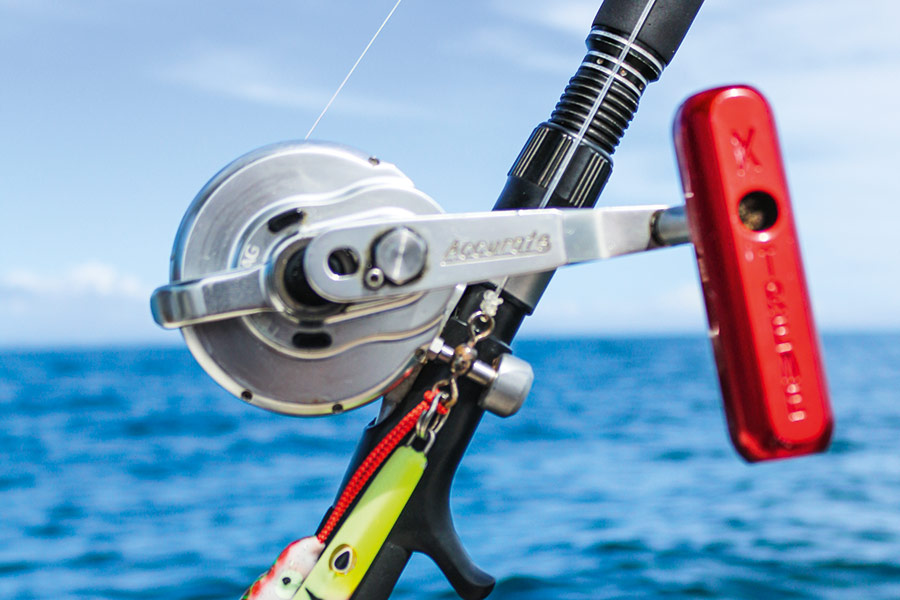
A typical mechanical jigging setup. Reels need to have big drag capacities.
We spool all of our jigging reels up with either 50 or 80lb braid, depending on the setup. It’s vital to use braid as you need to be constantly in touch with your lure to not only work it but set the hook should you have a strike. Braid is also much thinner in diameter than mono, which allows you to have greater spool capacity. I like to use a braid that changes colours in ten metre increments (also known as rainbow braid) as this enables me to accurately measure the depth I lower my jig to, allowing me to work the area where the fish are holding much more effectively.
I like to use a 100-130lb trace of about 3-4m long, which I will connect onto the mainline via a PR knot. This trace is connected onto a heavy barrel swivel with a ‘Uni Knot’, while the jig is connected to the bottom of the swivel using a heavy duty split ring. I will then attach the assist hook by looping it to the bottom of the swivel.
If you are lucky enough to own a couple of jigging sets, it is definitely worthwhile to have one ‘heavy’ setup for working the larger jigs and a ‘lighter’ setup for fishing smaller ones– you’ll find that the lighter set is significantly easier to use! The lighter setup is also ideal for someone with less physical strength to learn on.
Jigging gear will often be a reasonable investment so it pays to take good care of it. Some simple tips such as taking jigs off when travelling and not hooking the assist hook onto the eyes of the rod will ensure that your rod will stay in top condition for longer.
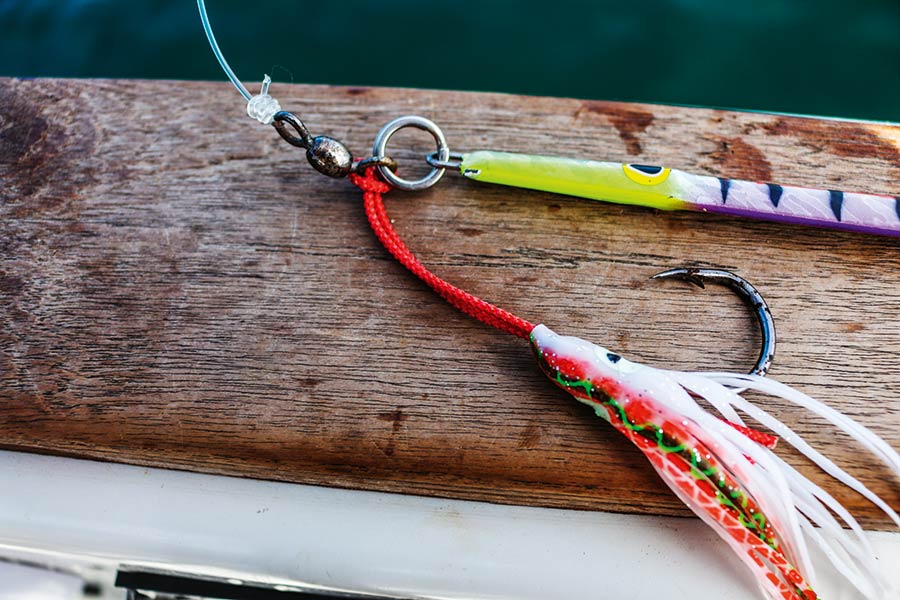
Most anglers favour an assist hook rig on their jigs.
When jigging, we will target the same areas that we would also fish with livebaits – this being reefs in anywhere from 20-200m. Upon arrival, take the time to scout around the reef marking good sign where the kings may be holding. They will often move about from previous days due to different currents, tide and time of day. It can be a good idea to do a ‘dummy drift’ while you get your gear sorted so that you can work out your drift line. You can then reposition up above the sign so you will drift back over it.
Often you will mark good sign on the sounder and will send jigs through it but just can’t get a bite. This is where you will need to change things up to try to entice the fish to strike. Sending the same lure down again and again with the same retrieve is less likely to get hit. It pays to have a range of jigs in all shapes, weights and colours as you never know what the kingfish will find attractive. My current favourite jig is a 200g pink ‘Zest’ cuttlefish jig.

January 2022 - Hayden Speed
New Zealand Fishing News Magazine.
Copyright: NZ Fishing Media Ltd.
Re-publishing elsewhere is prohibited
Recent Forum Posts Visit Forum

Trailer wheel clamp
in The Boat Shed1 hour ago
610gc
Hey teamI have a wheel clamp like the one below on the boat trailer. its getting harder and harder to unlockI've sprayed it with CRC on...

Shane Jones
in Fisheries Management24 hours ago
Tzer
Far cry to the twats at Liegasea/NZSFC were proposing of 5 Tarakihi person in their submission for the central management area and this is what our...

Bluefin Tuna at the cavs.
in The Briny Bar44 hours ago
smudge
Despite my years of fishing I haven't really fished many places, my focus has always been on Auckland's west coast and out toward Great Barrier. I...
Casting gloves
in Popper and Topwater Fishing89 hours ago
Mc Tool
100 bucks for a lure 😬. Watching one of them flying over the horizon without the line attached would be " character building " for sure...
I thought Id post some nice photo's , join...
in The Briny Bar140 hours ago
Alan L
That is a very cool pic Krow.The Far North is very cool, the Far far North even cooler. Mint looking day.Alan...

Mc Tools berley mincer
in The Briny Bar147 hours ago
SaltyC
Good size, they scrap well. Got an 18kg one up in Vava'u back a few years ago fishing off squeaky Going's boat. That was quite a...

Out with the "Twelves"
in Fishing Reports201 hours ago
Pcj
I should be able to get out end of October. The nephew been out virtually every weekend over winter and has done well. It seems the...
Manukau Harbour & West Coast fishing
in Fishing Reports209 hours ago
smudge
Nice work Schecter, I think snapper may be around sooner than you think. Well I am hoping so...

Whangarei Harbour report.
in Fishing Reports641 hours ago
krow
180 +m is where I've had to be lately. A lot less low foul around these parts and some of it shallower that looks like Tarakihi...
Whangarei Harbour Scallops
in Fisheries Management751 hours ago
Pcj
Reopening WhangÄ쳌rei Harbour to recreational scallop fishingTÄ“nÄ쳌 koeFisheries New Zealand is seeking feedback from tangata whenua, stakeholders, and the public on whether WhangÄ쳌rei Harbour should be...
Popular Articles

Softbait Fishing - Part 1 - gear selection
John Eichlesheim writes an article about selecting the right equipment for softbait fishing... Read More >
Softbait fishing Pt 2 - tips and tricks
Techniques, tips and tricks of softbait fishing – getting the most from your soft baits.... Read More >

Surfcasting - setting yourself up
Gary Kemsley helps sort out the necessary gear for intending surf fishers.... Read More >

Squid - How to catch them
Squid fishing is a rapidly growing aspect of fishing - Paul Senior shares some hints and tips to get started.... Read More >
Fishing Reports Visit Reports
Outer Hauraki Gulf Fishing Report 17/09/26
Spring wind the handbrake. Spring is starting to make its presence felt in the outer... Read More >
Top of the South Fishing Report - 17/09/26
Early snapper in Tasman Bay. Well, spring is finally here, and the days are getting... Read More >
Bream Bay Fishing Report - 17/09/26
Good snapper catches reported. After Tangaroa turned off the fish tap for a month or... Read More >
Bay of Islands Fishing Report - 17/09/26
Pacific bluefin tuna for the lucky few. The last fortnight has seen more fishable days... Read More >
Comments