
Maori fishing techniques
Due to oceanic environment and the significance of seafood in their diets, Polynesian people have historically been amongst the world’s most efficient catchers of fish.
The Polynesians who came to New Zealand brought their fishing practices with them, adapting them to new raw materials and different fish species. Along with their tools and weapons of war, their fishing technology dominates the archaeological record displayed in museums throughout New Zealand.
Maori had a huge range of fishing technology and used tactics that rival anything modern recreational fishermen use – plus a few extra tricks. There were few marine species they could not catch. Sharks and dolphins were harpooned, small game fish such as skipjack tuna, barracouta, kingfish and kahawai were taken on lures, and other fish were taken on hooks and in nets and traps.
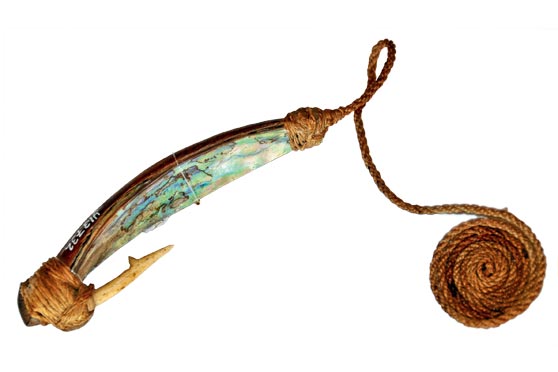
Many styles of exquisitely-made trolling lures and fishhooks were used. One key characteristic of Maori fishing gear – and indeed of most aspects of their material culture – is the effort that went into not only making a functional fishhook (or tool or weapon), but also into decorating it with symbolic shapes and markings. These go well beyond the purely decorative, indicating the significance that these items had within the wider spiritual world. It’s a true blend of function with belief.

Lures were made of bone, wood and sometimes coloured stone, including greenstone. Lacking tropical pearl shell, Maori often inlaid lure bodies with paua. Lure tips (hooks), sometimes barbed, were usually made of shell or bone.
Hooks for line fishing were typically made of one or two pieces of bone, shell or wood, or a combination of these materials. Often they did not have barbs. Unlike modern metal hooks, they were not usually designed to penetrate the fish’s flesh, but most had a characteristic re-curved shape – what we now call a circle profile – that rotated and locked inside the fish’s jaw.
Europeans’ relatively recent ‘discovery’ of the effectiveness of circle hooks, and now all the rage, is many centuries behind Polynesian fishermen.
When Maori first saw metal fishhooks, they immediately appreciated the value of that material, but not the J shape of the traditional western hook. Maori sometimes re-bent them into the circle shape and filed off the barbs.
During the contact period, Maori soon mostly gave up their traditional fish-hook materials because it proved much easier and quicker to trade for, or buy, ready-made metal ones. And to some extent fishing itself became a little less important to the diet of many people after the introduction of the European potato, other vegetables and pigs. Not only were the new foodstuffs produced
for their own consumption, but Maori produced surpluses to sell in the new colonial market.
Pre-contact archaeological sites in the Hauraki Gulf and region reveal a plethora of hooks and lures, but it seems likely most of the fish caught in the Gulf, and elsewhere, were netted.
Because nets were made of vegetable fibre, they have not survived well in the archaeological record, unlike hooks. When Cook sailed about the Firth of Thames, he noted a large number of stakes or posts used for supporting nets all along the shallower shores.
The nets could be huge; Cook saw some up to 10-metres deep and a kilometre long. This amounts to industrial-scale fishing, and indeed snapper bone and scales in middens show a decline in size over time, suggesting a reduction of numbers. Serious spotted shark fishing with nets in places such as Kawau Bay must also have had an impact on stocks. Early European travellers recorded thousands of them at a time being sun-dried on frames. A large quantity of mackerel and other school fish, such as maomao and mullet, was taken in nets, too.
Maori also used hand scoop nets and large hoop nets lowered to the bottom, then raised around an unsuspecting school of fish. There were fish traps of various kinds, including round pots made mainly of supplejack – very much like modern crayfish pots – for trapping crayfish and moray eels.
Large areas in shallow, tidal bays were surrounded with long stone walls to trap fish once the tide went out – another technique brought here from tropical Polynesia. Examples of these are readily seen at Colville Bay and Browns Island.
Maori also exploited what must then have been vast resources of shellfish in estuaries and coastal places. The whole of the Hauraki Gulf was a giant marine food basket.
They were very technically proficient in catching and gathering marine resources. Cook commented that none of his men were a match for Maori at catching fish, and in spite of our modern technology including fish-finding sonar, I think that ancient Maori were probably better fishermen than most of us are today.

One can still learn things from old Maori fishermen sometimes. Their traditional fishing calendar was attuned to what was actually happening in the sea, and when, and obviously did not have to take into account weekend or holiday fishing priorities. Unfortunately, many modern ‘Maori fishing calendars’ and ‘bite time’ predictions, now commonly built into GPS and available as apps, are just commercial hocus-pocus.
There is not much recreational-fishing technology we have today that did not have a Maori equivalent. But they also used a few tricks seldom seen now, such as banging bags of rocks on the rocky sea floor to entice groper, or knocking canoe floors with stones to attract sharks.
Another neat trick allowed them to get a line and hooks to float free on the bottom in deep water without being tethered by a sinker. Any old stone was bound with flax, or similar leaf, with about 30cm of leaf protruding. The baited hook point was inserted into the leaf close to the stone and everything let go overboard. When the stone hit the bottom, the hook was given a few sharp tugs to tear it out of the leaf, leaving the hooks free to drift naturally on the seabed. The people in remoter parts of Melanesia and Polynesia still use variations of this technique.
Of course Maori fishing was a necessity, not a recreational activity, though it was obviously also a social occasion. And it was steeped in fishing lore of great antiquity and significance. Every fish in the sea was the child of Tangaroa, the sea god. And, after all, what we prosaically call the North Island was Te Ika a Maui, the fish of Maui, whose magic hook was made from his grandmother’s jawbone. For those readers who enjoyed this feature, Harold Kidd has written a review on the book (p101) which is available from all good bookshops.
|
|
This article is reproduced with permission of |

Recent Forum Posts Visit Forum

Shane Jones
in Fisheries Management15 hours ago
Tzer
Far cry to the twats at Liegasea/NZSFC were proposing of 5 Tarakihi person in their submission for the central management area and this is what our...

Bluefin Tuna at the cavs.
in The Briny Bar35 hours ago
smudge
Despite my years of fishing I haven't really fished many places, my focus has always been on Auckland's west coast and out toward Great Barrier. I...

Casting gloves
in Popper and Topwater Fishing80 hours ago
Mc Tool
100 bucks for a lure 😬. Watching one of them flying over the horizon without the line attached would be " character building " for sure...
I thought Id post some nice photo's , join...
in The Briny Bar131 hours ago
Alan L
That is a very cool pic Krow.The Far North is very cool, the Far far North even cooler. Mint looking day.Alan...

Mc Tools berley mincer
in The Briny Bar138 hours ago
SaltyC
Good size, they scrap well. Got an 18kg one up in Vava'u back a few years ago fishing off squeaky Going's boat. That was quite a...

Out with the "Twelves"
in Fishing Reports192 hours ago
Pcj
I should be able to get out end of October. The nephew been out virtually every weekend over winter and has done well. It seems the...
Manukau Harbour & West Coast fishing
in Fishing Reports200 hours ago
smudge
Nice work Schecter, I think snapper may be around sooner than you think. Well I am hoping so...

Whangarei Harbour report.
in Fishing Reports632 hours ago
krow
180 +m is where I've had to be lately. A lot less low foul around these parts and some of it shallower that looks like Tarakihi...
Whangarei Harbour Scallops
in Fisheries Management742 hours ago
Pcj
Reopening WhangÄ쳌rei Harbour to recreational scallop fishingTÄ“nÄ쳌 koeFisheries New Zealand is seeking feedback from tangata whenua, stakeholders, and the public on whether WhangÄ쳌rei Harbour should be...
SNA1 Recc fishing cops the blame.
in Fisheries Management838 hours ago
Tzer
What Liegasea won’t tell you is that some of their own fisheries contractors were co-authors of this study for fear of being called hypocrites, one of...
Popular Articles

Softbait Fishing - Part 1 - gear selection
John Eichlesheim writes an article about selecting the right equipment for softbait fishing... Read More >
Softbait fishing Pt 2 - tips and tricks
Techniques, tips and tricks of softbait fishing – getting the most from your soft baits.... Read More >

Surfcasting - setting yourself up
Gary Kemsley helps sort out the necessary gear for intending surf fishers.... Read More >

Squid - How to catch them
Squid fishing is a rapidly growing aspect of fishing - Paul Senior shares some hints and tips to get started.... Read More >
Fishing Reports Visit Reports
Outer Hauraki Gulf Fishing Report 17/09/26
Spring wind the handbrake. Spring is starting to make its presence felt in the outer... Read More >
Top of the South Fishing Report - 17/09/26
Early snapper in Tasman Bay. Well, spring is finally here, and the days are getting... Read More >
Bream Bay Fishing Report - 17/09/26
Good snapper catches reported. After Tangaroa turned off the fish tap for a month or... Read More >
Bay of Islands Fishing Report - 17/09/26
Pacific bluefin tuna for the lucky few. The last fortnight has seen more fishable days... Read More >
Comments