
Manu Lala: The Kakahi King
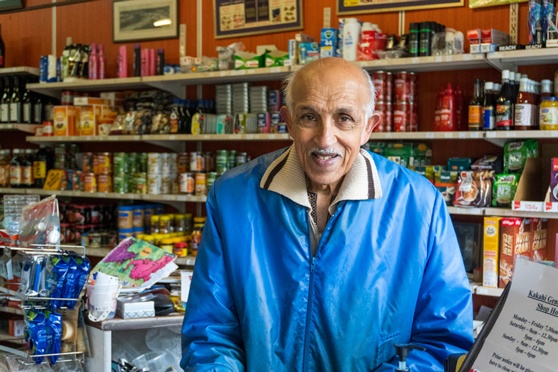
Jason Harman interviews Manu Lala - the Kakahi King...
You don’t end up in Kakahi by accident. Visitors must go out of their way to find it at the end of a twisting road. As you descend into the valley, past lush farmland and pockets of native bush, the sound of cicadas gets louder, and the air takes on an earthy, freshwater tang.
With a population of just one hundred and fifty, Kakahi is a peaceful little village, but it has a big history: epic Maori battles, intense Totara logging, Atlantic salmon farming – and fly fishing.
The town is inextricably linked with the nearby rivers; it sits just a stone’s throw from the Whakapapa River and its confluence with the mighty Whanganui River. Even its name derives from the water – Kakahi is the Maori word for freshwater mussels. Several influential fly fishers have called Kakahi home: author Greg Kelly, artist Peter McIntyre, and Postmaster Basil Humphries, the fly-tying mastermind behind the world-famous Kakahi Queen, Twilight Beauty, and Jessie dry flies.
The beating heart of Kakahi is the General Store, where, on any given day, you’ll find the shopkeeper Manu Lala going about his business.
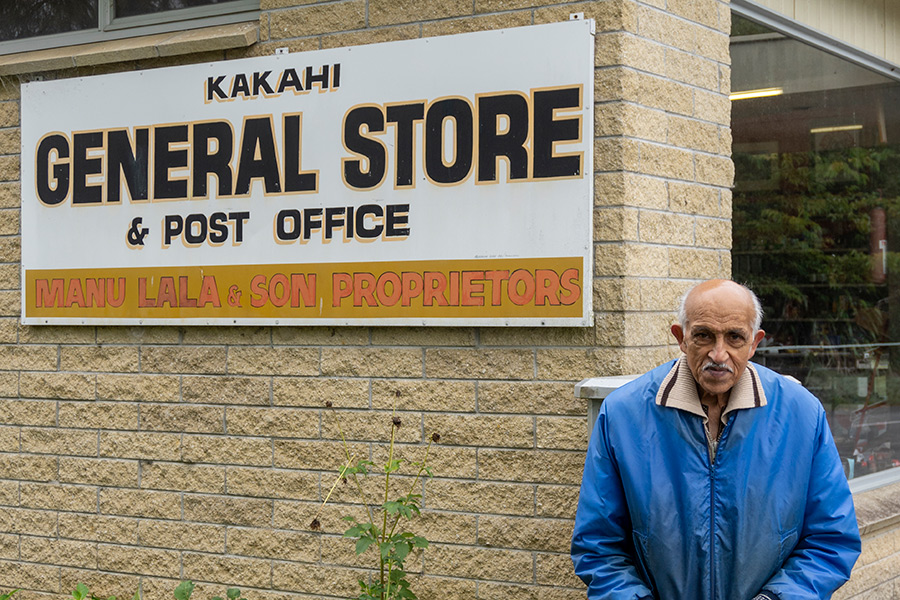
Manu in February 2023 , standing beside the same sign as his earlier photos.
When I arrived in Kakahi, I parked outside the store and walked in to ask for directions to the river. Inside, I felt like I’d departed to another world. The place was teeming with colour – a kaleidoscope of junk and gems, trash and treasure. There were old sepia-toned photographs crowding the walls, shelves and shelves of food cans, liquor bottles, books, fishing flies, hardware, magazines, and the thing that caught my eye and kept my gaze: an enormous taxidermied trout.
“Can I help you?” came a soft voice from the back.
“Yes, please. I was wondering about the fishing around here,” I replied, suddenly feeling a little foolish.
There was some movement and rustling, and then a slender old man appeared. His face was a light brown colour, like late-summer leaves or soft, tanned leather, and his eyes were big and kind. He sported a thin, white moustache that matched his horseshoe hairline and wore a knowing smile as he studied me from behind the counter.

A representative 4-pound Whakapapa rainbow,
“I can help you with that. There’s some good fishing around here.”
I later find out that Manu is the unofficial mayor of Kakahi and, at 81 years old, has gotten to know it pretty well. Thankfully, unlike other, more covetous fishermen, Manu was an open book regarding his knowledge of the fishery. He patiently explained how to get to the rivers – both the Whakapapa and the Whanganui – described the best pools, and said to me, “You’ve got to learn to read the water, so you can recognise where the fish are lying, you know?”
The most intriguing spot Manu shared with me was a place called ‘The Cutting’. He walked outside to show me where to go, pointing up the road. “Turn right up there, at the gravel, and then right again, follow Te Rena Road until it narrows. The Cutting is an old railway line that they cut through the hill beside the river in the early days. There is a beautiful campsite there, good fishing, and glowworms at night, too. “
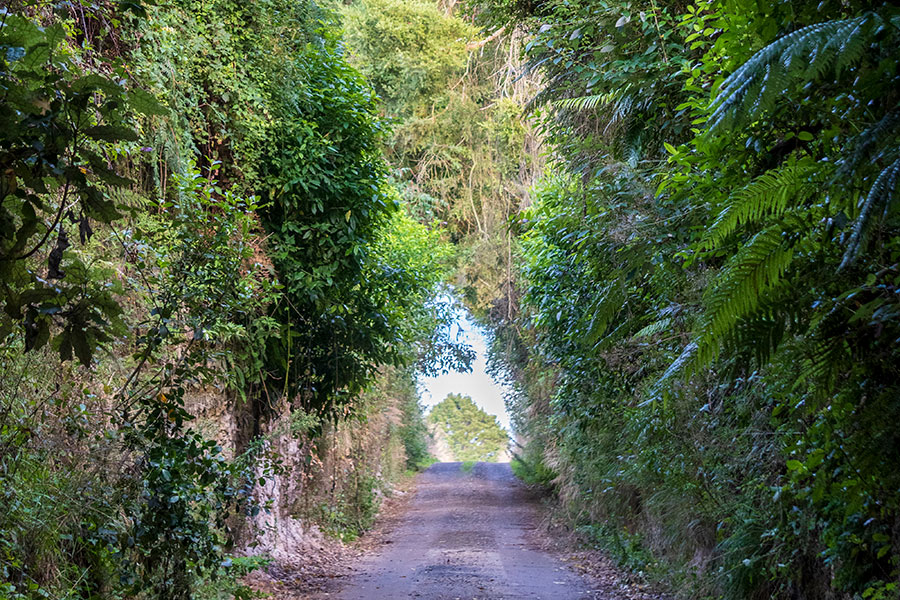
‘The Cutting’ – the place has a magic aura, and comes alive at night with glowworms.
He was right: the campsite was pretty, the fishing was great, and the glowworms shone like miniature, bioluminescent stars. The next day I returned to Manu to report on my success – he seemed pleased. I asked him how he ended up owning the store in Kakahi and how he got into fly fishing.
“My Dad Dahya came over from Bombay, India, in the early ‘20s. When he first arrived, he had nothing. He used to pick up bottles to survive, and he’d travel around working so he could get a feed and a bed. Eventually, he got a full-time job working for another Indian fulla in Tokaanu. He worked there for three years and saved his money. Then, one day, he travelled to Taumarunui looking for a business to buy. Somehow, he ended up in Kakahi and found the General Store for sale, so he bought it. That was 1937.”
“When I came over with Mum, it was 1949, I was young, and neither of us could speak a word of English. As soon as I arrived, Dad taught me how to flyfish, and it was fantastic. He taught me how to cast, what flies to use, and how to read the water to learn where the fish are. I loved casting – we used split-cane rods back then – and big fish were everywhere. We used to throw the three to four-pound fish back because they were ‘too small’.”
“I took over the shop in 1956 when Dad got sick. I was still at Taumarunui high school at the time and was dreaming of becoming an accountant in a big city, but I stayed here and ran the shop instead. Over the years, it’s done me so well. The lifestyle here is fantastic, and I’ve gotten to spend a lot of time fishing.”

This photo was taken by Manu in the early 1970’s outside the shopfront – note the guns on display in the front window.
“When you go to the river, you forget everything else. I just love going down there and being with nature. If you catch a fish, it’s a bonus; it’s always been that way for me.”
“There are still some big fish in the Whakapapa. Probably the biggest I’ve ever caught was a 10-pounder, but a few months back, a fulla came in and said, ‘Manu, I want to show you something.’ He pulled out a little camera he’d been wearing on his head and showed me a video of a huge, 14-pound rainbow trout he’d caught and released. So, the big ones are still in there.”
Peter McIntyre, New Zealand’s official war artist for the Second World War, described his experience fishing with Manu in his 1972 book, Kakahi:
“I have been intrigued to note how the ways of fishing tend to follow the temperament of the fisherman. Manu, who runs the store and does everything with a quiet restraint, fishes with short casts, never trying to get a great distance, never attempting too much, but he moves across the river boulders like a mountain goat, covering every eddy, dropping a fly behind every stone.”
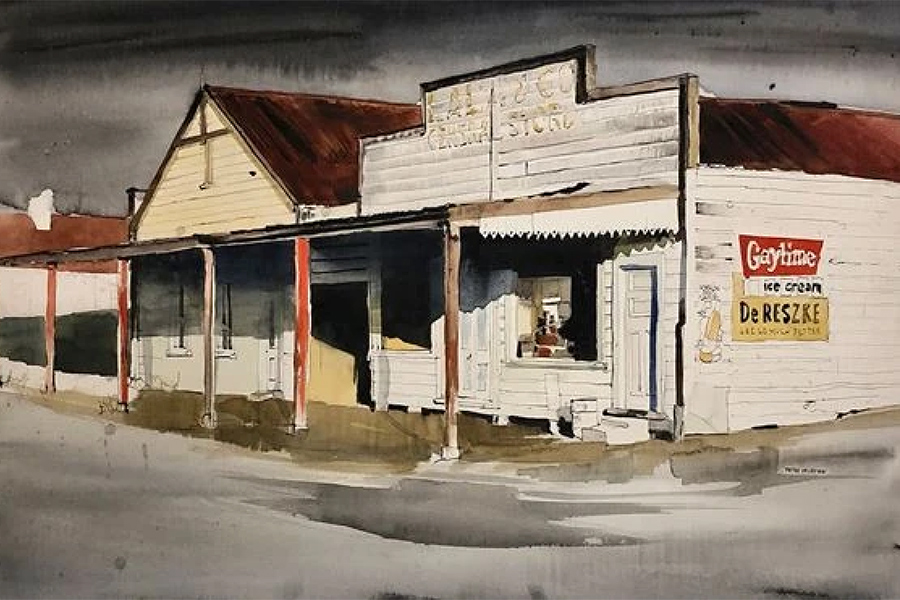
A Peter McIntyre painting of Kakahi.
Manu’s age means his days of navigating slippery boulders and deep runs are over, but he has kept his passion for fly fishing alive through conversations with visiting anglers and teaching the local kids.
“Sometimes kids come down to the shop and I teach them how to fly fish in between customers. I show them how to put the rod together, string up the line, attach the fly, and how to cast on the driveway. Kids love learning, you know? When they come back later, they have usually been practising and are pretty good.”
Manu’s own kids are very successful: his son works for Sydney University and has a doctorate in Philosophy and Research, his eldest daughter spent a decade living in London and now works as a clinical psychologist in Auckland, and his youngest daughter previously worked for the government in Wellington and has recently had a baby – they’ve all achieved the big city corporate dreams of Manu’s childhood.
Manu has been trying to sell the store for years, but it’s bittersweet. He wants to break free from his seven-day workweek and do some travel to the South Island, a part of New Zealand he has never seen. But he also wants to sell to someone who sees the value in the place’s rich history and cares for the community of Kakahi, and its rivers, in the same way he has.
“If I were 40 years younger, I would never sell. But I’m running out of time nowadays. It’s feeling a bit tough, you know? But you can never tell what will happen. There’s an old Indian saying: ‘What’s written for you is going to happen’.”

April 2023 - Jason Harman
New Zealand Fishing News Magazine.
Copyright: NZ Fishing Media Ltd.
Re-publishing elsewhere is prohibited
Recent Forum Posts Visit Forum

Offshore Power Boats - Gulf Harbour 17 Oct
in The Briny Bar45 hours ago
Phantom Menace
It was interesting helping out with the racing. I had the lap scorers / timekeepers and the chequered flag on board again.As the race briefing was...

Freams?
in Soft Bait Fishing47 hours ago
Mc Tool
Yeah , I dont get the whole "salt water in the bearings " thing . My rods sit in the holder at the back of the...

Anyone get out today??
in Landbased & Surfcasting72 hours ago
LBGer
Nice work looks like a you had a great day...

Manukau Harbour & West Coast fishing
in Fishing Reports267 hours ago
smudge
Thats a great catch Schecter, big fish. I'll post up a report from off the coast a bit later on...

Garmin vs Lowrance
in The Boat Shed360 hours ago
Roscoe C
Hi folksI'm looking at upgrading the electronics on my Stabi 1450. I've currently got a Lowrance Eagle 7 which I'm not especially impressed with. In particular...

Shimano 3500 baitrunner
in Buy Sell Trade or Exchange495 hours ago
0nlanders_Nz
Hello, I have come across to on the cash converters website search fishing reels $35 on there...
Manu bay boat ramp
in The Boat Shed501 hours ago
610gc
Hey teamhas any one tried the Manu bay boat ramp since the repairs?Is it any better to use?thank you ...

Out with the "Twelves"
in Fishing Reports504 hours ago
Telecaster
Popped out at about 3:30pm yesterday with a mate, usual zone and method. 10 snapper and 5 gurnard. The biggest snap we got (55cm) was definitely...
Popular Articles

Softbait Fishing - Part 1 - gear selection
John Eichlesheim writes an article about selecting the right equipment for softbait fishing... Read More >
Softbait fishing Pt 2 - tips and tricks
Techniques, tips and tricks of softbait fishing – getting the most from your soft baits.... Read More >

Surfcasting - setting yourself up
Gary Kemsley helps sort out the necessary gear for intending surf fishers.... Read More >

Squid - How to catch them
Squid fishing is a rapidly growing aspect of fishing - Paul Senior shares some hints and tips to get started.... Read More >
Fishing Reports Visit Reports
Manukau/West Coast Fishing Report - 15/10/26
Big spring snapper in 60 metres. The El Niño weather pattern isn’t going to be... Read More >
Rotorua Fishing Report - 15/10/26
Solid start to the season! The Rotorua lakes have all started the season well, and... Read More >
Tutukaka Fishing Report - 15/10/26
Big snapper in shallow. Things remain relatively quiet on the fishing front out of Tutukaka,... Read More >
Tauranga Fishing Report - 15/10/26
Bait and temperature on the rise. It’s been great to get out and see some... Read More >
Comments