
Mado profile

Mado can be seen year-round within their New Zealand range, however juveniles are most often observed in late summer.
As well as northern New Zealand, mado are found in the Kermadecs Islands, Norfolk Island, Lord Howe Island and sometimes New South Wales, Australia. The presence of mado in Australia is often overlooked however, as it co-occurs with the similar looking Australian mado.
Within their native range, our mado inhabit rocky reefs on pinnacles, headlands and offshore islands, from the surface down to 60m depth. They often swim above the reef, picking plankton out of the water column or grazing small invertebrates off the reef itself. Juveniles may also act as cleaner fish for larger species and will often be bombarded by demoiselles looking for a spa treatment.
So how do you know if the brightly coloured fish you caught or spotted during your dive is a mado? Firstly, mado have very distinctive horizontal black and yellow bands that extend the entire length of their bodies, hence their common names ‘stripy’ and ‘eastern footballers’. Mado have brightyellow fins, relatively large eyes and a diamond-shaped body. Juveniles have the same colouration as adult fish but are usually more vivid. You are likely to only catch mature fish on baited hooks and this may happen when targeting live baits or schooling species like blue maomao or sweep. All life stages of mado have been recorded in New Zealand. Mature mado are most often seen in pairs or small schools; they are very inquisitive and will often approach divers. Juveniles tend to be more solitary, but they will seek shelter in schools of common planktivorous fishes like blue maomao.
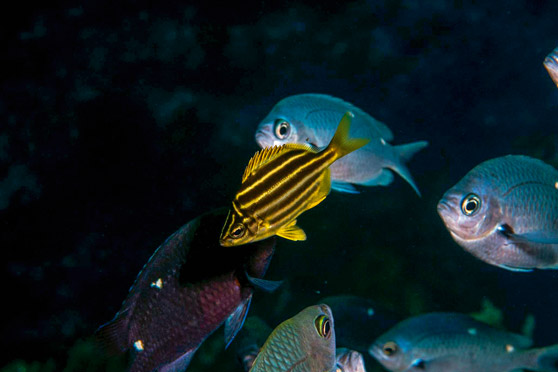
Most mado we see in New Zealand will grow to 20cm in length, but they can grow to a maximum size of 30cm. Juveniles are usually not encountered until they are at least 4cm long. It is not known whether these juveniles are being transported as larvae from more established populations at the Kermadecs or Norfolk Island, or if the adults are breeding here.
Mado are one of the subtropical fishes that is most likely to establish breeding populations in mainland New Zealand as waters warm, so we are particularly interested in observations of spawning behaviour and gravid or ‘ripe’ adult fish.
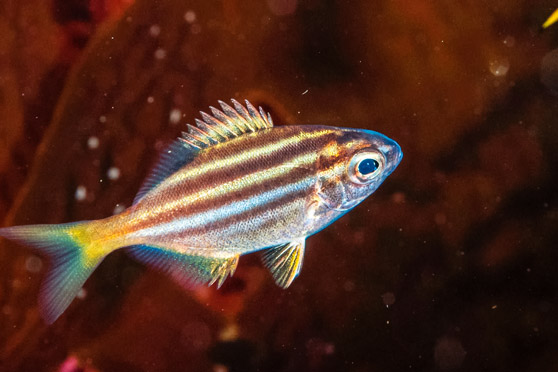
We may see more small, juvenile mado in northern New Zealand and mado occurring further south than East Cape as ocean temperatures increase in New Zealand. If you think you have spotted or caught mado south of East Cape or on the West Coast of New Zealand, send a photograph to WhatsThatFishNZ on Facebook or a fish taxonomist to confirm the identity. We are particularly interested in photos of small juveniles.
|
|
This article is reproduced with permission of |

Recent Forum Posts Visit Forum

Netting flounder in Tauranga harbour
in The Briny Bar14 hours ago
Tonto2
I have 2 granddaughters in Otemotai, one of them went floundering with her school and set a net and caught flounder. Now they want me to...

Wanted 10500 fin-nor reel
in Buy Sell Trade or Exchange26 hours ago
0nlanders_Nz
I am looking for a fin-nor 10500 fishing reel if any one has, please message me...
Wanted to Buy
in Buy Sell Trade or Exchange49 hours ago
honestbruce
Seen your post and that would work but its not up my alley or ability to make one. Dont have the means to manufacture here in...

Manukau Harbour & West Coast fishing
in Fishing Reports63 hours ago
smudge
Just a heads up. Sunday through to Tuesday next week is looking ok for over the coast. at this stage. If it is fishable I will...
Knife sharpeners
in The Briny Bar63 hours ago
smudge
I'm a big fan of Jason Abbot. A real down to earth approach. My son is a butcher and can put a mean edge on a...
Trailer wheel clamp
in The Boat Shed71 hours ago
610gc
Thanks team ill give that a goif that doesn't work is the a better option of the wheel clamp that people recmend...

Shane Jones
in Fisheries Management90 hours ago
Pcj
Taking my limit. Not high grading legal it comes home...

Foton tunland v9
in The Briny Bar137 hours ago
Ho Dee
not fishing related and delete if required but was wondering if any has one of these or someone who has just wanting so e real world...
Bluefin Tuna at the cavs.
in The Briny Bar184 hours ago
smudge
Despite my years of fishing I haven't really fished many places, my focus has always been on Auckland's west coast and out toward Great Barrier. I...
Casting gloves
in Popper and Topwater Fishing229 hours ago
Mc Tool
100 bucks for a lure 😬. Watching one of them flying over the horizon without the line attached would be " character building " for sure...
Popular Articles

Softbait Fishing - Part 1 - gear selection
John Eichlesheim writes an article about selecting the right equipment for softbait fishing... Read More >
Softbait fishing Pt 2 - tips and tricks
Techniques, tips and tricks of softbait fishing – getting the most from your soft baits.... Read More >

Surfcasting - setting yourself up
Gary Kemsley helps sort out the necessary gear for intending surf fishers.... Read More >

Squid - How to catch them
Squid fishing is a rapidly growing aspect of fishing - Paul Senior shares some hints and tips to get started.... Read More >
Fishing Reports Visit Reports
Rotorua Fishing Report - 01/10/26
Opening is here! The opening of the trout season is upon us and weather conditions... Read More >
Bream Bay Fishing Report - 01/10/26
Signs of spring snapper action. There are some promising signs that Bream Bay is getting... Read More >
Houhora Fishing Report 01/10/26
Softbaiting on fire. September has seen 269 catches submitted to the NZOFC monthly competition through... Read More >
Outer Hauraki Gulf Fishing Report 01/10/26
Fishing kicking into gear. Spring has well and truly arrived in the outer Hauraki Gulf,... Read More >
Comments