
Lure fishing tips and tricks

Right from early beginnings of eeling in the rivers of Kaihu, I have loved my fishing. However, it was an invite to join a friend in his small tinny out from Wenderholm that was the catalyst for taking my passion for fishing to another level.
What was different about this trip? There was no bait or berley on board, just a few packets of soft-baits – yet, that evening, I experienced fishing as good as I had ever had. Now, over a decade on, I have looked back, going on to work for a lure company and as a lure fishing guide, while also producing articles and presenting seminars on lure fishing. So, it will probably come as no surprise this article focuses on some of the things that I have come to value when out lure fishing.
Centre Consoles
I grew up fishing out of my grandparents tinny; looking back, I reckon it represented the quintessential Kiwi boat. At roughly 15 feet in length and with a small, smoky two-stroke on the back, it allowed us to enjoy many a fishing outing from the Whangaparaoa Peninsula. Next came a second-hand 5.5m Haines Signature. The Haines, a fibreglass boat, was both longer and wider than the tinny, and it also had a cuddy cabin that allowed just enough room and shelter for the odd overnight trip. Later, there was an upgrade to a used Buccaneer 635 that, thanks to its larger size and greater fuel capacity, took us on some incredible adventures to destinations such as Great Barrier Island.
As my love for lure fishing grew, however, I was eventually able to talk my father around to doing the unthinkable – downsizing the boat! While the larger fibreglass boats provided shelter from the elements and the ability to overnight, actual fishing room – and more specifically casting room – was limited. In addition to this, I felt somewhat nervous manoeuvring these larger fibreglass boats in the wash and shallow foul areas I now spent most of my time fishing.
Consequently, there was a move back to where it all began – well, at least to some degree. My father purchased an FC 430 centre console. While it had its limitations – no overnighters (unless we packed a tent) and minimal shelter from the elements – it had an abundance of fishing and casting room, afforded by the centre console design. Being aluminium, I also felt more confident fishing the wash and shallow foul areas, and there were also no issues with dragging it up on to a rocky beach. The FC 430 was also easy to tow and this led to trips game fishing off the back of the Poor Knights and hapuku fishing in the Far North (as an earlier NZ Fishing News cover can attest to). So it made sense that the next boat was the same design but slightly larger, an FC 500. Now, five years on from that acquisition, I have joined editor Grant Dixon in purchasing a new FC 535 Centre Console. In recent times I have noticed an increasing number of boat manufacturers offering centre console designs, and why wouldn’t they? These types of boat offer the lure fisherman a great platform for every kind of lure fishing. This is why I still miss the advantages of my centre console when out on friends’ larger but often more restricted boats.
Binoculars
Put simply, binoculars can sometimes be the difference between coming home with fish and coming home with nothing – especially when lure fishing. I have had many a hard day’s fishing saved as a result of picking up my trusty pair of binoculars and scanning the horizon. One of the advantages of bait fishing is the ability to draw fish to you from a stationary position thanks to berley. On the other hand, lure fishing requires that you remain on the move, constantly hunting for bait so you can also find the snapper or kingfish that prey on that bait.
This is why binoculars can be of so much value when lure fishing. The prey that snapper or even kingfish target is often a shared food source of other predators such as gannets and dolphins. If you can spot these other predators you greatly increase your chance of finding your target species. This is not just restricted to workup fishing out wide either. I use my binoculars even when soft-baiting inshore, as the presence of terns, shearwaters or even shags in the shallows can often indicate bait with snapper and kingfish close by.
Most people recommend a pair of 7 x 50 binoculars, with these specifications being recognised as the right magnification and objective lens size for optimal use on the water. However, I have been using a pair of Bushnell H20 8 x 42 waterproof binoculars for a number of years now and haven’t looked back. They are considerably more compact than the larger 7 x 50 binoculars (great for a small boat) and I haven’t found their utility decrease noticeably on the water despite the slightly stronger magnification and marginally dimmer image. Regardless, the important thing is that you get yourself a pair of suitable binoculars for use on the water, as they have the ability to turn your next fishing excursion from a down-trou to a triumph!
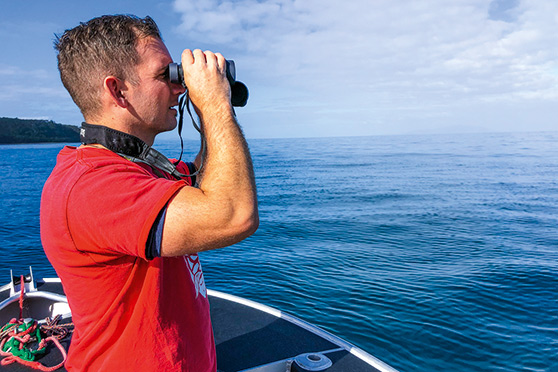
A decent pair of binoculars can make the difference between an average day's fishing and a great one.
Sea Anchor
Upon climbing aboard a friend’s boat, it is not just the absence of a centre console design that I sometimes lament. I’ve also often been disappointed to find that there is no sea anchor on board. Why? Because I know our chances of catching fish have just been reduced considerably, especially if there is a decent breeze.
It is important to have a relatively slow drift – less than one knot – for a number of types of lure fishing, and a good sea anchor can assist greatly with this. I have had the most success with hard-bodied lures, such as sliders, when fishing them vertically. When your drift is too fast, you greatly restrict the amount of time you have to work your lure in a vertical manner. In my opinion, this reduces your chance of a hook-up.
It is also important to have an optimal drifting speed when fishing soft-baits but for different reasons. Firstly, if you have located a small patch of fish, you want to maximise the time you have to present your soft-baits in this area. A drift that is too fast makes this difficult. Secondly, I have found it harder to maintain contact with my lure when drifting quickly. A fast drift will move you rapidly towards your deployed soft-bait creating a situation where slack line can become a constant issue. In both cases, a good sea anchor provides the solution and can go along way in increasing your hook-up rate.

A quality sea anchor enables Josh to stay positioned and fishing vertically above his quarry.
Soft-baits
Despite being more difficult to fish than other types of lures – such as inchiku or kabura style lures – the soft-bait is an incredibly versatile lure and one I wouldn’t want to be without. Soft-baits can be successfully fished in a number of different situations including in the wash, over low lying foul, and over the sand. They can also be fished in almost any depth and for many different species of fish.
However, it’s not just versatility that ensures the soft-bait makes it into my “five things I wouldn’t be without” list. Primarily, it is the enjoyment I get from the challenge soft-baiting brings – you have to be able to cast well, keep contact with your soft-bait consistently, and ensure you strike in the right manner and at the right time. There are also subtle changes you need to make with soft-baiting to improve your chances of success. This can include changes in jighead size, soft-bait colour and soft-bait style/size. Consequently, soft-baiting requires that you remain curious, adaptive and open to learning.
I primarily fish 7” soft-baits of the jerkshad variety, though I will also use curly and paddle tail type soft-baits in smaller sizes. My favourite colours include: New Penny, Shiner, Motor Oil, Nuked Pilchard, Atomic Sunrise and, of course, Bruised Banana. Whatever colour you go for, make sure you persist with soft-baiting as, of all of the styles of lure fishing, it can be one of the most rewarding.
Good fishing mates
The final thing I wouldn’t want to be without when I’m fishing is a bloody good fishing mate. Sometimes I enjoy taking out mates who don’t get to fish a lot, as you know there is a good chance they will experience something they never have before and it is exciting to share that with them. Other times, it is great to head out with a mate who has all their own gear, can tie their own knots and doesn’t require tuition of any kind. Finally, it is a bonus to be able to go out with mates who can help you to become a better angler – I’ve certainly been lucky to have a number of these over the years.
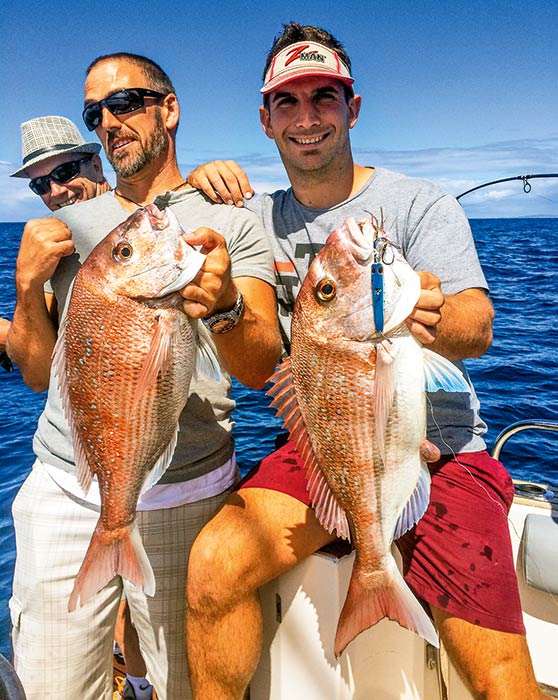
Sharing the joy of angling success with good fishing buddies is high up on Josh's 'favourites' list.
Regardless of who your fishing mate is, I mostly get a buzz from being able to share with others the many great experiences that can be encountered when fishing in Aotearoa. Sometimes it’s catching a different species of fish, or a particularly big fish; other times it’s seeing the food chain in action such is the case with a work-up. Most often, at least for me, it is simply the opportunity to share a knowing glance that says – “Damn, how lucky are we that we get to live in this place and experience all of this?!”
|
|
This article is reproduced with permission of |

Recent Forum Posts Visit Forum

Shane Jones
in Fisheries Management7 hours ago
Pcj
Taking my limit. Not high grading legal it comes home...

Trailer wheel clamp
in The Boat Shed39 hours ago
Mc Tool
either crc long life or 556 marine are way better ...

Foton tunland v9
in The Briny Bar54 hours ago
Ho Dee
not fishing related and delete if required but was wondering if any has one of these or someone who has just wanting so e real world...

Bluefin Tuna at the cavs.
in The Briny Bar101 hours ago
smudge
Despite my years of fishing I haven't really fished many places, my focus has always been on Auckland's west coast and out toward Great Barrier. I...
Casting gloves
in Popper and Topwater Fishing146 hours ago
Mc Tool
100 bucks for a lure 😬. Watching one of them flying over the horizon without the line attached would be " character building " for sure...
I thought Id post some nice photo's , join...
in The Briny Bar197 hours ago
Alan L
That is a very cool pic Krow.The Far North is very cool, the Far far North even cooler. Mint looking day.Alan...

Mc Tools berley mincer
in The Briny Bar204 hours ago
SaltyC
Good size, they scrap well. Got an 18kg one up in Vava'u back a few years ago fishing off squeaky Going's boat. That was quite a...
Out with the "Twelves"
in Fishing Reports258 hours ago
Pcj
I should be able to get out end of October. The nephew been out virtually every weekend over winter and has done well. It seems the...
Manukau Harbour & West Coast fishing
in Fishing Reports266 hours ago
smudge
Nice work Schecter, I think snapper may be around sooner than you think. Well I am hoping so...

Whangarei Harbour report.
in Fishing Reports698 hours ago
krow
180 +m is where I've had to be lately. A lot less low foul around these parts and some of it shallower that looks like Tarakihi...
Popular Articles

Softbait Fishing - Part 1 - gear selection
John Eichlesheim writes an article about selecting the right equipment for softbait fishing... Read More >
Softbait fishing Pt 2 - tips and tricks
Techniques, tips and tricks of softbait fishing – getting the most from your soft baits.... Read More >

Surfcasting - setting yourself up
Gary Kemsley helps sort out the necessary gear for intending surf fishers.... Read More >

Squid - How to catch them
Squid fishing is a rapidly growing aspect of fishing - Paul Senior shares some hints and tips to get started.... Read More >
Fishing Reports Visit Reports
Outer Hauraki Gulf Fishing Report 17/09/26
Spring wind the handbrake. Spring is starting to make its presence felt in the outer... Read More >
Top of the South Fishing Report - 17/09/26
Early snapper in Tasman Bay. Well, spring is finally here, and the days are getting... Read More >
Bream Bay Fishing Report - 17/09/26
Good snapper catches reported. After Tangaroa turned off the fish tap for a month or... Read More >
Bay of Islands Fishing Report - 17/09/26
Pacific bluefin tuna for the lucky few. The last fortnight has seen more fishable days... Read More >
Comments