
Lure Addiction in the Surf

Gary Kemsley was one of the first NZ surfcasters to give lures a shot. Flash forward half a century, and his addiction to lures is still alive and well…
Who said you have to be a bait fisher to be successful in the New Zealand surf? There may have been a time when fishers believed this and didn’t even try lures, but I suspect that was back when the seas were full of fish. I remember my father claiming that all he needed was a chunk of our cat’s dinner to catch a snapper – and then proving it.
I must have been introduced to surfcasting at just the right time. There were still plenty of fish in our near-shore waters and USA had just started to influence the NZ fishing scene. American magazines were making their way to our shores in increasing numbers and we were ready for some new ideas. The magazine Popular Mechanics seemed like an unlikely place to get fishing information but every issue had DIY fishing projects and I was fascinated. “How to Build a Bait Box to Fit Your Bike” and “Build Your Own Fish Smoker” were the sorts of articles I was always keen to read. Sportfishing magazines followed and it was there we saw anglers wearing sunglasses and waders in the surf casting wooden plugs to striped bass.
Early American imports
We knew we needed some of this action here in New Zealand; however, for a start, none of the fish mentioned actually reside in our waters so some thinking and planning was in order. I made a list of all the species I knew locally that could be lure munching contenders in my fishing areas of Hawkes Bay and Wellington. There were not a lot that I could think of to start with. Kahawai, which we caught at the local river mouth and in the estuary at Westshore on spinners, were number one on the list. I imagined casting a big wooden plug (like the big Creek Chub Pike lures the American surfcasters used on striped bass) into boiling surf and catching kahawai. The Hex Wobbler was the lure of choice at the Tutaekuri mouth where the kahawai gathered to feed on whitebait, smelt and, at times, pilchards or anchovies. After fishing with a big floating Rapala lure for a while, I noticed I was catching more barracouta than my mates using hex wobblers. The barracouta liked the surface approach and they went up in my estimation because of it.
As I delved more into the lure fishing for striped bass, a couple of things quickly became apparent. First, it seemed the surface lure approach was not the most effective. It was certainly the most exciting and deserved to be written about, but other lures caught more fish. Swimming plugs, like the big floaters which retrieved under the surface, were killers. Even better were the block tin or metal lures that cast further. These were known as metal squids.
Plastics were next on the scene. These, once developed for purpose, were easily mass produced and with subtle colouring and the attachment of eyes, offered a very realistic imitation of a baitfish. And not just any baitfish – these could be coloured to imitate specific species. Castability was always a worry as they didn’t weigh much, so anglers often used them in conjunction with a sinker to get casting weight.
Another lure type that has been overlooked here is the bucktail. Named due to the materials used to form its body and tail initially, these are lures made up on single weighted hooks. The bulbous lead head gives casting weight and a slim tail made of feather, bucktail, nylon or plastic makes it castable. I first saw these lures in 1960s. These were pure white, weighed 1 to 3oz and it didn’t take long to find they caught kahawai as well as any lure. They were great to use in deeper waters too where they could be jigged to attract other species like snapper and trevally.
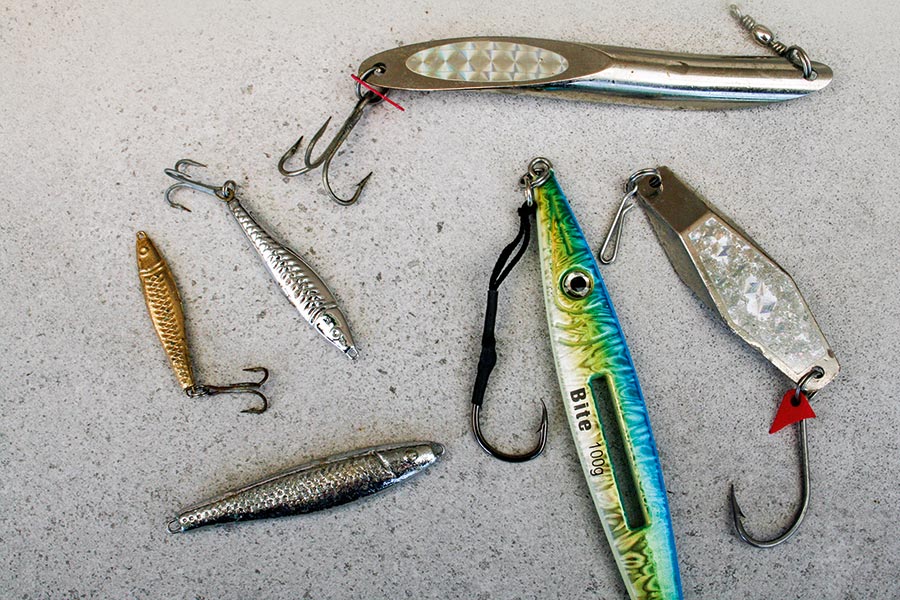
Metal lures work well in the surf and are easy to cast good distances.
The European influence
I should also mention the influence Sweden and Denmark had on the lure market through their cod jigs known as sildas. They came in a range of weights, colours and sizes and anglers soon sorted out that the Stingsildas were the best producers in our waters. These were made in a soft metal with the weight of lead. They were fish shaped, had an eye and could be bent for fishing differing speeds.
The Stingsilda has endured and is as effective today as ever. Surfcasters love them as they cast like bullets and are a deadly weapon for any schooling fish near the shore. Fished fast, they can be kept on or near the surface for spectacular surface strikes. When prospecting in the surf, bend them a little and fish them slower near the bottom.
After making use of all of the above, we thought we had it wired – wade out into the surf, fire out a Stingsilda, pull in a kahawai and use it for bait to catch a snapper. Could it be any easier?
It could be, it was, and still is. The soft-plastic revolution descended on New Zealand in the 1970’s. Thanks to forward thinking anglers like the late Graham Andrews who was the purchasing officer for Kilwell Sports at that time, Kilwell decided to get a couple of containers in to see how they went. They chose the Mr Twister brand, the biggest exporter of soft-baits in the USA. I travelled with the late tackle retailer Nigel Wood and a few others to the Far North to try the new lures out. On our first trip, we caught trevally, kahawai, snapper, kingfish, john dory, barracouta and a few other less likely species such as red pigfish, yellow-eyed mullet, grand-daddy hapuku and a large flounder from the surf.
Soft-plastics then became our go to lures. Back home in Hawkes Bay, I caught a couple of blue moki, a blue cod, several red cod and a lot of gurnard on crab-imitation soft-plastics. At this point we had a range of lures we could use in the surf. Currently, I still use soft-plastics whenever possible, Stingsildas and Hex Wobblers for distance stuff and a couple of bucktails in wild colours to show the fish something quite different if they are present and not biting.
If I am bait fishing, I will often put a soft-plastic on one trace and bait on the other. Funnily enough, it is the soft-plastic that often gets taken. Sometimes, I will put a soft-plastic on my circle hook and cover it with an oily bait like a pilchard fillet or half an anchovy. I know that even if yellow-eyed mullet steal the bait, I am still effectively fishing with the soft-plastic.
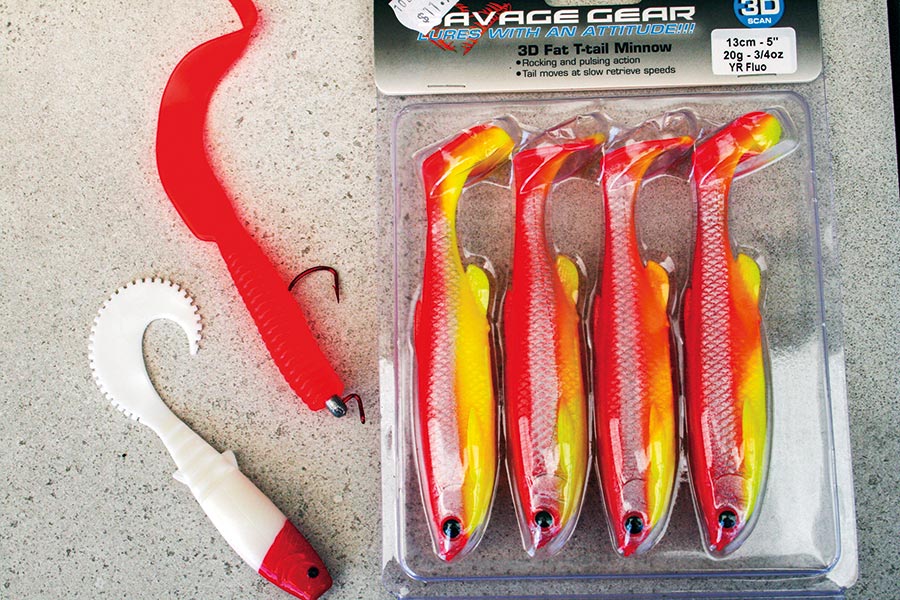
The writer will sometimes put a soft-plastic on his circle hook and cover it with an oily bait like a pilchard fillet or half an anchovy.
Lure fishing in the surf is great fun and anything could take your imitation. Think about the water you are casting into and believe that you are about to hook up on every cast. Change your colours and the depth you are fishing until you find the fish. If it turns out to be a kahawai every cast, squash down your barbs and release what you cannot use. If the surf is low, you can have a lot of fun with a trout sized spin set and a few smaller lures – even your favourite trout spinners like Toby lures will work.
|
|
This article is reproduced with permission of |

Recent Forum Posts Visit Forum

Netting flounder in Tauranga harbour
in The Briny Bar7 hours ago
Tonto2
I have 2 granddaughters in Otemotai, one of them went floundering with her school and set a net and caught flounder. Now they want me to...

Wanted 10500 fin-nor reel
in Buy Sell Trade or Exchange19 hours ago
0nlanders_Nz
I am looking for a fin-nor 10500 fishing reel if any one has, please message me...
Wanted to Buy
in Buy Sell Trade or Exchange42 hours ago
honestbruce
Seen your post and that would work but its not up my alley or ability to make one. Dont have the means to manufacture here in...

Manukau Harbour & West Coast fishing
in Fishing Reports56 hours ago
smudge
Just a heads up. Sunday through to Tuesday next week is looking ok for over the coast. at this stage. If it is fishable I will...
Knife sharpeners
in The Briny Bar56 hours ago
smudge
I'm a big fan of Jason Abbot. A real down to earth approach. My son is a butcher and can put a mean edge on a...
Trailer wheel clamp
in The Boat Shed64 hours ago
610gc
Thanks team ill give that a goif that doesn't work is the a better option of the wheel clamp that people recmend...

Shane Jones
in Fisheries Management83 hours ago
Pcj
Taking my limit. Not high grading legal it comes home...

Foton tunland v9
in The Briny Bar130 hours ago
Ho Dee
not fishing related and delete if required but was wondering if any has one of these or someone who has just wanting so e real world...
Bluefin Tuna at the cavs.
in The Briny Bar177 hours ago
smudge
Despite my years of fishing I haven't really fished many places, my focus has always been on Auckland's west coast and out toward Great Barrier. I...
Casting gloves
in Popper and Topwater Fishing222 hours ago
Mc Tool
100 bucks for a lure 😬. Watching one of them flying over the horizon without the line attached would be " character building " for sure...
Popular Articles

Softbait Fishing - Part 1 - gear selection
John Eichlesheim writes an article about selecting the right equipment for softbait fishing... Read More >
Softbait fishing Pt 2 - tips and tricks
Techniques, tips and tricks of softbait fishing – getting the most from your soft baits.... Read More >

Surfcasting - setting yourself up
Gary Kemsley helps sort out the necessary gear for intending surf fishers.... Read More >

Squid - How to catch them
Squid fishing is a rapidly growing aspect of fishing - Paul Senior shares some hints and tips to get started.... Read More >
Fishing Reports Visit Reports
Mercury Bay Fishing Report 01/10/26
Mercury Islands snapper fishing well. Nothing from out wide this past fortnight, but there were... Read More >
Tutukaka Fishing Report 01/10/26
Unpredictable spring weather Spring has arrived in Tutukaka, bringing with it the usual mix of... Read More >
Outer Hauraki Gulf Fishing Report 17/09/26
Spring wind the handbrake. Spring is starting to make its presence felt in the outer... Read More >
Top of the South Fishing Report - 17/09/26
Early snapper in Tasman Bay. Well, spring is finally here, and the days are getting... Read More >
Comments