
Lord Howe Moray Eel Profile
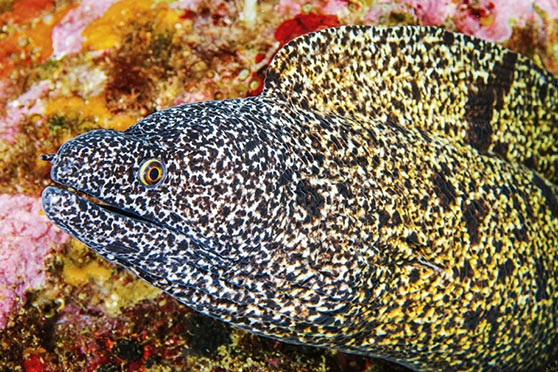
Despite the fairly balmy winter we had in Northland in 2019, I still escaped across the Tasman Sea toward the equator. I spent an amazing two weeks at Lord Howe Island, a tiny tropical crescent-shaped speck of volcanic rock located 780km north east of Sydney and 900km southwest of Norfolk Island… so, in the middle of nowhere really! This UNESCO world heritage site has an amazing diversity of endemic (endemic means species that only occur at this location) plants, insects and birds topside and due to its isolation, the level of endemism underwater is also incredibly high. One fish species that can only be found at this island, the nearby Middleton and Elizabeth reef and at Norfolk Island is the Lord Howe moray eel (‘LH moray’). This distinctive moray is fairly common at Lord Howe Island and I was lucky enough to encounter them on a few of my dives there. But, despite this being my first visit to this part of the world, it was not the first time I had seen this species – in April of 2018 I spotted the LH Moray in our own Bay of Islands (see image above)!
Somehow this ‘endemic’ species from Lord Howe ended up a long way away from home; and even more surprisingly, the Bay of Islands specimen was not the first to have been sighted in New Zealand waters. A few years earlier Dive! Tutukaka crew noticed a strange-looking moray eel at the Poor Knights Islands and sent photos to a local ecologist for identification. After some deliberation it was confirmed to be the first sighting of an LH Moray in New Zealand waters. These are the only two places LH Morays have been sighted in New Zealand waters and both were in fairly shallow depths (between 10 and 15m).
All eel species, including morays and freshwater eels, have an extended larval phase where they drift around in the ocean for between three months and three years. These long-lived larvae, or leptocephalus, are transparent (see image two) and can be over 10cm long before they metamorphose into the adult shape and settle onto reef habitats. It is likely that LH Morays found their way to New Zealand as larvae during this pelagic dispersal phase. LH Morays can grow to a total length of 1.5m but they are more commonly encountered at lengths up to 75cm. It is difficult to identify the size of the LH Morays that have been sighted in New Zealand from pictures but they are likely between 50 and 70cm long. It has been suggested that this species does not become sexually mature until they are at least 55cm long which means it’s unlikely that the specimens seen in New Zealand are breeding here.
In their home range LH Morays are associated with coral reef habitats and are usually found shallower than 30m depth. They live in cracks, holes and crevices during the day with only their heads visible. At night they are more active and leave their holes to hunt on the reef for small fishes and other prey. As with many morays, LH Morays are site specific, meaning they will come back to the same hole in the reef after each night out hunting. This makes them relatively easy to track so if you do know the location of one of these eels you can usually revisit it year after year.
But if you can only see the head of this eel sticking out of the reef, how are you going to be sure that this head belongs to an LH Moray? Even scientists struggle a bit with distinguishing LH Moray eels from other morays. It wasn’t until 2001 that the LH Moray was formally recognised as its own species. There are a few distinguishing features to look for. Firstly, LH Morays generally have a light yellowish grey body covered in small dark mottles, and often they have patches where the mottles are clustered together making them look like large dark marks. A number of other species of moray in New Zealand also have similar blotchy patterns, including the mottled moray (Gymnothorax prionodon) and the mosaic moray (Enchelycore ramose). The latter is superficially the most similar to the LH Moray but has much larger teeth and their body colour is much more vividly yellow than the LH Moray (see images three and four). One of the most distinctive features of the LH Moray is their bright yellow or orange eye – there are no other common moray species in New Zealand waters that have such a bright contrast between their pale body colour and bright eye.
LH Morays are a very recent addition to the New Zealand fish fauna and we are not sure if this species will compete with other species. We may sporadically see more LH Morays arrive in New Zealand waters, and any sighting of this species in our waters is incredibly valuable, even if it is from the known locations. Repeat sightings of the same specimen will inform us of how long they survive in New Zealand waters, their behaviour and depth range. If you think you have spotted or caught a LH Moray in New Zealand, send a photograph to WhatsThatFishNZ ([email protected] or www.facebook.com/whatthatfishNZ) or a fish taxonomist to confirm the identity. We are particularly interested in photos of LH Morays outside of Poor Knights and Bay of Islands!
|
|
This article is reproduced with permission of |

Recent Forum Posts Visit Forum

Shane Jones
in Fisheries Management17 hours ago
Tzer
Far cry to the twats at Liegasea/NZSFC were proposing of 5 Tarakihi person in their submission for the central management area and this is what our...

Bluefin Tuna at the cavs.
in The Briny Bar37 hours ago
smudge
Despite my years of fishing I haven't really fished many places, my focus has always been on Auckland's west coast and out toward Great Barrier. I...

Casting gloves
in Popper and Topwater Fishing82 hours ago
Mc Tool
100 bucks for a lure 😬. Watching one of them flying over the horizon without the line attached would be " character building " for sure...
I thought Id post some nice photo's , join...
in The Briny Bar133 hours ago
Alan L
That is a very cool pic Krow.The Far North is very cool, the Far far North even cooler. Mint looking day.Alan...

Mc Tools berley mincer
in The Briny Bar140 hours ago
SaltyC
Good size, they scrap well. Got an 18kg one up in Vava'u back a few years ago fishing off squeaky Going's boat. That was quite a...

Out with the "Twelves"
in Fishing Reports194 hours ago
Pcj
I should be able to get out end of October. The nephew been out virtually every weekend over winter and has done well. It seems the...
Manukau Harbour & West Coast fishing
in Fishing Reports202 hours ago
smudge
Nice work Schecter, I think snapper may be around sooner than you think. Well I am hoping so...

Whangarei Harbour report.
in Fishing Reports635 hours ago
krow
180 +m is where I've had to be lately. A lot less low foul around these parts and some of it shallower that looks like Tarakihi...
Whangarei Harbour Scallops
in Fisheries Management744 hours ago
Pcj
Reopening WhangÄ쳌rei Harbour to recreational scallop fishingTÄ“nÄ쳌 koeFisheries New Zealand is seeking feedback from tangata whenua, stakeholders, and the public on whether WhangÄ쳌rei Harbour should be...
SNA1 Recc fishing cops the blame.
in Fisheries Management840 hours ago
Tzer
What Liegasea won’t tell you is that some of their own fisheries contractors were co-authors of this study for fear of being called hypocrites, one of...

Popular Articles

Softbait Fishing - Part 1 - gear selection
John Eichlesheim writes an article about selecting the right equipment for softbait fishing... Read More >
Softbait fishing Pt 2 - tips and tricks
Techniques, tips and tricks of softbait fishing – getting the most from your soft baits.... Read More >

Surfcasting - setting yourself up
Gary Kemsley helps sort out the necessary gear for intending surf fishers.... Read More >

Squid - How to catch them
Squid fishing is a rapidly growing aspect of fishing - Paul Senior shares some hints and tips to get started.... Read More >
Fishing Reports Visit Reports
Outer Hauraki Gulf Fishing Report 17/09/26
Spring wind the handbrake. Spring is starting to make its presence felt in the outer... Read More >
Top of the South Fishing Report - 17/09/26
Early snapper in Tasman Bay. Well, spring is finally here, and the days are getting... Read More >
Bream Bay Fishing Report - 17/09/26
Good snapper catches reported. After Tangaroa turned off the fish tap for a month or... Read More >
Bay of Islands Fishing Report - 17/09/26
Pacific bluefin tuna for the lucky few. The last fortnight has seen more fishable days... Read More >
Comments