
Lithium Battery Options for Boats
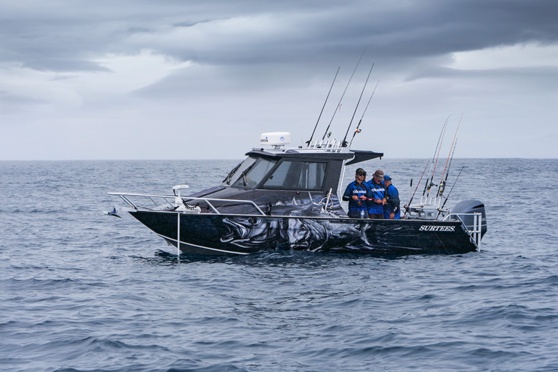
Until recently, most people’s exposure to lithium batteries was the type used in mobile phones and other small electronic devices. However, this is no longer the case, as nowadays a huge range of lithium batteries are available for a myriad of applications – including use in your trailerboat.
This article takes a look at some of the features and applications of lithium batteries, and will hopefully answer some of your questions along the way. I would like to acknowledge the assistance of BLA and Lusty & Blundell in my research for this article.
Are they safe?
Peter Sewell, who is a Technical Consultant at Lusty and Blundell, responds:
“Lithium ion phosphate batteries (the type used to power marine trolling motors) are nothing like the lithium batteries in a mobile phone, which have been known to catch fire and can be quite dangerous,” he says. “In fact, I would much rather have a LiFePO4 battery on board my boat than a conventional lead acid battery. They are safer, almost impossible to make catch fire (even by overcharging) and, if they are in a fire, they don’t sustain it.”
This makes lithium batteries a good choice for marine applications. However, make certain the battery you choose is appropriate for the punishment of the marine environment. Low-cost lithium batteries may be okay in a caravan but are unlikely to fare well in a boat pounding through rough seas.
 Care needs to be taken when fitting lithium batteries. This is what it looks like when it is done wrong.
Cost
The upfront cost of purchasing a lithium marine battery is significantly higher than buying a lead-acid battery. However, lithium batteries often last at least five times as long as their lead-acid counterparts. Lithium marine batteries will typically last 3,000-5,000 charge cycles, which usually translates to a 10-year working life.
Their longer lifespan combined with their increased efficiency makes lithium-ion marine batteries cheaper in the long term.
However, the cost of the battery is only one aspect of the change from lead acid to lithium. The purchaser really needs to look at the complete lithium system as a package, i.e. battery, charging, monitoring etc.
The increased use of lithium batteries for marine installations is significantly reducing prices and, also, it should be noted that the systems fitted to trailer boats are quite a lot cheaper than those used on launches, mainly because launches require certified charging systems.
However, it has to be said that some new high tech Absorbant Glass Mat (AGM) batteries are getting much improved performance over lead-acid, so the gap can be narrower in a cost benefit analysis.
As we load our trailerboats up with more and more electronics, the conventional ‘start and house’ battery combination will not always deliver the power to drive all the electrical features. Pete McGregor explores the suitability of the smaller, lighter lithium batteries for marine applications.
LITHIUM VS. CONVENTIONAL BATTERIES
Lithium-ion marine batteries are more efficient, weigh less, and can last up to 10 times longer than lead-acid batteries. They also hold voltage rate through the discharge, unlike lead-acid or AGM which drop voltage as the battery discharges. Lithium Ion batteries also don’t suffer if left unused for a period of time, unlike AGM or lead-acid.
On average, lithium batteries are about half, to a third, of the weight of lead-acid batteries with the same capacity.
The lifespan of a lead-acid battery is dependent on how well you maintain the battery. Lithium-ion batteries require almost no maintenance at all to optimize their performance and lifespan.
Draining a lead-acid battery below 50% of its capacity causes damage and shortens the battery’s life. Conversely, most lithium battery manufacturers rate their batteries to allow 80% depth of discharge. Often marine lithium batteries have a free phone app which will display Bluetooth data from the battery such as percentage charge, amp charge, or discharge. This enables the user to know exactly the state of the battery and know how long they have before charging is required. Alternatively, a shunt can plug into the NMEA 2000 bus and can be monitored through an appropriate MFD (multifunction display), providing alerts when batteries are running low. Battery monitoring will advise when batteries are about to disconnect. This is harder to tell without monitoring as lithium holds a more constant voltage.
Increased power storage is one of the top benefits of lithium batteries. Since you usually get almost double the capacity, you may only need half the batteries in some installations. Half the number of batteries, when each battery weighs a third to a half of what a lead-acid battery weighs, can result in almost a four-times reduction in weight!
Lithium can be deeper discharged with no remediable charging, and can be charged very quickly or slowly, meaning they are very flexible to different types of charging, whether that be from a grid source, alternator (with appropriate lithium setup) or solar.
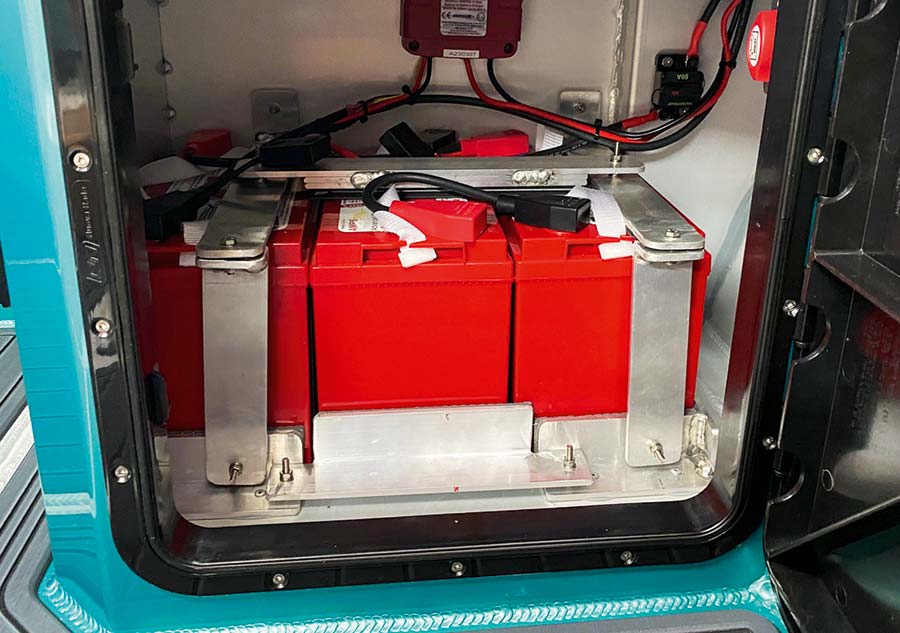 Like any batteries, lithiums must be installed and secured correctly. A good example of a battery and charger fitout.
What about warranties
Lithium batteries have warranties ranging from 2-7 years depending on the manufacturer. This compares with 1-2 years for conventional batteries.
Internal battery management systems – what do these do?
BMS (Battery Management System) protects the cells against misuse such as over charge, over heating, and short or reverse polarity.
Are they faster charging?
Lithium batteries will accept charge more efficiently than lead-acid or AGM, so charge times are a fraction of the time. Chargers need to be lithium compliant.
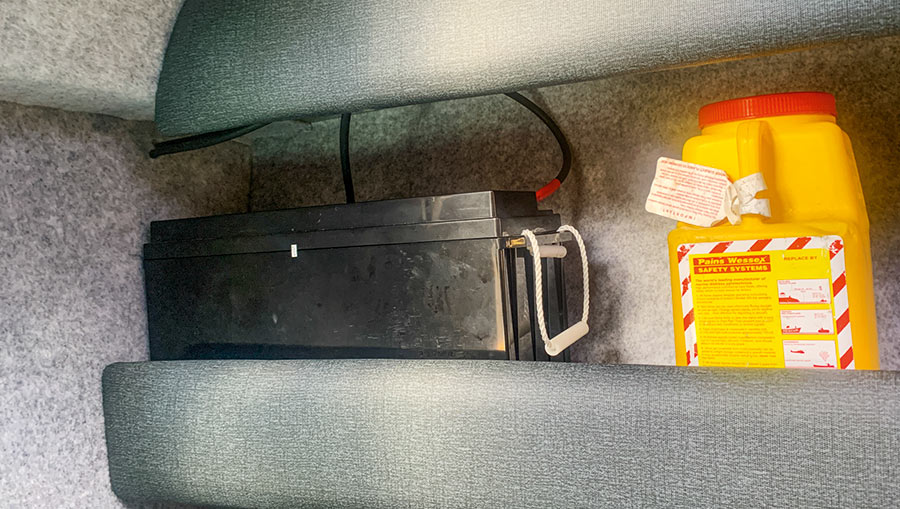
The compact 24 volt lithium installation on NZFN’s Grant Dixon’s Extreme 645 Tackle Tester where leads for quick charging have been fitted.
Can lithium batteries replace both house and starter conventional batteries?
House, yes no problem. Starter – No.
Standard lithium batteries are not designed for starter use. Having said that, there is a type of battery (Sterling with different BMS) that can be used for starting, but it is up to three times the cost of standard lithium.
Can lithium batteries be charged by your outboard’s alternator like conventional batteries?
No – if you are looking to charge on the go, you will require a DC/DC charger like that produced by Sterling Power or Victron. You will not be able to run directly from your alternator as you will require a lithium charge profile.
You can charge when you get home with a charger that plugs into the grid (AC), but these should not be permanently installed on the vessel as this contravenes unless the vessel gets proper electrical certification.
You may choose to install some quick connectors to the batteries so when you get home, it is effortless to connect your ac charger. However, chargers need to be lithium compliant.
Some outboard manufacturers do not warrant the use of lithium batteries, though this is changing, so check with your outboard manufacturer.
LITHIUM AND TROLLING MOTORS
BLA advise that lithium batteries are well suited for use with Minnkota, but due to the maintained high voltage of lithium it is recommended not to run the motor over 85% thrust for prolonged periods of time.
For use with MinnKota 24volt and 36volt motors, BLA offer a range of 24v and 36v batteries, eliminating the need for two or three batteries in series and making for a lighter setup and easier wiring installation. The BLA batteries can be mounted on their side if required – try doing that with a conventional one!
BLA also offer technical advice on installations. If you are looking at upgrading the battery system in your boat or if you are installing an electric trolling motor, it will certainly pay for you to investigate lithium, particularly if you are looking at long term ownership. Just make sure you buy quality and get good advice.
Lusty and Blundell have set up a specialist team for installing smart Lithium battery systems for trolling motors. Their comments:
“Lithium batteries are often considered the ‘gold standard’ when it comes to providing power for trolling motors. They weigh a lot less than a conventional battery, which is a real bonus considering almost all trolling motor installations are at or near the bow. They also offer twice the run-time, boast a life expectancy that can be an astonishing 10 to 20 times longer, and often come with a built-in Battery Management System, safety shut-down system, and their own Bluetooth battery monitoring app.”
However, there does appear to be quite a lot of confusion about the different types of lithium batteries, their safety and the fact that, in order to get the most out of them, they do need to be installed and used correctly.
They say many people also don’t realise that electric trolling motors should only be run at 80% of their available power, not flat out, or that once the charge in the battery drops beyond a certain level, many of the motor’s advanced functions, such as anchor lock, auto trim etc, will cease to work.
To address these concerns, the L&B team set out to design an effective, reliable, and powerful trolling motor battery system which includes:
• a Sterling Power AMPS lithium battery
• a DC-to-DC lithium charger that enables the trolling motor battery to be charged while the vessel is underway, either en route to a fishing spot or when moving between spots
• a dedicated battery switch that means the battery can either be used to operate the motor or be charged but not both
• a Victron smart shunt that acts like a fuel gauge for the battery, precisely showing how much power has been used/is available (via cable to the MFD screen or via Bluetooth to a mobile phone or tablet)
• a battery-to battery charger for use with a normal shore-based AC charger (this tops up the lithium battery once the vessel’s engine and house batteries have been fully charged).

April 2022 - Pete McGregor
New Zealand Fishing News Magazine.
Copyright: NZ Fishing Media Ltd.
Re-publishing elsewhere is prohibited
Recent Forum Posts Visit Forum

Trailer wheel clamp
in The Boat Shed1 hour ago
610gc
Hey teamI have a wheel clamp like the one below on the boat trailer. its getting harder and harder to unlockI've sprayed it with CRC on...

Shane Jones
in Fisheries Management24 hours ago
Tzer
Far cry to the twats at Liegasea/NZSFC were proposing of 5 Tarakihi person in their submission for the central management area and this is what our...

Bluefin Tuna at the cavs.
in The Briny Bar44 hours ago
smudge
Despite my years of fishing I haven't really fished many places, my focus has always been on Auckland's west coast and out toward Great Barrier. I...
Casting gloves
in Popper and Topwater Fishing89 hours ago
Mc Tool
100 bucks for a lure 😬. Watching one of them flying over the horizon without the line attached would be " character building " for sure...
I thought Id post some nice photo's , join...
in The Briny Bar140 hours ago
Alan L
That is a very cool pic Krow.The Far North is very cool, the Far far North even cooler. Mint looking day.Alan...

Mc Tools berley mincer
in The Briny Bar147 hours ago
SaltyC
Good size, they scrap well. Got an 18kg one up in Vava'u back a few years ago fishing off squeaky Going's boat. That was quite a...

Out with the "Twelves"
in Fishing Reports201 hours ago
Pcj
I should be able to get out end of October. The nephew been out virtually every weekend over winter and has done well. It seems the...
Manukau Harbour & West Coast fishing
in Fishing Reports209 hours ago
smudge
Nice work Schecter, I think snapper may be around sooner than you think. Well I am hoping so...

Whangarei Harbour report.
in Fishing Reports642 hours ago
krow
180 +m is where I've had to be lately. A lot less low foul around these parts and some of it shallower that looks like Tarakihi...
Whangarei Harbour Scallops
in Fisheries Management751 hours ago
Pcj
Reopening WhangÄ쳌rei Harbour to recreational scallop fishingTÄ“nÄ쳌 koeFisheries New Zealand is seeking feedback from tangata whenua, stakeholders, and the public on whether WhangÄ쳌rei Harbour should be...

Popular Articles

Softbait Fishing - Part 1 - gear selection
John Eichlesheim writes an article about selecting the right equipment for softbait fishing... Read More >

Softbait fishing Pt 2 - tips and tricks
Techniques, tips and tricks of softbait fishing – getting the most from your soft baits.... Read More >

Surfcasting - setting yourself up
Gary Kemsley helps sort out the necessary gear for intending surf fishers.... Read More >

Squid - How to catch them
Squid fishing is a rapidly growing aspect of fishing - Paul Senior shares some hints and tips to get started.... Read More >
Fishing Reports Visit Reports
Outer Hauraki Gulf Fishing Report 17/09/26
Spring wind the handbrake. Spring is starting to make its presence felt in the outer... Read More >
Top of the South Fishing Report - 17/09/26
Early snapper in Tasman Bay. Well, spring is finally here, and the days are getting... Read More >
Bream Bay Fishing Report - 17/09/26
Good snapper catches reported. After Tangaroa turned off the fish tap for a month or... Read More >
Bay of Islands Fishing Report - 17/09/26
Pacific bluefin tuna for the lucky few. The last fortnight has seen more fishable days... Read More >
Comments