
Light Tackle Topwater Techniques
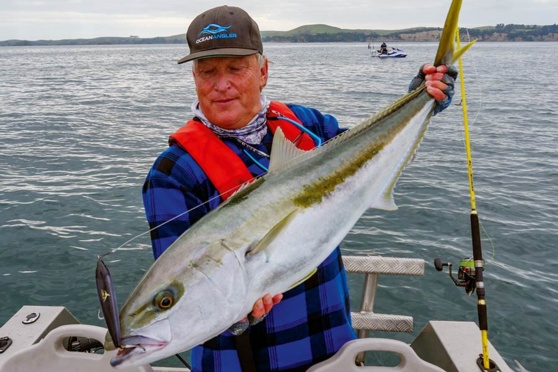
Mark Kitteridge suggests there are occasions when going lighter is not only reasonably practical, but also great fun!
There’s no getting away from the fact that as anglers we should try to avoid needlessly breaking fish off so they’re left trailing debilitating and potentially lethal tackle. So, looking at it from that point of view, nothing beats heavy gear: not only is it possible to place more pressure on the fish to slow it more quickly and control it more effectively, the heavier line’s thicker diameter is more forgiving when abrasion and angler error/s occur.
So why should lighter gear be considered at times? Well, there are situations and times of the year when kingfish are encountered in areas with a reasonably clear seafloor below, where the risk of breaking hooked fish off is greatly reduced. This tends to occur when schooling baitfish are in the area, which can be anything from anchovies, pilchards and piper through to mackerel and kahawai.
Yes, admittedly, such scenarios tend to be sporadic, apart from during anchovy season, but the potential topwater action is so much fun that I always have a PE3 (15kg) topwater outfit rigged and ready, just in case.
The other reason for using a lighter outfit comes down to the likely size of the fish encountered when fishing topwater lures. For example, it’s most unusual to come across kingfish over 15kg in Auckland’s inshore waters, with most tending to be between 6kg and 11kg when fishing 190-230mm lures – perfect for that PE3 rod and reel!
So what makes a good 15kg topwater outfit?
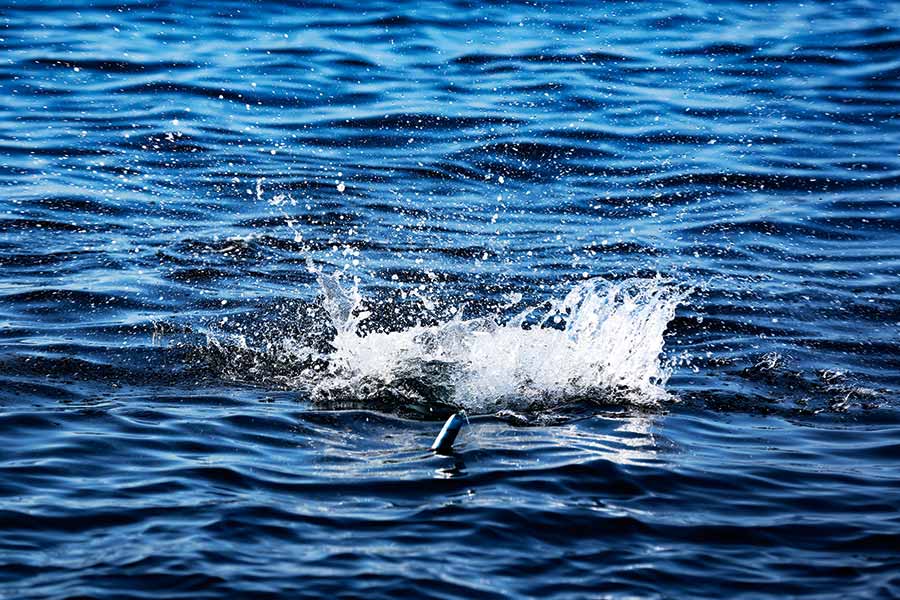
There’s topwater action aplenty for light-tackle enthusiasts when the anchovies make their way into Auckland waters.
The reel
Look for a high-quality reel that holds around 300 metres of 15kg braid, has a smooth drag capable of exerting at least 8-10kg of drag pressure, possesses strong gearing and which offers a reasonably zippy line-retrieval rate.
Shimano, Penn and Okuma have excellent candidates, but I’ve had trouble going past Daiwa Saltigas in recent times. Unfortunately for me, the curse of the COVID pandemic made the best options scarce last year. That’s how I came into possession of a second-hand Saltiga 4000H, which previously belonged to Big Angry Fish host Milan Radanovich. I could only hope he’d not been especially successful with it as I didn’t want a reel that was too worn out!
Line capacity
The Saltiga 4000H holds the suggested 300m of PE3 braid. This allows for an impressive 100-metre cast, another 100 metres to be ripped off the spool upon hooking up immediately, and another 100 metres in reserve to allow for encountering something bigger than expected – or fishing success is still possible should the reel not be fully loaded for whatever reason. (N.B. Do not compare this reel’s model size with other 4000-size reels, as most will be considerably smaller.)
Drag pressure
The 4000H is not a big reel, but it still offers 10kg of braking pressure. Most anglers set their drag to around a third of the braid’s breaking strain before starting fishing, but sometimes as much as half if highly skilled (or the ‘best guess’ wasn’t quite right!).
As 10kg of drag equals two-thirds the line’s breaking strain, that’s about right. After all, we don’t want a reel with capabilities that are close to, or at, the reel’s limitations as this will see wear occurring relatively quickly. Reels that operate well inside their maximum specifications will operate better for longer.
Reel gearing
Kingfish are brutal on gear, so topwater reels need to be reliable and well made. In the past, a reel with machine-cut main and pinion gears made from stainless or bronze indicated high quality, and I would still prefer my reel’s internal components to be made from these materials.
However, improved design has apparently enabled lesser quality materials to be used without impacting on the overall performance. For example, some of the latest top-of-the-line Daiwa reels boast an enormous main gear, which spreads the load over a larger area and enables digitally cut, aluminium gears to be used instead. To be honest, this aspect worries me a little, but my latest Daiwa Certate (which uses similar technology) has been the best soft-baiting reel I’ve ever owned to this point. Friends say I should also try the Shimano Vanquish, which purportedly offers very stiff opposition!
The other important element of reel gearing is the line-retrieval rate on offer – having the right balance between retrieval speed and winching power is critical. While it’s great to have a reel that whizzes lures in at Warp Factor Five, as this can be a very effective trigger with kingfish, if it’s too quick, valuable winching power is sacrificed after hooking up. Think of cyclists starting to climb a steep hill – time to chop down to a smaller gear or fail!
My reel’s ratio is 5.7:1. I suspected this was a bit too quick initially, but plenty of kingfish-catching experience in the field says otherwise now.
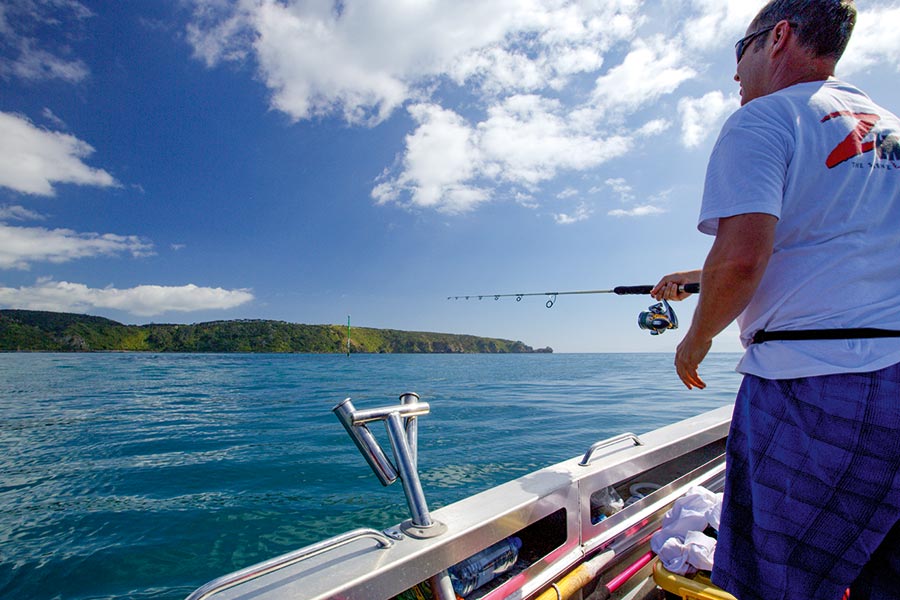
While casting at navigational devices and current-obstructing structure often produces plenty of spectacular topwater bites, the risks become greater when using light tackle.
The rod
The following features make a good topwater rod: good length for casting and covering plenty of water; enough tip-section power to load up and cast suitable lures; sufficient butt-section power to control and lift big fish; a tip section that ‘folds away’ upon hooking up; a practical-length butt configuration to enable long casts and help with battling fish; and high quality rod components.
Rod length
My head didn’t like the idea of long, stiff graphite poles, as logically they seemed likely to assume a role similar to that of a crowbar against me. So for several years I refused to go beyond 7’6” in length, and maybe I did land a couple of big fish I might otherwise have lost because of this.
However, it also became tough to watch guys repeatedly casting further to reach prime spots and cover more territory, and hook up more!
My current Daiwa Meter-Over rod is 8’3” and it’s an absolute weapon. I particularly like using it during the anchovy season, where the extra length proves useful for covering big areas of feeding action around the boat, or for targeting more localised activity, wherever that may be.
Power
Look at the rod’s butt section and check that it’s made to cast the lures you generally prefer. My favourite topwater rod has a recommended casting range of 20-70g – perfect for the 190mm poppers and stick-baits I mostly use in Auckland’s local waters.
A rod with plenty of lifting power offers a huge advantage, but obviously a 15kg topwater stick’s grunt will be somewhat limited. Even so, be sure to have a heave on any topwater rods shown to you by the fishing store salesmen from both ends. Novice topwater anglers get impressed when brought to their knees by sales staff hauling the rod tip down, but this is actually demonstrating how much leverage can be used against the angler. So also get the salesperson to pull on the rod while you hold the tip – if it’s reasonably hard to hang onto, the rod has decent power!
In a similar vein, I want my topwater rod to ‘fold away’ when hooked up; this effectively shortens its length so it’s easier for me to exert more leverage, rather than the other way around.
Nice butt!
The butt section should be long enough to enable plenty of casting power to be generated, but still be short enough so the reel handle falls handily and comfortably to your hand. You don’t want to have to reach up for it, as this affects winding coordination, power and speed. Similarly, the foregrip should be placed handily to allow a stiff-armed fighting position, as this generates good lifting power and is easier to maintain over a long, tough fight.
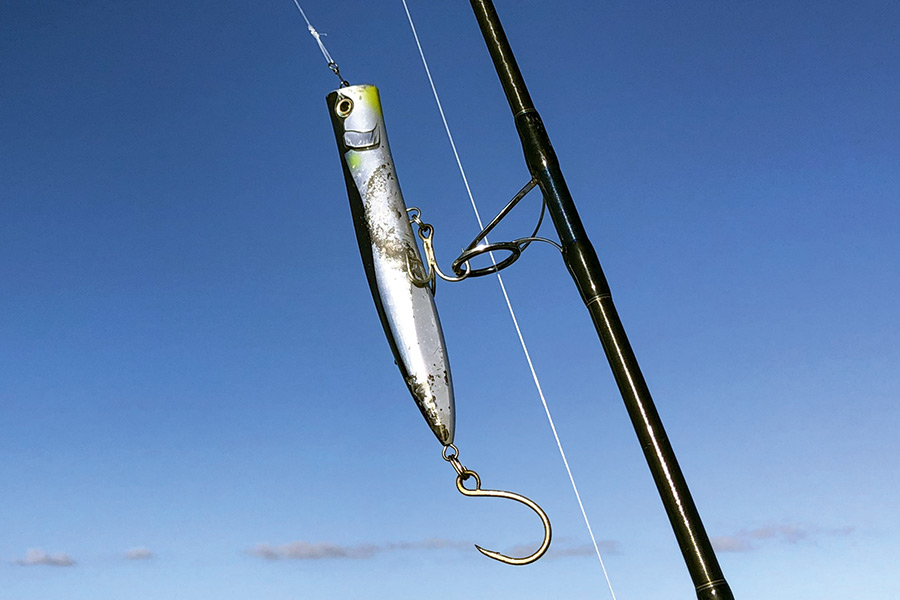
The writer’s current favourite topwater rod all set to go with his favourite popper; the Duckdive’s size, weight and relatively small ‘blooping’ face make it ideal for this outfit.
High quality components
Guides: All my favourite topwater rods have slanted, tangle-free Fuji guides, including my PE3 model, and they are excellent.
Grips: As already mentioned, the foregrip needs to be long enough to enable good fish-fighting leverage, but the current trend of streamlining them has me bemused. My hands are not especially big, yet my fingers curl right around many of the latest slimline grips to easily contact my hand. I know it’s just a PE 3 rod, but I could imagine cramp setting in over a long battle, so would prefer a bulkier grip that provides more surface area and a comfier grip.
Reel seats: Whatever the reel seat fitted, it must hold the reel firmly in place, especially under pressure.
So there you have it, my two cents worth, and for those who are wondering, no, I don’t get sponsored by Daiwa!

January 2022 - Mark Kitteridge
New Zealand Fishing News Magazine.
Copyright: NZ Fishing Media Ltd.
Re-publishing elsewhere is prohibited
Recent Forum Posts Visit Forum

Foton tunland v9
in The Briny Bar11 minutes ago
Ho Dee
not fishing related and delete if required but was wondering if any has one of these or someone who has just wanting so e real world...

Trailer wheel clamp
in The Boat Shed42 minutes ago
Pcj
Doesnt dry out like crc.I use it on my trailer lock...

Shane Jones
in Fisheries Management27 hours ago
Tzer
Far cry to the twats at Liegasea/NZSFC were proposing of 5 Tarakihi person in their submission for the central management area and this is what our...

Bluefin Tuna at the cavs.
in The Briny Bar47 hours ago
smudge
Despite my years of fishing I haven't really fished many places, my focus has always been on Auckland's west coast and out toward Great Barrier. I...

Casting gloves
in Popper and Topwater Fishing91 hours ago
Mc Tool
100 bucks for a lure 😬. Watching one of them flying over the horizon without the line attached would be " character building " for sure...
I thought Id post some nice photo's , join...
in The Briny Bar142 hours ago
Alan L
That is a very cool pic Krow.The Far North is very cool, the Far far North even cooler. Mint looking day.Alan...

Mc Tools berley mincer
in The Briny Bar150 hours ago
SaltyC
Good size, they scrap well. Got an 18kg one up in Vava'u back a few years ago fishing off squeaky Going's boat. That was quite a...
Out with the "Twelves"
in Fishing Reports204 hours ago
Pcj
I should be able to get out end of October. The nephew been out virtually every weekend over winter and has done well. It seems the...
Manukau Harbour & West Coast fishing
in Fishing Reports212 hours ago
smudge
Nice work Schecter, I think snapper may be around sooner than you think. Well I am hoping so...

Whangarei Harbour report.
in Fishing Reports644 hours ago
krow
180 +m is where I've had to be lately. A lot less low foul around these parts and some of it shallower that looks like Tarakihi...
Popular Articles

Softbait Fishing - Part 1 - gear selection
John Eichlesheim writes an article about selecting the right equipment for softbait fishing... Read More >
Softbait fishing Pt 2 - tips and tricks
Techniques, tips and tricks of softbait fishing – getting the most from your soft baits.... Read More >

Surfcasting - setting yourself up
Gary Kemsley helps sort out the necessary gear for intending surf fishers.... Read More >

Squid - How to catch them
Squid fishing is a rapidly growing aspect of fishing - Paul Senior shares some hints and tips to get started.... Read More >
Fishing Reports Visit Reports
Outer Hauraki Gulf Fishing Report 17/09/26
Spring wind the handbrake. Spring is starting to make its presence felt in the outer... Read More >
Top of the South Fishing Report - 17/09/26
Early snapper in Tasman Bay. Well, spring is finally here, and the days are getting... Read More >
Bream Bay Fishing Report - 17/09/26
Good snapper catches reported. After Tangaroa turned off the fish tap for a month or... Read More >
Bay of Islands Fishing Report - 17/09/26
Pacific bluefin tuna for the lucky few. The last fortnight has seen more fishable days... Read More >
Comments