
Landbased Fish Tagging
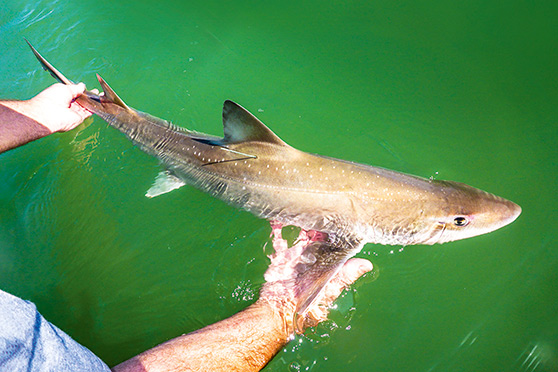
There are an awful lot of things we don’t know about inshore fish. Gary Kemsley gets in behind a recently started data-gathering initiative.
Are surfcasters catching less fish than they used to? It could be that there are now less fish to catch and to do something about this we need to find out why.
One reason for lower catch rates may be that fish are being harvested in large numbers in offshore areas away from the beaches. Hawke’s Bay gurnard are a good case in point. For several years they all but disappeared from the beaches around northern Hawke’s Bay, but a break from inshore trawling has seemingly led to a recent population increase.
How can we find out where and when our inshore fish travel? The easy answer, and one we can all help with, is to tag inshore fish in our area. A tagged fish that is later recaptured can tell us plenty about seasonal migration, growth rates and localised movement of species. All of this is valuable information when managing a fishery.
Inshore fish species vary in habitat. Some may be migratory while others are fiercely residential. Resident fish rely on their home waters being of good quality and may die if pollution increases, while wandering species may leave the area and never return. The data inferred from tag returns can tell us something about these habits. If fish are caught in the same area time after time they may not be moving, or they may migrate and return to the same area. Tagging returns for inshore species are proving that fish do return to the same areas year after year.
Some tag returns are surprising and enlightening. I once caught, tagged, and released a kingfish at Long Beach in the Bay of Islands. You can imagine my surprise when I re-caught the same fish 23 days later at Cape Brett, 23 miles away from the release point.
Another interesting one was a snapper tagged by Sue Tindale on November 29, 2018 which was recaptured on Christmas Eve 2019, only 630m from its release point. It had grown 4cm in its 390 days at large.
Another surprising tagging result came out of Canterbury. Greg Gilbert, clubbie and keen surfcaster, caught, tagged and released a 117cm rig (spotted smoothhound) off a south Rakaia Beach. Fifty-one days later Tim Murray caught the same fish on his longline in 10 metres of water. The interesting point is that it was caught at Bruce Bay in South Westland. That is almost straight across the South Island from where it was tagged. The minimum distance travelled was 1030km if it went north and through Cook Strait, or south and cut through Foveaux Strait. It was released again; that’s one lucky fish!
These sorts of things are the results we are after. The more information gathered, the better we can understand fish movements and protect the fish. The more data there is, the more accurate the results.
Have I interested you yet?
My previous tagging experience was with the Co-operative Tagging Program, which mostly deals with game fish like marlin, tuna, sharks and kingfish. It felt great tagging and releasing fish and ultimately recapturing a tagged one. Others caught some of my tagged fish and it was always interesting to hear where they had gone to and from.
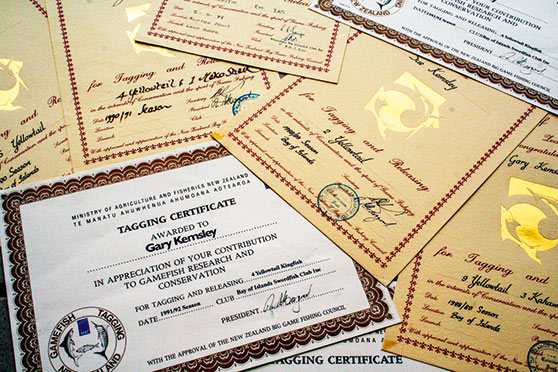
The Co-operative Tagging Program deals mostly with game fish like billfish, sharks, tuna and kingfish.
Two Lottin Point kingfish were re-caught at White Island. A mako shark we caught off the rocks at Cape Brett was tagged and released and recaptured hundreds of kilometres north of New Zealand by a commercial boat. It had grown from 9kg to over 40kg in six months!
This new program, however, is about inshore species like rig, snapper, trevally, kahawai, gurnard etc. Some will dismiss this as amateur science and of no use. Others will recognise that this sort of reporting (aka citizen science) is important and valuable.
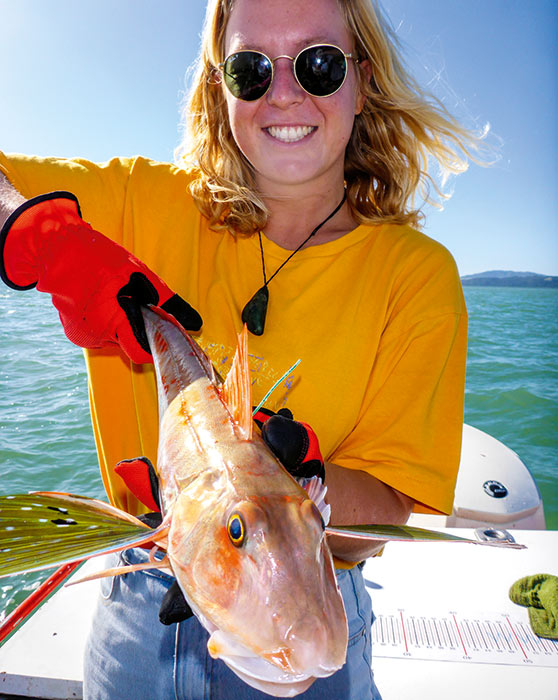
Inshore fish like gurnard need more research. The new 'citizen science' tagging program will help this.
When I fished for the Bay of Islands Swordfish Club, tagged fish were noted with a certificate for the fisher. There were also prizes for the most fish tagged and released during the club year. These were coveted accolades from our peers.
I want to encourage surfcasting clubs to do the same and get their members involved now that there is a well-organised official program in place for inshore fish.
I am about to promote the concept to the surfcasting clubs I belong to, the Pania Surfcasting Club and the Palliser Bay Surfcasting Club. I know not everyone will be enthused and get behind the idea, but I bet many do.
Are you interested in being part of this program? It is one way you can give something important back to this wonderful sport of fishing, and at little cost. Really, it’s at no cost when you consider all the money you have saved with the fish dinners you’ve pulled from the ocean.
Tagging kits are available from [email protected] and at events like boat shows, and they’re all sold at cost. I hope surfcasting clubs will make tagging kits more readily available soon.
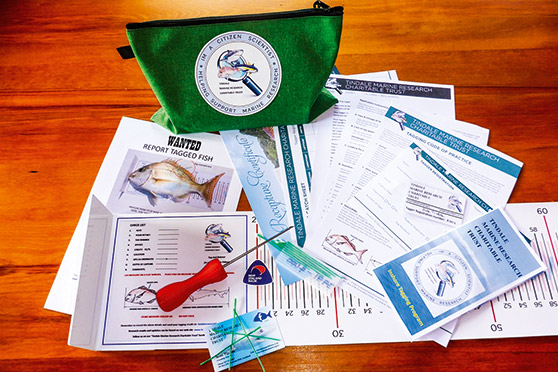
A tagging kit from the Tindale Marine Research Charitable Trust.
I am feeling deprived that this initiative went on for a couple of years without me hearing about it, but I am right behind the organisers now. This is a way for us all to help with the health of our fisheries. I plan on tagging more than a few fish in the months to come. You can too!
Inshore Fish Tagging Program
Information on the Tindale Marine Research Trust and its work can be gleaned from your local surfcasting club. If they don’t know about it, they need to contact the NZ Angling and Casting Association (their parent body) which has been fully briefed.
Otherwise, most fishing shops will have a “Wanted” poster up in store with details. Failing all of that, contact the Tindale Marine Research Charitable Trust at:
tindaleresearch.org.nz or email [email protected].
|
|
This article is reproduced with permission of |

Recent Forum Posts Visit Forum

Shane Jones
in Fisheries Management2 hours ago
Fish Addict
The recreational sector can expect no favours from politicians. They know all too well who butters their bread and it ain't the recs. No different over...

Foton tunland v9
in The Briny Bar2 hours ago
Ho Dee
not fishing related and delete if required but was wondering if any has one of these or someone who has just wanting so e real world...

Trailer wheel clamp
in The Boat Shed3 hours ago
Pcj
Doesnt dry out like crc.I use it on my trailer lock...

Bluefin Tuna at the cavs.
in The Briny Bar49 hours ago
smudge
Despite my years of fishing I haven't really fished many places, my focus has always been on Auckland's west coast and out toward Great Barrier. I...
Casting gloves
in Popper and Topwater Fishing94 hours ago
Mc Tool
100 bucks for a lure 😬. Watching one of them flying over the horizon without the line attached would be " character building " for sure...
I thought Id post some nice photo's , join...
in The Briny Bar145 hours ago
Alan L
That is a very cool pic Krow.The Far North is very cool, the Far far North even cooler. Mint looking day.Alan...

Mc Tools berley mincer
in The Briny Bar152 hours ago
SaltyC
Good size, they scrap well. Got an 18kg one up in Vava'u back a few years ago fishing off squeaky Going's boat. That was quite a...
Out with the "Twelves"
in Fishing Reports206 hours ago
Pcj
I should be able to get out end of October. The nephew been out virtually every weekend over winter and has done well. It seems the...
Manukau Harbour & West Coast fishing
in Fishing Reports214 hours ago
smudge
Nice work Schecter, I think snapper may be around sooner than you think. Well I am hoping so...

Whangarei Harbour report.
in Fishing Reports646 hours ago
krow
180 +m is where I've had to be lately. A lot less low foul around these parts and some of it shallower that looks like Tarakihi...
Popular Articles

Softbait Fishing - Part 1 - gear selection
John Eichlesheim writes an article about selecting the right equipment for softbait fishing... Read More >
Softbait fishing Pt 2 - tips and tricks
Techniques, tips and tricks of softbait fishing – getting the most from your soft baits.... Read More >

Surfcasting - setting yourself up
Gary Kemsley helps sort out the necessary gear for intending surf fishers.... Read More >

Squid - How to catch them
Squid fishing is a rapidly growing aspect of fishing - Paul Senior shares some hints and tips to get started.... Read More >
Fishing Reports Visit Reports
Outer Hauraki Gulf Fishing Report 17/09/26
Spring wind the handbrake. Spring is starting to make its presence felt in the outer... Read More >
Top of the South Fishing Report - 17/09/26
Early snapper in Tasman Bay. Well, spring is finally here, and the days are getting... Read More >
Bream Bay Fishing Report - 17/09/26
Good snapper catches reported. After Tangaroa turned off the fish tap for a month or... Read More >
Bay of Islands Fishing Report - 17/09/26
Pacific bluefin tuna for the lucky few. The last fortnight has seen more fishable days... Read More >
Comments