
Kayak fishing
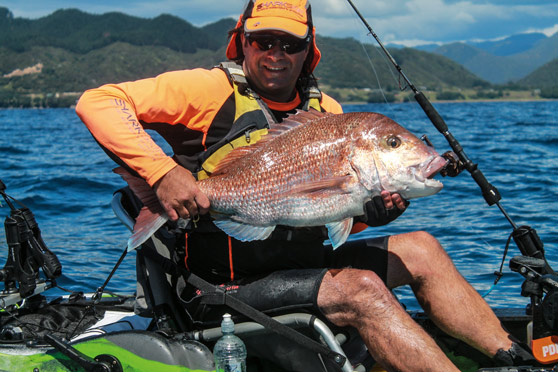
While fishing plays a huge part in my life, I’m also passionate about spear-fishing. In fact, it was the catalyst for purchasing my first kayak, which introduced me to kayak fishing in the process. Combining kayaking with fishing and spear-fishing has its benefits, giving me plenty of options for adventure. I prefer to hunt species such as kingfish from the kayak using a fishing rod and reel because of the challenge, but enjoy chasing snapper when swimming in their environment.
A spear-fisher must be quiet and stealthy to be successful with snapper. Kayaks are perfect for this purpose, with near-silent movement through the water making them excellent for sneaking along coastal areas. Using the kayak as a fishing platform has significantly increased the number of snapper over 20 pounds (9.1kg) I’ve secured.
The kayak can also provide one of the most successful platforms to fish from when using artificial lures and jigs, especially in shallow water. The challenge of enticing fish to take lures provides an angler with some very satisfying moments.

Most of us learn our fishing, kayaking and spearfishing skills in areas that are easy to access and close to home. However, eventually we get too familiar with the territory and crave new places to explore. My own exploits when filming the Reel Screaming Kayaks show and various other adventures have presented plenty of opportunities to do this, and this aspect is one of the most enjoyable provided by kayak use.
One region of the North Island that has given me lots of pleasure is the Eastern Bay of Plenty. It’s a great place to visit, offering a large stretch of coastline that runs from Matata to East Cape and on to Gisborne. Every year I head to this region and take part in the EBOP Kayak Fishing Tournament. The lure of new coasts makes it compulsory to spend some extra days, and this year I was joined by fellow kayak angler Kerry Flowers.
At the heart of this location is Whakatane. It’s a place well worth a visit, especially for supplies, before heading southeast. One of the most exciting things about regions like Whakatane is that deep water is not that far away from the coast in some areas, especially out towards Lottin Point.
Our base there involved a short drive to Ohope’s Top 10 Holiday Park, with a mate kindly offering his on-site converted caravan. Staying here put us in a central location: with Whakatane just over the hill, we were well positioned for the contest in a few days’ time.
The first day saw us taking things easy to start with; by the time we reached our destination near Waihau Bay it was mid-morning. We kicked activities off with some diving, and Kerry was first to get into action, nailing crayfish a few hundred metres from the launch site.

Next, we travelled east, resisting the temptation to stop along the way. After a short distance the anchors went over the side, holding the kayaks out from a nice-looking headland with plenty of shallow reef running out from it.
Once in the water, good visibility of least 10 metres greeted us – and fish were everywhere. A nest of crays was soon located, and Kerry was straight in there to try his luck.
It’s best to take your time when trying to get hold of one, but with the larger crays usually sitting behind the rest of the group, this can be difficult to do. Kerry slowly crept forward, easing his hand into position for a strike – but they were too fast, retreating under the boulder in a cloud of silt.
Further exploration of the area culminated in an encounter with a school of around fifty kingfish, and it was also great to find a decent population of butterfish here. However, one thing seriously lacking was paua, only a few small ones were around.
With just one more crayfish added to the kayak’s catch-storage area, we took a short break for lunch, also taking the opportunity to set the kayaks up for fishing.
One of the best things to do when looking at new locations is study marine charts, as they can indicate potential hotspots. We’d done this beforehand, so headed for a reef system we’d liked the look of in 50 metres of water, situated a few kilometres from our launch location.

After arrival, we investigated the area with the sounder for a while, finding where the fish were holding. (We look for large baitfish schools, especially when targeting kingfish.)
We then set up for the first drift and put some jigs amongst the densest fish concentrations. (A chart-plotter is very handy when tracking the drift direction, enabling us to put our kayaks right on top of the fish.)
Despite these advantages, the fishing started slowly – until it came right in a hurry, with a snapper well over 20 pounds being the first to take my green 200g Zest Hardy long jig; it was released to fight another day.
A kingfish around ten kilos was next to take the jig, but damage to the trace meant it was lost at the kayak while pulling it in closer. Kerry also hooked up, but had his trace sliced through midwater.
Increasing interest levels from the fish resulted in further hookups – as well as several bust-offs and plenty of gear loss, leaving us bemused.
Then, with registration for the kayak fishing tournament creeping up fast, it was time to head back. Despite our misfortunes, it was hard to drag ourselves away from the great evening fishing potentially ahead.
A few hours later saw us at the Whakatane Sports Fishing Club, the venue for the kayak-fishing tournament. After admiring the many fish mounts adorning the club’s walls and enjoying a few cold ones over a meal, we headed back to Ohope.
Next morning was tournament day, which meant an early start and a short ride back to Whakatane. Our launch site at Kohi Point offered easy access, and today Kerry and I were joined by Jeff Forse, who also had a pedal-powered kayak.
We located plenty of baitfish sign on the sounder straight out from the launch site, so the sabiki flies were deployed, and while gathering the bait my soft-bait got nailed by a feisty kahawai. From here we headed for Whale Island and the reef systems on its western side. It was a 10-kilometre trip, but the speed of our pedal kayaks made quick work of it.
The first reef produced our target species – kingfish – although not especially big specimens. Kerry hooked one that got the attention of a decent bronze whaler shark, which chased it right up to his kayak. However, his quick reactions, combined with the kayak’s incredible stability, meant the fish was pulled on board before being eaten. When this happens, it’s best to change location to avoid any further shark encounters.

A shift to the next reef eventually produced more kingfish, with all of us hooked up and having fun – until my kingfish was eaten just under the kayak by another big bronze whaler. Losing the fish and my rig suggested it was time to move on again.
Our attention shifted to the island and what was available on the other side, especially an area on the northeastern corner that looked ideal for jigging.
However, the afternoon’s fishing proved to be quiet, despite our best efforts. So we focused our attentions on the island’s amazing rock formations, including an underwater vent 50 metres down, with the bubbles emitted being visible on the surface.
Back on shore after a big day that involved traversing well over 30 kilometres of ocean, we still enjoyed prize-giving. As far as I’m concerned, it’s well worth attending events like the EBOP Kayak Fishing Tournament, especially on a social level, as it gives you the chance to meet other enthusiasts.
The last day of our trip offered challenging conditions that were set to worsen during the afternoon. So, with our time limited, we headed back towards Waihau Bay in search of paua. A calm launch site got us on the water and average visibility didn’t prevent us finding decent numbers of paua later on, along with a few crays.
That night saw us enjoying the spoils of our endeavours, with Kerry making one of the best creamed paua dishes ever. Experiences like these make our lives richer, and with so much country still to explore, I’m looking forward to enjoying many more.
|
|
This article is reproduced with permission of |

Recent Forum Posts Visit Forum

Shane Jones
in Fisheries Management1 hour ago
Fish Addict
The recreational sector can expect no favours from politicians. They know all too well who butters their bread and it ain't the recs. No different over...

Foton tunland v9
in The Briny Bar1 hour ago
Ho Dee
not fishing related and delete if required but was wondering if any has one of these or someone who has just wanting so e real world...

Trailer wheel clamp
in The Boat Shed2 hours ago
Pcj
Doesnt dry out like crc.I use it on my trailer lock...

Bluefin Tuna at the cavs.
in The Briny Bar48 hours ago
smudge
Despite my years of fishing I haven't really fished many places, my focus has always been on Auckland's west coast and out toward Great Barrier. I...
Casting gloves
in Popper and Topwater Fishing93 hours ago
Mc Tool
100 bucks for a lure 😬. Watching one of them flying over the horizon without the line attached would be " character building " for sure...
I thought Id post some nice photo's , join...
in The Briny Bar144 hours ago
Alan L
That is a very cool pic Krow.The Far North is very cool, the Far far North even cooler. Mint looking day.Alan...

Mc Tools berley mincer
in The Briny Bar152 hours ago
SaltyC
Good size, they scrap well. Got an 18kg one up in Vava'u back a few years ago fishing off squeaky Going's boat. That was quite a...
Out with the "Twelves"
in Fishing Reports206 hours ago
Pcj
I should be able to get out end of October. The nephew been out virtually every weekend over winter and has done well. It seems the...
Manukau Harbour & West Coast fishing
in Fishing Reports213 hours ago
smudge
Nice work Schecter, I think snapper may be around sooner than you think. Well I am hoping so...

Whangarei Harbour report.
in Fishing Reports646 hours ago
krow
180 +m is where I've had to be lately. A lot less low foul around these parts and some of it shallower that looks like Tarakihi...
Popular Articles

Softbait Fishing - Part 1 - gear selection
John Eichlesheim writes an article about selecting the right equipment for softbait fishing... Read More >
Softbait fishing Pt 2 - tips and tricks
Techniques, tips and tricks of softbait fishing – getting the most from your soft baits.... Read More >

Surfcasting - setting yourself up
Gary Kemsley helps sort out the necessary gear for intending surf fishers.... Read More >

Squid - How to catch them
Squid fishing is a rapidly growing aspect of fishing - Paul Senior shares some hints and tips to get started.... Read More >
Fishing Reports Visit Reports
Outer Hauraki Gulf Fishing Report 17/09/26
Spring wind the handbrake. Spring is starting to make its presence felt in the outer... Read More >
Top of the South Fishing Report - 17/09/26
Early snapper in Tasman Bay. Well, spring is finally here, and the days are getting... Read More >
Bream Bay Fishing Report - 17/09/26
Good snapper catches reported. After Tangaroa turned off the fish tap for a month or... Read More >
Bay of Islands Fishing Report - 17/09/26
Pacific bluefin tuna for the lucky few. The last fortnight has seen more fishable days... Read More >
Comments