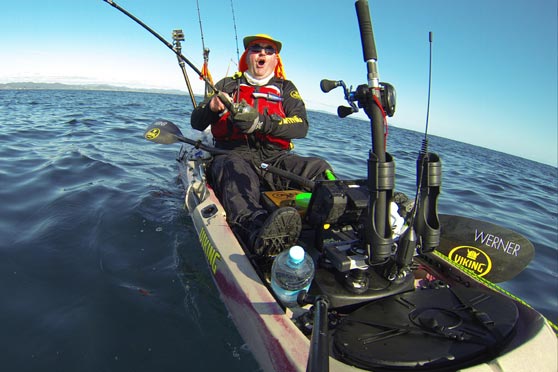
The session began with a long drive north to Whananaki to fish the first official weekend of summer. The goal: have a shakedown cruise on Sunday morning to make sure everything aboard (including the paddler!) was working properly. My plans this summer include a number of big offshore missions from both the east and west coasts, and everything needs to be up to scratch: electronics functioning properly, deck rigging and rudder working smoothly, and all the kit that can become misplaced over winter accounted for. The offshore missions targeting tuna need to be taken seriously.
The initial target was a feed of snapper, followed by a quick sojourn beyond the 120-metre mark to see if there were any late hapuku still hanging around. This would put dinner on the table and give the kayak the necessary workout to make sure everything was working properly. It would also push the paddler a little and give a gauge of how much fitness had been lost during the long windy spells of the last couple of months.
The 4:00am alarm wasn’t too much of a struggle, nor was the launch in near-perfectly conditions. Aside from a brief scramble to get the foot pedals sorted as I leapt aboard (the legacy of loaning my kayak to a shorter paddler and not remembering to readjust), everything was where it needed to be. Paddling away from the beach before sunrise with just the stars for company, the plan had gone without hitch so far.
Then the unexpected started to kick in. As the horizon lightened, the occasional splashes and fleeing flight in front of the Reload revealed themselves to be flying fish – lots of flying fish!
In the dark I had thought the splash and gliding escape had been shearwaters, but instead of feathers, these critters were covered in glinting scales - hardly what I expected in just 30 metres of water!
A glance at the surface water temperature showed it climbing through 17.5°C, despite the cool pre-sunrise air.
This called for an adjustment to the day’s fishing plan. As a confirmed tuna addict, I couldn’t pass up the potential for hooking my first for the season. A quick inventory of tackle showed I had a suitable selection of saltwater flies and two of my favourite bibbed tuna lures – perfect. (I occasionally get a bit of cheek from other anglers about the tackle I carry, but I’m usually ready for the unexpected if opportunities arise!)
The new plan involved heading directly to the 120-metre mark, monitoring water temperatures as I paddled. I could then land a snapper or two while hunting around for hapuku sign. Once the sun was above the horizon, a couple of hours could be spent trolling along the contour to see if there were any tuna about, before making my way back to the coast for the journey home.
By the time I passed the 100m mark, the surface water temperatures had climbed to 18°C, though the colour was still very green.
Upon reaching 120 metres, three pilchard baits drifted to fish sign halfway to the bottom resulted in three nice pan-sized snapper under cover in the back of the kayak. Without any hapuku sign nearer the bottom to keep my interest, it was time to deploy lures.
Cruising the contour while trolling lures allowed me to watch the surface temperature climb to 18.5°C as the sun rose higher. There were also substantial patches of baitfish and several more schools of what looked like snapper - very fishy sign indeed.
By mid-morning the water was still green and there was no action on the lures, but then I ran over some nicely-packed sign hard on the bottom. Though there weren’t any big arches, this looked just like baitfish or golden snapper rounded up by hapuku – typical sign for the area that has given me great success in the past. In came the lures and down went the day’s fourth pilchard.
The pilchard drifted down according to plan, and as it hit the edge of the bottom-hugging school it paused briefly. Flicking the reel into gear, I lifted the rod to set the hook and came up firm on an immovable object. Cautiously increasing the line pressure resulted in a strong head shake and the fish swimming off strongly – typical 20kg hapuku tactics for this area. With confidence growing, I set the drag and began to try lifting the fish.
Now for unexpected event number two: as I lifted at my end of the rod, the weight from the fish continued to increase, eventually dragging the tip below the surface. At the same time the departing line quickly accelerated to a speed I’ve never had hapuku swim at before – and then it went faster still!
With line now screaming from the reel, I was vaguely aware of lifting a scorching-hot thumb from the spool – and then watched, gobsmacked, as a thresher the length of my kayak leapt bodily from the water!
Expecting/hoping for a 20kg hapuku to take home, I was now hooked to a marauding fish around 10 times that size on 20lb braid attached to a 25lb fluorocarbon leader and short 80lb trace.
Time to evaluate my options. I’d caught small thresher sharks from kayaks before, but none anywhere near as big as this one. I was already a long way from the coast, but still within my paddling abilities. And despite the relatively light tackle I was using, I had great confidence in it handling the situation.
Having quickly weighed all the factors, I decided this would be a good start to the game season for me, and to have some fun before the inevitable release occurred.
But first I set the boundaries for the battle: I could afford up to three hours before having to start making for home. Also, I could be dragged up to a maximum of 5km closer towards the Poor Knight or around 8km along the coast, and still have the paddling range to make it back to the beach. With this clearly in mind, the battle commenced.
After the first jump and some spectacular runs, it became a war of attrition – who was going to tire first?
The kayak settled into a steady 3kph run, with me using the rudder to occasionally run out to the side to try and alter line angles.
After the first hour I had recovered most of my line, but then the thresher finally woke up to the danger and screamed off again.
As I clocked past the second hour, the GPS plot told me I was passing through the 5km barrier heading towards the Poor Knights.
I was now getting out of my self-imposed safety zone and it was time to bring everything to a head. Cranking up the drag even further, I had a go at short-stroking the monster out of the depths - and succeeded in getting it to angle towards the surface.
At the 2.5-hour mark - and now 6km from the hook-up point - I had the thresher on the surface and was winding the kayak closer.
Then, just 50 metres in front of the kayak, with a mad whip of its tail, the shark succeeded in whacking the much abused 25lb fluorocarbon leader and won its freedom.
For me this was the perfect result: I was still in good enough shape to get home and no long piece of line was left trailing behind the fish. That’s a promising way to start a new season!
Lessons learned
I learnt some valuable lessons about preparing for the unexpected. The following was successfully covered:
• Top quality rod and reel, with upgraded drag system up to the task
• Top quality line, leader, trace, and terminal tackle
• Well-tied knots, including a PR joint between braid and leader
• Two safety knives freshly sharpened in case I needed to free a tangled line or carry out a long-range release
• A proper selection of navigation and safety equipment for good communications during a protracted session on the water.
However, as the battle progressed passed the first hour, then the second hour, I discovered two more important aspects I hadn’t managed to address:
• I’d neglected to put my right-hand fighting glove on before dropping the bait, resulting in a badly sunburnt and swollen hand (I couldn’t get the snug-fitting glove on, even trying with my teeth!)
• I had plenty of water on board, but hadn’t broken the seal on any of the bottles – opening a new bottle one-handed while playing a monster fish and keeping the kayak balanced is an interesting exercise!
While these weren’t deal breakers for this session, they served to demonstrate how important some of the smaller stuff can be when pushing the boundaries.
Thresher sharks
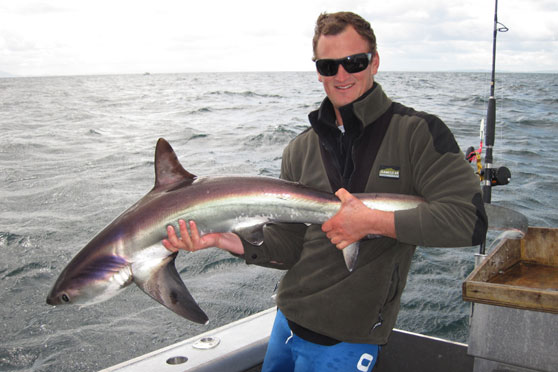
There are three species of thresher sharks recognised world-wide and two of them are present in New Zealand waters: The bigeye thresher, and the thresher (also called fox thresher). They are easily recognised by their extremely long tails – about the same length as the whole of rest of the body. The bigeye thresher is distinguished by large eyes and distinct groves starting above the eyes and running down towards the pectoral fins, forming a ‘hump’ behind the head. ‘Fox’ threshers have a distinctive white belly running almost back to the tail.
Threshers use these over-developed tails to hunt their preferred prey: small to medium schooling fish and squid. They herd their prey into ‘meatballs’ by swimming in tightening circles around them, often striking their prey with their tail to stun them. They are extremely accurate with their tail strikes and can even pick off individual fish by swimming alongside and striking with the tail. This feeding mode sees many of the thresher sharks caught by anglers foul-hooked in the tail as they strike at the lure or bait.
Both species have a similar growth potential – the high 380kg range world records for both (bigeye 363.8kg and fox 348kg) were caught in New Zealand. Pups are born alive, developing inside the mother and feeding on unfertilised eggs developed for that purpose. Two to four pups are usually born.
Threshers are powerful fighters on the line and jump clear of the water. They are favoured by game fishers, and their flesh is highly rated for eating, overseas, but these sharks are usually discarded when caught NZ longliners.
----- Advertisement -----







Comments