
Interesting Facts About Blue Cod
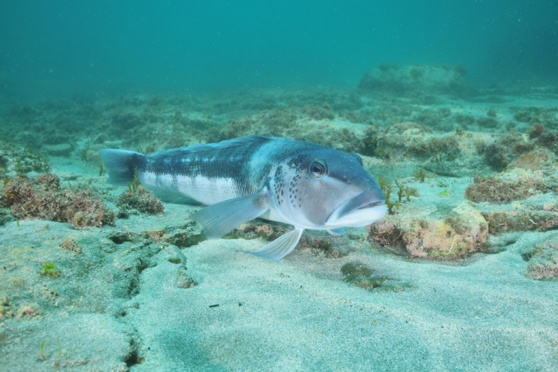
It’s time to put the fishing stories to one side for a mo’ – here is a quick review of the current scientific facts about the biology of blue cod.
By far the most popular recreational target species in the South Island, blue cod (Parapercis colias) is a bottom-dwelling fish commonly found near reefs down to depths of 150 metres. Cod are opportunistic carnivores that like to feed over open ground at reef edges.
Blue cod are not actually related to the true cods; in fact, they are weevers which are part of the wider sandperch family, with about 50 species internationally, occurring in both shallow water and depths to over 200 metres.
Blue cod are endemic and occur throughout most of New Zealand. While found from the shore to the edge of the continental shelf, they are primarily coastal and most abundant in temperate areas south of Cook Strait. Often attracted to divers, these naturally inquisitive fish are easily coaxed to hand-feed, even in remote areas where divers are rare.
Early development
After spawning, blue cod eggs float to near the surface and hatch after about six days. Larvae then remain floating for another three days or so before settling to the sea floor at around half a centimetre long. Generally not observed until at least 3cm, baby blue cod are mainly found among rubble or associated with living structures such as sponges and horse mussels (biogenic reefs). These very young fish require some habitat structure to avoid predators (often larger blue cod) and to find food such as tiny crustaceans.
Movement patterns
Typically a slow-moving fish, blue cod swim mainly propelled by their pectoral fins in a distinctive sculling motion, but are capable of sudden bursts of speed using their tail when required.
Large-scale tagging programmes have been done in the Marlborough Sounds over the years. These studies recorded maximum distances moved of up to 48km; however, less than a quarter of blue cod moved more than a mile during the 13 and 28 months during these studies.
Further south, tagging studies in Foveaux Strait (1998−1999) and Dusky Sound (2001−2002) recorded maximum distances moved of 156km and 30km respectively. However, most fish moved less than 800 metres over 20 months in Foveaux Strait and less than 600 metres over 17 months in Dusky Sound.
While a few blue cod do move some distance, they are the exception, and the small amount of movement shown by most fish in these studies explains why blue cod may be vulnerable to over-fishing and local depletion. Blue cod can therefore benefit from smaller-scale localised management in areas of high fishing pressure.
Social structure
While blue cod may aggregate when feeding, they do not school. As with other Parapercis species, large male blue cod probably defend rather loose territories. This has been observed directly in Northland, where small social groups have been recorded, with the territory of a large dominant male encompassing the home ranges of three to five females. The size of the territory appears to increase as the size of the fish increases.
Feeding
With large eyes, a wide mouth and an inquisitive nature, blue cod are voracious and opportunistic feeders. The main prey items of blue cod are crustaceans, small fish, shellfish, worms and small octopus. However, blue cod will eat almost any available animal matter, and their diet probably reflects what is most abundant in the environment. In one area, 52 different prey species were identified in the diet!
Growth
Blue cod grow to over 55cm in length, over 4kg in weight, and can reach a maximum age of more than 30 years. This moderately slow-growing species varies in growth rates around New Zealand, with males generally growing faster and larger than females. It takes up to 11 years for males and 12 years for females to reach the minimum legal size limit in Southland. Further north, growth may be a little faster, but it can still take seven years for males and 11 years for females to reach the size limit in the Marlborough Sounds (check here for the current size limits for various regions)
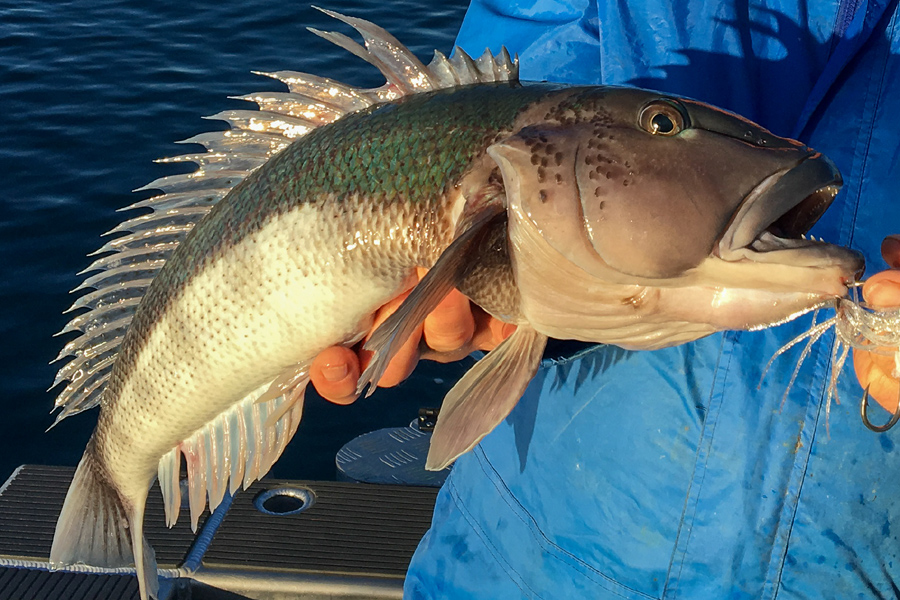 Blue cod may take up to 12 years to reach minimum size limits.
Colour phase
The colour of blue cod changes with size; juveniles (5-15cm long) have a whitish body with two brown stripes running the entire length. Maturing fish darken to a rusty brown and the stripes become barely distinguishable. Beyond 25cm both sexes change colour to a mottled grey, which lasts until about 30cm, when a further change to green or blue occurs. Larger fish then develop a green-blue head, wide stripes and a pale belly. Both sexes occur in these colour phases, so it is not possible to sex blue cod by colour.
Reproduction
Like growth, size at sexual maturity also varies between locations. Fish in the Marlborough Sounds mature sexually at 21-26cm, compared to those in Southland which mature at 26-28cm. Blue cod have a relatively long spawning period, potentially ranging from early spring to mid-summer, and evidence suggests that spawning occurs locally for both inshore and offshore populations.
Gender-benders
Like other weevers, blue cod are able to change sex from female to male, but the presence of some large, older females suggests that not all blue cod undergo a sex change. Just what controls sex change is largely unknown, but it is likely to be a complex process that is influenced by size, age and social interactions. In particular, the aggressive territorial behaviour of large males may be an important factor that suppresses sex changes in smaller females. This may explain why catches from heavily fished areas, such as the Marlborough Sounds, tend to be dominated by males (because there are no large males to suppress female sex change), while catches from areas with less fishing pressure, such as Dusky Sound, usually have a more balanced sex ratio.
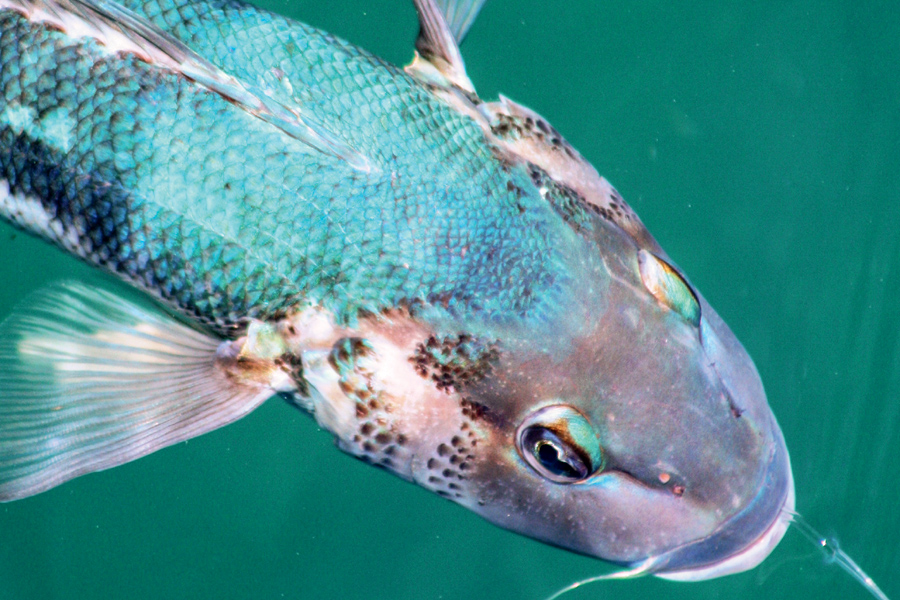
Blue cod can change sex from male to female, likely due to size, age, and social structures.
Just what effect a sex ratio biased towards males has on the reproductive output of blue cod populations is unknown, but a maximum legal size may be appropriate for blue cod in areas of high fishing pressure to ensure that some large fish remain in the population.
Fishing with care
Blue cod are slower growing and heavily fished areas have shown the need for conservative management.
Recreational fishers should be aware that when blue cod swallow a hook, damage is often done to the gut or gills during the process of unhooking, causing returned fish to bleed to death within a few hours of being released. To improve the survival of returned undersized blue cod, fishers should use large and/or circle hooks.
When returning undersized blue cod, handling time should be kept to a minimum, and fishers should also try to help undersized blue cod avoid predators such as birds when releasing them. If you find you are returning lots of undersized blue cod and birds or barracouta have turned up, move on and try somewhere else.
- NZ Fishing News
Recent Forum Posts Visit Forum

Shane Jones
in Fisheries Management15 hours ago
Tzer
Far cry to the twats at Liegasea/NZSFC were proposing of 5 Tarakihi person in their submission for the central management area and this is what our...

Bluefin Tuna at the cavs.
in The Briny Bar34 hours ago
smudge
Despite my years of fishing I haven't really fished many places, my focus has always been on Auckland's west coast and out toward Great Barrier. I...

Casting gloves
in Popper and Topwater Fishing79 hours ago
Mc Tool
100 bucks for a lure 😬. Watching one of them flying over the horizon without the line attached would be " character building " for sure...
I thought Id post some nice photo's , join...
in The Briny Bar130 hours ago
Alan L
That is a very cool pic Krow.The Far North is very cool, the Far far North even cooler. Mint looking day.Alan...

Mc Tools berley mincer
in The Briny Bar138 hours ago
SaltyC
Good size, they scrap well. Got an 18kg one up in Vava'u back a few years ago fishing off squeaky Going's boat. That was quite a...

Out with the "Twelves"
in Fishing Reports192 hours ago
Pcj
I should be able to get out end of October. The nephew been out virtually every weekend over winter and has done well. It seems the...
Manukau Harbour & West Coast fishing
in Fishing Reports199 hours ago
smudge
Nice work Schecter, I think snapper may be around sooner than you think. Well I am hoping so...

Whangarei Harbour report.
in Fishing Reports632 hours ago
krow
180 +m is where I've had to be lately. A lot less low foul around these parts and some of it shallower that looks like Tarakihi...
Whangarei Harbour Scallops
in Fisheries Management742 hours ago
Pcj
Reopening WhangÄ쳌rei Harbour to recreational scallop fishingTÄ“nÄ쳌 koeFisheries New Zealand is seeking feedback from tangata whenua, stakeholders, and the public on whether WhangÄ쳌rei Harbour should be...
SNA1 Recc fishing cops the blame.
in Fisheries Management838 hours ago
Tzer
What Liegasea won’t tell you is that some of their own fisheries contractors were co-authors of this study for fear of being called hypocrites, one of...
Popular Articles

Softbait Fishing - Part 1 - gear selection
John Eichlesheim writes an article about selecting the right equipment for softbait fishing... Read More >
Softbait fishing Pt 2 - tips and tricks
Techniques, tips and tricks of softbait fishing – getting the most from your soft baits.... Read More >

Surfcasting - setting yourself up
Gary Kemsley helps sort out the necessary gear for intending surf fishers.... Read More >

Squid - How to catch them
Squid fishing is a rapidly growing aspect of fishing - Paul Senior shares some hints and tips to get started.... Read More >
Fishing Reports Visit Reports
Outer Hauraki Gulf Fishing Report 17/09/26
Spring wind the handbrake. Spring is starting to make its presence felt in the outer... Read More >
Top of the South Fishing Report - 17/09/26
Early snapper in Tasman Bay. Well, spring is finally here, and the days are getting... Read More >
Bream Bay Fishing Report - 17/09/26
Good snapper catches reported. After Tangaroa turned off the fish tap for a month or... Read More >
Bay of Islands Fishing Report - 17/09/26
Pacific bluefin tuna for the lucky few. The last fortnight has seen more fishable days... Read More >
Comments