
How Spawning Affects Fishing in NZ

For fishing and fisheries management purposes, one of the most important things we can know about a species of fish is its spawning characteristics. How old are they when they first reach sexual maturity? How many eggs do they produce? Where do they spawn? When? What is the habitat of the larval/juvenile fish? That sort of thing.
As it turns out, this knowledge is scant even for many popular species and is often cobbled together from trawl surveys and a few personal observations.
Blue cod
Blue cod are members of the widely scattered family of weevers and sand perches and are found right around our coasts. They start to become more prevalent as snapper start to thin out about halfway down the North Island, and many anglers appreciate their snowy white, firm-flaking flesh with its delicate flavour. The further south you go, the more strongly the blue cod establishes itself as a dominant reef fish.
Blue cod are a moderately long-lived species, although ages over 20 years are relatively uncommon, making up just 2 percent of the population. The oldest recorded age for blue cod is 32 years (a 58cm male) which was caught offshore from Banks Peninsula. Size at sexual maturity also varies according to location. In Northland, maturity is reached at 10-19cm at an age of two years, while in the Marlborough Sounds it is reached at 21-26cm at three to six years. In Southland, the fish become mature between 26-28cm at an age of four to five years.
Most blue cod don’t get around much. While tagging programmes have shown occasional individual movement records of up to 156km, around two-thirds of the fish moved less than a kilometre.
Blue cod spawning seems to occur towards the second half of the calendar year but varies between areas, from August to November in the north, August to October in the Marlborough Sounds, August to December around Stewart Island, November to January at the Chatham Islands, October in Otago and November to January in Southland. Individual fish are involved in multiple spawning episodes and spawning aggregations have been reported in inshore and mid-shelf waters. Eggs are pelagic for about five days after spawning, then larvae are pelagic for about five more days before settling onto the seabed.
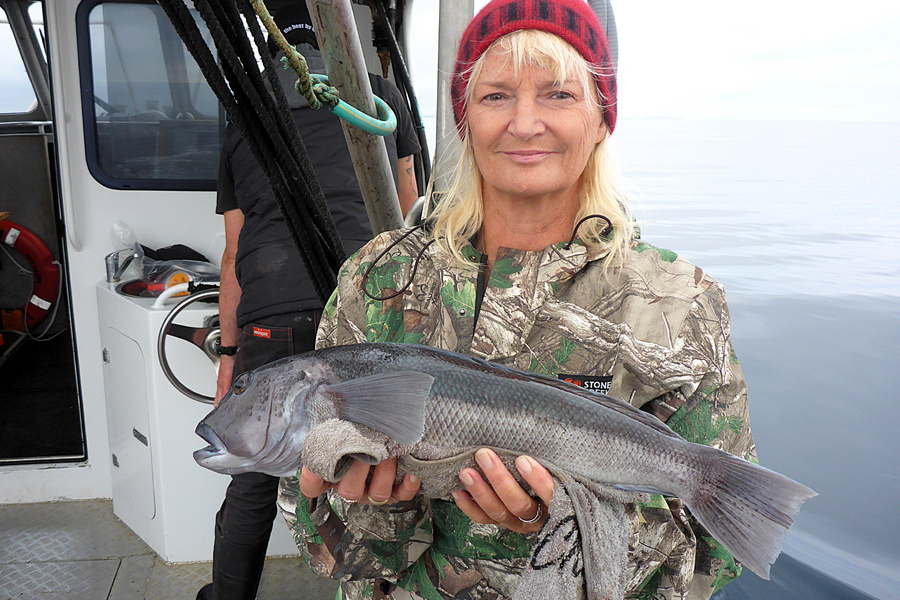
Blue cod are hermaphrodites, with individuals over a large length range changing sex from female to male, but the presence of some large, older females suggests that not all blue cod undergo sex change. Blue cod males grow faster and are larger than females. Large males defend a territory around a group of females, and this aggressive territorial behaviour of large males may suppress sex change in smaller females.
Constant pressure can knock cod populations back, and this has resulted in quite strict harvest regulations in some regions. What these regulations may often mean is that, in some harder fished regions, a good many cod may have to be returned as they are undersized. Predation by shags, seals and barracouta can take a big toll on released fish.
Recent studies have shown that reasonably careful handling of cod (easiest with a wet rag or glove) will mean little or no mortality to released fish if they are mouth hooked. Deeply hooked fish showed up to 25 percent mortality. The best way to avoid hooking fish deeply is to use a reasonably large hook, such as a 6/0 which the smaller fish can’t swallow so easily.
Blue cod are suckers for a wide range of lures. With single hooks this is a good way to fish for them as it also promotes a higher mouth hook-up rate, reducing the mortality of returned fish, and targeting larger, more aggressive specimens which are more likely to be keepers.
This sort of fishing is not too hard on the cod populations in an area, and the largest of the females in a group can change sex to fill the male population gaps. Jigging is also more fun than bait soaking, in my opinion.
Kahawai
With their range covering most New Zealand waters, and a diversity of habitat from open water surface schooling to estuaries and harbours, surf beaches and deeper reefs, kahawai are probably the fish most caught by recreational anglers.
Although recent years have seen the once vast schools of kahawai greatly reduced by commercial purse seining, they may still be regularly caught in many areas. Perhaps some small crumb of gain to set against this great loss is that, with reduced numbers available, many recreational anglers are finally appreciating the qualities of these strong, handsome fish.
Surprisingly, for such a popular species the spawning habitat of kahawai is unknown but is thought to be offshore in midwater, or on the bottom in mid to late summer in depths of around 60-100 metres. Here, schools of females with running ripe ovaries have been caught by bottom trawl between January and April. Kahawai eggs have been found in February in the outer Hauraki Gulf and personally I have encountered schools of kahawai with ripe roes around Easter (early April) near Tiri’ Island in the Hauraki Gulf.
It seems that kahawai mature for spawning around a length of 35-40cm. Fish of this length are around four years of age. The eggs are pelagic and float in the water. They are approximately 1mm in size and hatch within two days of fertilisation.
Juvenile kahawai, kopapa (which have pale brownish or golden vertical bars and spots on their sides over the normal colouring), can be found in shallow coastal waters, over eelgrass meadows, and in estuaries. Kahawai grow rapidly, attaining a length of around 15cm at the end of their first year, and maturing after three to five years at about 35–40cm, after which their growth rate slows. The longest recorded kahawai had a fork length of 79cm and was caught by a recreational fisher in the Waitangi Estuary, in Hawkes Bay in August 1997. The maximum recorded age of a kahawai is 26 years.
Kingfish
A big yellowtail kingfish is probably an angler’s toughest challenge in the inshore waters of this country. From the same family as trevally and jack mackerels, yellowtail kingfish are most common from about the line of Gisborne-Raglan up both sides of the North Island. Kings are found well south of here too, and it seems their range is extending south as water temperatures increase. Kings are caught off Christchurch in high summer and are encountered as far south as Fiordland. Certainly, they are to be found at the Chatham Islands to the east and as far north as Minerva Reef in Tongan waters. Migration to and from Australian waters is also recorded. Kingfish can be found in various depths, from shallow estuaries out to deep reefs of 200 metres-plus.
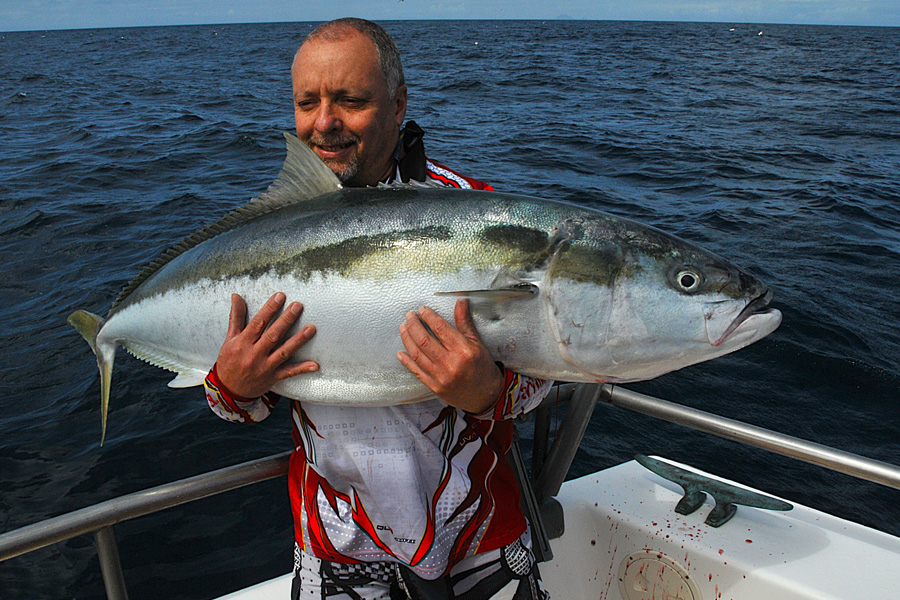
Again, not much is known about kingfish spawning behaviour, but adult kings seem to spawn well offshore around December to January. This lack of knowledge is a good thing as it means that kingfish spawning aggregations are seldom subject to targeted fishing pressure.
Small juveniles with bright blue backs or bold stripes are sometimes encountered offshore in late summer, often hanging under floating objects and slowly working their way into the coast. When they first arrive on the mainland coast at around 30cm in length, kings move around a lot. Then, as they grow, they form numerically smaller schools and seem to settle into specific areas, which they return to each year.
Most fish spawn by their third year, at which time they are about 65–70cm long, although some sources claim 50 percent of females mature at 94cm and 50 percent of males at 81cm.
Tarakihi
Tarakihi are from the morwong family, which includes porae and red moki. There are two species of tarakihi in our waters: the common, and the king tarakihi.
Common tarakihi reach maturity at around 25-35cm in length and four to six years of age. They typically spawn during the late summer and autumn months. Tarakihi are serial spawners and aggregate in specific areas for spawning. Numerous spawning grounds for tarakihi have been reported, with key locations including Cape Runaway to East Cape, Kaikoura to Pegasus Bay, and the west coast of the South Island near Jackson Bay. Other areas including the western Bay of Plenty, Conway Ridge, and possibly the Chatham Islands have also been identified as spawning grounds. Some tarakihi are known to migrate up to 500km from their home range to reach spawning grounds. These spawning aggregations can make the species vulnerable to commercial pressure.
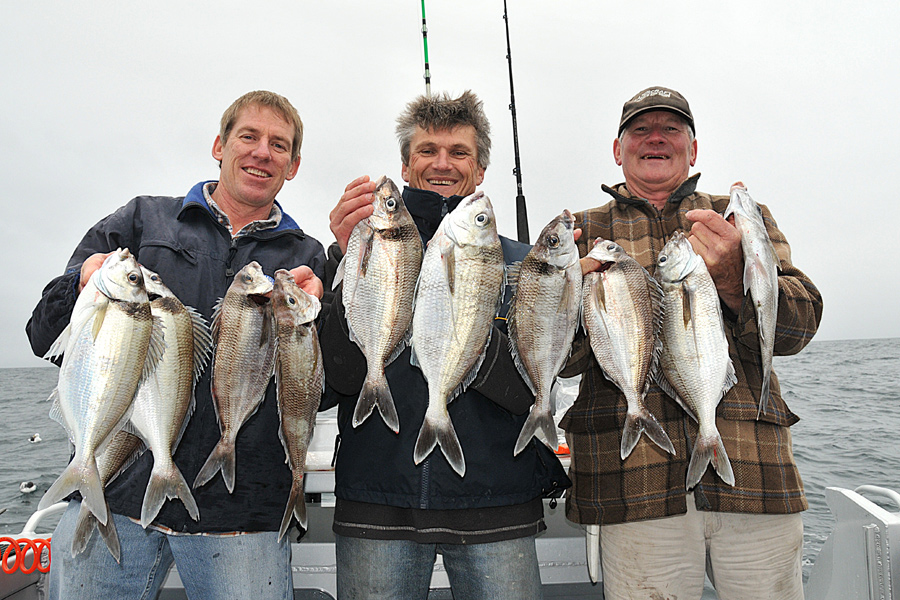
The larval stage is followed by a 9- to 12-month pelagic postlarval stage. Postlarvae then metamorphose into bottom-living juveniles, at a fork length of 70-90mm. Nurseries have been located at depths of 20-100m, usually 10-30km from the shore, although as a kid I used to catch juvenile tarakihi (80-150mm) off the wharf in Napier Port. Fish migrate out of their nursery area in their fourth to seventh year when they attain sexual maturity.
Gurnard
Gurnard are widely spread and are fish of sedimentary bottoms – sand and mud. In the north they are most common in west coast harbours like the Kaipara and the Manukau, and along the coastlines. Their east coast Valhalla would have to be the vast sediment basin of Hawke’s Bay but I have jigged up specimens in the Marlborough Sounds and even some from the shallower parts of Fiordland, where the dark, tannin-stained water has seen their orange colouring (and even their brightly coloured pectoral fins) change to brown and black.
They are common in New Zealand waters from the shallows out to around 150 metres, and consequently they are available to surfcasters, kite and kontiki fishers, small boat anglers and also those fishing greater depths.
They are a curious-looking fish, with a body well adapted to their lifestyle. The head is well armoured with bone plates and acts as an efficient shovel for digging out food from the bottom sediments. The main pectoral is a large fan-like structure which can fold flat against the body. At this stage, nobody except the gurnard seems sure what the purpose of such an over-developed fin is. Are they used for some sort of spawning signal, or to be suddenly opened to frighten predators away? Maybe they have some function in feeding. It’s an interesting puzzle which highlights how little research has been done on these fish.
Red gurnard mature at two to four years old with females reaching maturity a year later than males. North Island fish mature at about 20-33cm, and South Island fish at 25-45cm. Again, little seems to be known about their spawning which appears to be during the spring and summer months, with peak spawning activity occurring in early summer. Spawning grounds are thought to be widespread, and they have a long spawning period that extends through spring and summer in shallow and mid-shelf areas around most of the New Zealand coast.
I fished in Hawke’s Bay for many years over successive Christmas breaks and nearly all the gurnard caught then seemed to be females full of roe. Very few males ever featured in the catch. It set me wondering where all the ‘blokes’ were, and I started keeping an eye on the sex of the gurnard caught. Of the last several hundred I filleted, I only saw a couple of males, both of them the smallest fish of the respective catches for the day. If the catches I checked were representative of the male/female balance in the population, they were going to be busy boys!
This begs the question: does sexual dimorphism occur in gurnard, as in some other fish. That is, do the females grow bigger than the males? Maybe more of the small fish that are caught and returned (or not caught at all with tackle suited to the bigger specimens) are the missing males? If this is so, does the 25cm size limit have the unusual effect of protecting the males and concentrating the harvest on the females – the opposite of what may be desirable?
Snapper
Snapper are easily our most sought-after saltwater species in terms of the numbers of anglers that chase them. Consequently, this is one species that has been well studied, and, unusually, there is quite a good knowledge of snapper spawning.
In spring, as the water starts to warm, snapper begin moving into shallower waters to build up condition for spawning. Favoured spawning grounds are usually large bays, harbours with extensive estuaries, and shallow areas away from reef country (presumably to keep the precious eggs away from the small predatory fish that live there). In these areas, warm stable water is good for the survival of eggs, and estuaries and shallows provide suitable nursery areas for baby snapper. Doubtless Bay, the Bay of Islands, the Hauraki Gulf, the Bay of Plenty and Tasman Bay are good examples.
Snapper spawning takes place in the summer months, starting earlier in the Far North (around October) but becoming more restricted to high summer in southern waters, where the key water temperature for good egg survival – 18°C – occurs for a much shorter period.
When water temperatures reach 16-18°C, snapper school up for spawning, usually drifting in midwater and releasing large amounts of eggs and sperm. These eggs are buoyant and float to the surface. The surviving eggs hatch into larval fish in around 48 hours and head for the shelter of the bottom. After around four to six weeks, the juveniles begin to show up in estuaries and harbours as perfect little miniature snapper of 20–25mm. They find shelter and food for this vital first season in these areas. They become food, too. A kingfish that I once spotted cruising the fringes of Parengarenga Harbour, and subsequently caught, was packed with juvenile snapper around 20mm long.
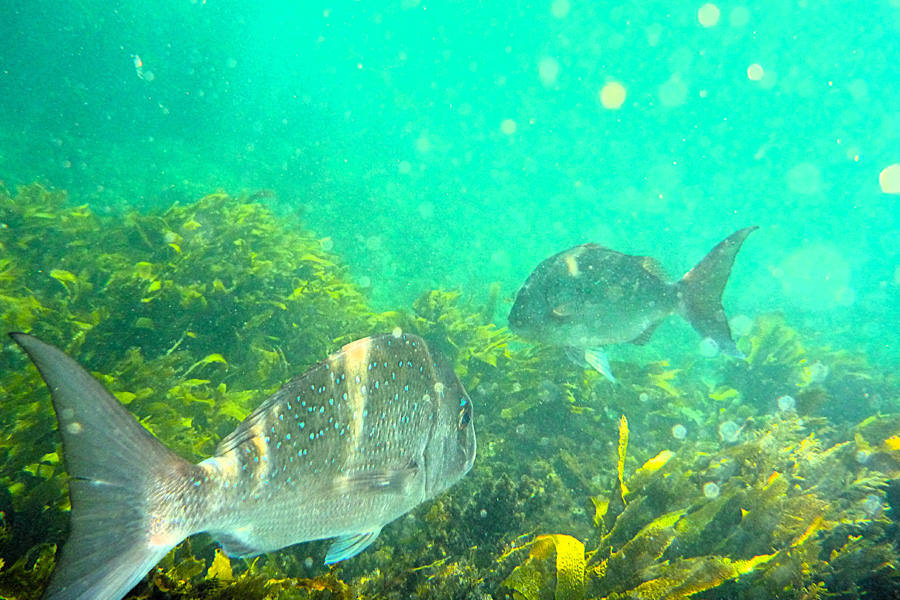
Scientists have found that there is a pretty good correlation between water temperature and snapper spawning success. And although some people have picked up the idea that snapper need 18°C water to trigger spawning, this is not the case. Snapper will spawn at lower temperatures, but temperature has a big effect on snapper egg survival. Eighteen degrees or more ensures that a higher percentage of snapper eggs hatch, and this forms a strong year-class that will be seen in good fishing when these snapper grow big enough to enter the fishery four to five years later. Inshore water temperature over the spawning season is one of the factors used to estimate snapper numbers for following years, for fisheries management purposes.
Snapper are serial spawners; they will spawn several times over the warmer months – probably a safeguard that at least some of their eggs will strike favourable conditions.
I am speculating here, but it seems that higher water temperatures mean better egg survival, stronger year classes and a more robust snapper population overall. If we do get increases of a degree or two in water temperature from climate change this century (as seems likely), it may be a good thing for the snapper fishery, extending the range of these fish further to the south and allowing better spawning success there.
Certainly, the reverse seems true. Archaeologist Foss Leach reports that evidence from the contents of Māori middens laid down during the depths of ‘little ice age’ (1300-1870 with the coldest period 1645-1715) shows that snapper populations withdrew northwards in the warmer North Island waters and pretty much vanished entirely from the cooler South Island during this period. Even today, the further south you go, the cooler the water temperatures are, and the more fragile the snapper stocks are as their spawning may not be overly successful.
While it is true that smaller snapper produce most of the eggs in a given spawning season, this is because they outnumber the big fish hugely. The big, old fish are important breeding stock, producing a huge number more eggs per fish than lesser snapper, and displaying good growth and survival characteristics that need to be passed on genetically. They are more valuable to the future of the species than quite a number of lesser fish.
A snapper, once it becomes a ‘big fish’ of about 20 old-fashioned pounds, is likely to be at least 20 years old. By the time it gets to this age it will be getting cautious in its approach to life, but each year these big fish lose a lot of their natural caution as they gather for spawning. There are spots that can hold a lot of big fish at this time of the year, often in relatively clean country.
There is a temptation for fishers to hit these spawning aggregations hard when the fishing is easy. By all means, take a trophy fish home to wow your family, neighbours and fishing mates. You can have one mounted and hang it on the wall, if you like. But please, don’t butcher a boatload and then expect that those fish, or their progeny, will be there for you and your progeny in the years ahead.
- By Sam Mossman
Recent Forum Posts Visit Forum

Offshore Power Boats - Gulf Harbour 17 Oct
in The Briny Bar32 hours ago
Phantom Menace
The course goes anti-clockwise and turns around the little island (Kotanui / Frenchmans Cap) just off Gulf Harbour. That turn should make for interesting viewing -...

Manukau Harbour & West Coast fishing
in Fishing Reports66 hours ago
smudge
Thats a great catch Schecter, big fish. I'll post up a report from off the coast a bit later on...


Garmin vs Lowrance
in The Boat Shed160 hours ago
Roscoe C
Hi folksI'm looking at upgrading the electronics on my Stabi 1450. I've currently got a Lowrance Eagle 7 which I'm not especially impressed with. In particular...

Shimano 3500 baitrunner
in Buy Sell Trade or Exchange295 hours ago
0nlanders_Nz
Hello, I have come across to on the cash converters website search fishing reels $35 on there...
Manu bay boat ramp
in The Boat Shed300 hours ago
610gc
Hey teamhas any one tried the Manu bay boat ramp since the repairs?Is it any better to use?thank you ...

Out with the "Twelves"
in Fishing Reports304 hours ago
Telecaster
Popped out at about 3:30pm yesterday with a mate, usual zone and method. 10 snapper and 5 gurnard. The biggest snap we got (55cm) was definitely...
Wanted 10500 fin-nor reel
in Buy Sell Trade or Exchange351 hours ago
0nlanders_Nz
I am looking for a fin-nor 10500 fishing reel if any one has, please message me...
Wanted to Buy
in Buy Sell Trade or Exchange374 hours ago
honestbruce
Seen your post and that would work but its not up my alley or ability to make one. Dont have the means to manufacture here in...

Popular Articles

Softbait Fishing - Part 1 - gear selection
John Eichlesheim writes an article about selecting the right equipment for softbait fishing... Read More >
Softbait fishing Pt 2 - tips and tricks
Techniques, tips and tricks of softbait fishing – getting the most from your soft baits.... Read More >

Surfcasting - setting yourself up
Gary Kemsley helps sort out the necessary gear for intending surf fishers.... Read More >

Squid - How to catch them
Squid fishing is a rapidly growing aspect of fishing - Paul Senior shares some hints and tips to get started.... Read More >
Fishing Reports Visit Reports
Canterbury Fishing Report - 01/10/26
Freshwater season underway. Wow, it’s October already, and our freshwater season is underway, and the... Read More >
Top of the South Fishing Report - 01/10/26
Snapper about but not yet firing. It’s certainly nice to see daylight savings upon us... Read More >
Hauraki Gulf Fishing Report 01/10/26
Big reds in the shallows. The weather has made getting out on the water challenging... Read More >
Bay of Islands Fishing Report - 01/10/26
Snapper moving in. A few Pacific bluefin are still gracing the weigh stations with last... Read More >
Comments