
How much are our fish worth?
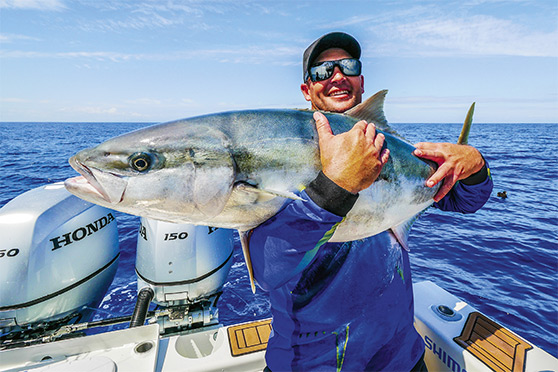
A good percentage of Mangawhai-based charter operator Tony Orton's clients are from overseas. A big advocate of sustainable sportfishing, Tony looks at the value overseas anglers bring to our shores...
I have just finished a four-day, six-night charter with a group of travelling Australians. As the team departed, you could not wipe the grins off their faces, and the great news is they have already booked to do it all over again next year.
I love taking Kiwi’s overseas and showing off some of the world’s best fishing destinations. Likewise, I enjoy overseas anglers coming to fish with me at the Mokohinau Islands. It’s great watching anglers having the time of their lives in our country and it’s also a nice little reminder to my family and myself just how special our fishery is. New Zealand is truly world class and as Kiwi’s we sometimes take it all for granted, forgetting what we have right on our back doorstep.
Sustainable fishing as tourism is big business in New Zealand; we have a world-class freshwater trout fishery in some of the most picturesque locations on this planet. From backpackers, right up to six-star lodges, all accommodate these travelling freshwater fishermen and they flock here by the droves year-round.
In more recent times we have seen a massive trend towards groups of overseas saltwater anglers coming to fish here for the mighty yellowtail kingfish. There are a few select specialised charter operators scattered around New Zealand, catering for and guiding more overseas anglers than Kiwis, targeting our stunning fisheries.
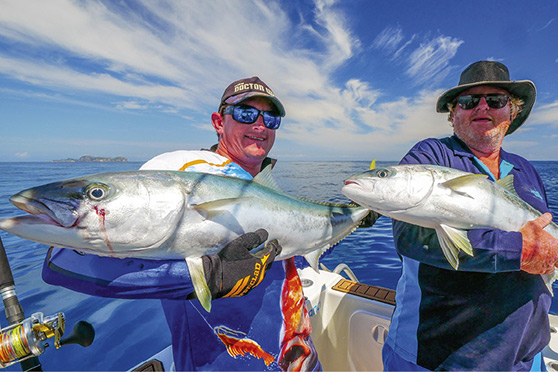
Over a four-day charter, the Aussie anglers took only these two modest kingfish for eating as well as taking home to be shared with their families.
The start of my summer season can be a little frustrating in the area I fish. Every day, looking from my balcony from our lodge in Mangawhai, I see scallop dredgers working followed by purse-seiners scooping up tonnes of jack mackerel, blue mackerel, trevally and kahawai that sadly are in full spawning mode. Just to rub salt in the wound the trawlers move in and give the seafloor a hiding; and the most disheartening thing is to watch the gill netters target the isolated pins around the Mokohinaus and the Hen and Chicken Islands.
The sad thing is, all these precious fish are then mostly exported for cheap protein and bait. This destruction takes place within only a few miles from our beach and some days less than a mile offshore. The talk around town is “I wish they could see what they are doing is not sustainable and hope one day our government could stand up, man up and grow some balls to protect our precious environment and future”. This does not just happen in my hometown, its nation-wide.
I have had countless days while running in from the Mokohinau Islands last spring and early summer feeling depressed as I think to myself “is what I am doing a waste of time”, as I drive past a purse-seiner scooping up tonnes of fish.
My wife Bea and I run a sustainable charter business – we only use non-offset circle hooks so we can release fish in the best condition; we never anchor in order to protect the sea floor; and only troll or drift fish. More importantly, we have self-imposed reduced bag limits that are a lot lower than those MPI sets – one kingfish per angler and take only enough snapper for a good feed.
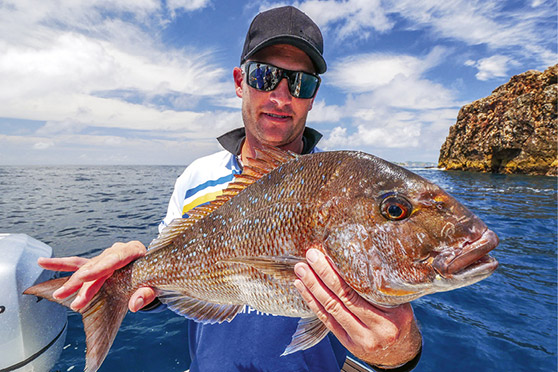
Our iconic species, snapper, are a popular target species for overseas guests.
For the record, I am not against all commercial fishing practises. I have friends that run smart long lining operations that are both sustainable and selectively target quality fish, which are sold in better condition than most commercial catch, and for higher prices, adding value to our economy – more so than other less desirable commercial fishing methods.
Near the end of our four-day Australian charter we started talking about the value of the fish that our guests were keeping and did some calculations to what a kilo of dead fish were worth to our country as opposed to unsustainable bulk-harvested, commercially-caught fish.
The great thing about sensible tourism fishing is that it is 100% sustainable and can be managed with no corruption and corporate greed intervening.
During this four-day trip, we only killed two modest kingfish, ten snapper and one john dory. The crew ate fish each night and what was left over was vacuum-packed to be taken home – even the fish frames were given to local friends. The crew got to take fresh fish back to Australia, along with photos, as a reminder of their fishing adventure this side of the Tasman.
We weighed the fillets while we processed the fish and it worked out to be around 14 kilos in total for four anglers over four days.
Below is a rough estimate of the value of those 14 kilos of sustainably-caught fish:
Airfares for four anglers (Air New Zealand): $2480
Six nights accomodation: $1800
Four day fishing charter: $8000
Car rental: $360
Local bottle store: $520
Local supermarket: $350
Local restaurant: $220
TOTAL: $13,730
TOTAL value of 14kg of fish fillets harvested: $980.71
Hopefully, these guys’ wives never read this article and find out the price of the fillets and trip!
These figures sure start putting the price of being sensible and sustainable into perspective, and starts making us look at the future of our fishery and how we can best utilise it. Compare $980.71 per kilo to $2.00 per kilo for unsustainably purse-seined fish that’s exported. It’s not until you see these numbers you realise our government and Fisheries New Zealand really have no clue to what is going on and the value our fragile fishery has to New Zealanders and international travelling anglers.
Over 60% of my summer charter season is booked out with trips just like this. Talk with skippers like Thomas Maxwell from Mad Max Charters in Whitianga, Carl Muir from Provider based out of Tairua, along with a bunch of other hard-working charter skippers from around the country, and you can see there is a bunch of sustainably-minded operators doing the same thing.
I am not going to give up on our environment until the day I die – I am going to do my best to look after it and educate all around me how precious our stunning New Zealand marine habitat is to us. I just wish our politicians could come out from under their cowardly bed sheets and do the same!
|
|
This article is reproduced with permission of |

Recent Forum Posts Visit Forum

Shane Jones
in Fisheries Management16 hours ago
Tzer
Far cry to the twats at Liegasea/NZSFC were proposing of 5 Tarakihi person in their submission for the central management area and this is what our...

Bluefin Tuna at the cavs.
in The Briny Bar36 hours ago
smudge
Despite my years of fishing I haven't really fished many places, my focus has always been on Auckland's west coast and out toward Great Barrier. I...

Casting gloves
in Popper and Topwater Fishing81 hours ago
Mc Tool
100 bucks for a lure 😬. Watching one of them flying over the horizon without the line attached would be " character building " for sure...
I thought Id post some nice photo's , join...
in The Briny Bar132 hours ago
Alan L
That is a very cool pic Krow.The Far North is very cool, the Far far North even cooler. Mint looking day.Alan...

Mc Tools berley mincer
in The Briny Bar139 hours ago
SaltyC
Good size, they scrap well. Got an 18kg one up in Vava'u back a few years ago fishing off squeaky Going's boat. That was quite a...

Out with the "Twelves"
in Fishing Reports193 hours ago
Pcj
I should be able to get out end of October. The nephew been out virtually every weekend over winter and has done well. It seems the...
Manukau Harbour & West Coast fishing
in Fishing Reports201 hours ago
smudge
Nice work Schecter, I think snapper may be around sooner than you think. Well I am hoping so...

Whangarei Harbour report.
in Fishing Reports633 hours ago
krow
180 +m is where I've had to be lately. A lot less low foul around these parts and some of it shallower that looks like Tarakihi...
Whangarei Harbour Scallops
in Fisheries Management743 hours ago
Pcj
Reopening WhangÄ쳌rei Harbour to recreational scallop fishingTÄ“nÄ쳌 koeFisheries New Zealand is seeking feedback from tangata whenua, stakeholders, and the public on whether WhangÄ쳌rei Harbour should be...
SNA1 Recc fishing cops the blame.
in Fisheries Management839 hours ago
Tzer
What Liegasea won’t tell you is that some of their own fisheries contractors were co-authors of this study for fear of being called hypocrites, one of...
Popular Articles

Softbait Fishing - Part 1 - gear selection
John Eichlesheim writes an article about selecting the right equipment for softbait fishing... Read More >
Softbait fishing Pt 2 - tips and tricks
Techniques, tips and tricks of softbait fishing – getting the most from your soft baits.... Read More >

Surfcasting - setting yourself up
Gary Kemsley helps sort out the necessary gear for intending surf fishers.... Read More >

Squid - How to catch them
Squid fishing is a rapidly growing aspect of fishing - Paul Senior shares some hints and tips to get started.... Read More >
Fishing Reports Visit Reports
Outer Hauraki Gulf Fishing Report 17/09/26
Spring wind the handbrake. Spring is starting to make its presence felt in the outer... Read More >
Top of the South Fishing Report - 17/09/26
Early snapper in Tasman Bay. Well, spring is finally here, and the days are getting... Read More >
Bream Bay Fishing Report - 17/09/26
Good snapper catches reported. After Tangaroa turned off the fish tap for a month or... Read More >
Bay of Islands Fishing Report - 17/09/26
Pacific bluefin tuna for the lucky few. The last fortnight has seen more fishable days... Read More >
Comments