
George Kittow - Giant Black Marlin

George Kittow is a pretty cool dude; he knows how to work a room (or cockpit), sports a few nautical-themed tattoos, carries a cheeky glint in his eye, and has even taken centre stage at a few rap gigs. But the coolest thing he does is hang onto giant black marlin along Australia’s Great Barrier Reef.
George felt a little underqualified for this interview, given he’s only done a couple of seasons as a deckhand over the ditch in Cairns. However, when I caught up with him at Shapiro’s Sports Bar in Auckland during his off-season, he provided a fascinating beginner’s look into an amazing fishery; one that’s a far cry from anything on offer along the gamut of NZ angling options.
Spending four years under the tutelage of Rick Pollock on Pursuit placed George in good stead to head off to Australia in 2019. His first black marlin season was a steep but enjoyable learning curve, and he was ready to do it all again before Covid-19 scuttled his plans. Finally, in 2022 he found himself working the deck of Hellraiser 2 – a Queensland-built O’Brien 43 – once more.

“From September to December, we exclusively run heavy-tackle marlin trips – extended liveaboard charters ranging from four days to two weeks,” says George. “Outside of the black marlin season, Hellraiser 2 runs a variety of other charters targeting reef species, GTs, barras and mud crabs.”
Clients are mainly Australians or Kiwis, supplemented by the occasional American (cha-ching!) or European group. I ask George what a standard day of hunting down goliath black marlin entails.
“We usually don’t start marlin fishing until around midday. The bommies around our anchorages are dangerous to navigate in the dark, and we normally invest three or four hours into catching fresh bait each morning.”
“When baitfishing involves big spanish mackerel, GTs, yellowfin tuna and a variety of other interesting species, most clients love the morning sessions! We sometimes have brekkie at anchor, enjoying the scenery, and often guests like to dive or snorkel in the clear water and spear a few coral trout. There’s normally no rush to get going because it’s well-regarded that there’s an afternoon bite in this fishery.”
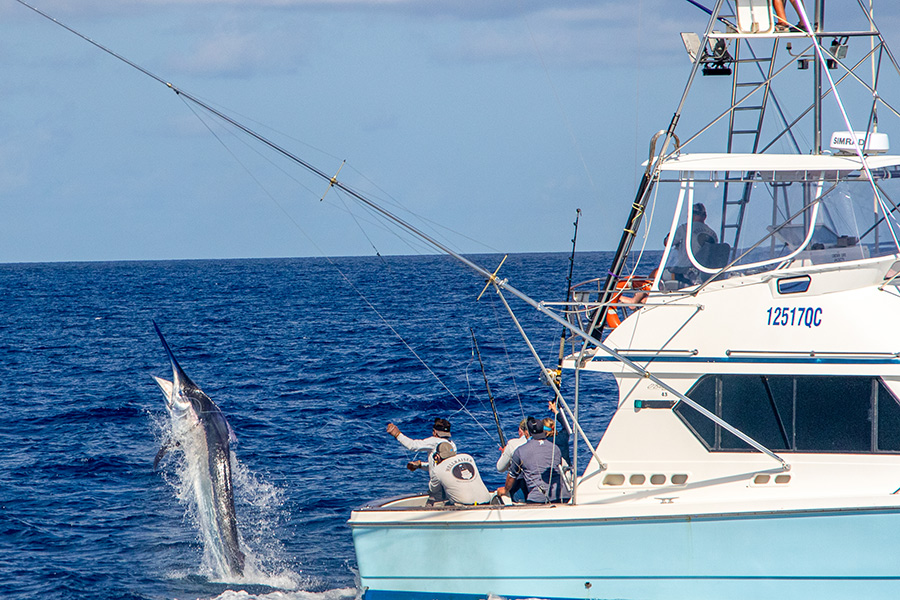
The Cairns black marlin fishery relies on the Southeast Tradewind that pushes the northern current hard onto the edge of the Great Barrier Reef.
“It’s called the fence. That’s where the boats fish and wait for them to come past.”
If the conditions aren’t right, the marlin don’t get concentrated by the reef edge, and boats often run lures to cover more ground.
“When the fence isn’t on, the fishing is more like a needle in a haystack. However, on one of our first days wide of the edge last season, we went three from four, catching two big blues and a black on lures – that was pretty fucking cool.”
When the current pushes fish hard onto the reef edge, fishing deadbaits is the name of the game. George says baits must be big and well-rigged if you’re targeting grander fish.
“We normally run a big skipbait, a small skipbait, and a scad or queenfish swimbait at about five knots. If your deckie doesn’t have a few hand cuts, the baits probably haven’t been rigged properly!”
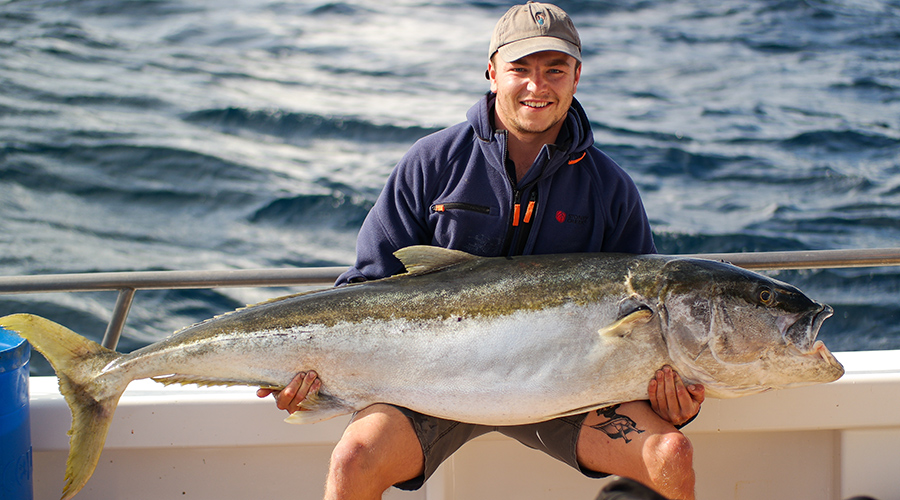
Vessels in the Cairns charter fleet typically run two deckhands. This is because there must be eyes on the baits at all times.
“It’s crucial that someone is always watching the baits. The size of the marlin and how it eats are massive factors in how you try to hook a fish. For example, if it’s a big fish and you see a clean eat, you won’t need much line dropback. The other thing is there are lots of chop-offs – ‘cuda, wahoo and sharks munching the tails off your baits. We might have 20-30 chop-offs on a bad day,” He says.
Because of this, deckies generally hold the rigger halyard to feel if their deeper swimbaits are getting harassed. George notes there are stories of deckies nodding off in this position and tumbling overboard!
Fishing for blacks out from Cairns is more about the size than the number of fish. George says there is a poor hook-up rate on smaller fish due to the big baits and terminal tackle, and it can therefore be tempting to downsize gear. However, when that big fish comes along you need the heavy stuff – typically 700lb leaders and 16/0-20/0 circle hooks.

Once hooked, George says the larger fish have a tendency not to show themselves until the deckhand grabs the leader.
“At that stage, you don’t know if a 700-pounder or a 1,000-pounder is gonna jump out of the water.”
George is coy about how many granders he’s seen. There’s a saying in Cairns: ‘If you don’t weigh it, don’t say it.’
“You’ll often hear ‘950-plus’ over the radio – this is the way to tell the fleet you got a fucking big marlin without sounding like a dickhead,” adds George.
Whether big fish are released is totally down to the anglers, although most captains are more than happy to string up a grander.
I asked George about his nerves when grabbing the leader on such large fish.
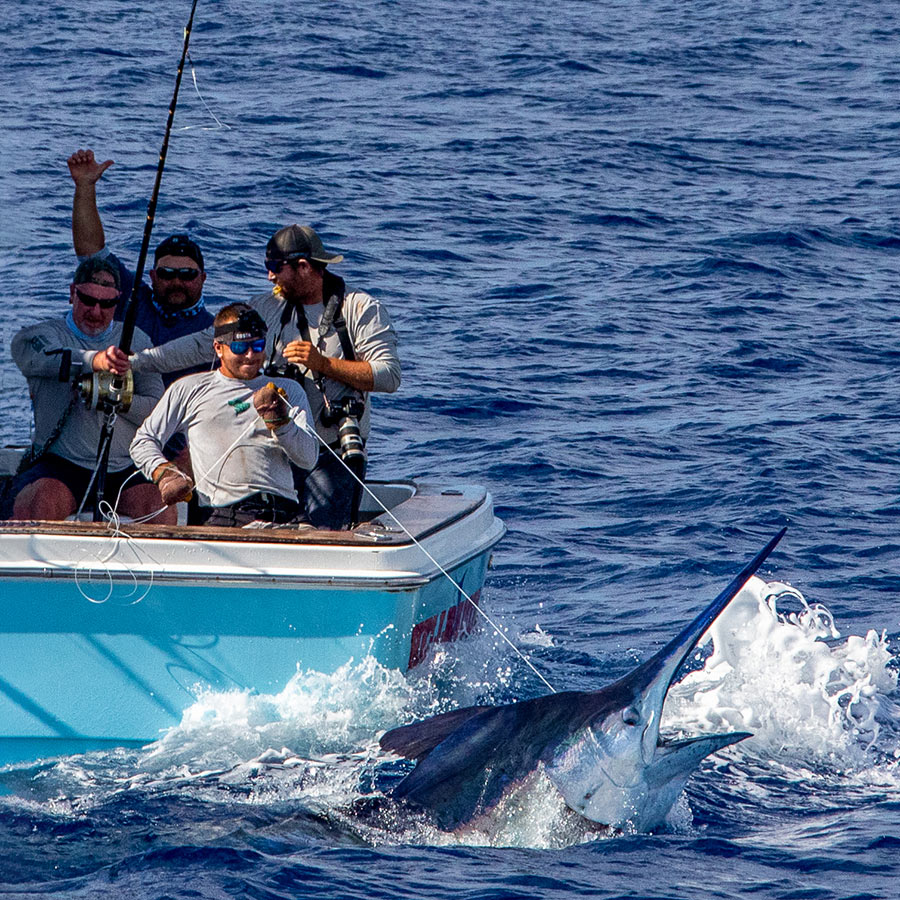
“I was shitting my pants my first time. Even now, I’m never not nervously excited. On a big fish, there’s so much weight, but they’re predictable because they move slowly, and there’s plenty of colour in the water to follow.”
Trusting your wraps on the leader is crucial, and George had to learn the backwrap technique that allows a first wrap to be taken without fighting against the pressure of the fish.
The leader is cut when the wireman is comfortable with the wraps, and this is when fish are deemed caught. Released fish are rarely tagged, either. George says this is not only down to the difficulty of getting monster fish alongside the boat but also because they’re racing the sharks.
“There’s no way you could tire out a big fish for hours along the reef. The amount of sharks makes Shearer’s Rock in the Hauraki Gulf look like a joke!”

March 2023 - Nick Jones
New Zealand Fishing News Magazine.
Copyright: NZ Fishing Media Ltd.
Re-publishing elsewhere is prohibited
Popular Articles

Softbait Fishing - Part 1 - gear selection
John Eichlesheim writes an article about selecting the right equipment for softbait fishing... Read More >
Softbait fishing Pt 2 - tips and tricks
Techniques, tips and tricks of softbait fishing – getting the most from your soft baits.... Read More >

Surfcasting - setting yourself up
Gary Kemsley helps sort out the necessary gear for intending surf fishers.... Read More >

Squid - How to catch them
Squid fishing is a rapidly growing aspect of fishing - Paul Senior shares some hints and tips to get started.... Read More >
Fishing Reports Visit Reports
Raglan Fishing Report - 12/11/26
Big spring snapper. With the more settled weather over the last couple of weeks there’s... Read More >
Mercury Bay Fishing Report - 12/11/26
Snapper hit and miss. Most reports have been telling us it’s becoming more difficult to... Read More >
Northland Fishing Report - 12/11/26
The switch has been flicked on! Call it what you want, El Niño, global warming,... Read More >
Tauranga Fishing Report - 12/11/26
Snapper and kahawai in close. Again, we start on a positive note, with some nice... Read More >
Comments