
Gannets and Finding Fish

There’s no doubt that birds are great indicators of life at sea, and it’s a comfort when seeking our own fishy meal to encounter any form of seabird. However, as Sam Mossman discusses, one species is particularly regarded as a fish indicator by most anglers – the gannet.
A wide range of marine electronics can aid fishers in their pursuit of fish. For example, my modest Fish City 430 (4.4m) tinny has a small Lowrance Elite 4X HDI chart plotter and sounder. Still, even this features high-tech applications like Hybrid Dual Imaging – Broadband Sounder plus DownScan, with overlay – and TrackBack to review recorded sonar history, allowing me to put a GPS marker back on fish that I have already passed. Although I have these near-magical electronic devices at my command, I would still only be half a fisherman if I didn’t know and use natural signs to find fish. One of the most important of these markers is seabirds.
Several weeks ago, during a rare fine break, my regular fishing buddy Mike and I ventured out for a fish near my home in the northern Hauraki Gulf. With long stretches of bad winter weather and increasingly higher grocery prices, the freezer was devoid of fish and so we were looking forward to a bit of fresh snapper. It was midwinter, and with regular heavy rain, the local rivers had been pushing out plenty of fresh water, so I expected to work to get a few fish. I don’t mind this situation as I enjoy the challenge of putting together a catch when times are tough.
As predicted, fishing was slow initially, with only one modest snapper in the bin by midmorning. We were considering switching from soft-baits to strayline and berley when my sharp-eyed mate spotted some bird activity in the distance. We raced over to the area and found a mix of terns, petrels, and a few gannets hammering schools of small baitfish that may have been whitebait.
Fishing a mix of softies, small slow-pitch jigs and sliders around the melee, we quickly made up for our slow start. The predators were a mixed bag, including schools of rat kingfish. It was hard to avoid hooking them, and although they fought like tigers on our light spin gear, none were legal-sized. Fortunately, there was a mixed bag of other species working the bait too – at one stage, I caught a king, a snapper, a koheru and a trevally in four consecutive casts.
We pulled the plug just after midday after a great morning’s fishing action and with a bin of pannie snapper and trevally for the table – all thanks to the seabirds showing us where the fish were. Following the birds made a big difference to our results that day, but how do birds locate their food in a seemingly limitless ocean?
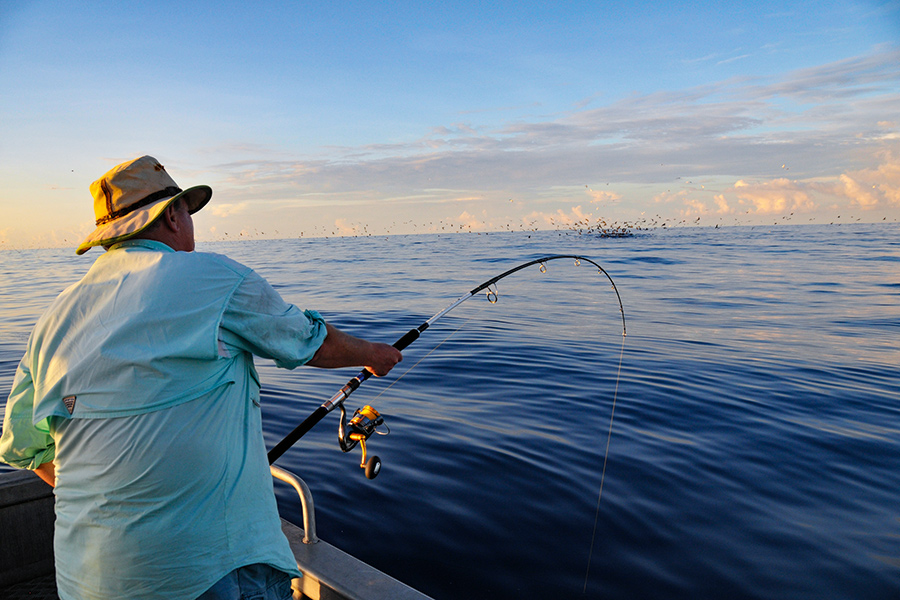
Throwing a stickbait into this bird-marked offshore workup resulted in a solid yellow-fin tuna hook-up.
See food and eat it
While many seabirds rely on a super sensitive sense of smell to locate food, others such as gannets rely on their eyesight to find food, and some have special adaptations to enhance vision when hunting. For example, some produce red or yellow oil droplets in the colour receptors of their eyes to improve distance vision – especially in hazy conditions – in the same way we humans use amber sunglasses.
Gannets are visual feeders and, unlike most birds, have binocular vision – their eyes are positioned to see forward with both. This adaptation probably allows them to estimate how far the fish are from the water’s surface. In addition, they have a dark patch around their eyes to help cut glare, as well as the ability to adapt their most effective eyesight function from ‘air’ to ‘water’ mode in a split second as they dive, effectively blocking out ultraviolet light reflection that distorts the position of darting prey.
The gannet’s feeding method is spectacular. Once they spot their prey, they can make amazing high-speed dives, folding their wings and hitting the water at speeds of up to 145kph, reaching depths of 20m, then pursue their prey further by swimming with their wings and large webbed feet. To withstand the shock of hitting the water at high speed, gannets have strongly built skulls, streamlined bills with no nostril holes, and upper and lower bills that fit tightly together to reduce water being forced into their mouths upon hitting the water. A gannet’s streamlined body also has a system of air cells between the skin of its neck and shoulders and the muscle beneath. As the gannet prepares to dive, these air cells are inflated to cushion its body when it strikes the water at high speed.
Even so, the impact of repeatedly hitting the surface at speed takes a toll; old gannets eventually go blind and, unable to hunt, they die. I have also found the odd dead bird that seems to have struck something hard, like maybe a dolphin or another gannet, and injured or killed itself. It’s a tough life out there!
Body language
In addition to their strong visual acuity, these birds also take cues from feeding predatory fish and mammals (dolphins, whales, and seals) and watch other birds – especially other gannets. Like vultures on the African Veldt, they spread out when searching for food and also watch each other. If their neighbour disappears or dives (their plummeting black-and-white bodies are easy for other birds – and anglers – to spot), they fly over to investigate.
Feeding gannets are always worth checking out. The height of their dive is proportional to the depth they penetrate, indicating how deep the baitfish are swimming. Sometimes gannets will sit on the surface and dip-feed on schools of pilchards, anchovies, or other baitfish driven to the surface by predators. When they start to wheel and ‘tower’ over a spot, it signals that the predators are chasing baitfish towards the surface, so get there fast!
It also pays to watch the head attitude of flying birds. If their heads are down, they may be watching fish. If their heads are up, they are usually just travelling (this applies to other bird species too). If all the birds are travelling in one direction in the morning, they are usually heading to an area of activity. It may be worth your while to follow them, although there is the chance that the active area is a considerable distance away (maybe further than you want to travel).
Gannets are a prime fish indicator, feeding mostly on baitfish like pilchards, anchovies, piper, saury, and mackerel. Sometimes found in numbers as far south as Fiordland, they are usually associated with tuna of various species, schooling kahawai and kingfish, and snapper schools in the north. North of East Cape, gannets are a key indicator for those jig fishing for snapper, and switched-on skippers put a lot of effort (and fuel) into locating and following gannets – particularly in the Hauraki Gulf.
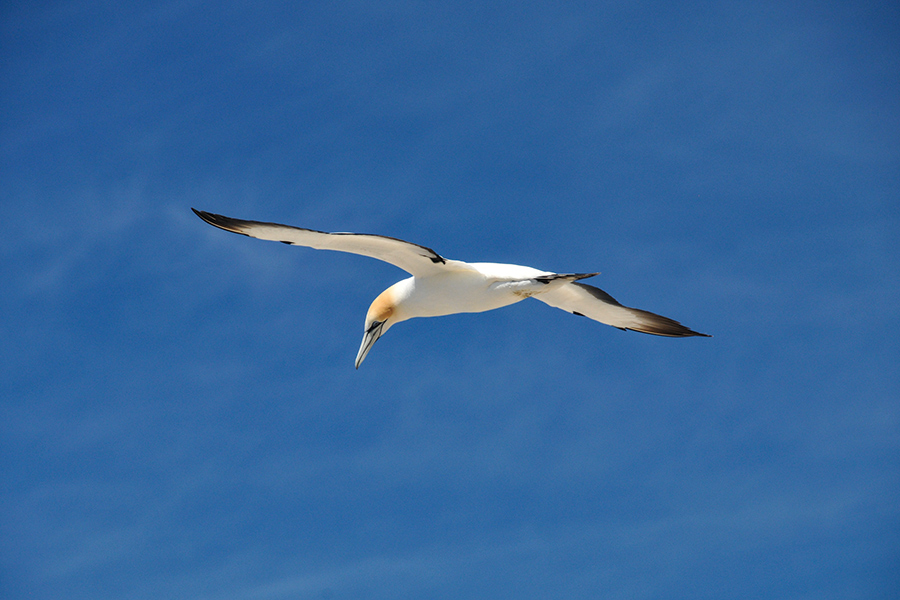
A head-down attitude means gannets may be watching baitfish.
It’s a hard life
Besides their valued aid in locating fish, Australasian gannets have a fascinating life history. There are three accessible mainland breeding colonies – Cape Kidnappers, Muriwai, and Farewell Spit – and over 20 offshore gannetries. The largest breeding colonies are those on the Three Kings Islands, Gannet Island, and White Island. The birds live all around New Zealand’s coastal waters, especially north of Cook Strait.
It is nice to see that gannet numbers in New Zealand increased markedly during the second half of the last century, from an estimated 27,000 breeding pairs in the first census of 1947 to 46,000 in the 1980–81 count. Although I could not find any more recent figures, many colonies seem to be increasing in size and the national annual increase is thought to be about 2%. New Zealand is home to 87% of the total population of adult birds, the rest breeding in Australia. It is great to see such a charismatic bird doing so well. Several programs are underway using gannet decoys and an audio system playing gannet colony sounds to entice gannets to breed in pest-free enclosures and start new colonies.
Despite this, the species’ success is probably more about what humans haven’t done. Although early Māori took the chicks for food and the adults for their feathers and bones, and Sir Joseph Banks (in his diary of Cook’s voyages) reports he shot three gannets in New Zealand waters on 24 December 1769, gannets have seldom been interfered with by humans.
Indeed, protective measures are often taken, especially at mainland colonies like Muriwai, Cape Kidnappers, and Farewell spit, and many other colonies are on offshore islands or rocks where the difficulty of access affords natural protection. And, as they mainly feed on live fish and squid, gannets avoid endangerment from many human-caused issues like plastic, nets, and longlines that take their toll on other seabird species. Nature is harsh enough. A cyclone in 1997 nearly wiped out the Farewell Spit colony, and volcanic activity at White Island regularly trims back numbers.
Even their lifecycle exacts quite a toll. The chicks are fledged at four months and then undertake their big OE. Without any previous flight practice or adult supervision, and with no previous experience having to seek out their own food, the young birds fly 2,740 kilometres across the Tasman Sea to the east coast of Australia. The epic journey typically takes eight to 14 days, depending on the weather and wind.
Juvenile birds remain in Australian waters for two or three years, returning to their hatching site in New Zealand. The two-way journey is fraught with dangers and has a high mortality rate. In a good year, only about a quarter of these birds safely return to New Zealand. They don’t migrate again. Fortunately, gannets are long-lived, some surviving 30 years, so they get plenty of years to breed.
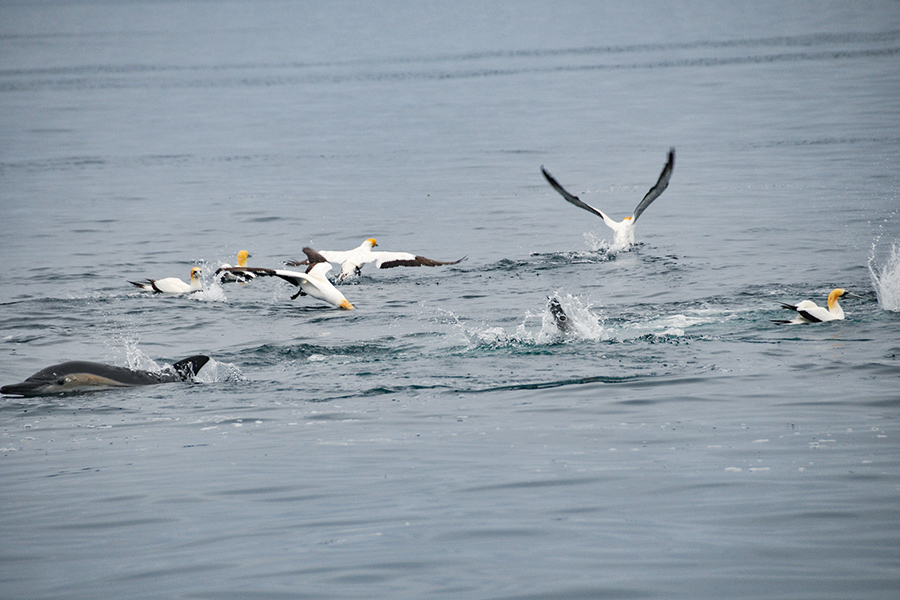
Gannets sometimes dip-feed at the surface on baitfish driven up by dolphins and other predators.
What goes around comes around
So, the birds watch the fish, and we watch the birds. Some fishermen take it a step further and use electronic aids to watch the birds. Some large boats have used ‘bird radar’ for many years to pick up workups many miles beyond the range of human vision. This high-resolution radar system incorporates a beam angle directed above the surface clutter. The large, high-diving gannets are particularly helpful to those using this system. Now, new small-ship systems have made bird radar more accessible to owners of smaller vessels. I have fished with several skippers who have told me they can locate workups by radar at distances of up to about eight kilometres, completing the link between natural and technological methods of finding fish.

October 2022 - Sam Mossman
New Zealand Fishing News Magazine.
Copyright: NZ Fishing Media Ltd.
Re-publishing elsewhere is prohibited
Recent Forum Posts Visit Forum

Shane Jones
in Fisheries Management1 hour ago
Fish Addict
The recreational sector can expect no favours from politicians. They know all too well who butters their bread and it ain't the recs. No different over...

Foton tunland v9
in The Briny Bar1 hour ago
Ho Dee
not fishing related and delete if required but was wondering if any has one of these or someone who has just wanting so e real world...

Trailer wheel clamp
in The Boat Shed2 hours ago
Pcj
Doesnt dry out like crc.I use it on my trailer lock...

Bluefin Tuna at the cavs.
in The Briny Bar48 hours ago
smudge
Despite my years of fishing I haven't really fished many places, my focus has always been on Auckland's west coast and out toward Great Barrier. I...
Casting gloves
in Popper and Topwater Fishing93 hours ago
Mc Tool
100 bucks for a lure 😬. Watching one of them flying over the horizon without the line attached would be " character building " for sure...
I thought Id post some nice photo's , join...
in The Briny Bar144 hours ago
Alan L
That is a very cool pic Krow.The Far North is very cool, the Far far North even cooler. Mint looking day.Alan...

Mc Tools berley mincer
in The Briny Bar151 hours ago
SaltyC
Good size, they scrap well. Got an 18kg one up in Vava'u back a few years ago fishing off squeaky Going's boat. That was quite a...
Out with the "Twelves"
in Fishing Reports205 hours ago
Pcj
I should be able to get out end of October. The nephew been out virtually every weekend over winter and has done well. It seems the...
Manukau Harbour & West Coast fishing
in Fishing Reports213 hours ago
smudge
Nice work Schecter, I think snapper may be around sooner than you think. Well I am hoping so...

Whangarei Harbour report.
in Fishing Reports645 hours ago
krow
180 +m is where I've had to be lately. A lot less low foul around these parts and some of it shallower that looks like Tarakihi...
Popular Articles

Softbait Fishing - Part 1 - gear selection
John Eichlesheim writes an article about selecting the right equipment for softbait fishing... Read More >
Softbait fishing Pt 2 - tips and tricks
Techniques, tips and tricks of softbait fishing – getting the most from your soft baits.... Read More >

Surfcasting - setting yourself up
Gary Kemsley helps sort out the necessary gear for intending surf fishers.... Read More >

Squid - How to catch them
Squid fishing is a rapidly growing aspect of fishing - Paul Senior shares some hints and tips to get started.... Read More >
Fishing Reports Visit Reports
Outer Hauraki Gulf Fishing Report 17/09/26
Spring wind the handbrake. Spring is starting to make its presence felt in the outer... Read More >
Top of the South Fishing Report - 17/09/26
Early snapper in Tasman Bay. Well, spring is finally here, and the days are getting... Read More >
Bream Bay Fishing Report - 17/09/26
Good snapper catches reported. After Tangaroa turned off the fish tap for a month or... Read More >
Bay of Islands Fishing Report - 17/09/26
Pacific bluefin tuna for the lucky few. The last fortnight has seen more fishable days... Read More >
Comments