
Gamefishing History
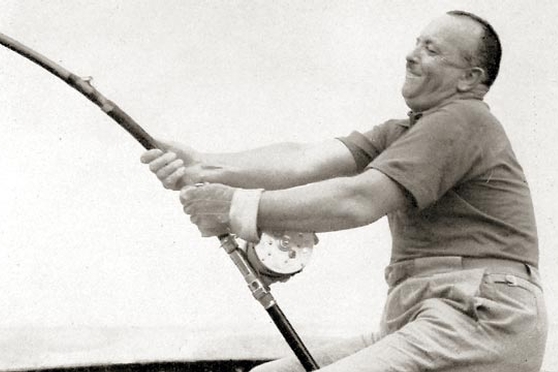
Around the time of the first rod-and-reel marlin capture in 1915, tackle was typically based on up-sized salmon gear with centre-pin ‘Nottingham’ reels. Game fishing rods were 2.1 to 2.5m (7-8’) long with soft-actions; initially split-cane imports from England, they often incorporated a steel core. When anglers were looking for a local substitute for expensive split-cane rods, they initially tried manuka, but tanekaha proved to be better. Many rods were made from this locally-sourced timber, bound with a few large guides and a tip, and finished with spiral leather or cord grips.
These rods may have looked a bit crude, but tanekaha is a timber to be reckoned with (translated to English, ‘tanekaha’ means ‘strong man’). Also called celery pine, tanekaha is found about as far south as Taranaki, and the timber is straightgrained, strong, white and dense. In fact, it is one of the most elastic timbers in the world and able to withstand extreme bending without breaking. It was highly sought after for special applications, including ladders, mine props, bridge building, ship masts, archery bows and fishing rods.
To make rods, saplings were cut out of the bush and submerged in a stream for several months to flush the sap out of the wood. Next, they were soaked in linseed oil for a month before a reel seat, guides and tip were fitted. Prepared tanekaha ‘blanks’ could be bought at tackle stores for 10 to 20 shillings. Later, imported hickory rods also became popular.
Fishing line was mostly 54-thread (180lb/82kg breaking strain) or 39-thread (130lb/60kg b/s). In later years 24-thread (80lb/37kg b/s) became more popular as the quality of lines improved and Dacron arrived on the scene. These ‘cuttyhunk’ twisted linen (flax) lines were high maintenance: they had to be removed from the reels, washed and then dried after every use so they didn’t rot.
The initial 2-2.5m (6-8ft) wire leaders used for kingfish were soon found to be inadequate for billfish and were replaced by 6-9m (20-30ft) of wire cable (no mono in those days). Treble hooks were widely used, resulting in a lot of foul-hooking and gut-hooked fish, giving a poor fight. Single hooks became commonly used after 1928.
American know-how
Compared to this was American-style tackle, originally devised for their tarpon fishery and further developed for marlin fishing at Catalina around 1900. The reels were larger capacity, with mechanical braking and fished on top of a shorter, more powerful (often hickory) rod.
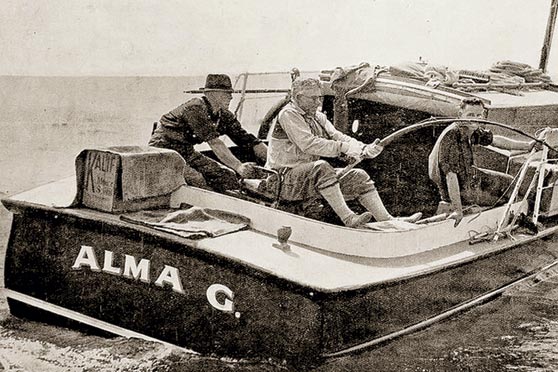
While Zane Grey, who fished the Bay of Islands at the invitation of the government in 1926, claimed to have introduced this style of equipment to New Zealand: “not until my first visit in 1926 had any other kind been used…”, the quiet Kiwi, Charles Alma Baker (who initiated Grey’s first visit), had the same background as Grey in the techniques and tackle developed in the Catalina fishery around 1900. He had plenty of money to buy the best gear and seems to have beaten Grey by introducing it to New Zealand’s game fishery, using the gear in 1923, three years prior to Grey’s visit.
In fact, Baker must have been quite a diplomat. Without fanfare he seems to have spent several years introducing the Americanstyle tackle (geared reels mounted on top of short, powerful rods) and techniques (trolling and tease and switch) to local anglers. But instead of hitting them between the eyes with it, he quietly let them see the advantages for themselves.
Then along comes the Zane Grey dog-and-pony show, with three truck-loads of equipment, his paid fishing companion, his cameramen, his secretary (one of his mistresses – he left his wife back in the USA) and a possie of NZ government facilitators.
Grey was not very tactful and was not slow to let local anglers know how wrong, ineffective and unsportsmanlike he thought their gear and techniques were. While Grey was eventually proved right about the Catalina tackle and techniques being superior, as history shows, his attitude certainly managed to get up many of the locals’ noses at the time.
Although not unfamiliar with the trolling, teasers and even teaseand- switch techniques favoured by Grey (and Baker), most of the locals preferred to drift with the tide or wind, fishing a live or dead bait under a breakaway float. Kahawai and trevally were popular baits, and floats were mostly rubber balloons, sealed 1lb tins, or cork blocks. The baits were usually fished ten or fifteen fathoms (20-30m) down, and many boats were fitted with rudimentary livebait tanks.
The locals considered drifting to be more successful than trolling, but the reason was probably also partly to do with conserving fuel. ‘Benzene’ was expensive and anglers on charters had to pay for it on top of the flat charter rate.
Early techniques
Once a fish took the bait, a long drop-back was given so it could be swallowed (the fish were also often foul hooked by the large treble hooks used). Then the boatman would start the engine, which was much more involved than just turning a key and could take a bit of time. If the angler hadn’t been spooled by then, they would follow the fish. The long, soft rods of the day could apply little pressure (although the line drag was much greater than that produced by modern lines) and it was a case of following the fish until it gave up.
Local boats seldom fished further out than the Bird Rock-Cape Brett area, as they were slow, fuel was expensive, and there were plenty of gamefish inshore in those days.
A little later, trolling started to become more popular. TE Donne, the author of the 1927 book Rod Fishing in New Zealand Waters reported: ‘Depending on conditions they would drift or troll. If trolling, either a hook is passed through the jaws of the bait fish which is trailed astern at five knots. A variation is to trail two Tarporinos (the popular teaser of the day), one from each side of the launch, fastened to rods or props set at right angles to the hull, set at 50 or 60-feet back.
‘The angler is harnessed up and sits in the chair with his baitfish impaled through the muscles or skin of its back. When a marlin rises and begins to play with one of the Tarporinos, the bait is dropped over the side. As soon as the marlin becomes more interested in the bait than the Tarporinos, the latter are pulled out of the way.’
Baker’s 1937 book A rough Guide to New Zealand Big Game Fishing also shows a 150mm (six-inch) bridle rig being used to troll kahawai baits.
Early trolling was done straight off the rod tip. Local skippers, the Arlidge Brothers, experimented with single outriggers on their boats in 1937, and paired outriggers were formally introduced into New Zealand by Michael Lerner, the then IGFA President, while on the association’s New Zealand Scientific Expedition in 1939.
The final chapter
Somehow Baker managed to keep a fairly low profile through the controversy Grey caused in 1926, trying to support his guest in the press (after all, he had been quietly pushing the same message for several years himself) but seemingly staying out of the wasps’ nest Grey had stirred up with many of the locals. There is no record of Baker and Grey ever falling out, but I imagine the reserved Baker must have been cringing a bit over some of Grey’s behaviour.
However, intensely patriotic, he sucked it up for the future good of the country.
Grey and his party had some great action and subsequently returned to New Zealand to fish three more times in later years, but kept a lower profile. And ultimately the American methods and tackle won the day. Although drift fishing was still practiced in Mayor Island waters into the 1960s, trolling has been the norm in New Zealand fisheries for many years now. Grey’s Book Tales of the Anglers El Dorado: New Zealand became a best seller and, as the New Zealand government and Baker had hoped, attracted hordes of foreign anglers and lots of tourist dollars to these shores.
Grey’s name still lives in legend around the world, but the quiet Kiwi, Charles Alma Baker, while awarded a CBE and well-regarded for a wide range of good works, is rather less well known. Yet, from a fisherman’s perspective, perhaps natural justice prevailed in the end.
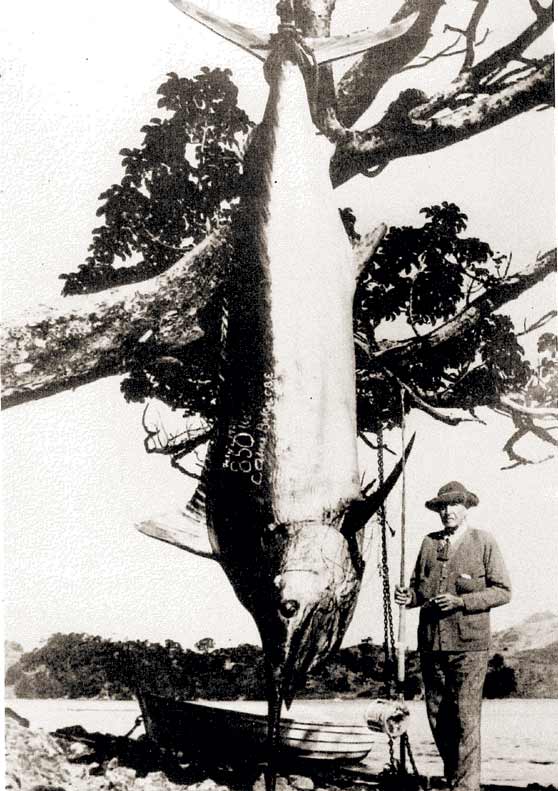
Baker continued to fish the Bay of Islands for a number of years with his friend and skipper Stan Adamson on the Reliance. Although he had enjoyed plenty of successes, he’d never caught the really big fish anglers dream of. Then, in February 1937, at the age of 80, he finally hooked his dream fish.
He battled it for 2.5 hours and it jumped 25 times before being brought to the boat. The huge black marlin weighed 385.6kg (850lb), was the heaviest for the season, and at the time the third-heaviest ever caught in the Bay of Islands. It was nearly 150 pounds (68kg) heavier than Grey’s best black from back in 1926, and an incredible catch by an 80-year-old. Men of iron indeed!
As mentioned, that year Baker privately published a slender volume A rough Guide to New Zealand Big Game Fishing which had a very limited print run (about 300 I believe), and despite being only 28 pages is now highly valued by collectors as a snapshot of fishing techniques at the time. Baker’s last game fishing season was in 1940 and he died in 1941. In 2006, 65 years after his death, Charles Alma Baker was, rightly, inducted into the IGFA Hall Of Fame.
|
|
This article is reproduced with permission of |

Recent Forum Posts Visit Forum

Shane Jones
in Fisheries Management1 hour ago
Fish Addict
The recreational sector can expect no favours from politicians. They know all too well who butters their bread and it ain't the recs. No different over...

Foton tunland v9
in The Briny Bar1 hour ago
Ho Dee
not fishing related and delete if required but was wondering if any has one of these or someone who has just wanting so e real world...

Trailer wheel clamp
in The Boat Shed1 hour ago
Pcj
Doesnt dry out like crc.I use it on my trailer lock...

Bluefin Tuna at the cavs.
in The Briny Bar48 hours ago
smudge
Despite my years of fishing I haven't really fished many places, my focus has always been on Auckland's west coast and out toward Great Barrier. I...
Casting gloves
in Popper and Topwater Fishing93 hours ago
Mc Tool
100 bucks for a lure 😬. Watching one of them flying over the horizon without the line attached would be " character building " for sure...
I thought Id post some nice photo's , join...
in The Briny Bar144 hours ago
Alan L
That is a very cool pic Krow.The Far North is very cool, the Far far North even cooler. Mint looking day.Alan...

Mc Tools berley mincer
in The Briny Bar151 hours ago
SaltyC
Good size, they scrap well. Got an 18kg one up in Vava'u back a few years ago fishing off squeaky Going's boat. That was quite a...
Out with the "Twelves"
in Fishing Reports205 hours ago
Pcj
I should be able to get out end of October. The nephew been out virtually every weekend over winter and has done well. It seems the...
Manukau Harbour & West Coast fishing
in Fishing Reports213 hours ago
smudge
Nice work Schecter, I think snapper may be around sooner than you think. Well I am hoping so...

Whangarei Harbour report.
in Fishing Reports645 hours ago
krow
180 +m is where I've had to be lately. A lot less low foul around these parts and some of it shallower that looks like Tarakihi...
Popular Articles

Softbait Fishing - Part 1 - gear selection
John Eichlesheim writes an article about selecting the right equipment for softbait fishing... Read More >
Softbait fishing Pt 2 - tips and tricks
Techniques, tips and tricks of softbait fishing – getting the most from your soft baits.... Read More >

Surfcasting - setting yourself up
Gary Kemsley helps sort out the necessary gear for intending surf fishers.... Read More >

Squid - How to catch them
Squid fishing is a rapidly growing aspect of fishing - Paul Senior shares some hints and tips to get started.... Read More >
Fishing Reports Visit Reports
Outer Hauraki Gulf Fishing Report 17/09/26
Spring wind the handbrake. Spring is starting to make its presence felt in the outer... Read More >
Top of the South Fishing Report - 17/09/26
Early snapper in Tasman Bay. Well, spring is finally here, and the days are getting... Read More >
Bream Bay Fishing Report - 17/09/26
Good snapper catches reported. After Tangaroa turned off the fish tap for a month or... Read More >
Bay of Islands Fishing Report - 17/09/26
Pacific bluefin tuna for the lucky few. The last fortnight has seen more fishable days... Read More >
Comments