
Flyfishing with rubber legs
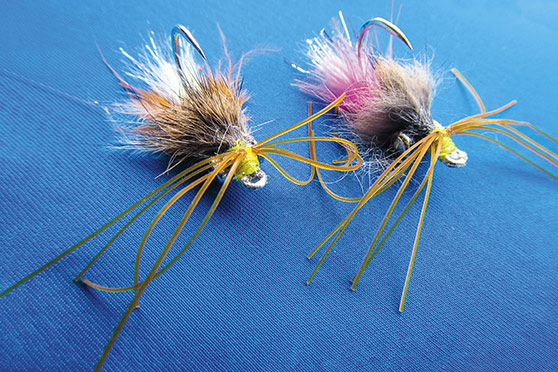
Silicone rubber legs tied into flies are all the rage these days, tempting both salt and freshwater species. Craig Worthington shares his frustrations, failures and successes with silicone appendages…
Flies with silicone rubber legs have wriggled their way into virtually every corner of fly tying and can now be found across the full spread of fish-catching flies, from trout-tempting damsel nymphs to GT-teasing monstrosities. And yet there are a variety of opinions out there regarding their use. Some claim they’re an unnecessary and annoying gimmick, while others insist that they’re an essential part of many flies. So where lies the truth?
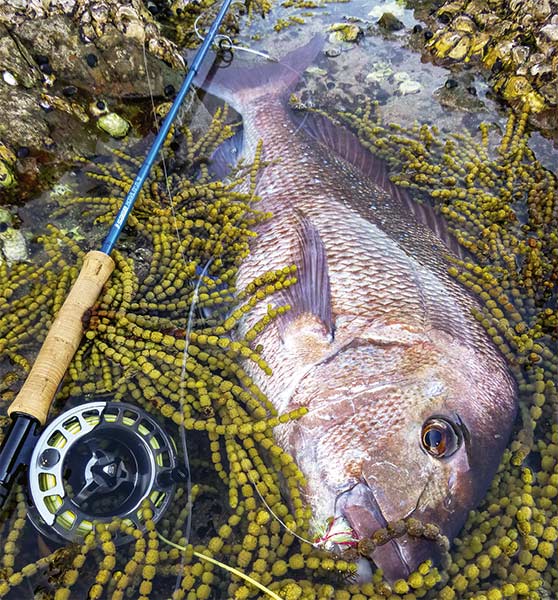
I personally have had an on-again off-again relationship with silicone rubber legs. Despite catching my personal best landbased ‘pure-fly’ snapper on a ghastly fur fly creation that had six prominent red and black barred silicone legs, I didn’t go on to become a rubber leg fan. They were fiddly to work with and slowed me down considerably at the fly-tying bench. I told myself that I just got lucky with the red legged creation that caught the big snapper and that they wouldn’t make much difference to my future fishing success. You could say I mentally constructed an ‘easy way out’.
The trouble I had with rubber legs was they hung up a lot on the bend of the hook or tangled themselves in other materials on the fly. They also seemed to be devils of things to position in the exact spot I wanted them. I seemed to be very good at creating deformed ‘critter’ flies with legs that pointed in a whole variety of random directions.
As a result, I gave up on the damn things completely. Life was easier that way. The only difficulty came when I decided to embark on an overseas trip in search of permit and golden trevally.
Both species were said to respond well to crabby/shrimpy flies that moved slowly on the bottom. As such, many of the flies I would be casting at them would benefit from having the addition of silicone rubber legs.
Indeed, a quick search of ‘permit flies’ on the internet revealed a whole host of loosely themed ‘crustacean’ flies that used, in some way or another, a wide range of silicone legs. If I was to have any chance of connecting with a permit it seemed I would have to move boldly forward into this fly-tying space.
The only other option was to tie crab flies. Every second internet page on catching permit mentioned crab flies, crab flies and more crab flies. Crab flies are even harder to tie than rubber legged flies in my opinion. If you can’t tie them well, they are a hard fly to have confidence in. The rubber legged fly concept at least gave me a direct path away from this conundrum.
Rubber legged flies are, it appears, more ‘variable imitators’ rather than direct prey-item recreations. To be truthful, of the many different types of rubber- legged flies I looked at on the internet, not one of them looked anything like any creature I have ever seen in the ocean. And yet fish eat rubber legged flies all the time. This definitely says something about how much life-like action rubber legs deliver to the fly.
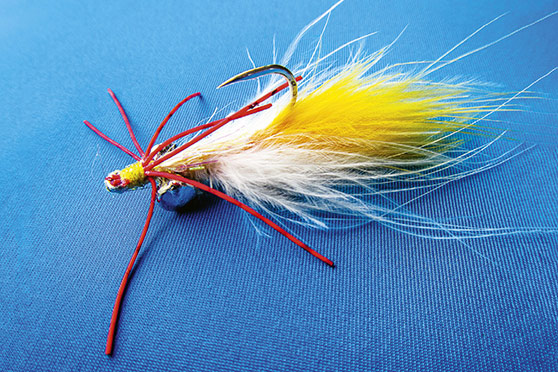
So, I re-launched myself into silicone leg fly tying. This time I approached the task a bit more methodically and made mental notes of lessons learned along the way.
Number one was to use a multi-stranded fly-tying thread and loosely tie down the rubber legs in the position you want with a light non-compressing cross-hatch weave. Once in position, extra thread and a good blob of glue helped firm up the leg base.
Number two was to avoid leg positions where the silicone legs could easily wrap around the hook bend. This meant tying them in a flared style off the tail (with a fur or marabou spacer in the middle) or further up the body, either sticking directly out from the hook shank or pointing upwards and outwards from just behind the eye. The emphasis was on getting lots of ‘wiggle’.
I tested the flies on baby snapper and came away liking the forward position for silicone legs more and more. The fix point at the front of the hook meant you could go for maximum leg length and maximum ‘wiggle’ effect. The legs are neutrally buoyant in the water and move naturally when the water moves. Even with no retrieve, the flies wiggle their legs madly and drive the baby snapper wild.
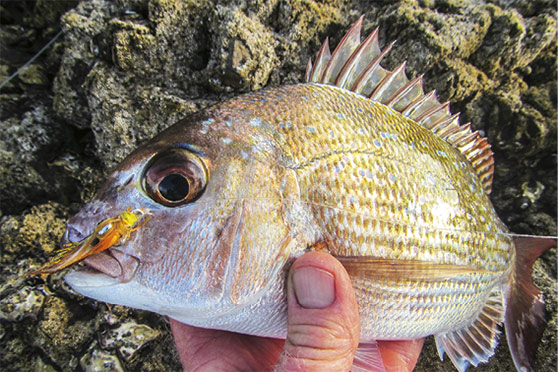
Baby snapper are suckers for rubber-leg flies.
The real test came when the fly was left to sit stationary on the bottom. The baby snapper still attacked it. Sure, baby snapper are permanently hungry when the water is warm, but it was still pleasing to get numerous hits when the flies were ‘dead’ on the bottom.
The stationary approach to fly presentations was said to be one of the secrets to successfully catching permit on fly. This is why it mattered so much. The flies needed to be well weighted, too, so that they would hit the sand and stay there. A heavy rubber-legged fly fitted the bill exactly.
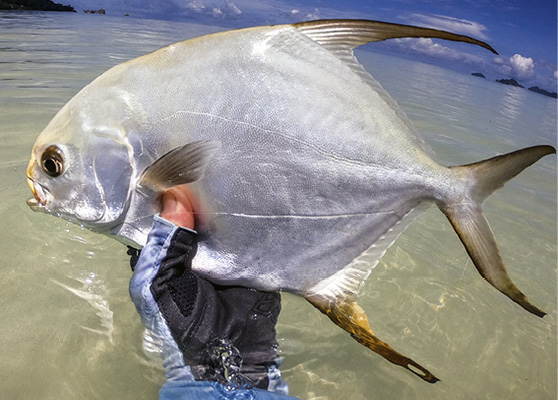
Permit are on of fly-fishing's most sought-after fish.
Consequently, I had a new appreciation of rubber-legged flies as snapper catchers and also felt I could head to the tropics with some degree of confidence in my rubber legged flies. Permit are said to be one of the most challenging fish you can cast at. They are a huge prize for any dedicated saltwater fly fisherman. I wanted one badly and I hoped my new siliconee rubber legged flies would show me the way.
|
|
This article is reproduced with permission of |

Recent Forum Posts Visit Forum

Trailer wheel clamp
in The Boat Shed5 minutes ago
Pcj
Doesnt dry out like crc.I use it on my trailer lock...

Shane Jones
in Fisheries Management26 hours ago
Tzer
Far cry to the twats at Liegasea/NZSFC were proposing of 5 Tarakihi person in their submission for the central management area and this is what our...

Bluefin Tuna at the cavs.
in The Briny Bar46 hours ago
smudge
Despite my years of fishing I haven't really fished many places, my focus has always been on Auckland's west coast and out toward Great Barrier. I...

Casting gloves
in Popper and Topwater Fishing91 hours ago
Mc Tool
100 bucks for a lure 😬. Watching one of them flying over the horizon without the line attached would be " character building " for sure...
I thought Id post some nice photo's , join...
in The Briny Bar142 hours ago
Alan L
That is a very cool pic Krow.The Far North is very cool, the Far far North even cooler. Mint looking day.Alan...

Mc Tools berley mincer
in The Briny Bar149 hours ago
SaltyC
Good size, they scrap well. Got an 18kg one up in Vava'u back a few years ago fishing off squeaky Going's boat. That was quite a...
Out with the "Twelves"
in Fishing Reports203 hours ago
Pcj
I should be able to get out end of October. The nephew been out virtually every weekend over winter and has done well. It seems the...
Manukau Harbour & West Coast fishing
in Fishing Reports211 hours ago
smudge
Nice work Schecter, I think snapper may be around sooner than you think. Well I am hoping so...

Whangarei Harbour report.
in Fishing Reports643 hours ago
krow
180 +m is where I've had to be lately. A lot less low foul around these parts and some of it shallower that looks like Tarakihi...
Whangarei Harbour Scallops
in Fisheries Management753 hours ago
Pcj
Reopening WhangÄ쳌rei Harbour to recreational scallop fishingTÄ“nÄ쳌 koeFisheries New Zealand is seeking feedback from tangata whenua, stakeholders, and the public on whether WhangÄ쳌rei Harbour should be...

Popular Articles

Softbait Fishing - Part 1 - gear selection
John Eichlesheim writes an article about selecting the right equipment for softbait fishing... Read More >
Softbait fishing Pt 2 - tips and tricks
Techniques, tips and tricks of softbait fishing – getting the most from your soft baits.... Read More >

Surfcasting - setting yourself up
Gary Kemsley helps sort out the necessary gear for intending surf fishers.... Read More >

Squid - How to catch them
Squid fishing is a rapidly growing aspect of fishing - Paul Senior shares some hints and tips to get started.... Read More >
Fishing Reports Visit Reports
Outer Hauraki Gulf Fishing Report 17/09/26
Spring wind the handbrake. Spring is starting to make its presence felt in the outer... Read More >
Top of the South Fishing Report - 17/09/26
Early snapper in Tasman Bay. Well, spring is finally here, and the days are getting... Read More >
Bream Bay Fishing Report - 17/09/26
Good snapper catches reported. After Tangaroa turned off the fish tap for a month or... Read More >
Bay of Islands Fishing Report - 17/09/26
Pacific bluefin tuna for the lucky few. The last fortnight has seen more fishable days... Read More >
Comments