
Fly fishing - 3 basic insect patterns
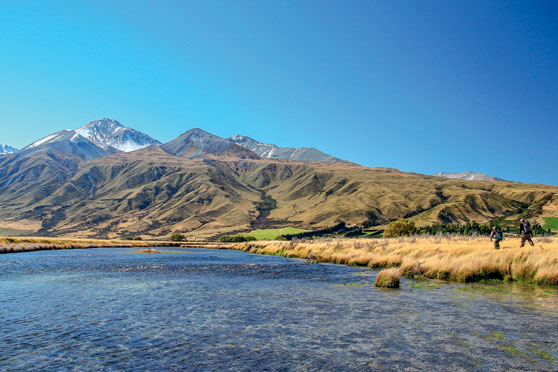
For many fly anglers, river fishing before Christmas is all about searching the depths of rivers and streams, fishing blind and throwing heavily-weighted nymphs into likely-looking spots.
There is no doubt that this nymph-fishing style catches good numbers of fish, but the more observant angler can enjoy more exciting and visual fishing.
When I was younger, fishing was all about numbers on the board – the more fish I caught, the better. These days, though, as I have aged and grown in experience, I have become more obsessed with the overall picture and the quality of my fishing experience. Everything nowadays is based around trying to bring more fish to the surface for longer periods of time throughout the year.
With a better understanding of some of our terrestrial and water-borne insects, you will find that some fantastic surface activity can be enjoyed well before Christmas. Early season, the best place to target surface-feeding trout is along the margins of our smaller rivers and in many of our back-country systems. Some fantastic dry-fly fishing can be enjoyed.
By staying away from some of our larger waterways and targeting the smaller or medium-sized tributaries, you will be more successful with your dry fly fishing. Trout will take the easiest meal available to them, so to consistently deceive them early in the season, it pays to target fish in smaller waterways or in water less than waist deep.
The three patterns listed below have served me very well early in the season, before the peak of the cicada season, and are well worth having in the fly box.
Beetles
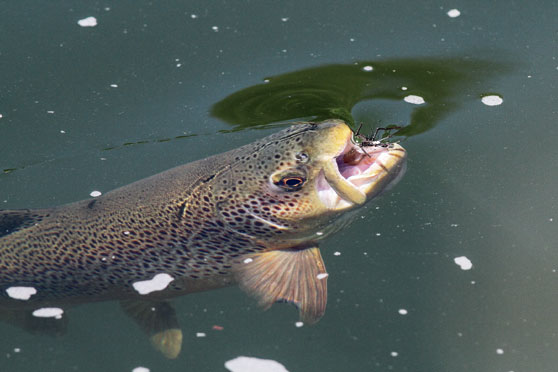
Beetles are a terrestrial insect, and one of the trout’s food items most underestimated by anglers. Two types of beetles are of interest to the fly-fisher: the green or ‘manuka’ beetle and the brown beetle.
From late November through to February, these two beetles make up a huge part of a trout’s diet, whether lake or river fish. The beetles hatch en masse during the night, then mate. At times large numbers can be found literally covering the water’s surface.
When I was a youngster, we often heard stories from our grandfather about the unbelievable green and brown beetle hatches that produced awesome fishing during the early summer months. The beetle fishing was legendary, and many of the old angling books tell of the rafts of manuka beetles drifting across Lakes Taupo and Tarawera. As a rule, any lake surrounded by bush, especially native bush, will have large beetle hatches that create a smorgasbord of trout tucker at the right time of year.
Some of the old stories also say how frustratingly hard the fishing could become: although fly-fishers would see fish rising everywhere, the number of beetles present meant the chance of one choosing an angler’s fly was akin to finding a needle in a haystack.
Beetles tend to be blown onto the water’s surface, where they lie trapped in the surface film, wriggling away. This makes them easy prey for the trout, especially on the windward side of lakes, where the wind collects the beetles together.
On rivers, beetles become concentrated along the main currents’ foam lines or are trapped in back-eddies.
The brown beetle is considered a pest in its ‘grass grub’ stage by pastoral farmers and those people who love their lawns, as the beetle larvae feed on the grass roots. At times the numbers of emergent brown beetles in the grass are in plague proportions.
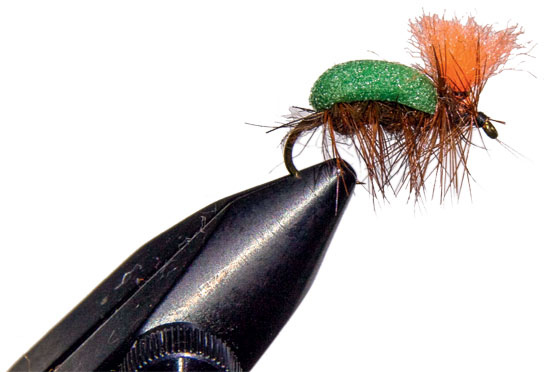
My number-one dry fly prior to February is a beetle pattern called the ‘Hammer’, which my brother Phil designed and is very effective. The Hammer can be tied to represent both the brown and green beetle. I use it mainly on sighted fish, but also find it effective when searching and prospecting likely-looking holding water, as it always causes fish to react.
There are several different beetle patterns available on the market, mostly in sizes 10 and 12, but I often tie them up to a large size 8 – the trout love them as they are highly visible on the water. Tying in a brightly-coloured post can be an advantage for sighting the fly as it drifts downstream, because the fly is designed to sit in the surface film and not float too high, as a Stimulator dry fly does.
There are many new metallic fly-tying materials that can give the bright, iridescent look of the hard-bodied shell on both types of beetles. With foam tied in as the wing case, beetle patterns will float forever and require very little floatant.
Because the beetles hatch at night, these flies can be fished successfully into the night or any time during the day, and are rarely turned down by the opportunistic trout. Sometimes you won’t see any on the surface during the day, but that’s because the fish have gorged all night and morning on the beetles. Consequently, every angler should have manuka and brown beetle imitation fly patterns in their fly box, whether fishing into a raft of beetles or used as a solitary searching pattern.
Spiders
When it comes to talking about spiders and fly fishing, most people think of the soft-hackled ‘wee wet’ flies fished across and downstream with great success during the emerging stage of mayfly and caddis hatches. For this exercise, though, we are talking about the eight-legged arachnid that many people have phobias and nightmares about.
When you look at past or present angling literature, or read the many fly-tying books available, nothing is ever written about the various types of spiders, yet New Zealand has lots of them. Even better, the trout take spiders readily, either fished sub-surface or on top.
Spiders of varying sizes are present along most of our waterways, but on our freestone riverbeds, especially those that are bush-lined, there is a very large water spider that looks fearsome but makes a superb dry or sub-surface fly.
The female water spider builds its web in the rocks and boulders along the river stones to protect its young, rather than snare prey. The web is fascinating, looking like a sheet of Gladwrap pulled between two rocks.
The water spider can hunt down prey above and below the water. It has the ability to skitter freely across the water’s surface, unlike most insects and other spiders, and can also swim under the water, the hairs on its legs capturing air bubbles to provide an oxygen supply.
I have seen water spiders up to 7 or 8cm in length, and as intriguing as they are, they deserve a little space as they jump very well and have large fangs.
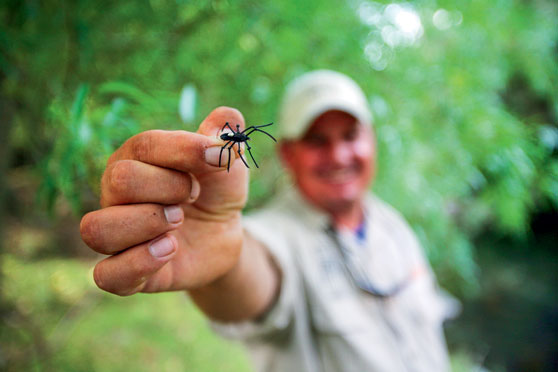
Russell Anderson, arguably New Zealand’s best imitative fly-tier, has a brilliantly realistic pattern called ‘Sparky’s Spider’ which is tied commercially, sold worldwide by Umpqua, and distributed in New Zealand through Fly Tackle NZ.
Once again, the dry-fly version of the water spider is designed to sit in the surface film, so is not that visible on the water’s surface. Where Sparky’s Spider comes into its own, is when sight-fishing to large fish in skinny water (shallow glides usually less than knee deep), especially over the summer months during times of low water flow. When a trout is in this situation, most large flies hitting the water would spook it instantly. Sparky’s Spider, however, deceives the fish almost every time with its slim profile, and is therefore a must-have in any fly box.
This pattern has become one of my go-to flies in the backcountry on tricky, hard-to-get-at fish. The spider is tied on a size 8 hook, so it has plenty of strength to handle large fish. I use it to target those large fish in skinny water, instead of trying with smaller patterns. Don’t worry if the fly is hard to see on the surface: you are casting to a sighted trout and will see the fish’s every movement, so there is no mistake when the fish takes the fly.
Blowflies
South Island fly-fishers have been using blowfly patterns for years with great success, and in some areas it is considered the only fly to use. However, the blowfly is the North Island’s most underrated fly, with very few sold in the shops here.
Let’s face it, blowflies are everywhere, whether in the bush, on the farm, or up in the tussock country. Wherever there is stock, or any animals for that matter, the flies will be numerous, and consequently it is only logical they must be a commonplace food item for trout.
The Humpy blowfly is a great imitation and a very good skinny-water fly, or when fishing through shallow riffles where the trout are likely to be feeding.
Trout rarely refuse the blowfly, although I tend to use it more on sighted fish than as a searching pattern. The great thing about using blowflies is that they are most comfortably used in sizes 10 and 12, so the hook sizes are not too small.
The blowfly can be used prior to Christmas, but is often very successful right through till the end of April.
Many fly-fishers are very conservative in their approach to fly selection, often using double-nymph rigs right up to the height of the cicada season, changing over to big dries for a couple of weeks, then reverting to the tandem-nymph rigs again.
Others will stick to the stock-standard dry-fly patterns, such as the Royal Wulff and Adams, which are great all-rounders, but there will be times when fish lock onto specific insects and won’t take anything else.
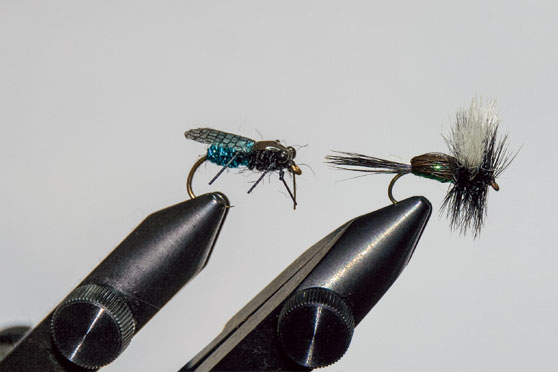
The three fly patterns covered in this feature are true imitations, rather than attractor patterns that roughly imitate aspects of a variety of insects. When the fishing gets tough, it’s the former patterns that will help you enjoy greater dry-fly fishing success over more of the year than ever before.
|
|
This article is reproduced with permission of |

Recent Forum Posts Visit Forum

Trailer wheel clamp
in The Boat Shed1 hour ago
610gc
Hey teamI have a wheel clamp like the one below on the boat trailer. its getting harder and harder to unlockI've sprayed it with CRC on...

Shane Jones
in Fisheries Management24 hours ago
Tzer
Far cry to the twats at Liegasea/NZSFC were proposing of 5 Tarakihi person in their submission for the central management area and this is what our...

Bluefin Tuna at the cavs.
in The Briny Bar44 hours ago
smudge
Despite my years of fishing I haven't really fished many places, my focus has always been on Auckland's west coast and out toward Great Barrier. I...
Casting gloves
in Popper and Topwater Fishing89 hours ago
Mc Tool
100 bucks for a lure 😬. Watching one of them flying over the horizon without the line attached would be " character building " for sure...
I thought Id post some nice photo's , join...
in The Briny Bar140 hours ago
Alan L
That is a very cool pic Krow.The Far North is very cool, the Far far North even cooler. Mint looking day.Alan...

Mc Tools berley mincer
in The Briny Bar147 hours ago
SaltyC
Good size, they scrap well. Got an 18kg one up in Vava'u back a few years ago fishing off squeaky Going's boat. That was quite a...

Out with the "Twelves"
in Fishing Reports201 hours ago
Pcj
I should be able to get out end of October. The nephew been out virtually every weekend over winter and has done well. It seems the...
Manukau Harbour & West Coast fishing
in Fishing Reports209 hours ago
smudge
Nice work Schecter, I think snapper may be around sooner than you think. Well I am hoping so...

Whangarei Harbour report.
in Fishing Reports641 hours ago
krow
180 +m is where I've had to be lately. A lot less low foul around these parts and some of it shallower that looks like Tarakihi...
Whangarei Harbour Scallops
in Fisheries Management751 hours ago
Pcj
Reopening WhangÄ쳌rei Harbour to recreational scallop fishingTÄ“nÄ쳌 koeFisheries New Zealand is seeking feedback from tangata whenua, stakeholders, and the public on whether WhangÄ쳌rei Harbour should be...

Popular Articles

Softbait Fishing - Part 1 - gear selection
John Eichlesheim writes an article about selecting the right equipment for softbait fishing... Read More >
Softbait fishing Pt 2 - tips and tricks
Techniques, tips and tricks of softbait fishing – getting the most from your soft baits.... Read More >

Surfcasting - setting yourself up
Gary Kemsley helps sort out the necessary gear for intending surf fishers.... Read More >

Squid - How to catch them
Squid fishing is a rapidly growing aspect of fishing - Paul Senior shares some hints and tips to get started.... Read More >
Fishing Reports Visit Reports
Outer Hauraki Gulf Fishing Report 17/09/26
Spring wind the handbrake. Spring is starting to make its presence felt in the outer... Read More >
Top of the South Fishing Report - 17/09/26
Early snapper in Tasman Bay. Well, spring is finally here, and the days are getting... Read More >
Bream Bay Fishing Report - 17/09/26
Good snapper catches reported. After Tangaroa turned off the fish tap for a month or... Read More >
Bay of Islands Fishing Report - 17/09/26
Pacific bluefin tuna for the lucky few. The last fortnight has seen more fishable days... Read More >
Comments