
Fishing with Curly-Tail Soft-Baits
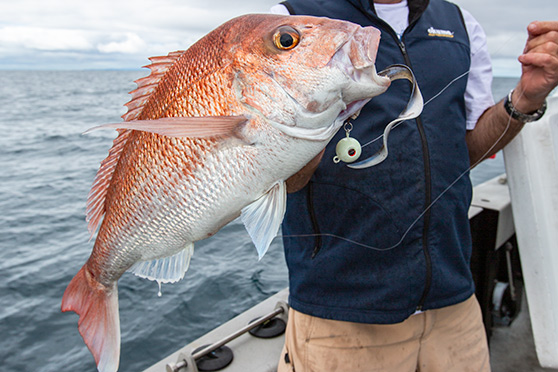
Why do soft-baits come in so many different shapes? Previously, Mark Kitteridge discussed the advantages associated with jerk-type soft-baits; here he moves on to the attributes provided by curly/grub tails.
Okay, I admit it, I am a bit slow; I’m still working out basic soft-baiting stuff that other anglers may have sorted out long ago. But for those other anglers also struggling to realise the bleedin’ obvious, please read on…
Curly/grub tails
My introduction to grub tails occurred around 37 years ago while working for Kilwell Sports. At the time they were the wholesale agents for Mister Twister, an early soft-bait manufacturer. Mister Twisters were pretty basic, but boy did they catch fish – even then!
Among the range was a small grub-tailed model called the Teeny, made for freshwater use, and a semi-transparent emerald-green one immediately caught my eye. Aptly named ‘Bloodline’ due to the darker green colouration deep within the lure which looked like intestines, they made a great tadpole imitation.
Realising their potential to press the right buttons of trout, I took some to the nearby Kaituna River for a test swim. After tying one on, I dropped it into the water below me and watched in surprise as the curly tail immediately waggled happily into life with the slightest of movements. Oh yes!
And, sure enough, my whippy rod was soon bent hard over, accompanied by a squealing reel, as the first of several fat, fit, silvery trout fell victim to its seductive charms!
About 10 years ago, I started regularly fishing with the Wavedancer Charters team, and they did well in 30-60 metres of water using a much bigger (9”) curly-tailed version called a Z-Man GrubZ. Generally, these were attached to a heavily weighted Ocean Angler Cyclops or Berkley Elevator rig and simply dropped straight down, their tails thrashing wildly throughout. They were responsible for hooking some impressive snapper and kingfish, both on the bottom and during their descent, despite whizzing down at high speed!
Another memorable introduction was provided shortly afterwards by a Gulp! 7” curly-tail shape called ‘Nemesis’. On just my second-ever cast, the lure got smashed mid-descent, and after a tough fight in reefy territory, I ended up landing a humdinger snapper of around 11.5kg.
Overview
Those curly tails are genius. As mentioned earlier, it takes very little movement – or current for that matter – to bring them to tail-thrashing life, making them perfect for all jig-head weights and a wide variety of fishing scenarios, from trout to yellowfin tuna.
But obviously not all curly tails are created equal. Some have more effective scents than others, and the degree of durability, realism, buoyancy and natural mobility vary greatly, too. Other features that can make a big difference to pushing the right buttons at times include luminous, fluorescent and UV reflective properties, either incorporated within the lure or as a coating – and I’m sure there are others we don’t even know about yet! In short, it depends on the soft-bait’s intended role as to which of these features matter more, then buying a product that ticks the boxes. (Ironically, the curly tail’s greatest feature, its wriggly tail, is also the Achilles heel: this relatively thin appendage is prone to being damaged, especially as fish have sharp, savage teeth!)
High speed casting and retrieving
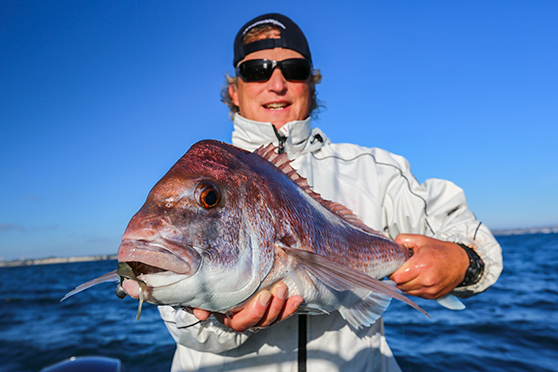
When targeting kahawai and skipjack tuna around schools of anchovies and whitebait, try casting and retrieving relatively small curly tailed soft-baits, especially those in natural baitfish colours. A heavier than usual jig-head is recommended so you can cast further, covering more area and maximising the retrieval opportunities. Once you’ve cast, wind in at a sharp clip (it’s hard to outrun these aggressive speedsters!) with your rod pointing down along the line to keep the lure just under the surface. This will also help you maintain good contact throughout the retrieve and reduce the effects of wind.
You can use a similar strategy when chasing kingfish, albacore and yellowfin – just increase the lure and lead-head weight/hook size to suit the situation – and perhaps allow the lure to drop deeper before cranking it back fast. Adding the odd rod stab or jiggle into the mix can do the trick at times, as can a sudden stop for a few, long seconds!
Such setups are also well-suited to trolling, and although it is possible to catch fish by leaving the rod in a suitably angled rod holder, you’ll do much better by holding it out to one side of the boat’s wake like a mini outrigger (perhaps with another angler doing the same on the other side), then regularly pulsing the lure back and forth.
Dragging curly tails
While curly-tailed lures are definitely worth casting out and jiggling back in along the bottom, I believe they really excel when dragged, especially the smaller 4” models.
Z-Man and Gulp! both offer worthwhile candidates, and it comes down to individual preferences regarding the merits of durability and natural buoyancy (causing the lure to lift up tail-first from the bottom, offering improved visibility) versus a very effective scent and a range that comes in many sizes and colours.
Because we’re targeting snapper poking around in the mud and silt for crabs, shellfish, worms and other critters, I find the following colours/combinations push the right buttons: those in brown such as New Penny (both brands), Bruised Banana (Z-Man), Satay Chicken (Gulp!), Pinfish (Z-Man), and Cappuccino and Bloodworm (Gulp!). However, those softies with plenty of UV reflective qualities can be very worthwhile in depths less than 20 metres, too: Atomic Sunrise, Motor Oil (Z-Man), Fire Tiger and Green Chartreuse (Gulp!) have proven themselves to be consistent fish catchers. In addition to the lure’s enticing action, you can ‘juice up’ your soft-bait with a slug of scent additive before dropping down. After all, the snapper will have plenty of time to inspect your dragged offering, and although the lure’s action and colour can push enough buttons to achieve success, having an attractive scent can be the clincher that gets the fish biting harder and hanging on for longer afterwards.
As discussed already, very little in the way of movement and tidal flow are required to get curly tails waggling away happily, so dropping an appropriately weighted curly tail to the bottom, then leaving it to its own devices, can prove surprisingly effective. Just be sure to let out some extra line so the lure bounces along the seafloor behind the drifting boat, kicking up sand and silt as it does so.
Be sure to pay attention to which rod holder you place the rod in too, as its angle can determine whether the rod snaps after hooking up to a decent fish!
If the rod-to-line angle looks too severe, try casting the curly tail away from the boat first or letting more line out so the desired line angle is achieved.
It can also pay to reduce the reel’s drag a bit and place some padding where the rod butt comes into contact with the rod holder. No one likes to be left with just a rod butt and no big fish to skite about!
Keep in mind that successful dragging is achieved by small, subtle actions, as well as by changing the lure’s trundling pace occasionally. Interestingly, the rocking, joggling boat imparts a much better action to curly tails than most anglers do deliberately, making rod-holders hard to beat as far as attracting fish goes. However, unless the fish is weighty and aggressive enough to hook itself (and, fortunately, plenty are!), you’ll see lots of bites go unpunished by the holder.
I have had limited success by quickly winding the reel’s handle or grabbing the line and jerking downwards firmly (a bit risky), but neither response is ideal.
So instead, be the rod holder and largely leave the lure alone; concentrate on mimicking the boat’s slightly rolly, jerky movements through the rod, and every 30 seconds or so let a metre or two more line out (or wind some of the line in) before clicking the reel back into gear. When you do so, make sure the line is back in position under the bail roller, because as soon as the line tightens again, a fish often savagely grabs the curly tail!
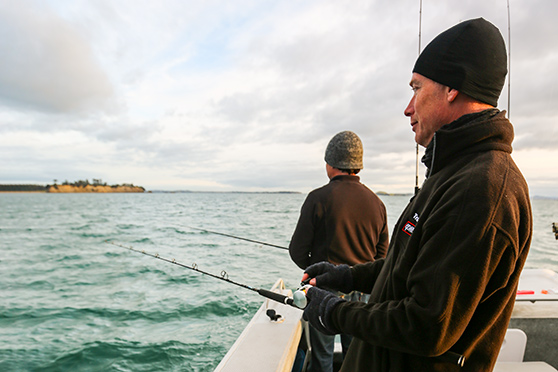
Try to imitate the boat's rolling, jerky movements when dragging, and let a bit more line out occasionally, as the snapper find sudden changes in movement hard to resist.
Whenever those bites occur, slowly lift your rod in response; if the rod starts to load up, lift firmly to set the hook properly. So simple.
Next time, we look at paddle-type soft-baits and the unique buttons they can push!
|
|
This article is reproduced with permission of |

Recent Forum Posts Visit Forum

Trailer wheel clamp
in The Boat Shed2 hours ago
krow
I like the SAS wheel clamp. I've had no issues with the lock....

Shane Jones
in Fisheries Management4 hours ago
Fish Addict
The recreational sector can expect no favours from politicians. They know all too well who butters their bread and it ain't the recs. No different over...

Foton tunland v9
in The Briny Bar4 hours ago
Ho Dee
not fishing related and delete if required but was wondering if any has one of these or someone who has just wanting so e real world...

Bluefin Tuna at the cavs.
in The Briny Bar51 hours ago
smudge
Despite my years of fishing I haven't really fished many places, my focus has always been on Auckland's west coast and out toward Great Barrier. I...
Casting gloves
in Popper and Topwater Fishing96 hours ago
Mc Tool
100 bucks for a lure 😬. Watching one of them flying over the horizon without the line attached would be " character building " for sure...
I thought Id post some nice photo's , join...
in The Briny Bar147 hours ago
Alan L
That is a very cool pic Krow.The Far North is very cool, the Far far North even cooler. Mint looking day.Alan...

Mc Tools berley mincer
in The Briny Bar154 hours ago
SaltyC
Good size, they scrap well. Got an 18kg one up in Vava'u back a few years ago fishing off squeaky Going's boat. That was quite a...

Out with the "Twelves"
in Fishing Reports208 hours ago
Pcj
I should be able to get out end of October. The nephew been out virtually every weekend over winter and has done well. It seems the...
Manukau Harbour & West Coast fishing
in Fishing Reports216 hours ago
smudge
Nice work Schecter, I think snapper may be around sooner than you think. Well I am hoping so...
Whangarei Harbour report.
in Fishing Reports648 hours ago
krow
180 +m is where I've had to be lately. A lot less low foul around these parts and some of it shallower that looks like Tarakihi...

Popular Articles

Softbait Fishing - Part 1 - gear selection
John Eichlesheim writes an article about selecting the right equipment for softbait fishing... Read More >
Softbait fishing Pt 2 - tips and tricks
Techniques, tips and tricks of softbait fishing – getting the most from your soft baits.... Read More >

Surfcasting - setting yourself up
Gary Kemsley helps sort out the necessary gear for intending surf fishers.... Read More >

Squid - How to catch them
Squid fishing is a rapidly growing aspect of fishing - Paul Senior shares some hints and tips to get started.... Read More >
Fishing Reports Visit Reports
Outer Hauraki Gulf Fishing Report 17/09/26
Spring wind the handbrake. Spring is starting to make its presence felt in the outer... Read More >
Top of the South Fishing Report - 17/09/26
Early snapper in Tasman Bay. Well, spring is finally here, and the days are getting... Read More >
Bream Bay Fishing Report - 17/09/26
Good snapper catches reported. After Tangaroa turned off the fish tap for a month or... Read More >
Bay of Islands Fishing Report - 17/09/26
Pacific bluefin tuna for the lucky few. The last fortnight has seen more fishable days... Read More >
Comments