
Fishing with Crocs

Sam Mossman reckons lyricist Jack Lawrence got it right when he penned the words for ‘Never Smile at a Crocodile’ from the Walt Disney Animation of Peter Pan.
“Never smile at a crocodile. No, you can’t get friendly with a crocodile. Don’t be taken in by his welcome grin. He’s imagining how well you’d fit within his skin.”
I have encountered some dangerous animals over the years while fishing in remote parts of the world. Creatures like bears, snakes, poisonous spiders, and scorpions (to name a few) can be hazardous to your health. However, if you are aware of your surroundings, be careful where you put your feet, and obey local advice (like shaking out your clothes and boots before putting them on, for example) you are usually OK.
In the waterways themselves, there are many species of fish like sharks, stingrays, stonefish, piranha, and so on, but often there is a boat hull between you and them. You are most at risk when wading or bank fishing, or swimming. Again, there are precautions to be taken. If wading, wear solid footwear and do the ‘saltwater shuffle’ to spook away any rays before you step on them. Piranha are no real problem as long as you’re not bleeding.
There is a whole suite of crocodilian species around the globe, too, and some of them are guilty of reminding humans that sometimes we are no longer at the top of the food chain. If I had to make a choice, the animal I would least like to be in the water with is an adult saltwater crocodile or its African cousin, the Nile crocodile. The mugger crocs of India nail a few people each year, too, as do American alligators. However, give salties and Nile crocs a chance and these mobile handbags will always have a go and are responsible for around 1,000 deaths worldwide each year. Sharks, by comparison, are responsible for about 80 attacks on humans worldwide each year, about 10% of which are fatal.
On the Amazon
During a trip to Brazil to fish the planet’s largest river, it was damn hot, and we swam daily. The locals did not worry about the piranha, so neither did I, even though I often caught them where we had been swimming. The local croc species there were black caimans, and I was a little leerier of them, but although they grow to six metres, they did not seem particularly aggressive. The local wisdom has it that it is OK to swim in the main river channels, but not the backwaters and lagoons where the caiman may be nesting and protective of their territory.
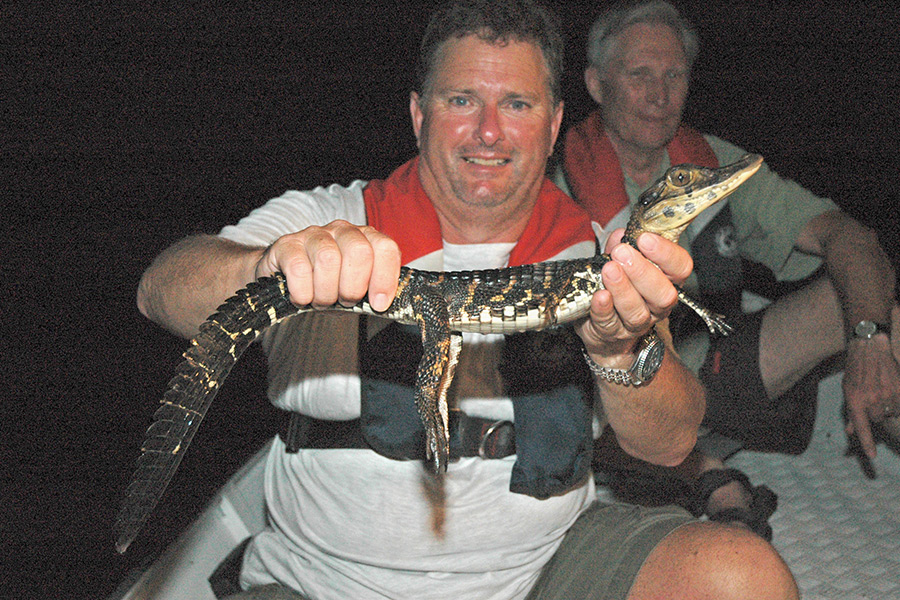
Black caiman in the Amazon are not very aggressive. Sam with a yearling.
Out of Africa
During a trip chasing tigerfish in Zambia’s Zambezi River, I was amazed to find that, despite about 400 Africans being killed by Nile crocs every year, the locals there are pretty fatalistic about the proximity of these big saurians, showing no qualms about swimming, getting water or washing clothes at the same spot where their relatives or friends had been taken by a croc just a day or two before. I was not quite so blasé though, especially when I found out that, in the previous wet season, when the water levels were right up near the huts of a lodge we stayed at, a guy had been taken by a croc while having a drink at the bar, dragged into the river and (presumably) eaten! Alcohol can be bad for your health, alright. You wouldn’t catch me swimming or wading in the Zambezi.
Although Nile crocodiles are one of the world’s most dangerous species, there seemed to be an exception to the rule: Lake Nasser in Egypt... or maybe not! The temperature in most afternoons was over 40°C, but one day was a real killer, over 50°C! Only an almost total lack of humidity, and a reasonably steady breeze off the Sahara Desert, made these summer temperatures bearable.
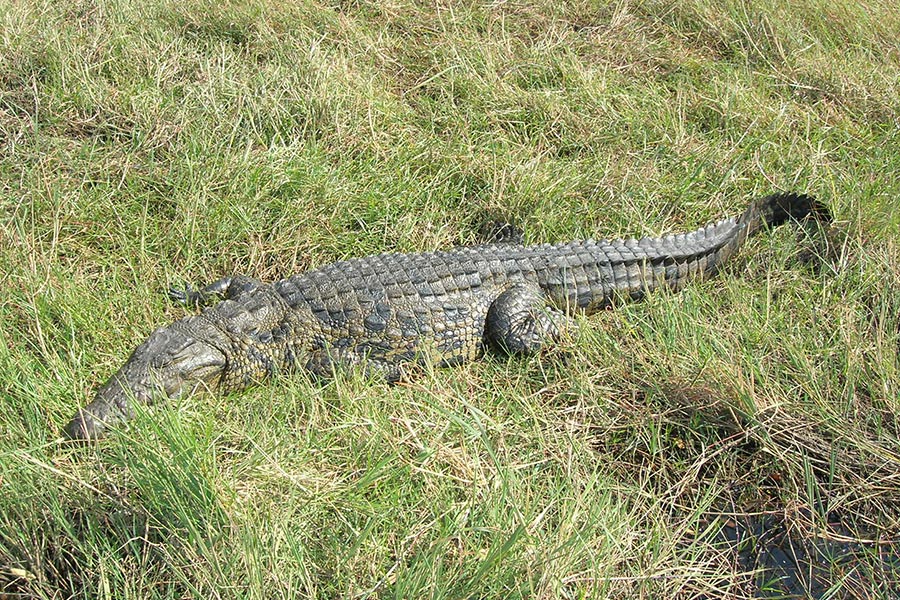
Africa’s Nile crocodiles kill around 400 people each year.
We were there to fish for Nile perch, (which can grow to over 100kg) but soon learned the importance of shade and why most people visited Egypt in the cooler months. We drank copious amounts of fresh water and, along with the crew, swam in the lake every lunchtime. A couple of metres under the surface was a thermocline, and once we swam below that, the water was beautifully cool.
We saw the odd crocodile in the evenings but were assured by the locals that they were only active at first and last light and that a lack of animals in the Sahara Desert around the lake shore had turned them into a race of fish-eaters, uninterested in us mammals. At the time I was there, in 2008, there was no memory of anyone being taken by a croc in Lake Nasser, unlike central Africa, where they nail about 400 people a year.
“And anyway”, said Captain Ali, who ran our supply ship Nubian Queen, “the crocodiles much prefer white meat, so we Nubians are quite safe when you are in the water!” One of the favourite Nubian jokes was to swim up behind you underwater and grab your leg.
However, I am told that these days, croc numbers in this lake have multiplied, and someone now gets taken by a croc every three or four years.
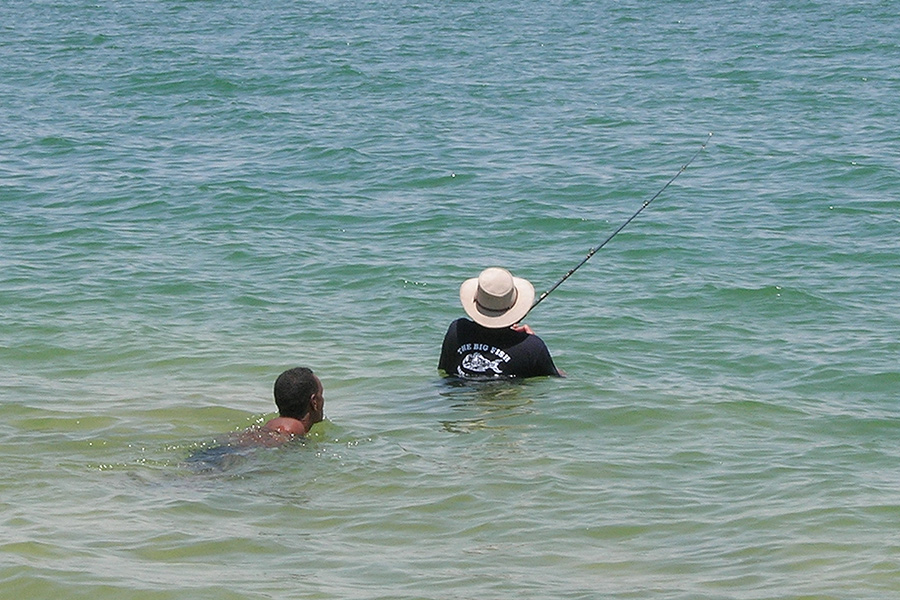
One of the favourite jokes of our Nubian guides on Lake Nasser was to swim up behind you underwater and grab your leg.
Australia’s salties
Australia’s Northern Territory is a land of extremes. The capital, Darwin, is a bright, clean, vibrant tropical city of 80,000 people, but there are still aspects of frontier living about the place. Ocean and river swimming is made hazardous by concentrations of the very nasty box jellyfish. The tidal range can approach thirty feet in places, resulting in strong currents – and then there are the crocodiles.
The saltwater crocodile is a very dangerous species. Since the full protection of Australian crocodiles in 1971, populations of these saurians have increased rapidly. In 2022, a total of 273 saltwater crocodiles were caught and relocated by NT Parks and Wildlife, a great many of them from Darwin Harbour.
At least five people have lost their lives in crocodile attacks at the Cahill Crossing, a tidal concrete ford in the Northern Territory’s Kakadu National Park. A 47-year-old local man was killed by a 3.3-metre crocodile while walking across the river several years ago. The most famous fatality there was back in 1987, when 40-year-old Kerry McLoughlin was decapitated by a crocodile while fishing at the Crossing.
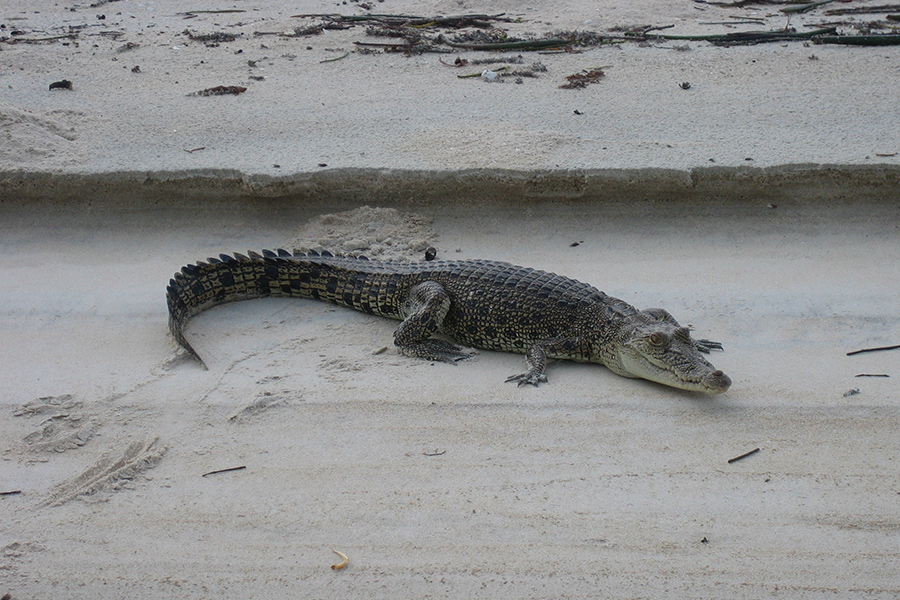
An Australian salty in a tidal creek in Arnhemland.
I have visited the Northern Territory four times to fish for that finned icon of Australia, the barramundi. On my first visit, I hoped to see a saltwater crocodile or two in their natural habitat and maybe get a photo. This hope was fulfilled within my first hour on the water.
We launched our guide’s boat in Corroboree lagoon, a twenty-kilometre-long billabong complex cut off from the sea during the dry season. We saw our first croc, about an eight-footer, basking on a mud bank not far from the boat ramp. I framed up this specimen in the camera and started shooting as the guide slowly headed the boat in towards it. The image swelled in the viewfinder until I realised I could only fit the head in. I looked up from the camera to find the croc only a couple of metres away, with the boat cutting off its escape route to deep water.
Despite this provocation, the saurian never moved, much to the disappointment of our guide, Alex, who had expected a much more violent reaction from the croc, and a badly frightened Kiwi cameraman.
My next day of fishing was in another lagoon called Shady Camp, named for the protection its ancient banyan trees give to travellers. Shady is much more compact water than Corroboree, but it has a heavy crocodile population. I saw five of the big reptiles from the boat ramp and counted thirteen basking on the first corner.

The finned icon of Australia, the barramundi, shares its habitat with crocs.
We were blessed with another top guide, Lindsay, and another day of good bara’ fishing. There were many crocs about, but we had no problems with them. Some were smallish light-coloured crocs that had been born since protection was instituted and had little fear of man. There were some massive, dark old muggers about too, fifteen to sixteen-footers that had been around since the heyday of crocodile hunting and were still, even after many years of protection, a bit cautious of people.
With increasing numbers of both humans and crocs in the Northern Territory (and other northern Australian states), the odds of ‘close encounters’ keep rising. Since crocs were protected in 1971, up until 2021, there have been 23 fatal attacks by saltwater crocodiles on humans, and a further 51 injuries, in the Northern Territory. Queensland reported 12 deaths in the state caused by crocs between 1975 and 2021 and 41 non-fatal attacks. You can add in a few for Western Australia, too.
Many of these happened because people foolishly put themselves at risk. Swimming, wading, and approaching crocodile nests account for many of these attacks. Often alcohol has been involved, too.
In Aussie, there are some basic rules to avoid problems, and these are often painted on large signs at boat ramps and river crossings:
• Do not enter the water.
• Keep children away from the water.
• Clean fish well away from the water and remove all waste.
• Camp well back from the water’s edge. A hundred metres is not too far (crocs are known to leave the water and have attacked campers).
• Do not draw water from the same spot each day (crocs are quick to spot patterns and will lie in wait).
• Do not canoe or use a small, low-sided boat in crocodile country (crocs have capsized kayaks and pulled people from small boats).
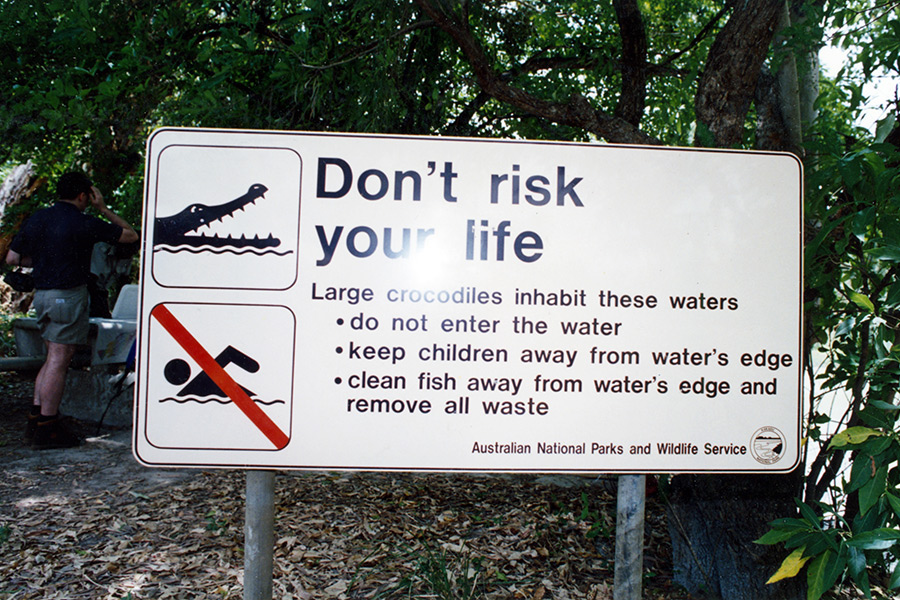
In Aussie, there are some basic rules to avoid problems, and these are often painted on large signs at boat ramps and river crossings.
To people who live in the region, this is all basic stuff. They would no more consider breaking the rules than you or I would consider wandering across a motorway at rush hour. Following these common-sense rules, and a federal program to remove any crocs that start getting too friendly, should ensure the safety of all fishermen. Most of the time, anyway.
Crocs are not cruel or evil after all – these are human attributes. They are just predators, and if you give them a chance, they will kill and eat you in the same way they would approach any other animal.
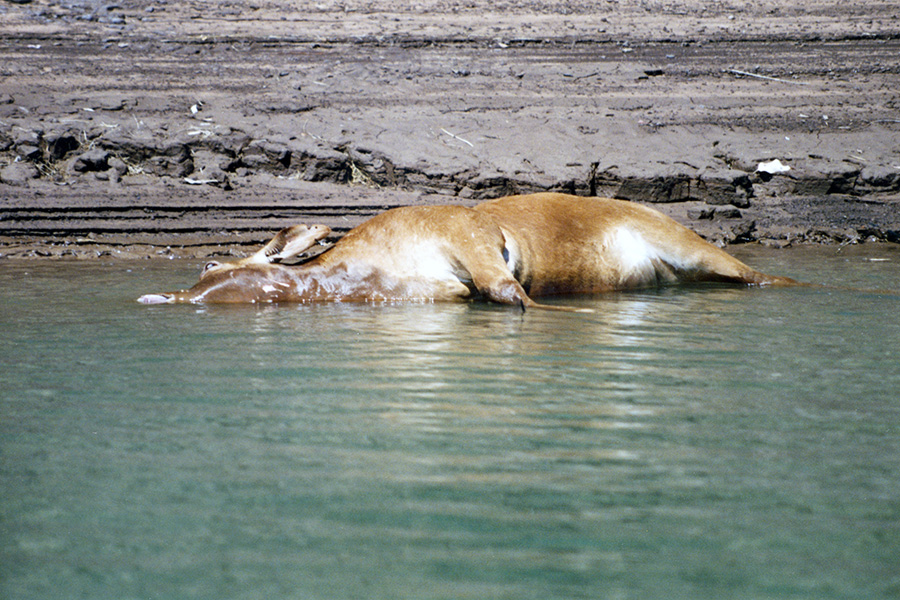
On the Northern Territory’s Victoria River, one of Auvergne Station’s cattle floats at the water’s edge, killed by a croc.
By our second day of chasing the mighty barramundi, crocs had ceased to be a novelty. They were part of the scenery, a part to be cautious and wary of, mind you, and added a bit of spice to an exotic fishing adventure. In a very short time, taking normal precautions became second nature. But how much so I only realised a couple of weeks after my return to New Zealand.
I was holding a boat in the water at a ramp in the Manukau Harbour while my companion was parking the vehicle and trailer. My mind was in neutral, dreaming still of hot, arid, bush-covered plains, jade-green billabongs fringed with pink-flowered water lilies, and leaping silver barramundi.
And then, with a slow awakening, I realised that I was deliberately keeping the boat between me and the deep water. And more than that, I was intently scanning the nearby waters, beaches, and mud banks for any signs of sly, lurking crocodiles.

March 2023 - Sam Mossman
New Zealand Fishing News Magazine.
Copyright: NZ Fishing Media Ltd.
Re-publishing elsewhere is prohibited
Recent Forum Posts Visit Forum

Trailer wheel clamp
in The Boat Shed2 hours ago
krow
I like the SAS wheel clamp. I've had no issues with the lock....

Shane Jones
in Fisheries Management5 hours ago
Fish Addict
The recreational sector can expect no favours from politicians. They know all too well who butters their bread and it ain't the recs. No different over...

Foton tunland v9
in The Briny Bar5 hours ago
Ho Dee
not fishing related and delete if required but was wondering if any has one of these or someone who has just wanting so e real world...

Bluefin Tuna at the cavs.
in The Briny Bar52 hours ago
smudge
Despite my years of fishing I haven't really fished many places, my focus has always been on Auckland's west coast and out toward Great Barrier. I...
Casting gloves
in Popper and Topwater Fishing97 hours ago
Mc Tool
100 bucks for a lure 😬. Watching one of them flying over the horizon without the line attached would be " character building " for sure...
I thought Id post some nice photo's , join...
in The Briny Bar148 hours ago
Alan L
That is a very cool pic Krow.The Far North is very cool, the Far far North even cooler. Mint looking day.Alan...

Mc Tools berley mincer
in The Briny Bar155 hours ago
SaltyC
Good size, they scrap well. Got an 18kg one up in Vava'u back a few years ago fishing off squeaky Going's boat. That was quite a...

Out with the "Twelves"
in Fishing Reports209 hours ago
Pcj
I should be able to get out end of October. The nephew been out virtually every weekend over winter and has done well. It seems the...
Manukau Harbour & West Coast fishing
in Fishing Reports217 hours ago
smudge
Nice work Schecter, I think snapper may be around sooner than you think. Well I am hoping so...
Whangarei Harbour report.
in Fishing Reports649 hours ago
krow
180 +m is where I've had to be lately. A lot less low foul around these parts and some of it shallower that looks like Tarakihi...

Popular Articles

Softbait Fishing - Part 1 - gear selection
John Eichlesheim writes an article about selecting the right equipment for softbait fishing... Read More >
Softbait fishing Pt 2 - tips and tricks
Techniques, tips and tricks of softbait fishing – getting the most from your soft baits.... Read More >

Surfcasting - setting yourself up
Gary Kemsley helps sort out the necessary gear for intending surf fishers.... Read More >

Squid - How to catch them
Squid fishing is a rapidly growing aspect of fishing - Paul Senior shares some hints and tips to get started.... Read More >
Fishing Reports Visit Reports
Outer Hauraki Gulf Fishing Report 17/09/26
Spring wind the handbrake. Spring is starting to make its presence felt in the outer... Read More >
Top of the South Fishing Report - 17/09/26
Early snapper in Tasman Bay. Well, spring is finally here, and the days are getting... Read More >
Bream Bay Fishing Report - 17/09/26
Good snapper catches reported. After Tangaroa turned off the fish tap for a month or... Read More >
Bay of Islands Fishing Report - 17/09/26
Pacific bluefin tuna for the lucky few. The last fortnight has seen more fishable days... Read More >
Comments