
Fishing the Hydro Canals
An old fishing buddy, Mark Kitteridge, had a very significant birthday last year. Amazingly, he managed to convince both our wives that allowing the two of us a few days at the hydro canals of the Mackenzie Country chasing trophy trout would be a good way to celebrate.
Unfortunately, Covid-19 got in the way and a subsequent attempt a few months later was stymied when Mark broke his foot! But fast-forward to late June 2021 and the pair of us belatedly boarded a plane for the South Island, almost one year after our first attempt. Happy birthday Mark!
The Tekapo-Twizel hydro canal complex has become perhaps the most publicised freshwater fishery in New Zealand. Containing huge brown and rainbow trout, as well as lots of salmon, it is recognised as the best place in the country, maybe the world, to catch trophy trout. Fish over 10kg are commonly caught and 15kg-plus specimens are sometimes landed. Trout estimated to weigh in excess of 20kg can be seen swimming below the hydro dam tailraces.
Ten or 12 years ago, when this phenomenal canal fishery was being ‘discovered’, the fishing was by all accounts considerably easier. Angling pressure was light and fish were relatively naïve, which made them susceptible to a wide range of lures, baits and fishing techniques, especially the escaped salmon hanging around the salmon farm cages.
These days the fishing is quite a bit tougher, with educated fish that have seen plenty of lures and baits and many, many more anglers on the water.
We’d talked about fishing the canals for years. Once upon a time we’d done a lot of trout fishing together, but for the last 20 years trout have barely featured. We are fly-fishers, but fishing the hydro canals is predominantly a spin-fishing gig. That didn’t faze us too much, especially since we both have extensive soft-baiting experience and fishing soft-baits was reportedly very effective. We fancied our chances.
The same only different
The primary method, however, is a technique called egg rolling – trotting trout egg patterns downstream on lightweight braid with fine diameter leaders and slip-sinkers weighing just enough to allow the eggs to drift naturally with the current.
It sounded simple enough, and quite similar in principle to indicator nymphing with globugs on the Tongariro, with which we were familiar. Although a bit rusty, Mark and I felt up for it. How wrong could we be!
Joined for the weekend by another old fishing mate who now resides in Central Otago, we started fishing bright and early on Saturday morning, choosing a stretch of canal beside one of the salmon farms. Anticipation was high and we Aucklanders barely found time to complain about the cold, though braided lines freezing to bail arm rollers was a nuisance at first.
We spent the morning softbaiting and fish weren’t long in coming: two very small salmon for me and a fish lost, much bigger, to Mark. We’d been told about the importance of casting lures as close as possible to the salmon cages, but the slightest misjudgment would hang the lure on the cage structure. The tackle attrition rate was high, but we’d been assured short casts would get no bites.
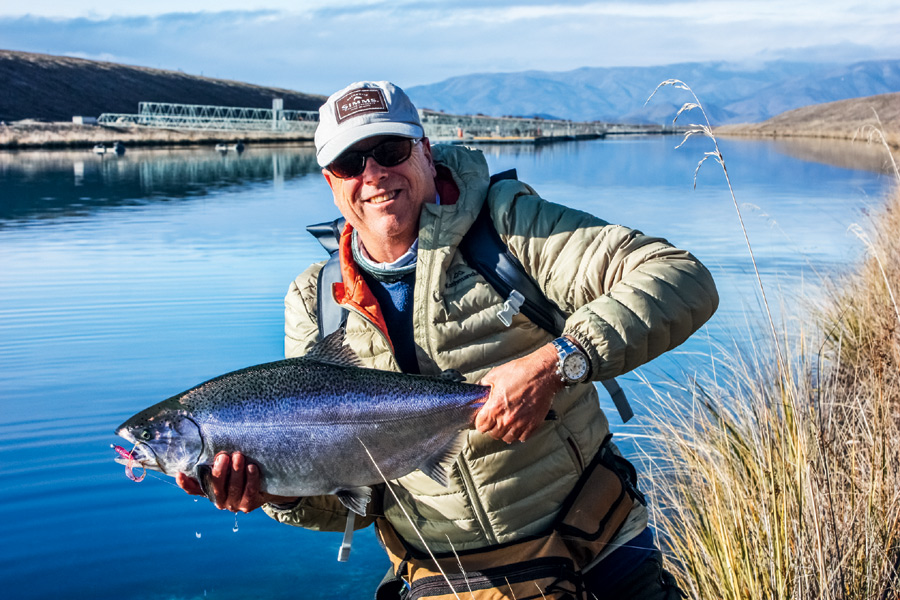
Not that the bites came with any urgency. On the contrary, they were few and far between. But late in the morning, working my last three-inch translucent pink Z-Man curly tail grub, I hooked a decent fish. It showed itself immediately and I called it for a modest rainbow, but it gave me quite a battle in the swift current and for a while I struggled to keep it away from the cages. I reminded myself to get downcurrent so the fish couldn’t make use of the canal’s strong flow. The tactic worked and I was able to bring what I initially thought was a rainbow of around five pounds to the bank. As it turned out, while the fish was about the right length to weigh five pounds, it was so deep through the belly and wide across the shoulders it was easily eight pounds. Not a Tekapo Canal trophy, but a nice fish nonetheless.
Sadly, I hung the lucky lure on a salmon cage the very next cast and afterwards, no matter what I used, I failed to contact another fish. The other guys fared no better. Mark and I were also a little surprised at how short the winter days are – arriving at 6:30am on the first morning meant struggling with unknown water in the dark for the first hour. And it was already too dark for us old fellas to tie on new lures by 5pm, not to mention bloody cold!
Another old fishing buddy joined us that afternoon. Fishing a slowly retrieved three-inch pink soft-bait, Peter Langlands was rewarded with a nice salmon, which joined him for dinner, along with another he caught later that evening after we parted ways.
 Day two dawned foggy but a little less cold. We explored some of the other canals and fished different stretches of the canals we knew. We also tried egg-rolling, which had sounded simple enough, but proved to require considerable skill.
I think it’s fair to say that in two and a half days of fishing eggs, neither Mark or I mastered the technique. It was only in the last couple of hours, after some pointers from local guide and hydro canal legend Ben Booth, that we finally began rolling eggs effectively. By then it was too late to save the trip.
But I digress. On day two we believed we were doing things right and our morale was high. I hooked and landed a rainbow weighing a bit over a kilo on the egg-rolling gear, which encouraged me to stick with it for the rest of the day. Mark, too, managed a couple of small salmon, both well under legal size.
The other anglers around us (and there were plenty!) weren’t catching either – even the bait fishers soaking prawns or drifting pilchards under floats – so we weren’t alone. Poor Ian left for home on Sunday afternoon having caught nothing…
Wonderful one fish
The highlight of the trip was witnessing a huge trout landed from the tailrace at Glenbrook on Sunday. Justin had been fishing the tailrace pretty much non-stop for four days, swinging weighted homemade flies on spinning gear from the spillway wall.
He had his first and only decent bite just as we pulled up. As we exited our vehicle, what was clearly a huge fish led Justin on a merry chase downstream, forcing him to clamber over concrete walls and wire fences to keep pace with the charging fish.
After maybe 20 minutes of seesaw battle in the strong current, Justin managed to bring the fish to the bank. It was the biggest, fattest rainbow any of us have ever seen. We guessed it weighed over 15kg, a guess later confirmed by Ben and others more familiar with such giant hydro canal fish. It was the fish of a lifetime for Justin, well worth four days’ effort, and exactly the sort of birthday trout Mark and I were after.
 Alas, it was not to be. Days three and four were worse in terms of fish caught: a few undersize salmon for Mark and a couple for me, a couple of missed bites each and a bust-off on a soft-plastic. Note to self: don’t strike at bites as though you are snapper fishing when using sixpound leader.
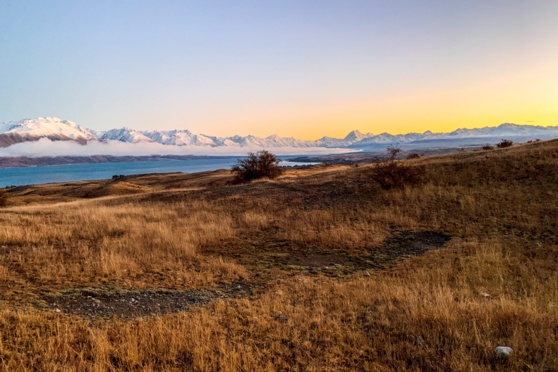
We woke up on the final morning feeling despondent and a little desperate, aware we’d have to leave by 11:30am to catch our plane. But the morning was gorgeous – cold and clear – giving us unobstructed views of the surrounding mountains. It was hard to feel anything but gratitude for the privilege of fishing in such a lovely place.
 The morning slipped away in the same fashion as all the others. I hooked a fish on an egg but dropped it early in the fight, Mark reported a bite or two and we walked for kilometres up and down the bank, trotting our imitation salmon eggs (we reckon we walked 12-15km per day), with nothing to show for it.

You are doing it wrong!
It was only when we came across Ben Booth and his clients and had a chat that the penny dropped: we’d missed the finer nuances of egg rolling. After three days of walking the bank, neither of us had the technique right.
Ben was generous with his advice: my fly was too big, the wrong colour and the wrong yarn, and apparently single eggs were the only way to go. Our rods, reels and rigs were fine (thanks YouTube), but our sinkers were too heavy; there was too much bow in our lines, creating induced drag, and we were allowing the terminal tackle to get ahead of or behind us as we walked – both were bad.
We were also casting too far, which meant the faster midstream current inevitably created a bow in the line.
The key, explained Ben, was to always keep the line taut and at right angles to the current. Always keep a finger on the line to feel bites and if there is too much feedback from the bottom through the line, you are using too much weight.
The very first drift after Ben’s advice, I got a bite but missed the hook-up – I was so surprised I was slow to respond. It proved a point though, and explained why Ben’s clients were catching fish when we weren’t.
There is no happy ending to Mark’s birthday expedition. Time was up. He didn’t catch a single legal-sized fish and I probably didn’t catch any trout – of the two halfway decent fish I’d caught, the pictures show the big one was really a salmon and I now suspect the smaller one was too!
Although we lucked out on trophies, we agreed it had been a brilliant few days spent on an amazing fishery – a great way to celebrate one of life’s significant milestones. We can’t wait to go back, especially with our new egg-rolling knowledge. But next time we’ll go when it’s a bit warmer. I’m also told that softbaits work much better in spring and summer when trout are less preoccupied with spawning.
I’m sure there’s a big rainbow or brown still waiting for us in one of those canals.
Recent Forum Posts Visit Forum

Trailer wheel clamp
in The Boat Shed3 minutes ago
Pcj
Doesnt dry out like crc.I use it on my trailer lock...

Shane Jones
in Fisheries Management26 hours ago
Tzer
Far cry to the twats at Liegasea/NZSFC were proposing of 5 Tarakihi person in their submission for the central management area and this is what our...

Bluefin Tuna at the cavs.
in The Briny Bar46 hours ago
smudge
Despite my years of fishing I haven't really fished many places, my focus has always been on Auckland's west coast and out toward Great Barrier. I...

Casting gloves
in Popper and Topwater Fishing91 hours ago
Mc Tool
100 bucks for a lure 😬. Watching one of them flying over the horizon without the line attached would be " character building " for sure...
I thought Id post some nice photo's , join...
in The Briny Bar142 hours ago
Alan L
That is a very cool pic Krow.The Far North is very cool, the Far far North even cooler. Mint looking day.Alan...

Mc Tools berley mincer
in The Briny Bar149 hours ago
SaltyC
Good size, they scrap well. Got an 18kg one up in Vava'u back a few years ago fishing off squeaky Going's boat. That was quite a...
Out with the "Twelves"
in Fishing Reports203 hours ago
Pcj
I should be able to get out end of October. The nephew been out virtually every weekend over winter and has done well. It seems the...
Manukau Harbour & West Coast fishing
in Fishing Reports211 hours ago
smudge
Nice work Schecter, I think snapper may be around sooner than you think. Well I am hoping so...

Whangarei Harbour report.
in Fishing Reports643 hours ago
krow
180 +m is where I've had to be lately. A lot less low foul around these parts and some of it shallower that looks like Tarakihi...
Whangarei Harbour Scallops
in Fisheries Management753 hours ago
Pcj
Reopening WhangÄ쳌rei Harbour to recreational scallop fishingTÄ“nÄ쳌 koeFisheries New Zealand is seeking feedback from tangata whenua, stakeholders, and the public on whether WhangÄ쳌rei Harbour should be...

Popular Articles

Softbait Fishing - Part 1 - gear selection
John Eichlesheim writes an article about selecting the right equipment for softbait fishing... Read More >
Softbait fishing Pt 2 - tips and tricks
Techniques, tips and tricks of softbait fishing – getting the most from your soft baits.... Read More >

Surfcasting - setting yourself up
Gary Kemsley helps sort out the necessary gear for intending surf fishers.... Read More >

Squid - How to catch them
Squid fishing is a rapidly growing aspect of fishing - Paul Senior shares some hints and tips to get started.... Read More >
Fishing Reports Visit Reports
Outer Hauraki Gulf Fishing Report 17/09/26
Spring wind the handbrake. Spring is starting to make its presence felt in the outer... Read More >
Top of the South Fishing Report - 17/09/26
Early snapper in Tasman Bay. Well, spring is finally here, and the days are getting... Read More >
Bream Bay Fishing Report - 17/09/26
Good snapper catches reported. After Tangaroa turned off the fish tap for a month or... Read More >
Bay of Islands Fishing Report - 17/09/26
Pacific bluefin tuna for the lucky few. The last fortnight has seen more fishable days... Read More >
Comments