
Fishing Solo

There are lots of reasons why anglers enjoy fishing solo. Josh Coombridge explains what appeals to him most about fishing in his own company.
Solo fishing is becoming something I do a lot more often these days. Whether it’s because of COVID restrictions, your mates don’t like you, or you simply don’t want to be tying knots for a newbie, heading out on your kayak or boat with only the company of a couple of terns and your own thoughts is sometimes necessary. While there may be no one to share the highs and lows with at the time, the rewards are great when they eventually come.
Almost all of my best memories as a fisherman include good mates and a boat – that’s the best part of fishing for me. I can overlook a lack of fish if I’ve had a good day on the water cracking jokes and spinning yarns. Fishing with mates is good for relationships and a great way to improve mental health. However, this is not always practical or ideal. In my job, I start early and finish early meaning I have many mid-week opportunities to get out on the beautiful moana. The texts are always sent, but inevitably the replies come in: “Sorry mate, I’m flat tack with work (crying emoji) but keen for next time!”
Well, next time will be fun I’m sure, but it doesn’t change the fact that there’s a five knot variable on a Tuesday! If you’re anything like me, you take every opportunity possible so that’s when the call must be made to head out fishing solo.
Launching solo
Fishing solo in my experience takes more planning. The first thing to consider is launching. To launch successfully off the beach on your own requires you to know the limits of your boat, and more importantly, the limits of your vehicle. You don’t want to be the star of your local Facebook page after getting your car stuck below the tide line overnight! I have been stuck a few times when I was younger and nowadays I find it is better to err on the side of safety. I had one disaster of a trip out from Whangaparaoa’s Army Bay where I got my 1997 Corolla stuck so bad that waves were coming in the front doors. Panic ensues pretty quickly when this occurs – thankfully there were a bunch of people around to save my car from the ocean’s clutches.
I have had times where I’ve had to change plans dramatically because of conditions too. Have you ever seen a variable five knot forecast and got so excited that you’ve forgotten to look at the swell? Knowing your boat is important here. If it looks surfable, it may be worth heading to a more sheltered location – even if it means switching to Plan B. I normally go to an estuary or marina to launch if there is any swell forecast, but some local knowledge is helpful, especially if there is a bar crossing involved.
I have a small boat so I can unhook the trailer and wheel the whole boat down to the water, making solo launching on the beach easy enough, as long as there isn’t too much swell. The trickier part is the retrieval, but for this, I normally just whip out some anchor rope, loop it round the towbar and haul the boat out of the water without my vehicle having to even leave the ramp. This can take a bit more time, but if you make it look like hard enough work, some great Kiwi will offer you a hand.

The writer preparing to launch his Seaforce.
Safety
Safety on the water is important too. Most of these safety items are a given no matter how many people are on board. When solo though, there are a few extras that I like to make sure of.
GPS: Thankfully, I have never been so lost that having a GPS has been a really serious concern but I have had thick fog come in around Kawau Island before, which made the GPS essential to getting home. Not everyone has a sounder but for less than $20 you can buy an app that will get you out of these situations. New Zealand Topo Maps Pro cost me $16.99 and I might still be at sea if it wasn’t for that app – which has marine charts and can be used offline.
Sea Anchor: When I’m on my own, I secure this from the bow. In my small boat, I found in the rough it was a bit dodgy leaning out the back of the boat and hauling it in while waves were coming in over the transom. Rigging it from the front means I can safely retrieve it and it also keeps the nose of the boat into the waves while fishing, which works well also.
PLB: My personal Locator Beacon (PLB) stays zipped in my pocket from the moment I leave the house. It has to be on my person as it is no use if I can’t reach it in an emergency. I also make sure I don’t use that pocket for anything else during the trip. I am chronic for leaving stuff open (I’m the guy who doesn’t clip up my tackle box as we motor off and my hundreds of hooks and lures all end up on the floor). You don’t want to have gone to the effort of buying a PLB, registering it and taking it with you, only to find it’s lost because you decided to keep taking your phone out of the same pocket and forgot to zip it back up.
Landing fish
After planning for a safe launch, I start planning for actually catching some fish on my own. I normally do this in a calm patch of water in a harbour or bay before setting out for the fishing spot. Landing the fish on your own can be the difficult part. Making sure your net is easy to get a hold of is really important. For some reason, nets have an uncanny ability to get caught on something once you’ve already started to see colour; panic ensues at this point. As a result, I now put the net up in a rod holder. My boat only has two factory rod holders at the back of the boat, so I put a third plastic one up by my driver’s seat so I can quickly get into the fishing as soon as I pull up to a spot or see some surface activity.
On one trip to the waters around Kawau Island on a late winter’s afternoon, I had been working a Catch Double Trouble micro jig to some success. I like the slightly larger hooks on these jigs, but they only have a single hook assist rig. As I got my nice 40cm snapper to the surface, I saw that it was only lip hooked. I had carelessly left my net on the floor after my previous fish and it was all tangled in the chilly bin handle as I bent down to get it. I lost tension on the line, and the fish got away. Not the end of the world, but a good lesson learned.
The next time I went out there, I was soft-baiting and hooked up to something big on the drop. The head nods were indicating a big snapper, but I know not to get too excited when there are kahawai around. A pang of anxiety hit. I had just landed two nice 45cm fish on previous casts – what had I done with the net? Thankfully, I had slapped it right back in its place in the rod holder. All I had to focus on now was not standing on my knife which had not been put away properly and was rolling around the floor. I had to laugh – I always forget about something! The red of the snapper slowly became more visible as it came out of the depths and I gave one last rotation on the reel, reached around with the net, lifted the rod slightly and then boom – a nice fat male 12-pounder hit the deck. There’s no one to high-five at the end, but that old fella who’s always judging your trailer backing skills at the boat ramp gives you a pretty good smile when he sees that your chilly bin can’t close. It’s also satisfying to know you can provide for your family all on your own.

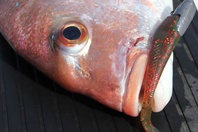
Soft-baiting is the writer's preferred method of fishing.
I’ve had many moments where it would have been handy to have another mate with me, but the rewards are pretty sweet when you finally net a snapper you’ve been carefully playing for 10 minutes. I could probably get better at the self-photography thing, but how many fishermen can be bothered with selfies when the fish are biting? I find I’m more concerned with getting my line back to the bottom to see what other monsters lurk below.
|
|
This article is reproduced with permission of |

Recent Forum Posts Visit Forum

Shane Jones
in Fisheries Management18 hours ago
Tzer
Far cry to the twats at Liegasea/NZSFC were proposing of 5 Tarakihi person in their submission for the central management area and this is what our...

Bluefin Tuna at the cavs.
in The Briny Bar38 hours ago
smudge
Despite my years of fishing I haven't really fished many places, my focus has always been on Auckland's west coast and out toward Great Barrier. I...

Casting gloves
in Popper and Topwater Fishing83 hours ago
Mc Tool
100 bucks for a lure 😬. Watching one of them flying over the horizon without the line attached would be " character building " for sure...
I thought Id post some nice photo's , join...
in The Briny Bar134 hours ago
Alan L
That is a very cool pic Krow.The Far North is very cool, the Far far North even cooler. Mint looking day.Alan...

Mc Tools berley mincer
in The Briny Bar141 hours ago
SaltyC
Good size, they scrap well. Got an 18kg one up in Vava'u back a few years ago fishing off squeaky Going's boat. That was quite a...

Out with the "Twelves"
in Fishing Reports195 hours ago
Pcj
I should be able to get out end of October. The nephew been out virtually every weekend over winter and has done well. It seems the...
Manukau Harbour & West Coast fishing
in Fishing Reports203 hours ago
smudge
Nice work Schecter, I think snapper may be around sooner than you think. Well I am hoping so...

Whangarei Harbour report.
in Fishing Reports635 hours ago
krow
180 +m is where I've had to be lately. A lot less low foul around these parts and some of it shallower that looks like Tarakihi...
Whangarei Harbour Scallops
in Fisheries Management745 hours ago
Pcj
Reopening WhangÄ쳌rei Harbour to recreational scallop fishingTÄ“nÄ쳌 koeFisheries New Zealand is seeking feedback from tangata whenua, stakeholders, and the public on whether WhangÄ쳌rei Harbour should be...
SNA1 Recc fishing cops the blame.
in Fisheries Management841 hours ago
Tzer
What Liegasea won’t tell you is that some of their own fisheries contractors were co-authors of this study for fear of being called hypocrites, one of...

Popular Articles

Softbait Fishing - Part 1 - gear selection
John Eichlesheim writes an article about selecting the right equipment for softbait fishing... Read More >
Softbait fishing Pt 2 - tips and tricks
Techniques, tips and tricks of softbait fishing – getting the most from your soft baits.... Read More >

Surfcasting - setting yourself up
Gary Kemsley helps sort out the necessary gear for intending surf fishers.... Read More >

Squid - How to catch them
Squid fishing is a rapidly growing aspect of fishing - Paul Senior shares some hints and tips to get started.... Read More >
Fishing Reports Visit Reports
Outer Hauraki Gulf Fishing Report 17/09/26
Spring wind the handbrake. Spring is starting to make its presence felt in the outer... Read More >
Top of the South Fishing Report - 17/09/26
Early snapper in Tasman Bay. Well, spring is finally here, and the days are getting... Read More >
Bream Bay Fishing Report - 17/09/26
Good snapper catches reported. After Tangaroa turned off the fish tap for a month or... Read More >
Bay of Islands Fishing Report - 17/09/26
Pacific bluefin tuna for the lucky few. The last fortnight has seen more fishable days... Read More >
Comments