
Fishing Options in Winter

While winter fishing can be hard going, John Eichelsheim enjoys the challenge – and the variety.
A recent mid-winter session didn’t produce a whole lot of fish, but those we did catch were good ones and there was quite a variety as well, at least for the Waitemata Harbour.
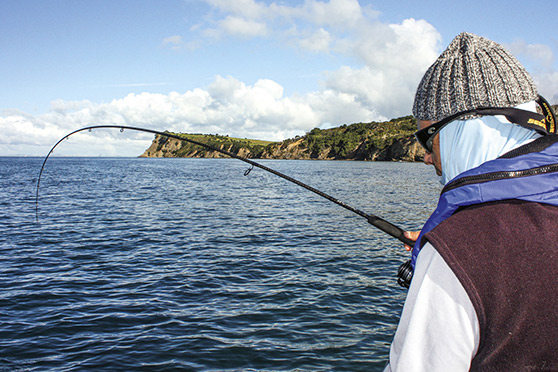
Winter fish may be fewer, but bigger sizes make up for it.
As usual, Mark Kitteridge and I set out early, armed with soft-bait rods and an assortment of jigs. Our loose plan was to start with some close inshore soft-plastics fishing while light levels were low, before trying our luck a bit deeper later in the morning.
Plans should be loose for good reason: when fishing it pays to be flexible so that you can take advantage of situations as they develop. As we approached the reef complex on the end of the island where we wanted to start fishing, I noticed quite a lot of bait sign and some good snapper marks off the edge of the reef in 15-20 metres of water. There were also a lot of gannets in the area sitting on the water and patrolling overhead. It looked fishy.
On the strength of that, we decided to make our first drift in 17 metres rather than right in against the rocks. It took a few casts, but the first bite turned out to be a decent winter snapper of around 1.5kg. Encouraged, we repeated our drift a few times over the next hour, boating a couple more snapper, but many of the bites were tentative and we lost several fish to pulled hooks. The fish were there, but they weren’t really on the chew.
Nevertheless, our modest success was enough to inform our next move. We cruised to the end of the island, starting in 20 metres where the rock meets the sand. I’d like to say the move did the trick and we filled the fish bin, but that’s not what happened. Instead, it was typical winter fishing, on par for a cold, blue sky morning with little wind. We had to work for every bite, but perseverance paid off and we gradually put a respectable catch together.
All our snapper were like peas in a pod: around 40cm long and a bit over a kilo in weight. But it was the surprise catches that made the session so interesting. The first of these registered as a solid weight when I lifted my soft-bait off the seabed. Obviously not a snapper, it provided solid, if unspectacular, resistance as I worked it up from 23 metres.
Both Mark and I called it for a john dory, so we were surprised when more than a kilo of gurnard spread its wings on the surface. That’s a solid gurnard for the Hauraki Gulf and an unexpected catch for that location. It is the first I’ve ever caught there, but that’s winter fishing – full of surprises.
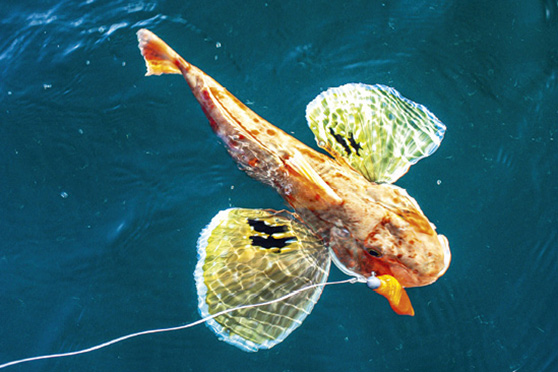
A big gurnard was another welcome catch.
It was also a welcome catch: I love eating gurnard, which makes a nice change from snapper.
Not two casts later I came up solid again, but like the last fish, this was obviously no snapper. There was considerable weight, but not much movement and certainly no tugs or headshakes. With the previous catch in mind, I voiced my hope that it was another fat gurnard, perhaps even bigger than the last, but I wasn’t disappointed when it turned out to be a fat john dory.
In my opinion john dory are not as plentiful as they used to be, but those I do catch are usually taken in winter. That said, a few bites later I was connected to another slow-moving weight, which turned out to be yet another john dory, the same size as the last. The ice box was starting to look very healthy!
In between the ‘exotics’ we continued to catch snapper at a slow but steady rate. There were just enough bites to hold our interest and the fish were, for the most part, big enough to be worth catching.
The morning slowly played out with a fish here and a fish there until suddenly it was 10am and we still hadn’t tried the shallows. A quick run across the bay, with a couple of stops on the way to investigate promising bird activity, saw us eventually nosing in against the cliffs at a location we both like to fish.
The light breeze worked with the tidal stream to carry us slowly up the channel and towards the beach, so we started fishing in about 10 metres of water and drifted our way inshore until the water was around three metres deep.
With the sun high overhead and the water winter-clear, Mark was a little skeptical about our chances, especially since most of the time we could easily see the bottom. We both hooked keeper snapper pretty quickly, however, so we stuck with it, repeating the drift but starting at a different position each time so as to cover new water.
As is always the case at this location, there were a lot of kahawai to contend with, but plenty of snapper too. We released both kahawai and snapper, since we already had enough for a feed. In such shallow water, fish survive catch and release just fine.
The next catch was neither a kahawai nor a snapper, but a trevally, adding to our mixed bag. Trevally love soft-plastics and are a reasonably common in shallow, kelpy territory, especially in winter. They feel quite different to snapper on the line, pulling strongly, boring down and often circling under the boat.
Mark gets a bit twitchy if I go in too close, preferring to fish in 10-15m of water at this location, but our best fish of the morning fell to a New Penny Z-Man jerk shad in just three metres of water. I fished it on a quarter-ounce jighead cast well away from the boat and the fish hit like a freight train. At 3.5kg, it was no giant, but we’ve both caught much bigger snapper here and also hooked biggies we simply couldn’t extricate from the rocks and kelp.
By now it was nearly midday and bites in the shallows had pretty much dried up, so I relented and took Mark out to 15m where he promptly hooked a snapper. I joined in and together we enjoyed steady fishing for the next hour, but none of them were more than about a kilo.
We decided to call it a day at 1pm and beat the rush at the boat ramp. It had been a good day. We’d had to work for our fish, as is often the case in winter, but we were well pleased with our winter mixed bag.
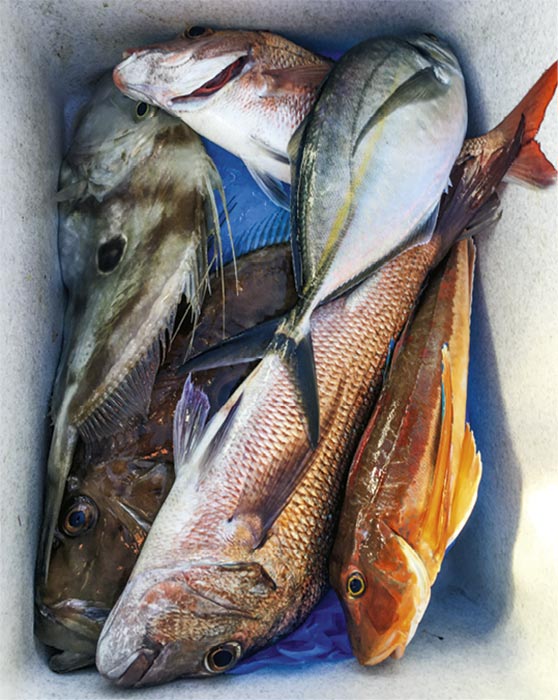
A mixed bag of top table fish; who could ask for more?
|
----- Advertisement -----
|
This article is reproduced with permission of |

Recent Forum Posts Visit Forum

Shane Jones
in Fisheries Management16 hours ago
Tzer
Far cry to the twats at Liegasea/NZSFC were proposing of 5 Tarakihi person in their submission for the central management area and this is what our...

Bluefin Tuna at the cavs.
in The Briny Bar36 hours ago
smudge
Despite my years of fishing I haven't really fished many places, my focus has always been on Auckland's west coast and out toward Great Barrier. I...

Casting gloves
in Popper and Topwater Fishing81 hours ago
Mc Tool
100 bucks for a lure 😬. Watching one of them flying over the horizon without the line attached would be " character building " for sure...
I thought Id post some nice photo's , join...
in The Briny Bar132 hours ago
Alan L
That is a very cool pic Krow.The Far North is very cool, the Far far North even cooler. Mint looking day.Alan...

Mc Tools berley mincer
in The Briny Bar139 hours ago
SaltyC
Good size, they scrap well. Got an 18kg one up in Vava'u back a few years ago fishing off squeaky Going's boat. That was quite a...

Out with the "Twelves"
in Fishing Reports193 hours ago
Pcj
I should be able to get out end of October. The nephew been out virtually every weekend over winter and has done well. It seems the...
Manukau Harbour & West Coast fishing
in Fishing Reports201 hours ago
smudge
Nice work Schecter, I think snapper may be around sooner than you think. Well I am hoping so...

Whangarei Harbour report.
in Fishing Reports633 hours ago
krow
180 +m is where I've had to be lately. A lot less low foul around these parts and some of it shallower that looks like Tarakihi...
Whangarei Harbour Scallops
in Fisheries Management743 hours ago
Pcj
Reopening WhangÄ쳌rei Harbour to recreational scallop fishingTÄ“nÄ쳌 koeFisheries New Zealand is seeking feedback from tangata whenua, stakeholders, and the public on whether WhangÄ쳌rei Harbour should be...
SNA1 Recc fishing cops the blame.
in Fisheries Management839 hours ago
Tzer
What Liegasea won’t tell you is that some of their own fisheries contractors were co-authors of this study for fear of being called hypocrites, one of...

Popular Articles

Softbait Fishing - Part 1 - gear selection
John Eichlesheim writes an article about selecting the right equipment for softbait fishing... Read More >
Softbait fishing Pt 2 - tips and tricks
Techniques, tips and tricks of softbait fishing – getting the most from your soft baits.... Read More >

Surfcasting - setting yourself up
Gary Kemsley helps sort out the necessary gear for intending surf fishers.... Read More >

Squid - How to catch them
Squid fishing is a rapidly growing aspect of fishing - Paul Senior shares some hints and tips to get started.... Read More >
Fishing Reports Visit Reports
Outer Hauraki Gulf Fishing Report 17/09/26
Spring wind the handbrake. Spring is starting to make its presence felt in the outer... Read More >
Top of the South Fishing Report - 17/09/26
Early snapper in Tasman Bay. Well, spring is finally here, and the days are getting... Read More >
Bream Bay Fishing Report - 17/09/26
Good snapper catches reported. After Tangaroa turned off the fish tap for a month or... Read More >
Bay of Islands Fishing Report - 17/09/26
Pacific bluefin tuna for the lucky few. The last fortnight has seen more fishable days... Read More >
Comments