
Fishing on Holiday – Where to Start
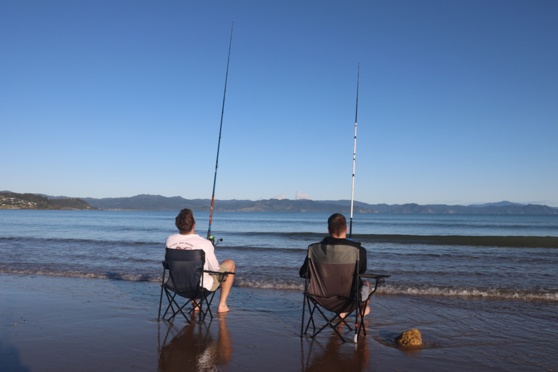
If you’re heading to a new place where you haven’t fished before, here’s a few basic things you can do to make the most of your trip.
Local knowledge
One option is to ask a local – or the guy at the campground who has been staying there every summer for the last 30 years – where and how to catch the fish. However, there’s a problem with this: 50% of the time you will be told straight out lies, and 40% of the time locals will tell you enough so you can get a few fish but won’t give away the best info. This means that just 10% of the time, you’ll be given the best local knowledge available. This might sound mean, but hey, would you give a stranger your fishing spots?
As a Bay of Islands local, I get asked by visitors where and how to catch the fish here, and I’m one of the 40% that give a degree of info. I want visitors to have fun and catch a feed, but I don’t like to see them smashing out their limit every day and then dumping fish frames on the beach.
If you want to get good info from locals, there are some things you can do to help your cause, the most important of which is to be a good bugger. Don’t bowl up to someone and in the first ten seconds say, “Where are all the fish and have you got some GPS marks for me?” If someone likes you, they’re more likely to want to help, so be friendly and respectful – beer helps also.
Try what you know
Most people will do this by default anyway. If you have been catching fish in a particular depth, over a particular type of terrain, with a particular technique in your own backyard, you’re probably going to try the same thing in a new area. This is a good place to start, and it might just work, but if your usual style of fishing doesn’t get results, before you try something radical, just try some common-sense variations. For example, try using heavier or lighter sinkers depending on the depth or current; changing to lighter leader if the water is clearer than you are used to; or try drifting if you usually anchor, and vice versa. Often slight changes to the way you usually fish is enough to get you catching.

Fishing a new area over the summer holidays, Matt tried a likely looking reef. After applying some basic fishing knowledge, his son Shaw caught and released his first two 20-pound-plus snapper.
Apply fishing knowledge
There is a basic premise to catching fish: you have to find them first. So, rather than obsessing on where someone told you where to go (remember, at least 50% of the time it’s lies anyway), look for the signs of where fish might be. Here’s a few for you.
If it’s spawning time you want to find water that is 18 degrees or warmer, and is 20-50 metres deep. Spawning fish like to aggregate in a body of water that is relatively sheltered from storm surges and ocean currents that can rapidly change the water temp. Keep your eyes up and look for bird activity, baitfish, surface feeding activity, current lines and strong colour-change lines. Once you find these things, use your sounder to survey the area. If you don’t have a sounder, give it a go anyway because all the above visual signs mean there is food in the area.
And don’t forget, if you want to know how to tie knots, rig baits and find fish, we have all the step by step videos available free at ultimatefishing.tv or take the knowledge out fishing with you with the free Ultimate Fishing app. If you ever wonder what I would do to catch fish, just look at the app because it’s all there.
But fish or no fish, be good to your fellow Kiwis this summer. Be patient on the roads and boat ramps that we share with one and other. Locals, be good hosts, and visitors, be respectful, and let’s enjoy this place together.
|
|
This article is reproduced with permission of |

Recent Forum Posts Visit Forum

Otago harbour
in The Briny Bar10 minutes ago
Mc Tool
Thats the best pressie I have had for a while . I know its me but every time I went looking for charts like this I...

2026 Grunter Hunter
in The Briny Bar10 hours ago
krow
Thanks Guys. I'll have another go as soon as the weather and work miss-align. I have Kahawai and Mullet. ...

Manukau Harbour & West Coast fishing
in Fishing Reports12 hours ago
smudge
That's a great catch Schecter! Kayak fishers do it so much harder than anyone else. It would be an absolute pleasure to hand over the $5k...
Knife sharpeners
in The Briny Bar59 hours ago
krow
I'm about to order a couple from Amazon. Check your PM Smudge...
1989 Evinrude 90hp V4
in The Boat Shed60 hours ago
bricker
Inherited the above outboard on a boat - is in very good order with little use. The serial number is A1351974. Is there a way of...

Auckland Yakkers
in Yak Yak Yak138 hours ago
BananaBoat
Out from Mission bay this evening. Went to the red marker by Mission & Kohi. Never fished this area beforeHad a quick looksie for some structure....
Yellowfin
in The Briny Bar155 hours ago
krow
I heard there were Yellowfin East of the chicks yesterday but I'd suggest this is unusual this late in the season as the water is cooling....

Mac'nificent Autumn Fishing....Mokau!
in Fishing Reports182 hours ago
Snappa Geoff
Thankyou for the replies guys... Tagging some bigger fish is a good idea Krow! but it doesn't interest me enough to get involved....
Yozuri crystal minnow deep diver lure 6"?
in Popper and Topwater Fishing221 hours ago
SeniorInvissibl
Anyone ever used this lure before to provide feedback? I've never used yozuri before.The package states it dives to 20 feet, I'm using it to troll...
Smart battery chargers
in The Briny Bar326 hours ago
Mc Tool
I went for the Victron Blue smart IP22 12v 15a with 3 outputs , (max 15a across any of 1 - 3 outputs ) $249 .Thanks...
Popular Articles

Softbait Fishing - Part 1 - gear selection
John Eichlesheim writes an article about selecting the right equipment for softbait fishing... Read More >
Softbait fishing Pt 2 - tips and tricks
Techniques, tips and tricks of softbait fishing – getting the most from your soft baits.... Read More >

Surfcasting - setting yourself up
Gary Kemsley helps sort out the necessary gear for intending surf fishers.... Read More >

Squid - How to catch them
Squid fishing is a rapidly growing aspect of fishing - Paul Senior shares some hints and tips to get started.... Read More >
Fishing Reports Visit Reports
Tauranga Fishing Report - 28/05/26
Tarakihi on the bite Trips are few and far between at this time of year,... Read More >
Canterbury Fishing Report - 28/05/26
Fresh and salt turning it on! It is not very often I get to say... Read More >
Bay of Islands Fishing Report - 28/05/26
Lures paying dividends We finally had a break in the SE winds that have been... Read More >
Manukau/West Coast Fishing Report - 28/05/26
Snapper and gurnard in the harbour The weather has finally taken a turn for the... Read More >
Comments