
Fishing From Small Boats

Mark Kitteridge outlines the benefits of fishing from small boats in New Zealand...
It’s interesting: I fish with some of Auckland’s keenest fishers regularly, yet none of us owns a boat over six metres in length. Tellingly, all of us have chosen tinnies, too.
True, none of us is particularly wealthy, which obviously has a significant influence on the boat chosen and used, but we’re not poor either. We could buy a bigger boat if we really wanted to.
So why are our various vessels so modest in size?
Initial financial outlay
Buying a boat involves a serious amount of cash these days, especially those over six or seven metres in length, and as the prices of materials and components continue to soar, they will only get more expensive still.
Then, of course, we also need an outboard, trailer, various fittings and electronics, and so on. But fortunately, everything is of modest size, and there is only so much bling that can be fitted in and on a small boat!
In my case and those of my friends, we each figured out what we wanted from a boat and bought the best possible for the amount we could afford at the time (and a bit more besides!). This currently sees us owning vessels that vary from my own short and chunky Stabicraft 389 (a bit like me, really), to John Eichelsheim’s Stabicraft 1450 ProFish and Andre Kassal’s RC450 Senator, up to Josh Darby’s soon-to-arrive Kingfisher 570 Minicat ‘gin palace’.
Why tinnies?
We all opted for various brands of tinnies because the material is very versatile and adaptable, allowing the boat builder to cater to our specific needs. Chop a bit out there, and add a bit on here, according to the prospective owners’ specific requirements. You simply can’t do the same to fibreglass moulds.
Aluminium is much lighter, too, making it easier to handle and tow. And if it bashes into something unforgiving, it’s just a scratch, dent or, at worst, something to cut out and replace with some welding.
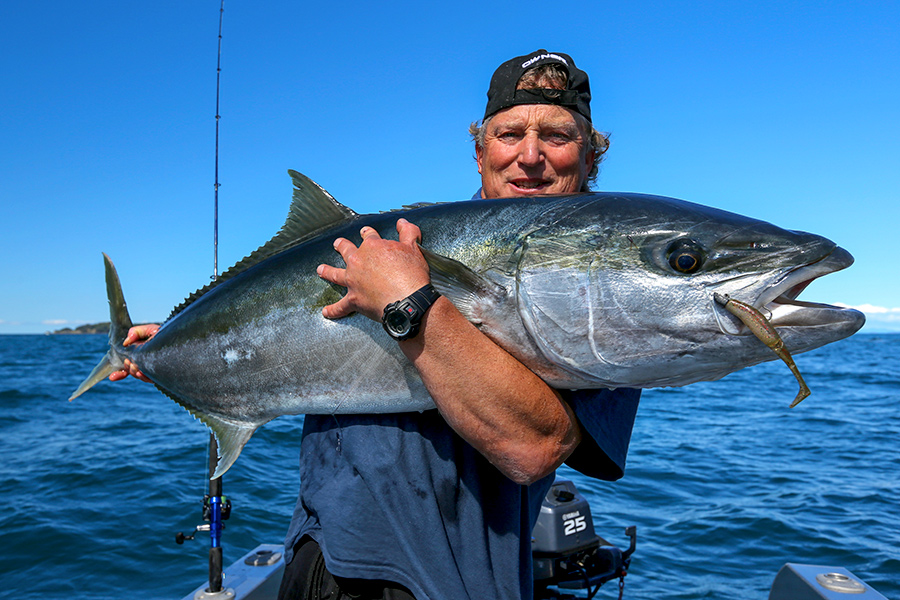
Quick work at the Stabi 389’s tiller saw this huge light-tackle kingfish chased down, landed and released
Storage space
We live in Auckland, a sprawling yet very cramped area full of intensive housing jammed onto small properties. Our boats must fit within our tiny kingdoms or be stored elsewhere, perhaps at a friend’s place (inconvenient for both parties generally) or a storage facility (inconvenient and quite costly!). Indeed, the available space we have tends to determine which boat we can realistically buy. Similarly, when buying a new house, not having sufficient room for the boat tends to be a deal breaker!
Preparation
We are all keen fishermen, and that means we want to go fishing as much as possible. However, work and family commitments must be considered and worked around, and then there’s that tiny issue called weather – especially in recent times! The ability to organise our boats at short notice is obviously a huge advantage, enabling us to take advantage of weather windows and other fishing opportunities. Small boats are easy and quick to get ready.
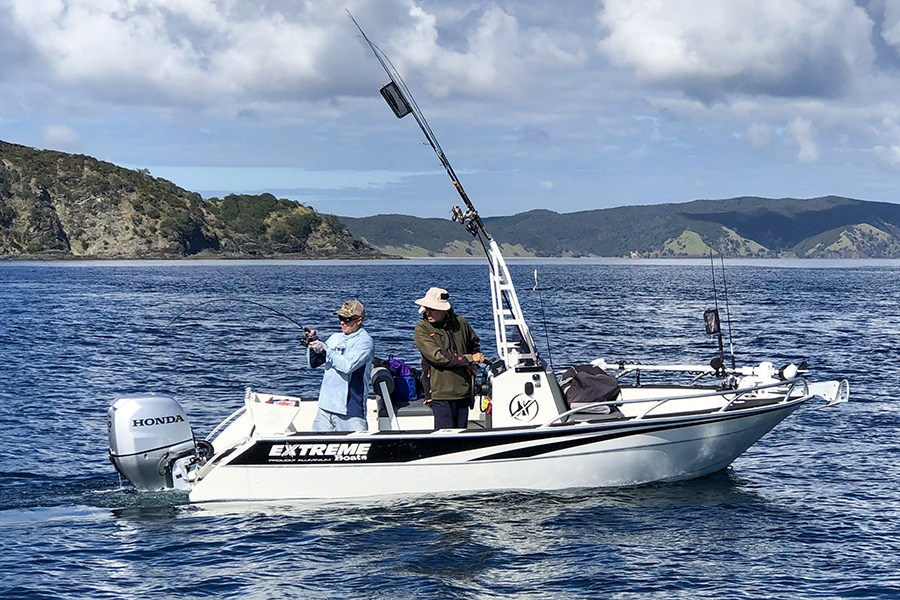
Small boats are very nimble, a significant advantage when chasing especially big fish.
Transportation
A small boat is relatively simple and cheap to move to the preferred launching spot, enabling us to zip to wherever the fishing action might be and/or where some shelter is offered from the existing weather and sea conditions.
No need for a gas-guzzling monster truck when you own a small boat, either. My own 2.5L Subaru barely knows it’s got the 389 Stabi’ hitched on the back, so my petrol consumption remains very reasonable.
It’s also less stressful when your towed vessel is of modest size. Passing is easier (and potentially less dangerous), there’s no holding up of traffic on steep hills, and navigating very narrow, windy roads with big trucks on them is less scary.
Launching and retrieving
Not only is launching and retrieving small boats so much easier, it’s also quicker – an aspect you really appreciate when big sets of swells are sweeping across the launching ramp or beach landing.
Similarly, there are so many more potential launching sites available for smaller boats, something we really value when settled weather coincides with peak fishing times and long ramp queues.
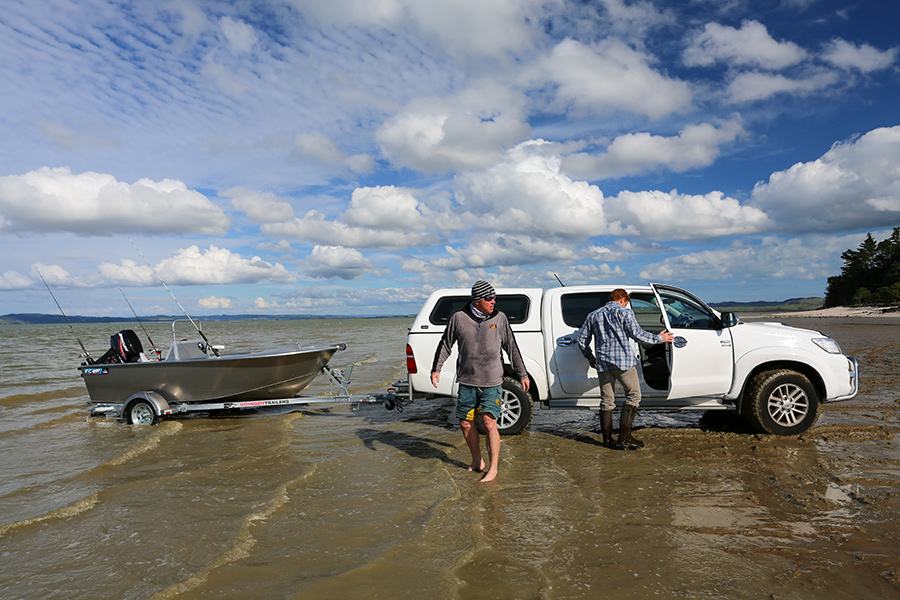
Borderline launching conditions? No worries when you own a small, light tinny!
Running costs
A typical day out fishing for me costs around $20-50 (max). That’s around $15-40 for gas per person (usually divided between two or three persons), and typically $0-10 for a couple of durable softbaits and jigheads. Add a bit more on for the petrol used by the car while towing as well, although the size and weight of the boats we tow means that’s not significantly more than usual.
Conclusion: If I had to spend two or three times that amount for whatever reason – as many anglers must do – my wife would definitely not be as supportive of my addiction!
Fishability
I usually prefer fishing from relatively open four to six-metre fishing craft. The noises and shadows generated from such vessels are not significant, enabling us to sneak into relatively shallow water and target fish efficiently with our softbaits, especially if armed with an electric motor (talk about a game-changer!).
Specialist boats like ours often sacrifice overhead protection to varying degrees to enable plenty of casting room. We can therefore be in a five-metre boat but have way more fishing room than six-metre-plus boats with ‘standard’ cockpits. This allows more anglers to cast softbaits and topwater lures where they want – a big plus when effectively covering the area and/or precise casting angles are required.
Better still, upon hooking up, it’s generally possible to move right around the boat if necessary to follow more active fish. And if it’s something unusually large, it’s no problem to jump onto the boat’s helm or tiller and perform whatever manoeuvres are required at the time.
The fact tinnies are made from metal means we can take some risks too – I’ve had to fend off rocks occasionally when drifting in the shallows casting softbaits – and borderline launching sites are less likely to result in significant structural damage should things go somewhat awry.
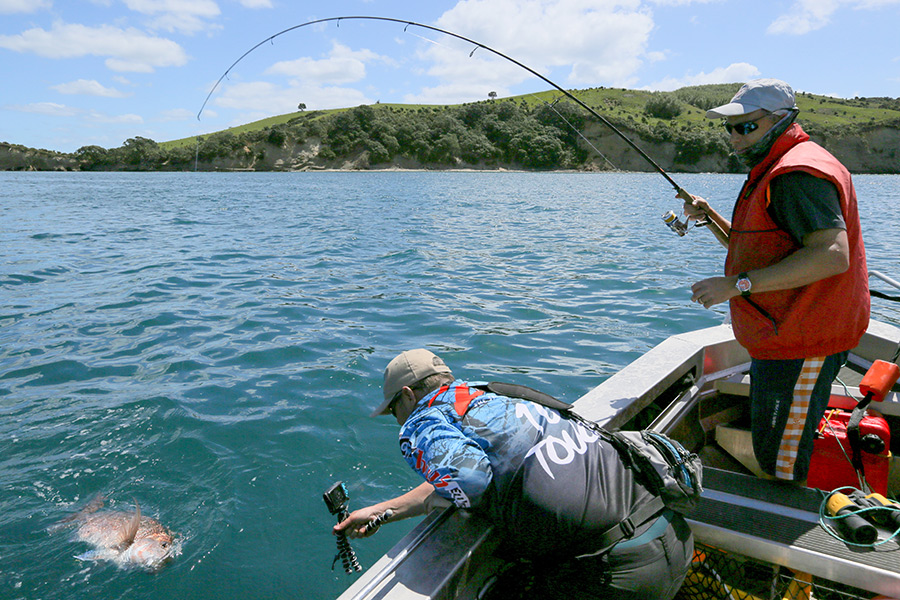
Many modern pontoon boats are incredibly stable!
Range
Most times there are enough great destinations within an hour’s drive to keep keen anglers like myself more than happy. Sure, some spots require specific tides or winds to be practical, comfortable or safe, but that’s what the plethora of weather apps are for. The world is a small-boat operator’s oyster.
However, it’s surprising the places you can reach in four to five-metre craft, too. I once got out to Little Barrier Island in my little 3.89m tinny, and we regularly go there – and even as far out as the Mokes if conditions are especially settled – in my friends’ bigger craft. Get it wrong, though, and you will pay to varying degrees, so common sense obviously needs to prevail!
In a similar vein, that’s why it’s especially important to carry all the required safety and communication devices when using small boats like ours. It’s also why I wear a PDF at all times (I’ve unexpectedly ended up in the water in calm conditions and nearly drowned once, so it does happen) and why I recommend being a Coastguard member.
Anonymity
I make a living talking to like-minded folk about fishing, lures especially, but I’d prefer to stay out of the limelight when on the water. Workups excepted, I’m hoping to find quiet areas with minimal boat activity where the fish are happily carrying on doing their usual fishy duties, so we can fish for them the way we want to. A small tinny devoid of fishing-related branding helps keep me under the radar and the fish coming on board.
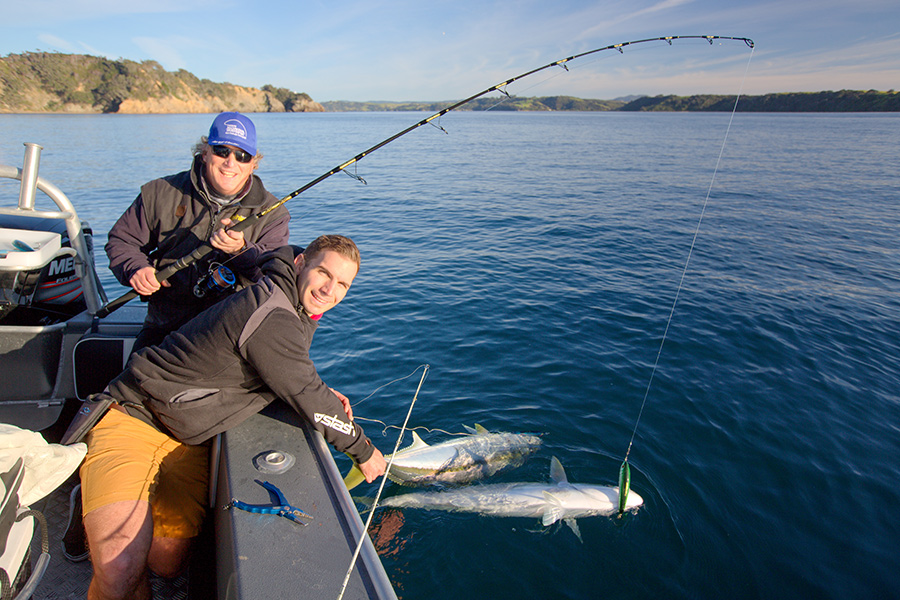
You don’t need to travel far – a nice double of ‘local’ kingfish from Josh Darby’s FC boat.
Day’s end
When we get home, it’s usually a case of a quick squirt of the hose (perhaps combined with a little soap or salt remover for the particularly proud owners), running some fresh water through the outboard, and then leaving everything to dry. Job done. Another bonus when bait and berley aren’t used.
Maintenance
This aspect varies a massive amount between craft of any size, depending on the ‘amount of fruit’ fitted. I’ve deliberately kept my own little vessel as open and spartan as possible to enable maximum casting space when softbaiting, topwater lure fishing and saltfly fishing, as well as ensuring there are fewer things to potentially maintain or break.
Yet I must admit to some envy when fishing aboard my friends’ vessels. Despite only being a bit bigger, their centre or side-console boats tend to easily accommodate several more rods, the valuable dry storage is more generous, and more shelter is available in unpleasant conditions. The ability to stand up in choppy conditions and hang onto something solid is something I miss when in my own boat occasionally, too.
And while I love going out with friends operating electric motors – these devices truly are game changers when it comes to lure fishing – I can’t be bothered with the regular charging of batteries required.
On the plus side, I pay very little for my boat’s upkeep over the year, provided I wash it down, lubricate moving bits, and have my Honda 30 four-stroke outboard regularly serviced.
Still room for big boats?
Yes, of course! I really enjoy the comforts on offer in bigger boats and love going to the places that can be reached, even when conditions aren’t perfect. But if I’m stuck with smaller boats for the rest of my life, I’ll be more than happy.

June 2023 - Mark Kitteridge
New Zealand Fishing News Magazine.
Copyright: NZ Fishing Media Ltd.
Re-publishing elsewhere is prohibited
Recent Forum Posts Visit Forum

Trailer wheel clamp
in The Boat Shed2 minutes ago
Pcj
Doesnt dry out like crc.I use it on my trailer lock...

Shane Jones
in Fisheries Management26 hours ago
Tzer
Far cry to the twats at Liegasea/NZSFC were proposing of 5 Tarakihi person in their submission for the central management area and this is what our...

Bluefin Tuna at the cavs.
in The Briny Bar46 hours ago
smudge
Despite my years of fishing I haven't really fished many places, my focus has always been on Auckland's west coast and out toward Great Barrier. I...

Casting gloves
in Popper and Topwater Fishing91 hours ago
Mc Tool
100 bucks for a lure 😬. Watching one of them flying over the horizon without the line attached would be " character building " for sure...
I thought Id post some nice photo's , join...
in The Briny Bar142 hours ago
Alan L
That is a very cool pic Krow.The Far North is very cool, the Far far North even cooler. Mint looking day.Alan...

Mc Tools berley mincer
in The Briny Bar149 hours ago
SaltyC
Good size, they scrap well. Got an 18kg one up in Vava'u back a few years ago fishing off squeaky Going's boat. That was quite a...
Out with the "Twelves"
in Fishing Reports203 hours ago
Pcj
I should be able to get out end of October. The nephew been out virtually every weekend over winter and has done well. It seems the...
Manukau Harbour & West Coast fishing
in Fishing Reports211 hours ago
smudge
Nice work Schecter, I think snapper may be around sooner than you think. Well I am hoping so...

Whangarei Harbour report.
in Fishing Reports643 hours ago
krow
180 +m is where I've had to be lately. A lot less low foul around these parts and some of it shallower that looks like Tarakihi...
Whangarei Harbour Scallops
in Fisheries Management753 hours ago
Pcj
Reopening WhangÄ쳌rei Harbour to recreational scallop fishingTÄ“nÄ쳌 koeFisheries New Zealand is seeking feedback from tangata whenua, stakeholders, and the public on whether WhangÄ쳌rei Harbour should be...
Popular Articles

Softbait Fishing - Part 1 - gear selection
John Eichlesheim writes an article about selecting the right equipment for softbait fishing... Read More >
Softbait fishing Pt 2 - tips and tricks
Techniques, tips and tricks of softbait fishing – getting the most from your soft baits.... Read More >

Surfcasting - setting yourself up
Gary Kemsley helps sort out the necessary gear for intending surf fishers.... Read More >

Squid - How to catch them
Squid fishing is a rapidly growing aspect of fishing - Paul Senior shares some hints and tips to get started.... Read More >
Fishing Reports Visit Reports
Outer Hauraki Gulf Fishing Report 17/09/26
Spring wind the handbrake. Spring is starting to make its presence felt in the outer... Read More >
Top of the South Fishing Report - 17/09/26
Early snapper in Tasman Bay. Well, spring is finally here, and the days are getting... Read More >
Bream Bay Fishing Report - 17/09/26
Good snapper catches reported. After Tangaroa turned off the fish tap for a month or... Read More >
Bay of Islands Fishing Report - 17/09/26
Pacific bluefin tuna for the lucky few. The last fortnight has seen more fishable days... Read More >
Comments