
Fishing for Tropical Trevally
Sam Mossman lists the different trevally species he has encountered fishing in the tropical South Pacific...
There are a great many trevally species spread through our tropical backyard – the South Pacific Ocean – with its far-flung sprinkling of islands, reefs and seamounts. Sometimes it is hard to tell one trevally species from another, but most trevallies have features in common that make them popular with anglers: they take lures (especially surface lures), jigs, and flies well, and fight like demons on the line. Here is a rundown of some of the species I have encountered over the years in the tropical South Pacific.
Bluefin trevally
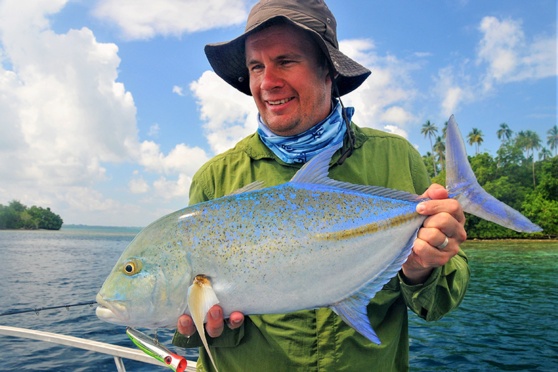
There is no doubt that trevally, as a group, are good-looking fish, but probably the prettiest is the bluefin trevally with its green, silver and gold sides, and amazing bright fluorescent blue fins, tail and spots. Distributed widely through the tropical Indian and Pacific oceans they are found in lagoons and around reefs, making them easily accessible to shore and small boat anglers.
Some of my happiest fishing experiences have included wading the fringes of isolated lagoons with a light spin rod catching bluefin trevally. Small silver jigs and poppers work well on these fish. They tend to fight fairly cleanly, so lighter gear (6-10kg) can be used successfully. Bigger specimens are often a bycatch when targeting GTs outside the reef.
Averaging 2-4kg, bluefin are recorded to 13kg, although they are known to sometimes crossbreed with giant trevally (GTs) with specimens of mixed parentage over 40kg reported. They are good eating fish but, like most members of the clan, avoid consuming big, old specimens, especially in areas with ciguatera toxin issues.
Brassy trevally
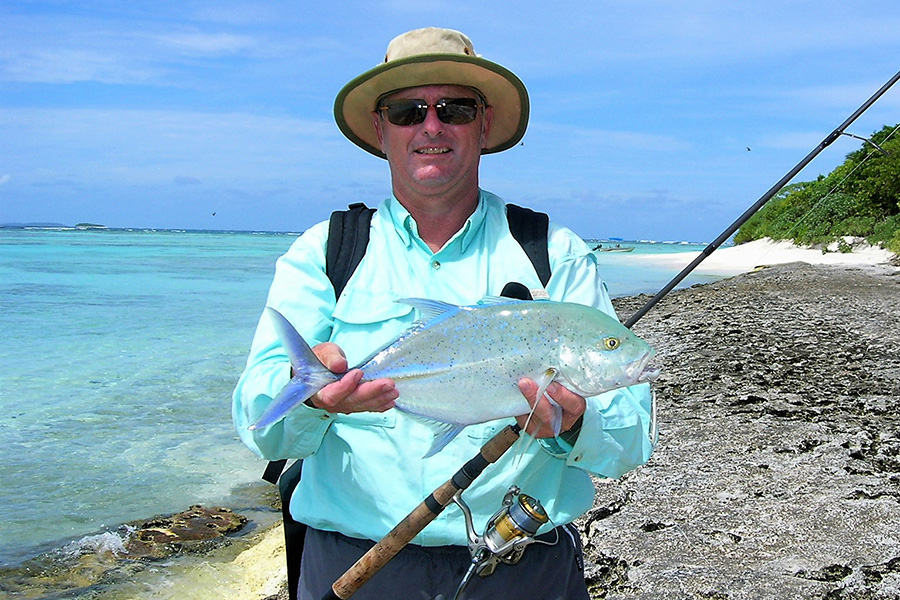
Also known as Papuan or sometimes island trevally, these are another species widely spread across the tropical Indian and Western Pacific as far east as the Tahitian group. It is often encountered by anglers fishing lagoons.
Similar in shape to bluefin, the smaller ones tend to be white/silver all over but as they age, they develop a brassy back with fine black spots and a yellowish tint to their fins. At Aitutaki in the Cook Islands, where they are common, those living over the dazzling white sand in the lagoon stay a white colour for longer.
Brassies grow to about 7kg and are willing takers of lures, in my experience preferring swimming lures to surface lures. However, the best I ever caught took a fly in a lagoon in Vava’u, Tonga, and was only extracted from its coral-studded home after a tough half-hour battle on the long rod. At a near-maximum size for the species on modest tippet and a tiny whitebait fly, it was a particularly pleasing capture.
Bigeye trevally
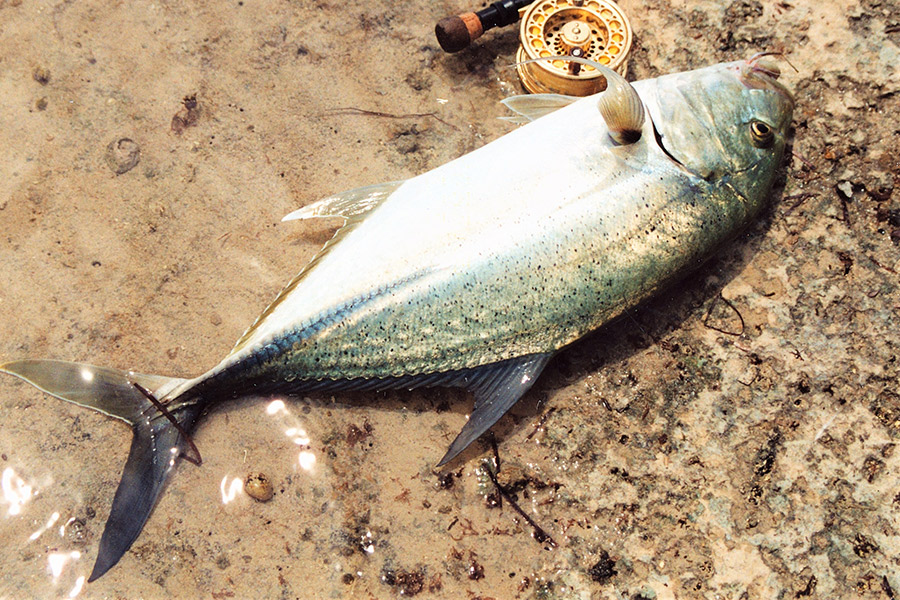
Another widespread tropical trevally, the bigeyes are best distinguished by their large eye, the dark spot at the top of the gill plate, a light spot at the tip of the secondary dorsal fin, dark scutes, and green-blue back. They grow to about 8kg and can form large schools during the day. Although they tend to be mainly nocturnal hunters (note the large eye), they can be caught during the day and are known lure takers. The best I ever caught was many years ago while popper fishing off the southern end of Australia’s Great Barrier in the middle of the day. I released it without weighing it but the local blokes reckoned it was right up there, size-wise.
Golden trevally
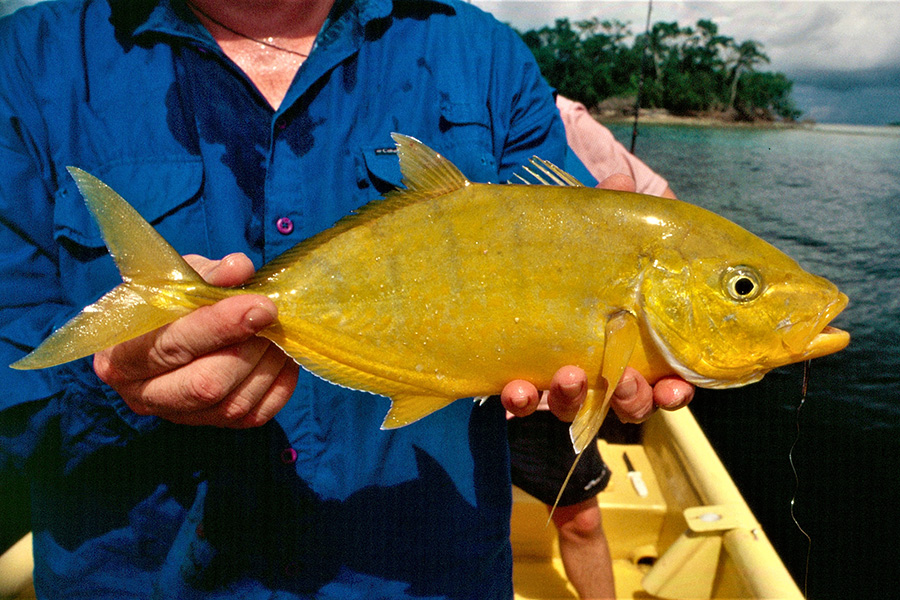
Found throughout the Indo-Pacific, golden trevally are popular sportfishing targets, especially amongst fly fishermen in northern Australia. As the name suggests, juveniles are a bright golden yellow but this bright colour fades as they reach adulthood. They also feature 7-11 dark vertical stripes. Adults develop thick blubbery lips which they use to bottom-feed for shellfish, crustaceans, and small fish. A big one is up towards 10kg, and the all-tackle record is over 17kg, so they are no lightweights. The best action I have had for this species was in the Arafura Sea north of Australia’s Arnhemland, but I have had the odd one in other parts of the Pacific. They take swimming minnows, poppers and flies and are considered good eating fish with sweet flesh.
Black trevally
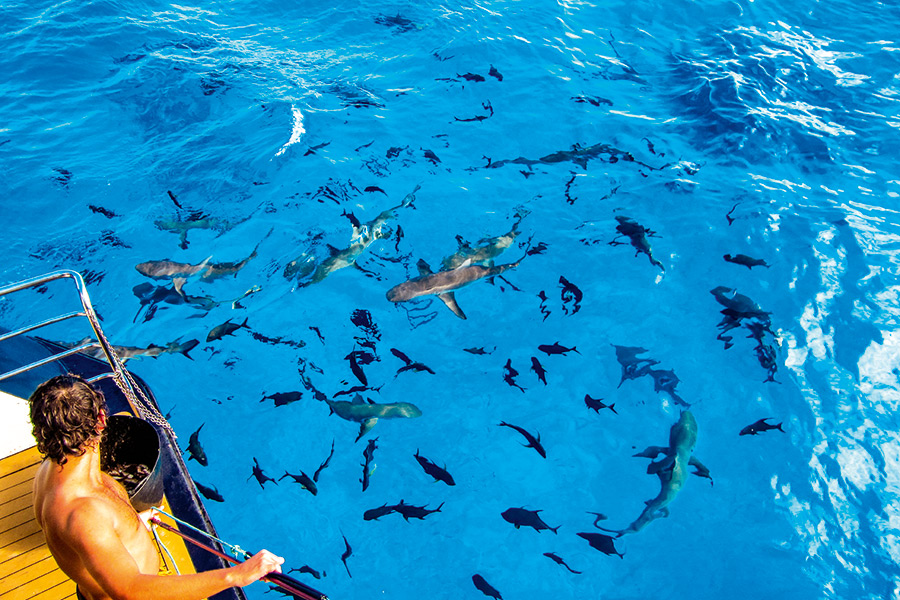
The black trevally, or black jack, (not to be confused with a ‘dark phase’ GT which we will come to later) is rarely found in shallow inshore habitats. The species is most common in oceanic habitats around offshore islands where they inhabit deep reefs and reef drop-offs, also being common around oceanic seamounts. Paul and Brendon Pasisi from Niue provided me with a photo of many black trevally schooling with sharks in the shallow internal waters of Beveridge Reef (now part of the Niue marine protected zone), so they are not always deep water inhabitants.
However, the black jacks I have caught have been taken deep jigging along the drop-offs of isolated Islands like Aitutaki and Niue. Tough fighters, they are found worldwide in tropical waters and grow to about 18kg. They are easily recognised by their humped heads, dark grey-green bodies, and black fins and scutes. Smaller fish have disproportionately long secondary dorsal and anal fins.
Bludger trevally
Bludgers were given their colourful name in Australia, where their dark oily flesh makes them unpopular as a food fish, but sought-after for bait and berley. Yet another Indo-Pacific inshore trevally, bludgers feature erratic dark spots and splotches on their elongated bodies, fight well, and take lures and flies.
Gold spot trevally
Same, same – this trevally has Indo-Pacific distribution, takes lures, jigs and flies, and around 10kg is an exceptional specimen. They are distinguished by a smattering of gold spots across their blue-green upper bodies. I have picked up the odd one as by-catch when jigging Tongan seamounts and popping for GTs in the Solomons and on the Great Barrier Reef, so the bigger ones, at least, are not shy about big poppers.
I will have to stop here. Although there are a great many more trevally species that may be encountered in Pacific waters, these are the main ones, except of course, for one other…
Giant trevally
I’ve saved the best until last. Giant trevally are a terrific fish – including in the old sense of the word ‘terrific’ – something that induces terror!
Giant trevally, or ‘GTs’ as they are called by most anglers, have earned their capitalisation. If they were people, they would be built like those old-fashioned leather couches stuffed with horsehair – big, hard, and lumpy. They would wear greasy denims, studded leather belts and jackets, and would sport a couple of days’ growth of stubble. They would have scars, tattoos, possibly gang patches, and would carry concealed weapons.
As fish, they are bull-headed, deep-flanked powerhouses. The colour of adult GTs can vary from silvery to grey with irregular spots, through to almost uniformly black, a bit like the black trevally already mentioned in this piece. Studies done in the Hawaiian Islands and South Africa have revealed that the black-coloured GTs are mature males, which can take up this dark colouration once they exceed around 70cm in length.
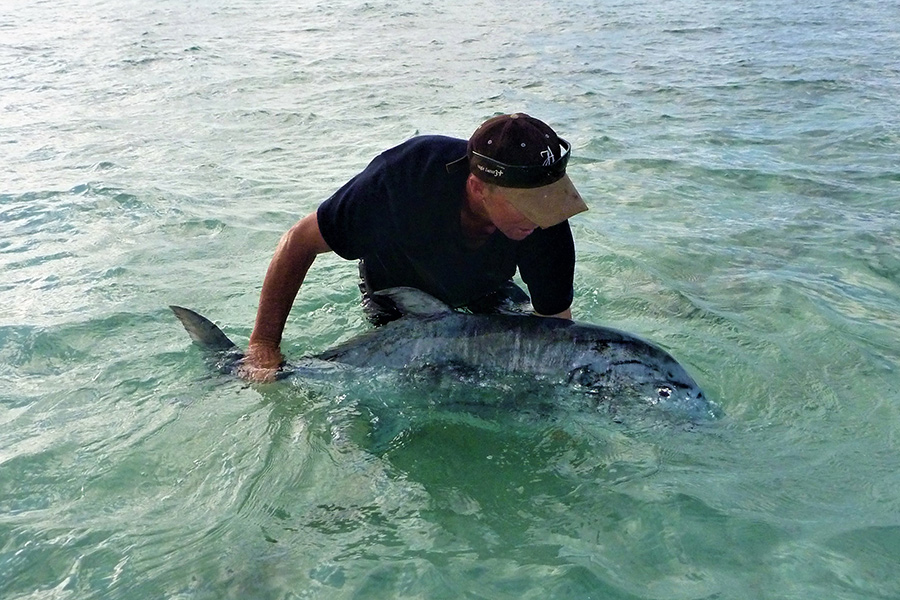
These aggressive, immensely strong predators are powerful enough to hunt even in the white-water breaks on coral reefs. They are thick of skin, the tail wrist is heavily armoured with heavy, razor-sharp scutes, and the hugely powerful jaws are studded with evil spikes of teeth. They grow to over 70kg, but their habitat of often sharp and shallow coral country makes these Volkswagen-sized fish very difficult to extract on rod and reel, so the maximum growth potential may well exceed 100kg.
GTs grow reasonably quickly, and studies have shown they mature at around 60cm in length after three or four years. Growth remains rapid and fish around a metre long are thought to be about 8-10 years old, while large GTs over 1.5 metres long may be over 25 years old.
GTs have become a cult fish, with travelling anglers targeting them on heavy high-tech spin tackle armed with poppers and stick baits. Electronic tracking of adult GTs in the Hawaiian Islands showed that they spent most of their time patrolling relatively small home ranges (around 5-9km) which might explain why continued fishing pressure of localised areas often sees catch rates drop away, even if fish are released. They are tough fish and acoustic tagging studies in Hawaii found that the survival rates of fish caught on casting gear with barbless single hooks is nearly 100%. So, areas where results have dropped away may not be ‘fished out’. I just think catch and release means that GTs get educated quickly. Smart fish!

October 2023 - Sam Mossman
New Zealand Fishing News Magazine.
Copyright: NZ Fishing Media Ltd.
Re-publishing elsewhere is prohibited
Recent Forum Posts Visit Forum

Shane Jones
in Fisheries Management9 minutes ago
smudge
Who else do we have? 100,000 rec fishers all wanting something different? Ohhh and 900,000 that couldn't care less....

Trailer wheel clamp
in The Boat Shed9 hours ago
Mc Tool
either crc long life or 556 marine are way better ...

Foton tunland v9
in The Briny Bar24 hours ago
Ho Dee
not fishing related and delete if required but was wondering if any has one of these or someone who has just wanting so e real world...
Bluefin Tuna at the cavs.
in The Briny Bar71 hours ago
smudge
Despite my years of fishing I haven't really fished many places, my focus has always been on Auckland's west coast and out toward Great Barrier. I...
Casting gloves
in Popper and Topwater Fishing116 hours ago
Mc Tool
100 bucks for a lure 😬. Watching one of them flying over the horizon without the line attached would be " character building " for sure...
I thought Id post some nice photo's , join...
in The Briny Bar167 hours ago
Alan L
That is a very cool pic Krow.The Far North is very cool, the Far far North even cooler. Mint looking day.Alan...

Mc Tools berley mincer
in The Briny Bar174 hours ago
SaltyC
Good size, they scrap well. Got an 18kg one up in Vava'u back a few years ago fishing off squeaky Going's boat. That was quite a...

Out with the "Twelves"
in Fishing Reports228 hours ago
Pcj
I should be able to get out end of October. The nephew been out virtually every weekend over winter and has done well. It seems the...
Manukau Harbour & West Coast fishing
in Fishing Reports236 hours ago
smudge
Nice work Schecter, I think snapper may be around sooner than you think. Well I am hoping so...

Whangarei Harbour report.
in Fishing Reports668 hours ago
krow
180 +m is where I've had to be lately. A lot less low foul around these parts and some of it shallower that looks like Tarakihi...
Popular Articles

Softbait Fishing - Part 1 - gear selection
John Eichlesheim writes an article about selecting the right equipment for softbait fishing... Read More >
Softbait fishing Pt 2 - tips and tricks
Techniques, tips and tricks of softbait fishing – getting the most from your soft baits.... Read More >

Surfcasting - setting yourself up
Gary Kemsley helps sort out the necessary gear for intending surf fishers.... Read More >

Squid - How to catch them
Squid fishing is a rapidly growing aspect of fishing - Paul Senior shares some hints and tips to get started.... Read More >
Fishing Reports Visit Reports
Outer Hauraki Gulf Fishing Report 17/09/26
Spring wind the handbrake. Spring is starting to make its presence felt in the outer... Read More >
Top of the South Fishing Report - 17/09/26
Early snapper in Tasman Bay. Well, spring is finally here, and the days are getting... Read More >
Bream Bay Fishing Report - 17/09/26
Good snapper catches reported. After Tangaroa turned off the fish tap for a month or... Read More >
Bay of Islands Fishing Report - 17/09/26
Pacific bluefin tuna for the lucky few. The last fortnight has seen more fishable days... Read More >
Comments