
Fishing for Goatfish
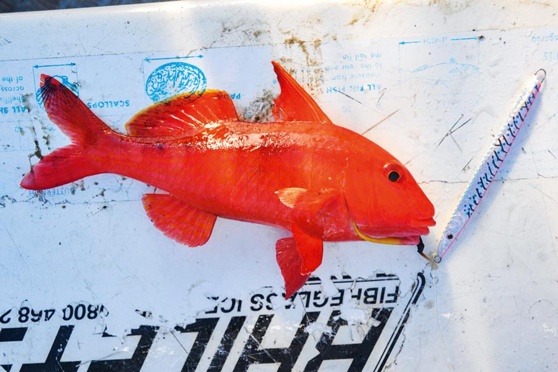
Craig Worthington goes out of his way to catch some of the lesser targeted fish species found in NZ waters, and one of his favourites is the goatfish. He gives us a rundown of where to find and how to catch this rare and attractive fish…
Goatfish are one of the most colourful and interesting small fish you can catch in New Zealand. They are not an everyday catch (which in my book makes them even more interesting), but they will bite lures, flies and sabikis quite readily. They are, in fact, a fish that you can target on any given fishing day – just don’t expect your catch return to be massively high.
Confusingly, they are sometimes referred to as ‘red mullet’ even though they are obviously not related to proper mullet at all. This name comes from the Mediterranean and has ancient origins. The Romans referred to goatfish as ‘mullus’ and considered them a great delicacy. The Family name of Mullidae reflects this history.
I cannot remember ever having actually eaten a goatfish, but I am assured by others that they are quite tasty. There are many different types of goatfish around the world and they all have a good reputation on the plate. In Aitutaki in the Cook Islands you’ll quickly attract a crowd if you give any of the goatfish you catch to one of the locals. Every single species is considered great tucker and there are upwards of ten species there to choose from.
Here in New Zealand there are three or four species of goatfish recorded, but only one species is common – the red goatfish (Upeneichthys lineatus). This goatfish can be found all around the northern parts of the country, favouring soft sediments on the edge of reefs, through harbour channels and in sheltered bays. It is not an uncommon in some flounder spearing locations to disturb a slumbering goatfish with the glow of the flounder light. In some prime locations where coastal currents flow over soft substrates on the edge of kelp smothered rocks, they can be incredibly abundant. The best locations will also have several john dory hovering silently amongst the goatfish schools with shags (cormorants) trying to dive down and grab the goatfish from above. Kingfish too, will make smashing attacks on those goatfish herds. Everything, it seems, likes to eat goatfish.

Our beautiful and very red goatfish - one of the most stunningly coloured fish you will ever catch in New Zealand.
You’ll catch them in depths that range from a few metres right down to one hundred, but they’re most abundant in ten to thirty metres of water. The big male fish frequently attack the lure first. It may be some sort of territorial response. These boys have vivid red hues on their scales and fins with iridescent blue/purple lines and spots running through them, finished off with a vivid, yellow border. Very pretty. Even their eye contains dazzling combinations of blue, purple and red.
The smaller female fish can be a mix of more natural colours in shallow water, while the deeper water fish of all sexes are nearly always a standard red.
All goatfish have the distinctive muscular barbels under their chin. These are a great hunting weapon that they use extremely effectively. They can taste the sand, worm holes and rock crevices with these barbels and winkle out any likely prey. The worldwide abundance of goatfish and their success as a species is mostly a result of these fascinating appendages. They use them so effectively for hunting that it is not uncommon to hook them in the barbel when catching them on sabikis. Watching a school of goatfish working a patch of sand with their barbels is a fascinating sight underwater. They are truly a uniquely adapted fish for the environment they live in.
In terms of size, they are not the biggest fish on the planet, but they more than make up for it with all their other interesting traits. Forty centimetres is about as big as the New Zealand red species gets, but they’re not uncommon in the twenty to thirty centimetre range. At this size they are quite chunky and can produce reasonable sized fillets, if you have the desire to eat one.
Catching goatfish involves bouncing a soft-bait, metal jig or a set of sabikis right on the sand of their soft bottom habitat. They can be quite aggressive and will attack remarkably large lures, even lures bigger than themselves.
I have several spots where I can target them directly, but the catch rate never quite reflects the large numbers I see in these locations when diving. The nice thing about it is that john dory, tarakihi and porae are something of a by-catch in the same environment and so the jigging over these ‘goatfish flats’ can be an interesting diversion for a species hunter like myself.
It is, however, overseas and in the tropics where the goatfish family really comes into their own as a sportfish species. There are several species of tropical goatfish that get even bigger than our chunky red variety. Some of these species get up to fifty centimetres long and are very much predatory in habit. They will nail any fly, lure or soft-bait cast their way.

Red goatfish will attach soft-baits - and just about any other lure or fly you cast their way.
In this regard, Aitutaki is something of a goatfish hotspot. It has a worldwide reputation as a producer of monster bonefish, but those same productive sand flats and coral channels also deliver big goatfish of several types.
The dot-dash goatfish is a bonafide baitfish eater that will eagerly smash any lure cast its way, while the heavy shouldered gold-saddled goatfish is even bigger and more colourful and does very much the same. Both species are a common capture in Aitutaki.

A lovely dot-dash goatfish taken on a fly in Aitutaki.
Slightly smaller than these two ‘premier’ Aitutaki goatfish species are a whole host of other goatfish species that are equally keen on lures and flies. Part of the fun of an Aitutaki adventure can be seeing how many different goatfish species you can catch in the duration of your stay.
The two bigger species can actually be found actively hunting baitfish and can be specifically targeted when they’re on the hunt. Generally, you’ll see a small spray of hardiheads or other baitfish beside a shallow coral bombie or down a sand bottomed coral channel. The big goatfish tend to stick to their territories fairly strongly so you can sneak up on a likely location and lay out a cast when you see baitfish moving. Even once the surface action has calmed down the big goatfish will still be there. As long as you don’t spook them they don’t tend to move too far.

The gold-saddled goatfish is a big stunning goatfish from the tropics that also comes in a bright yellow variety.
At other times the goatfish will be caught on blind casts into channels that have a little bit of current flowing down them. They seem to like a mix of reef and sand with a bit of water flowing over the top.
Catching goatfish in these pristine bluewater tropical environments is an absolute delight, but equally so is jigging for our beautifully coloured red goatfish in quiet sheltered bays nearer to home.
Wherever you find it, goatfish fishing is great fun.

October 2021 - Craig Worthington
New Zealand Fishing News Magazine.
Copyright: NZ Fishing Media Ltd.
Re-publishing elsewhere is prohibited
Recent Forum Posts Visit Forum

Trailer wheel clamp
in The Boat Shed1 hour ago
Mc Tool
either crc long life or 556 marine are way better ...

Shane Jones
in Fisheries Management6 hours ago
Tzer
From what I see too even commercial in WA aren’t getting any favours from politicians there. I think here our advocacy groups like Liegasea aren’t doing...

Foton tunland v9
in The Briny Bar16 hours ago
Ho Dee
not fishing related and delete if required but was wondering if any has one of these or someone who has just wanting so e real world...

Bluefin Tuna at the cavs.
in The Briny Bar63 hours ago
smudge
Despite my years of fishing I haven't really fished many places, my focus has always been on Auckland's west coast and out toward Great Barrier. I...
Casting gloves
in Popper and Topwater Fishing108 hours ago
Mc Tool
100 bucks for a lure 😬. Watching one of them flying over the horizon without the line attached would be " character building " for sure...
I thought Id post some nice photo's , join...
in The Briny Bar159 hours ago
Alan L
That is a very cool pic Krow.The Far North is very cool, the Far far North even cooler. Mint looking day.Alan...

Mc Tools berley mincer
in The Briny Bar166 hours ago
SaltyC
Good size, they scrap well. Got an 18kg one up in Vava'u back a few years ago fishing off squeaky Going's boat. That was quite a...

Out with the "Twelves"
in Fishing Reports220 hours ago
Pcj
I should be able to get out end of October. The nephew been out virtually every weekend over winter and has done well. It seems the...
Manukau Harbour & West Coast fishing
in Fishing Reports228 hours ago
smudge
Nice work Schecter, I think snapper may be around sooner than you think. Well I am hoping so...

Whangarei Harbour report.
in Fishing Reports660 hours ago
krow
180 +m is where I've had to be lately. A lot less low foul around these parts and some of it shallower that looks like Tarakihi...
Popular Articles

Softbait Fishing - Part 1 - gear selection
John Eichlesheim writes an article about selecting the right equipment for softbait fishing... Read More >
Softbait fishing Pt 2 - tips and tricks
Techniques, tips and tricks of softbait fishing – getting the most from your soft baits.... Read More >

Surfcasting - setting yourself up
Gary Kemsley helps sort out the necessary gear for intending surf fishers.... Read More >

Squid - How to catch them
Squid fishing is a rapidly growing aspect of fishing - Paul Senior shares some hints and tips to get started.... Read More >
Fishing Reports Visit Reports
Outer Hauraki Gulf Fishing Report 17/09/26
Spring wind the handbrake. Spring is starting to make its presence felt in the outer... Read More >
Top of the South Fishing Report - 17/09/26
Early snapper in Tasman Bay. Well, spring is finally here, and the days are getting... Read More >
Bream Bay Fishing Report - 17/09/26
Good snapper catches reported. After Tangaroa turned off the fish tap for a month or... Read More >
Bay of Islands Fishing Report - 17/09/26
Pacific bluefin tuna for the lucky few. The last fortnight has seen more fishable days... Read More >
Comments