
Fish With Big Teeth

Apart from sharks and barracouta, New Zealand anglers are not overly troubled by heavily fanged fish. But this is not the case in other parts of the world. Here are a few specimens that Sam Mossman has encountered in his travels...
Payara - Fang You Very Much
The Amazon is easily the greatest of all rivers. Its flow is greater than the world’s next eight largest rivers combined, and it has the largest drainage basin in the world, 40% of South America – an area the size of Australia. One of the attractions of fishing in the mighty Amazon watershed is the huge diversity of fish species (over 3,000) that may be encountered.
A distant tributary of the massive Amazon catchment in the far north of Brazil, just short of the Venezuelan border, is the Urariquera (pronounced, unfortunately, you-are-a-queer-a) River.
There are many species to be fished for there, but the glamour sportfish is the payara. They have a body a bit like that of a salmon – until you get to the bone-armoured, chrome-plated head with an ivory-studded bear trap of a mouth with a pair of massive fangs in the front of the lower jaw. These are so long that they have sockets in the upper jaw to fit into. One of the many nicknames payara have earned is ‘Dracula-fish’.
Life in the fast currents of the Rio U makes the payara a powerful fighter that zooms from the depths to attack its prey from below and it takes to the air with little provocation. Casting with big, deep-diving minnow lures is a standard technique, although strip baits and livebaits are apparently effective too. With a face full of fangs, a bony mouth, and head-thrashing jumps, payara, like tigerfish, are well-known for being hard to hook and for throwing lures during the fight.

This payara's incredible lower fangs fit into slots in the upper jaw.
The need for wire leaders when fishing for payara was made doubly so when a healthy population of big piranha (more on them later) was added to the mix, along with various other toothy critters. I used around 250mm of 30kg single-strand wire, and deep-diving lures the like of Rapala’s CD14 and 18 produced the results, fished on 15kg braid.
My first encounter with a payara came on the first morning of fishing, in the first pool I fished. A payara zoomed up and grabbed my lure right in front of me, then started to tenderize it with those incredible teeth. I almost couldn’t believe my eyes, but when I tried to set the hook, I just pulled the lure straight out of the fish’s mouth, fortunately managing to tame its flight before it impaled my guide.
I lost a number of these impressive fish but eventually persistence paid and some nice payara were brought to the boat over the following days. Later that afternoon we were drifting a large, slow pool. First cast, I had a solid hit from an unseen fish which came unstuck. I checked the lure and there was the tell-tail sign of a payara – a snapped-off ivory spike embedded deep in the lure! It didn’t matter though, as the next cast brought a solid hook-up and a silver bar took to the air. After its aerobatics, it fought deep and hard but eventually yielded to the line and came to the boat where it was lifted aboard for photos, a nice fish of 5kg.
We caught payara pretty much every day after that, and started to think we had it really sussed until one morning we dropped five fish in one pool!

Diving minnows are good medicine on payara.
Piranha Surprise
Piranha were also regular customers when I was fishing in the Amazon River catchment, mauling lures with their powerful jaws, and making it unprofitable to use soft plastics or bucktail jigs. Big piranha were not uncommon, some up to three or four kilos. Their savage teeth scarred even hard-bodied lures and made unhooking definitely a job for pliers.
Besides providing a bycatch on lures and being a sure thing on cut baits, piranha provided some surprises. We pulled the boat up to a shady bank for lunch one day, and after eating I moulded some bread dough around a small hook and flicked it out into the current to see what it would catch. The answer came in the form of three big piranha in as many minutes. I guess they like a little carb with their protein, too!
It was very hot in the rainforest, and we swam daily. Despite their reputation, the locals did not worry about sharing the water with piranha, so neither did I, even though I often caught them where we had been swimming. But although Hollywood has blown the aggression of these fish out of all proportion, these fish still deserve respect. By way of experiment, one day I pulled a piranha onto the bank and slipped a pencil-thick green branch across its jaws. With little apparent effort and a ‘snip’ like a set of pruning shears, it chopped the stick cleanly in half! It certainly doesn’t pay to take liberties with the pointy end!

Unhooking piranha is definitely a job for pliers.
Doctor 'Hoo - Marine Surgeon
Wahoo are long, near-perfectly streamlined fish, with a needle nose and a powerful, rigid, upright, business-like tail. They have silver bellies and bright blue-black backs. While they are alive, they show bold tiger stripes on their sides. These fade after death and are also less prominent on larger, older fish.
Wahoo are members of the mackerel and tuna family, the Scombridae. Internationally, most of the tuna species are regarded as pretty nippy on their fins, but wahoo are biological torpedoes reputed to be capable of swimming at up to 80 kilometres an hour!
They can grow to about 85kg but anything over 30kg is a pretty good fish, with 15 to 20kg about average. At any size, besides their speed, they are renowned for one thing in particular – destroying baits and lures.
The teeth on wahoo are incredible. Although not as visually prominent as, say, those on sharks, they are highly efficient. They could be compared to sets of razor-sharp, finely-serrated shears. In addition, their upper jaws can tilt up, increasing their gape and this, added to their extreme speed, makes them capable of cutting a fish like a skipjack tuna cleanly in half with one bite.
Extreme caution should be taken when boating these fish, and most skippers like to use a fish club on them before bringing them aboard. Even when they are dead, care must be taken. The next angler to open up their leg or toes by just brushing past a wahoo’s head will not be the first.
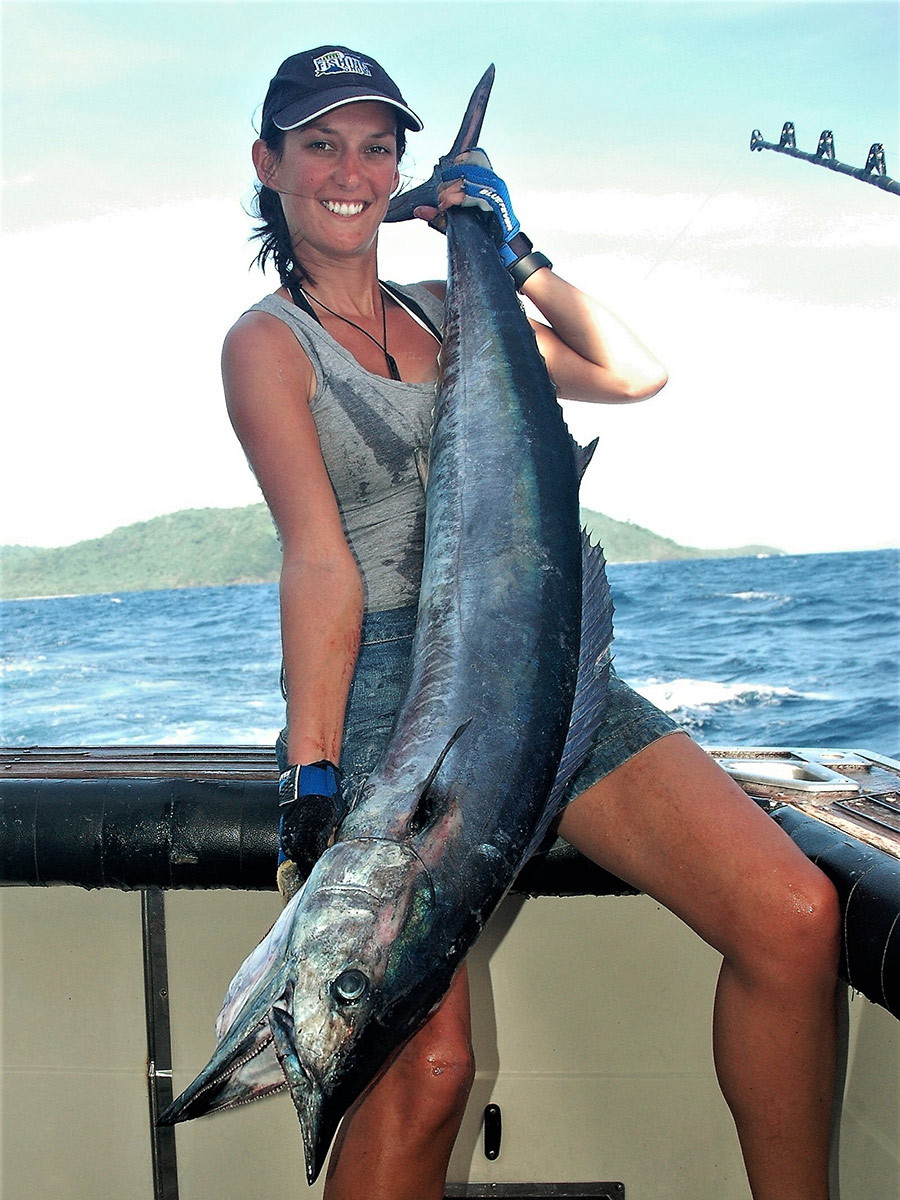
Leanne Tasman-Jones with a nice wahoo from Vanuatu.
They mostly travel in small groups and can be encountered in most tropical to semi-tropical oceans. They are occasionally caught in NZ waters during a warm summer. In our backyard – the South Pacific Ocean – wahoo are often caught around the Pacific Islands with Fiji, Tonga, Samoa, Vanuatu, the Cooks, the Solomons and Niue, notable fisheries. The best fishing for them is in winter, as they seem to prefer water temperatures below 25°C.
Running through July-August-September, wahoo congregate in areas that provide both structure and current concentration, such as reef and island corners and passes, seamounts and submarine banks. Around any fish aggregation buoy (FAD) is another spot worth trying. They are often to be found in conjunction with yellowfin tuna.
Besides being popular with anglers for their high-speed runs, wahoo are excellent table fish. They are targeted in several ways. Trolling dead baits (such as flying fish) rigged with chin-weights is very successful, especially when these are run off a downrigger at 20m or so. Around FADs, I have caught them high-speed jigging, on straylined cube baits, and I even had one hit a popper once.
But most wahoo are caught incidentally while trolling lures. They like swimming lures such as bibbed or bibless minnows in the 18cm range, and gold with an orange back or redhead are hot colours. Skirted lures take a lot of hits too, with the combinations of darker over bright colours seeming most preferred: blue, purple, or black over red, gold, or orange. A bit of wire is a necessity if targeting them.

Popular-eating fish, wahoo are biological torpedoes.
Tigers of Africa
Nearly 50 years ago I wandered into the late Keith Draper’s Taupo tackle store and was stopped in my tracks. There on the wall was a mount of the most incredible, exotic-looking fish I had ever seen. It was gold and silver with black stripes running the length of its body. Its large, deeply forked tail spoke of speed and power, and like all its other fins, was bright orange. I would have taken it for a saltwater fish, but it had an adipose fin, like a trout. And, most amazing of all, were its teeth: a cage of ivory daggers that a mako shark would not be ashamed of.
On enquiry, I learned that this outrageous evolutionary experiment was a tigerfish, a resident of the rivers and lakes of Africa. I was captivated, and right then the ambition to go to Africa and catch one of these amazing critters for myself was born, but it was another 30 years before I fulfilled my dream.
It turned out that there are several species of tigerfish, including the massive goliath tigerfish which can weigh up to 70kg. These are found in the Congo River system, which is a dangerous place to fish. The more common tigerfish vittatus are found in many African waters and some buddies and I fished for them in the Zambezi River in Zambia.
As mentioned, tigerfish have powerful jaws that are heavily armoured by bony plates, making it very hard to set a hook. Their outrageous teeth are replaced throughout their lives as full sets and fit into sheaths in the opposing jaw. These fangs also allow them to hold lures so tightly that it is near impossible to strike a hook home.
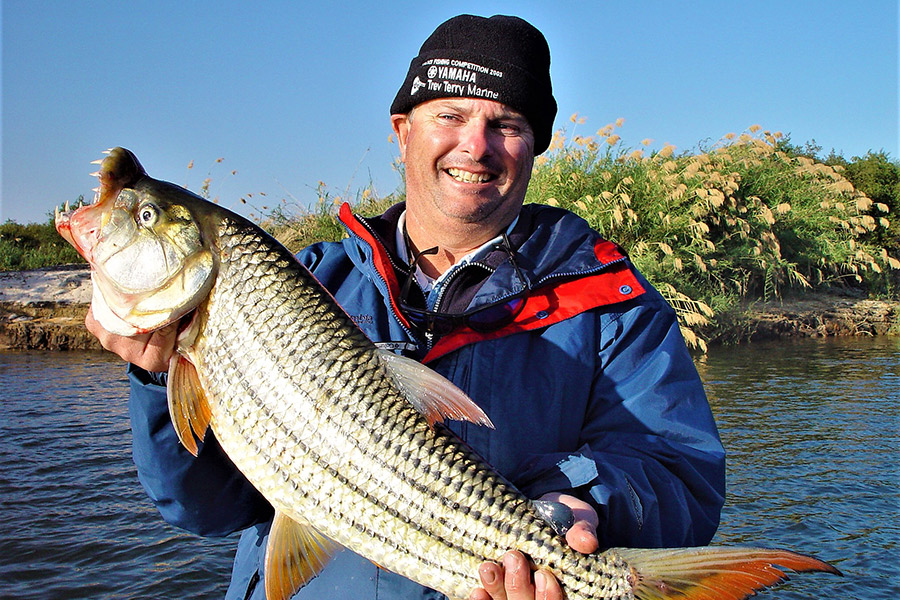
After many losses, Sam finally got his trophy.
Tigers are extremely fast, change direction swiftly and erratically, and jump and headshake repeatedly. It is no wonder they are so hard to hang onto and are held in such high regard as sportfish. The various statistics I read stated that only about one in eight fish struck on lures are actually landed, and that turned out to be roughly true for me. Various ex-pat South Africans I had spoken to about tiger fishing before leaving NZ all recommended cut baits and livebaits on wire as being the most effective, but we really wanted to stick to artificials.
A specimen tigerfish in the area we fished was a ten-pounder (4.5kg), and while not as rare as a ten-pound trout in New Zealand, (excluding the canals, of course) they are a lot harder to hook and hang onto. Ultimately, after many losses, we all got our trophy fish, but only after substantially upgrading the hooks on our lures. Light wire traces were a must.
Interestingly, the lures we had the most success with over the trip were black and orange, or red, gold and orange, and ‘fire-tiger’ diving minnows. I had always considered these to be attractor rather than imitator colours, but on checking a book of Zambezi fish, found that there are exotic baitfish amongst the approximately 250 fish species in the river that actually matched our brightly-coloured lures. Even the fanciful fire-tiger (orange-yellow-chartreuse with black stripes) has a real-life counterpart called the banded jewelfish.
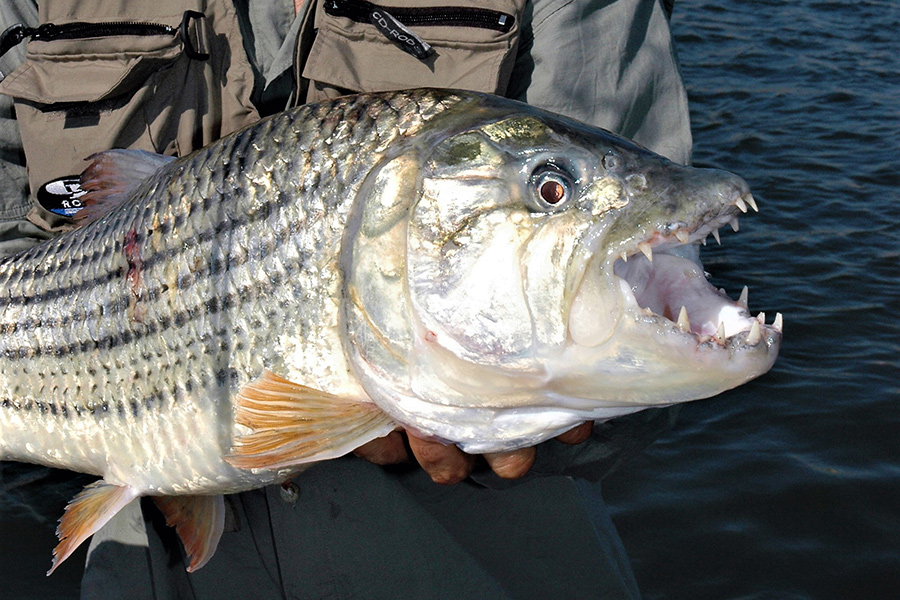
Pete Francis' trophy tigerfish.

August 2023 - Sam Mossman
New Zealand Fishing News Magazine.
Copyright: NZ Fishing Media Ltd.
Re-publishing elsewhere is prohibited
Recent Forum Posts Visit Forum

Trailer wheel clamp
in The Boat Shed1 hour ago
krow
I like the SAS wheel clamp. I've had no issues with the lock....

Shane Jones
in Fisheries Management4 hours ago
Fish Addict
The recreational sector can expect no favours from politicians. They know all too well who butters their bread and it ain't the recs. No different over...

Foton tunland v9
in The Briny Bar4 hours ago
Ho Dee
not fishing related and delete if required but was wondering if any has one of these or someone who has just wanting so e real world...

Bluefin Tuna at the cavs.
in The Briny Bar51 hours ago
smudge
Despite my years of fishing I haven't really fished many places, my focus has always been on Auckland's west coast and out toward Great Barrier. I...
Casting gloves
in Popper and Topwater Fishing96 hours ago
Mc Tool
100 bucks for a lure 😬. Watching one of them flying over the horizon without the line attached would be " character building " for sure...
I thought Id post some nice photo's , join...
in The Briny Bar147 hours ago
Alan L
That is a very cool pic Krow.The Far North is very cool, the Far far North even cooler. Mint looking day.Alan...

Mc Tools berley mincer
in The Briny Bar154 hours ago
SaltyC
Good size, they scrap well. Got an 18kg one up in Vava'u back a few years ago fishing off squeaky Going's boat. That was quite a...

Out with the "Twelves"
in Fishing Reports208 hours ago
Pcj
I should be able to get out end of October. The nephew been out virtually every weekend over winter and has done well. It seems the...
Manukau Harbour & West Coast fishing
in Fishing Reports216 hours ago
smudge
Nice work Schecter, I think snapper may be around sooner than you think. Well I am hoping so...
Whangarei Harbour report.
in Fishing Reports648 hours ago
krow
180 +m is where I've had to be lately. A lot less low foul around these parts and some of it shallower that looks like Tarakihi...

Popular Articles

Softbait Fishing - Part 1 - gear selection
John Eichlesheim writes an article about selecting the right equipment for softbait fishing... Read More >
Softbait fishing Pt 2 - tips and tricks
Techniques, tips and tricks of softbait fishing – getting the most from your soft baits.... Read More >

Surfcasting - setting yourself up
Gary Kemsley helps sort out the necessary gear for intending surf fishers.... Read More >

Squid - How to catch them
Squid fishing is a rapidly growing aspect of fishing - Paul Senior shares some hints and tips to get started.... Read More >
Fishing Reports Visit Reports
Outer Hauraki Gulf Fishing Report 17/09/26
Spring wind the handbrake. Spring is starting to make its presence felt in the outer... Read More >
Top of the South Fishing Report - 17/09/26
Early snapper in Tasman Bay. Well, spring is finally here, and the days are getting... Read More >
Bream Bay Fishing Report - 17/09/26
Good snapper catches reported. After Tangaroa turned off the fish tap for a month or... Read More >
Bay of Islands Fishing Report - 17/09/26
Pacific bluefin tuna for the lucky few. The last fortnight has seen more fishable days... Read More >
Comments