
Fish ID: Amberjack and almaco jack
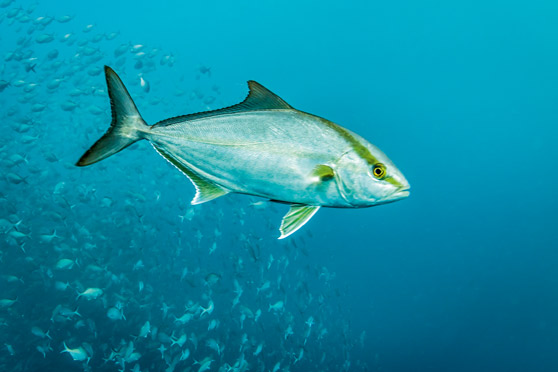
Amberjack (Seriola dumerili) and almaco jack (Seriola rivoliana) are circum-tropical species ranging from about 45oN to 30oS.
Amberjack are found throughout the Atlantic, Mediterranean, and Indo-West Pacific whereas almaco jack are distributed in the Indian Ocean, Pacific and western Atlantic. These globally sought-after gamefish species are also known to occasionally venture into northern New Zealand waters during late summer and early autumn.
Although amberjack grow to a maximum size of 190cm and almaco jack are a bit smaller, growing to a maximum size to 160cm, the largest amberjacks described around New Zealand mainland were 50cm and almaco jack were slightly bigger at 65cm. Our own kingfish (Seriola lalandi) – which are a close relative of these jacks – do not reach maturity until they are over 70cm long, so it is likely that all the amber- and almaco jack recorded in New Zealand waters are reproductively immature.
Outside of mainland New Zealand, the closest breeding populations for both jack species are likely in Norfolk Island and eastern Australia. Juveniles of both species associate with drifting debris and so probably disperse into New Zealand by drifting with logs and seaweed.
So how do you know if you’re looking at an amberjack, an almaco jack, or a plain old kingfish? Amberjack are blueish-grey on top and silvery below the lateral line, and there is often a distinct amber stripe along the flanks, hence ‘amberjack’. Almaco jack usually have a brown-olive tinge to the whole body and a dark bar that runs from the eyes back to the start of the dorsal fin. The most distinguishing feature of almaco jack is the tall dorsal fin – it is generally over 1.5 times as tall as the pectoral fin is long. Both jack species are generally deeper-bodied and squatter than our local Kingfish. However, none of these features are especially obvious, and the three species can easily be confused.
We’d like to know more about these jacks arriving in New Zealand – whether they are surviving our winters, and how big they’re getting over here. To help us track these species, it is recommended that any strange looking kingfish or jack species you catch, spear, or see are photographed and the image is sent to WhatsThatFishNZ for a fish taxonomist to identify.

|
----- Advertisement -----
|
This article is reproduced with permission of |

Recent Forum Posts Visit Forum

Shane Jones
in Fisheries Management3 minutes ago
Tzer
Smudge while I agree with the concept of Legasea and initially did support them as I did for the NZSFC but I with drew my support...

Trailer wheel clamp
in The Boat Shed21 hours ago
Mc Tool
either crc long life or 556 marine are way better ...

Foton tunland v9
in The Briny Bar37 hours ago
Ho Dee
not fishing related and delete if required but was wondering if any has one of these or someone who has just wanting so e real world...

Bluefin Tuna at the cavs.
in The Briny Bar83 hours ago
smudge
Despite my years of fishing I haven't really fished many places, my focus has always been on Auckland's west coast and out toward Great Barrier. I...
Casting gloves
in Popper and Topwater Fishing128 hours ago
Mc Tool
100 bucks for a lure 😬. Watching one of them flying over the horizon without the line attached would be " character building " for sure...
I thought Id post some nice photo's , join...
in The Briny Bar179 hours ago
Alan L
That is a very cool pic Krow.The Far North is very cool, the Far far North even cooler. Mint looking day.Alan...

Mc Tools berley mincer
in The Briny Bar187 hours ago
SaltyC
Good size, they scrap well. Got an 18kg one up in Vava'u back a few years ago fishing off squeaky Going's boat. That was quite a...

Out with the "Twelves"
in Fishing Reports241 hours ago
Pcj
I should be able to get out end of October. The nephew been out virtually every weekend over winter and has done well. It seems the...
Manukau Harbour & West Coast fishing
in Fishing Reports249 hours ago
smudge
Nice work Schecter, I think snapper may be around sooner than you think. Well I am hoping so...

Whangarei Harbour report.
in Fishing Reports681 hours ago
krow
180 +m is where I've had to be lately. A lot less low foul around these parts and some of it shallower that looks like Tarakihi...
Popular Articles

Softbait Fishing - Part 1 - gear selection
John Eichlesheim writes an article about selecting the right equipment for softbait fishing... Read More >
Softbait fishing Pt 2 - tips and tricks
Techniques, tips and tricks of softbait fishing – getting the most from your soft baits.... Read More >

Surfcasting - setting yourself up
Gary Kemsley helps sort out the necessary gear for intending surf fishers.... Read More >

Squid - How to catch them
Squid fishing is a rapidly growing aspect of fishing - Paul Senior shares some hints and tips to get started.... Read More >
Fishing Reports Visit Reports
Outer Hauraki Gulf Fishing Report 17/09/26
Spring wind the handbrake. Spring is starting to make its presence felt in the outer... Read More >
Top of the South Fishing Report - 17/09/26
Early snapper in Tasman Bay. Well, spring is finally here, and the days are getting... Read More >
Bream Bay Fishing Report - 17/09/26
Good snapper catches reported. After Tangaroa turned off the fish tap for a month or... Read More >
Bay of Islands Fishing Report - 17/09/26
Pacific bluefin tuna for the lucky few. The last fortnight has seen more fishable days... Read More >
Comments