
Fish Art with Tim Li

Tim Li’s first encounter with NZ Fishing News was poring through the Black Magic Tackle pages as an 8-year-old to look at photos of fish. In fact, the magazine inspired him and his brother to sketch different species of marine life at their grandparents’ dining room table after school for hours on end. Now, 25 years on, Tim is a full-time artist based on the Kapiti Coast, drawing (you guessed it)... fish!
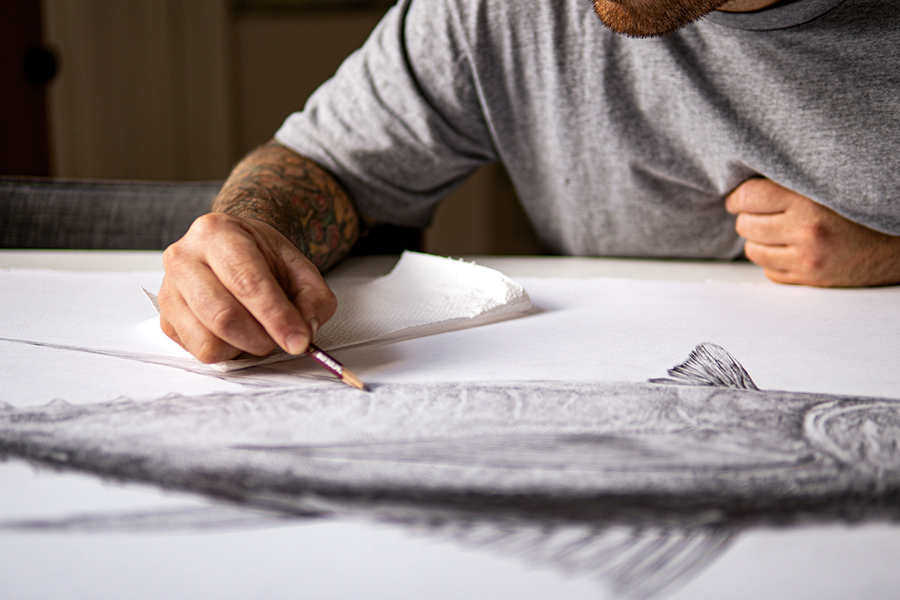
Nestled amongst hundreds of extremely detailed kina spikes, Tim sits and draws as he talks. You may have seen him pop up on Piri’s Tiki Tour, Clark Gayford’s Fish of the Day, or an episode of South Seas Spearo, but what the man is more commonly known for are his larger-than-life, graphite pencil drawings of endemic marine species. What I initially thought was a black and white photo in front of him turns out to be the current piece Tim is working on – a scaled-up 1000x700mm realistic depiction of a sea urchin, which he had found washed up on a stony south coast beach in Te Whanganui a Tara (Wellington).
His phone pings a few times and Tim apologises for the interruption as he messages people back. They are trying to get their hands on his most recent limited edition print release; a packhorse lobster, his sixth of the crayfish family so far.
“There’s always something else to capture about that species that I haven’t got to yet. Even when I look at that cray now, I already want to draw another one!”

Growing up in Taupō at a fish and chip shop, Tim was fascinated with the iconic New Zealand fish species poster hanging on the wall. When he and his brother weren’t there or at their grandparents’, drawing, they would spend afternoons down the Waikato River flicking metal lures into the river, hoping to hook a trout or two. And in the school holidays, they would head up to East Cape with their uncles and cousins for some saltwater fishing action. This was where Tim’s self-described fish obsession began. It wasn’t until a couple of years ago, when he was looking through boxes in the basement at his parent’s home, that he found the drawings of fish he’d done as a kid and realised he’d come back full circle to his childhood musings.
Tim sharpens his pencil and sits back to critique the four-centimetre spike he has been detailing. It was only at the beginning of this year that he made the giant leap to pursue his art full-time, although drawing has always been a strand in his kete. During university Tim got heavily into freediving and spearfishing, filming his endeavours and posting them under the guise of the ‘Insatiable Pursuit’ blog and YouTube channel. He quickly grew frustrated with the content-driven nature of this.
“It became about the followers you were attracting and the attention you were getting, instead of the fundamentals of being in the ocean and feeding yourself physically and spiritually”.
Tim’s motive to start drawing again sprung from a desire to celebrate what he was seeing in the ocean and share it with others, without measuring success by what you could take from the ocean or how big your catch was. This has since become something that Tim has grown to prioritise in his life. He encourages people to look at the ocean not just as a resource but as a place to recognise our role as kaitiaki, and connect spiritually.
Tim explains more of his philosophy. It is particularly humbling – the idea that through his art he wants to showcase the best of the ocean. Not the perfect image of the perfect fish, but the spectrum of beauty contained in its imperfections: the abrasions of the skin, damaged fins, or irregular scale patterns. The imperfectly perfect. Tim believes this honest realness is what people are drawn to in his art, especially in an age where we see everything through filters.
“The ocean itself is something you can’t just see on an Instagram post. You have to get in it, immerse yourself in it… that’s what I want to achieve with my drawings. For people to be overwhelmed by and experience all the beauty the ocean has to offer”.
Over the last five years, Tim has gone from strength to strength in his practice and drawn numerous New Zealand endemic marine species.
“I think I’m addicted!” he says with a grin, now detailing the very tip of the kina spike in front of him.
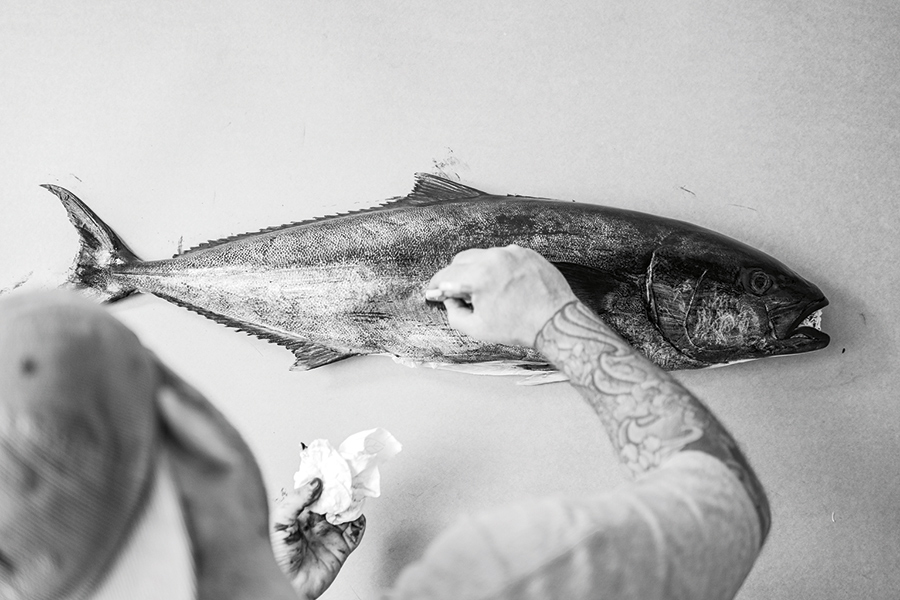
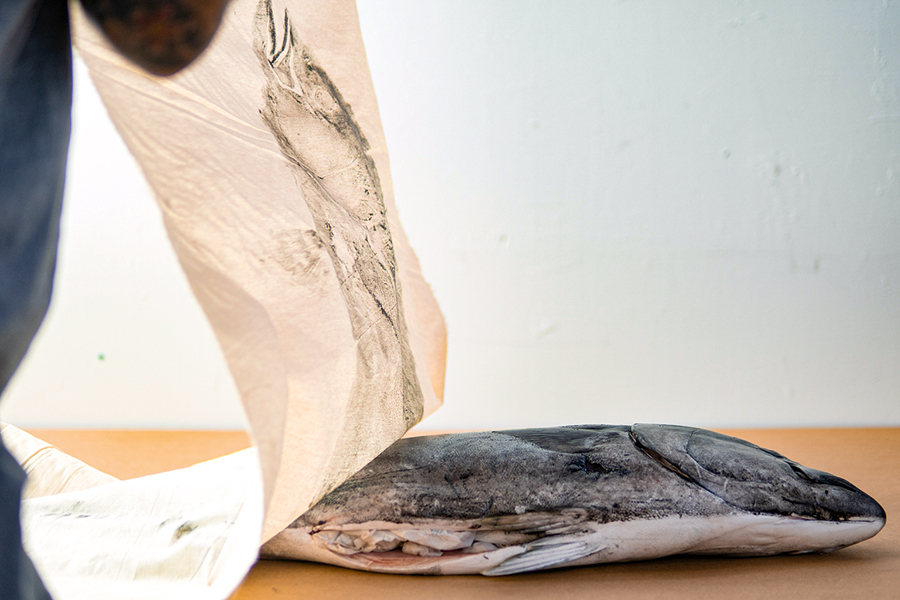
He has developed his repertoire to include printmaking and gyotaku, a traditional Japanese technique where fishermen printed their fish with ink to showcase the variety, size and shape of their catches for customers at the market.
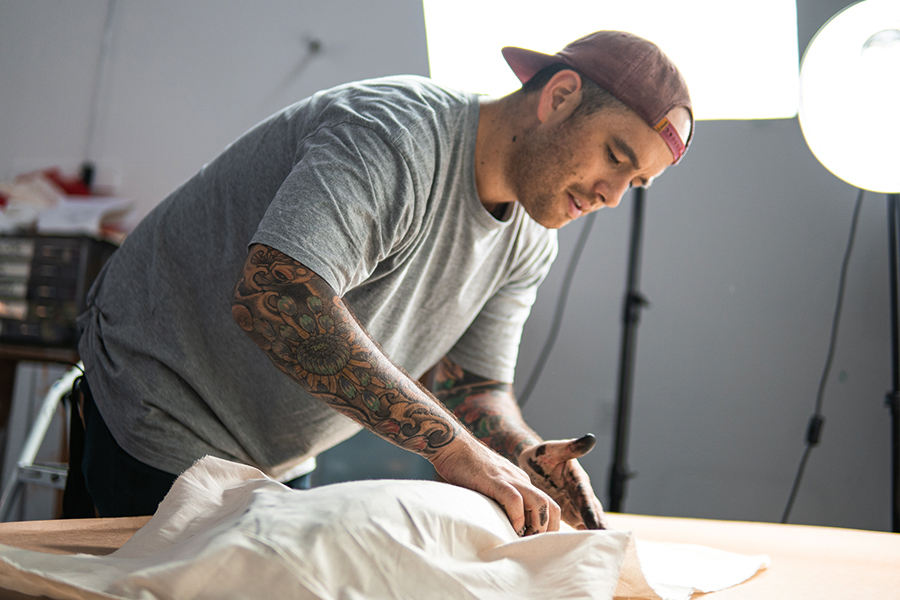
Initially giving up because of the spontaneity of his own results, Tim persevered and started to fall in love with gyotaku and how it captures each individual fish’s uniqueness.
“You are at the full mercy of the process with gyotaku. You can lose all control and every print is different”.
This is the polar opposite of his drawing, where every mark, pencil stroke and erasure is finely controlled. The best thing about gyotaku, he says, is the full utilisation of the fish: you can print it to record your catch, wash the ink off, and then cut it up for a feed.
Wrapping up his work on the kina for the morning, Tim points out an octopus that his seven-year-old son has drawn next to a replica print of his own. He thinks this octopus may be the next graphite drawing he will start following the kina. I cheekily ask Tim if he’s aiming to draw every fish species on the poster he geeked out on as a kid. He is as down-to-earth as ever.
“Even though my works are becoming more detailed and more labour intensive and longer and longer, that’s nothing in the scheme of things – how long it takes for a butterfish to grow, a paua to reach maturity, a crayfish to develop to the size it can be harvested”.
As we walk down the footpath with the outline of Kapiti Island to the west, I can’t help but think I may have a deeper appreciation of the ocean after talking to Tim. And that I may have to put myself on the presale list for that octopus.

October 2022 - Anna Macrae
New Zealand Fishing News Magazine.
Copyright: NZ Fishing Media Ltd.
Re-publishing elsewhere is prohibited
Recent Forum Posts Visit Forum

Trailer wheel clamp
in The Boat Shed2 hours ago
krow
I like the SAS wheel clamp. I've had no issues with the lock....

Shane Jones
in Fisheries Management4 hours ago
Fish Addict
The recreational sector can expect no favours from politicians. They know all too well who butters their bread and it ain't the recs. No different over...

Foton tunland v9
in The Briny Bar4 hours ago
Ho Dee
not fishing related and delete if required but was wondering if any has one of these or someone who has just wanting so e real world...

Bluefin Tuna at the cavs.
in The Briny Bar51 hours ago
smudge
Despite my years of fishing I haven't really fished many places, my focus has always been on Auckland's west coast and out toward Great Barrier. I...
Casting gloves
in Popper and Topwater Fishing96 hours ago
Mc Tool
100 bucks for a lure 😬. Watching one of them flying over the horizon without the line attached would be " character building " for sure...
I thought Id post some nice photo's , join...
in The Briny Bar147 hours ago
Alan L
That is a very cool pic Krow.The Far North is very cool, the Far far North even cooler. Mint looking day.Alan...

Mc Tools berley mincer
in The Briny Bar154 hours ago
SaltyC
Good size, they scrap well. Got an 18kg one up in Vava'u back a few years ago fishing off squeaky Going's boat. That was quite a...

Out with the "Twelves"
in Fishing Reports208 hours ago
Pcj
I should be able to get out end of October. The nephew been out virtually every weekend over winter and has done well. It seems the...
Manukau Harbour & West Coast fishing
in Fishing Reports216 hours ago
smudge
Nice work Schecter, I think snapper may be around sooner than you think. Well I am hoping so...
Whangarei Harbour report.
in Fishing Reports648 hours ago
krow
180 +m is where I've had to be lately. A lot less low foul around these parts and some of it shallower that looks like Tarakihi...
Popular Articles

Softbait Fishing - Part 1 - gear selection
John Eichlesheim writes an article about selecting the right equipment for softbait fishing... Read More >
Softbait fishing Pt 2 - tips and tricks
Techniques, tips and tricks of softbait fishing – getting the most from your soft baits.... Read More >

Surfcasting - setting yourself up
Gary Kemsley helps sort out the necessary gear for intending surf fishers.... Read More >

Squid - How to catch them
Squid fishing is a rapidly growing aspect of fishing - Paul Senior shares some hints and tips to get started.... Read More >
Fishing Reports Visit Reports
Outer Hauraki Gulf Fishing Report 17/09/26
Spring wind the handbrake. Spring is starting to make its presence felt in the outer... Read More >
Top of the South Fishing Report - 17/09/26
Early snapper in Tasman Bay. Well, spring is finally here, and the days are getting... Read More >
Bream Bay Fishing Report - 17/09/26
Good snapper catches reported. After Tangaroa turned off the fish tap for a month or... Read More >
Bay of Islands Fishing Report - 17/09/26
Pacific bluefin tuna for the lucky few. The last fortnight has seen more fishable days... Read More >
Comments