
Favourite Fishing Items

Continuing this column on favourite items of tackle, Sam Mossman lists five of his current fishing favourites.
This was harder to write than I thought it would be. There are so many bits of gear I love and enjoy using, it was hard to narrow the list down to five choices. In the end it came down to basic items I use these days on a daily basis for my bread-and-butter fishing, and which have proven their worth, giving years of good service.
FC430
Seven years ago, I bought a new boat. Nothing unusual about that. My little plastic 360 Mac with its 20hp Suzuki was replaced by a FC430, a 4.3m aluminium pushed by a Mercury 40hp two-stroke. There are several reasons I did this. The Mac had given me a decade of service and a whole lot of inshore fishing, but now that I am in my mid-sixties, comfort on a boat becomes increasingly important if I am not to pay for a day on the water with aches and creaking joints when I wake up the next morning.
This meant I needed a bit more space. In small boat parlance, that’s enough hull stability to stand up, stretch and move around, and decent-sized comfortable seats. There were other reasons to upsize a bit too. A bigger boat would allow me more range, handle scruffier sea conditions better when the sea breeze gets up a bit in the afternoon, and the 40hp Merc has plenty of power and charges a battery, allowing the luxury of electric start and tilt/trim, as well as a built-in sounder/GPS.
In combination with Polaroid glasses to help spot rocks or reef, the tilt/trim is great for shallow running when feeling your way into unfamiliar bays, as well as simplifying trimming the boat for more comfortable running in differing sea conditions. Apart from upsizing the seats a bit, another customization was to add an extra wear strip along the keel line to beef up the hull. This has also had the effect of adding some extra weight low down on the hull which improved the ride further.
I choose the FC430 having done a boat test on one for this magazine in the past – I was greatly impressed by its performance for its size and price. It is perfect for coastal fishing: stable, comfortable and roomy with excellent sea-keeping, but it maintains the advantages of easy towing (it was regularly towed to the Coromandel and the Far North in pre-Covid days), easy launching and retrieving, and cheap running (typically less than $20 fuel costs for a full day). It has a self-flooding live-bait tank and the extra space also allows more room for a fishing buddy (or even two), or my partner if we fancy a day of boating, picnicking, fishing and swimming on the Hauraki Gulf.
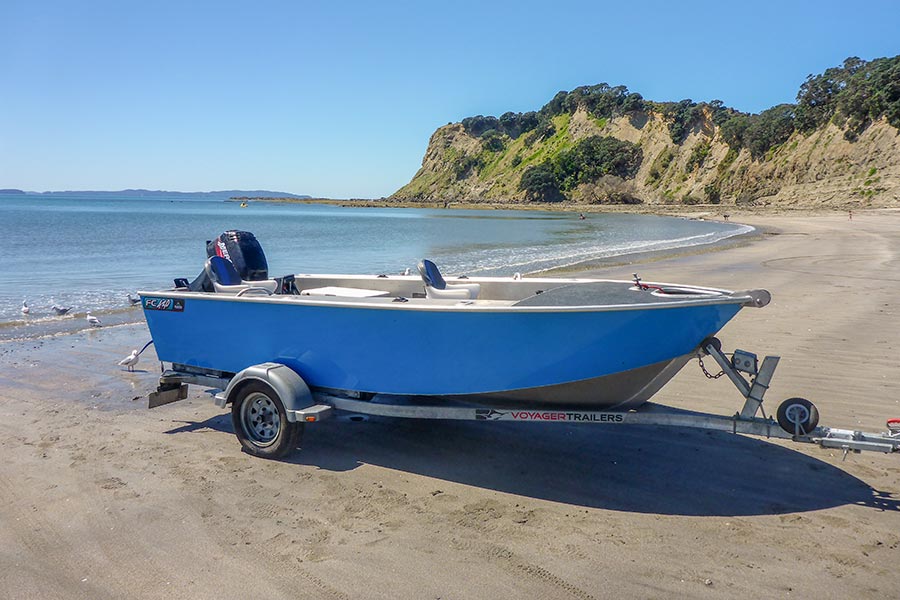
The FC430 is seaworthy, spacious, easy to tow and launch off the beach and has the range to enjoy much of the north-east coast’s island- and reef-rich environment.
Black Magic Tough Trace
The leader is that very important link between the main line and hook. It needs to be hard enough to resist abrasion from the fish’s mouth, tail, scales and spines and also any sharp rocks, shells or other obstructions it may be pulled across. But it must also be limp enough to allow a natural-looking presentation of a bait, and not dampen the action of a lure.
Other properties I look for in good leader material are low visibility (so fish are not spooked by it) and, importantly, it should have good knot strength and pull up snugly. Some of these properties, such as abrasion resistance (hardness) and limpness, counter each other to some extent and are difficult to achieve in a single material. I tried fluorocarbon for a while but had issues with its knotting performance and found that its stiffness tended to sandbag the action of lures a bit (although I still use it in light weights for freshwater tippets).
I have had great results out of Black Magic’s Tough Trace. This is a clear Japanese-made copolymer monofilament extruded to Black Magic’s specifications and extensively tested by them. I have been using this product since it first came out (about twenty years ago at a guess) and I catch just as many fish as my buddies using other products do, so the fish are obviously not spooked by it. I am very impressed by the abrasion resistance having had, for example, kingies drag it through the reef and sharks chew on it, and it still remaining intact.
Its knot strength is excellent, and knots pull up nicely. It is packaged in a compact dispenser pack that fits easily in my tackle bag. Tough Trace is available in 20lb, 30lb, 40lb, 50lb, 60lb, 80lb, 100lb, 130lb, 200lb, 300lb and 400lb. Personally, my day-to-day needs are met by spools of 20lb, 40lb, 60lb, 80lb and 100lb carried in a ‘Leader Feeder’ dispenser which keeps all the loose ends under control.
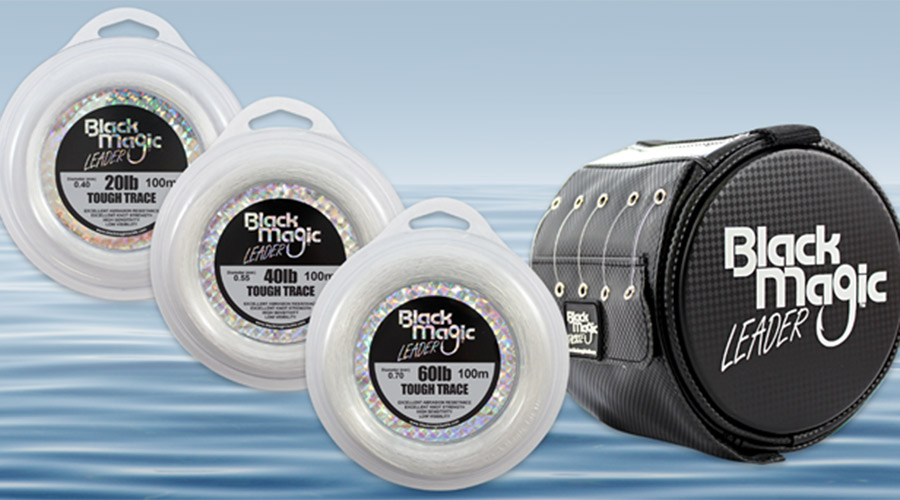
Sam's day-to-day leader needs are met by spools of 20lb, 40lb, 60lb, 80lb and 100lb Tough Trace carried in a 'Leader Feeder'.
Soft-baits
Soft-plastic lures have come and gone on the New Zealand fishing scene several times over the years. The first ones I found were a six-pack of Rebel bass worms in the ‘specials bin’ of an Auckland tackle store fifty years ago. They produced a heap of Hawkes Bay blue cod for me and on one memorable occasion, a four-kilo snapper. When tackle company Kilwell started importing ‘Mr. Twister’ soft-plastics in the early ‘80s, they sent me a box of samples to try. Again, these were successful on a wide range of species, including snapper, trevally, john dory, kahawai, blue cod, kingfish and so on. And there were other soft-plastics, such as Vibrotails and Scampis, that came and went.
But in the early 2000s a wide range of advances in tackle from the US, Japan and Australia saw the foundation of a whole new system of soft-bait fishing. In 2004 I was in Brisbane and managed a few hours of soft-baiting in the Gold Coast canals catching bream, flathead and trevally. I brought back from Australia some of the light braid line, soft-plastic tails and light lead heads that were the keys to the new system but were not available in New Zealand at the time.
After six months of playing with the new toys, which included several 50-snapper days, I was highly impressed and began writing about my experiences with the new generation soft-plastics in the March 2005 issue of this magazine. Since then, soft-plastic fishing has been adapted into a highly successful technique for our local fishery that shows no sign of stopping and is still my favourite way of catching snapper and other inshore species.
Fishing soft-baits on light spin gear is just so much fun. Casting, working the lure, detecting the strike, hooking the fish and good battles on light tackle are all enjoyable parts of the process. And there is no mucking around with bait and berley.
I have had a great deal of success with Gulp! and my current favourite, Z-Man. The latter, particularly, are very robust, lasting many fish, don’t dry out and are very effective, especially when combined with ‘Secret Sauce’ scent additive.
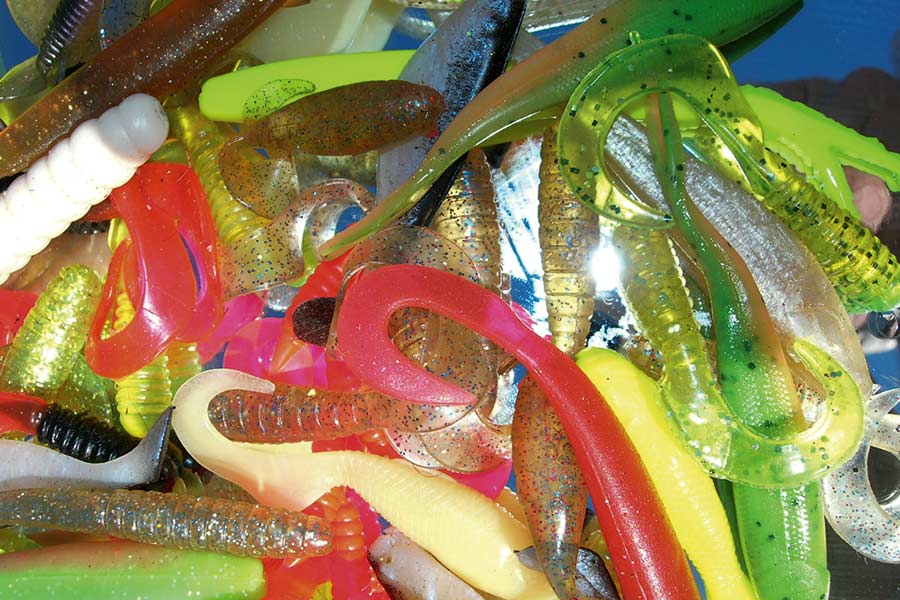
Soft-bait tails come in a wide range of sizes, designs and colours.
Circle hooks
My love of lures like soft-baits aside, I am quite happy to fish with bait when the occasion demands it, and when I do I mostly use circle hooks. Classic circle hooks have a short-ish shank, and a point that faces back towards the shank. They work by rotation, rather than a straight spear-like thrust delivered by the standard European style or ‘J’ hook. Basically, the fish takes the baited hook into its mouth, and as pressure is applied to the line (either by the fish swimming off or the angler pulling steadily on the line), the hook is pulled from its mouth. As soon as the shank starts to come clear of the mouth, the hook rotates rapidly and (usually) rolls around the jawbone. A firm, steady tightening of the line, once the fish has taken the hook, is the best way to make sure the hook is well set.
Besides longlines and bottom fishing with baits in medium to deep water, circle hooks have extended their applications to other fishing tasks including flasher rigs, surf fishing and even bait fishing for marlin. My personal best marlin, a black estimated at over 1000lb, was taken on a 20/0 circle hook off the Great Barrier Reef.
The big advantage of circle (recurve) hooks, as far as I am concerned, is that their use results in (mostly) jaw hook ups that allow unwanted fish to be unhooked and released with minimum mortality, and this is important to me. My favourite circle hooks are Black Magic KLT, Mustad Demon Circles and Gamakatsu Octopus Circle.
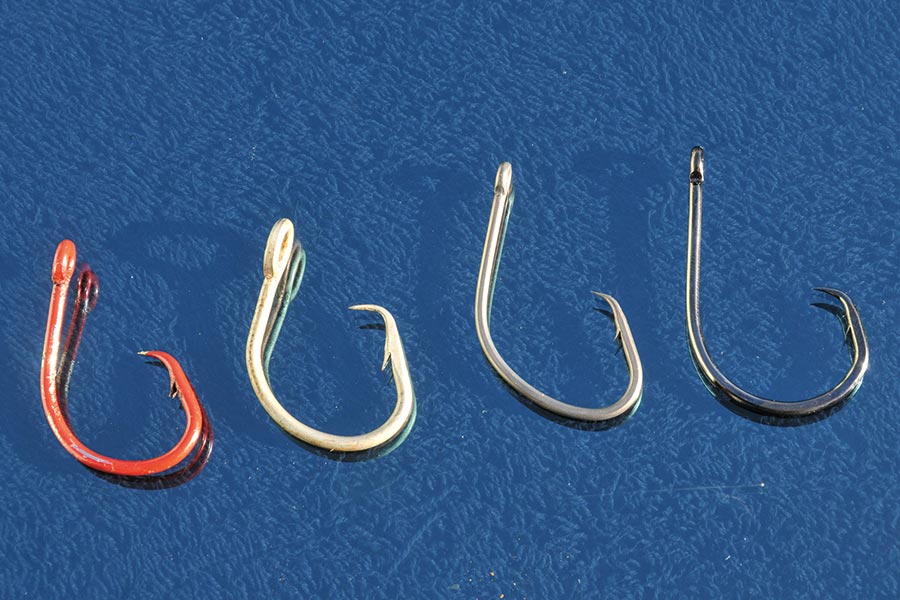
Circle hooks have a point that faces back towards the shank.
Victory filleting knives
Most of my favourite fishing knives have certain very practical features in common. For example, I like moulded plastic handles because they don’t work loose, are easy to keep clean and don’t have crevices and joints (as many wooden-handled knives do) where bacteria can build up. I also like a guard so that wet or slimy fingers don’t slide off the handle and onto the blade with teeth-suckingly messy results. Similarly, I prefer handles with good grip pattern (i.e. not smooth and slippery). And I like stainless steel blades, too. While many types of stainless will not take quite the razor edge that the best carbon steels will, carbon steels rust quickly in the marine environment unless they receive a much higher level of care than I typically provide. And in practical terms there are some pretty good stainless steels out there that will take a good edge and hold it well enough. The range I have settled on is New Zealand made, reasonably priced and readily available – Victory knives.
Nowhere is the well sharpened right style of knife more important than when filleting fish. The one I use the most is a long (24cm) narrow and reasonably flexible blade that is excellent for wider fish like snapper, trevally and tarakihi, having plenty of length to reach right across the fillet and enough flex to get right down on the bone. This knife is also ideal for skinning fillets.
I prefer a shorter (16cm), wider, heavier blade with less flex for fish like gurnard and blue cod. It needs to be kept pretty sharp and when you learn the correct angles to cut on, it will whip the fillets off these smaller, rounder-sectioned fish quickly and easily.
Finally, I have a big-fish knife, used for large snapper, hapuku, bass, kingfish, tuna and even marlin. A decent length (25cm) and weight of blade is a real advantage when disassembling bigger fish and is also capable of cutting through larger bones and doing other heavy work.
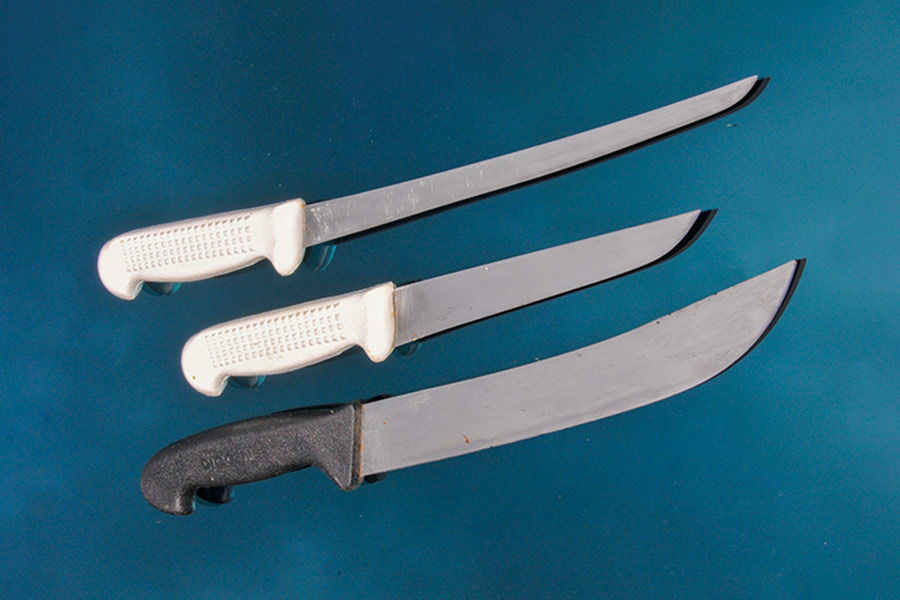
Sam’s favourite filleting blade types – top to bottom: general purpose filleter (also makes a fair skinning blade); ‘gurnard’ knife; and heavy duty big-fish knife.
This list is by no means exhaustive as I have a lot of favourite gear but, in the words of the song, “these are a few of my favourite things.”

December 2021 - Sam Mossman
New Zealand Fishing News Magazine.
Copyright: NZ Fishing Media Ltd.
Re-publishing elsewhere is prohibited
Recent Forum Posts Visit Forum

Trailer wheel clamp
in The Boat Shed9 minutes ago
610gc
Hey teamI have a wheel clamp like the one below on the boat trailer. its getting harder and harder to unlockI've sprayed it with CRC on...

Shane Jones
in Fisheries Management23 hours ago
Tzer
Far cry to the twats at Liegasea/NZSFC were proposing of 5 Tarakihi person in their submission for the central management area and this is what our...

Bluefin Tuna at the cavs.
in The Briny Bar43 hours ago
smudge
Despite my years of fishing I haven't really fished many places, my focus has always been on Auckland's west coast and out toward Great Barrier. I...
Casting gloves
in Popper and Topwater Fishing88 hours ago
Mc Tool
100 bucks for a lure 😬. Watching one of them flying over the horizon without the line attached would be " character building " for sure...
I thought Id post some nice photo's , join...
in The Briny Bar139 hours ago
Alan L
That is a very cool pic Krow.The Far North is very cool, the Far far North even cooler. Mint looking day.Alan...

Mc Tools berley mincer
in The Briny Bar146 hours ago
SaltyC
Good size, they scrap well. Got an 18kg one up in Vava'u back a few years ago fishing off squeaky Going's boat. That was quite a...

Out with the "Twelves"
in Fishing Reports200 hours ago
Pcj
I should be able to get out end of October. The nephew been out virtually every weekend over winter and has done well. It seems the...
Manukau Harbour & West Coast fishing
in Fishing Reports208 hours ago
smudge
Nice work Schecter, I think snapper may be around sooner than you think. Well I am hoping so...

Whangarei Harbour report.
in Fishing Reports640 hours ago
krow
180 +m is where I've had to be lately. A lot less low foul around these parts and some of it shallower that looks like Tarakihi...
Whangarei Harbour Scallops
in Fisheries Management750 hours ago
Pcj
Reopening WhangÄ쳌rei Harbour to recreational scallop fishingTÄ“nÄ쳌 koeFisheries New Zealand is seeking feedback from tangata whenua, stakeholders, and the public on whether WhangÄ쳌rei Harbour should be...
Popular Articles

Softbait Fishing - Part 1 - gear selection
John Eichlesheim writes an article about selecting the right equipment for softbait fishing... Read More >
Softbait fishing Pt 2 - tips and tricks
Techniques, tips and tricks of softbait fishing – getting the most from your soft baits.... Read More >

Surfcasting - setting yourself up
Gary Kemsley helps sort out the necessary gear for intending surf fishers.... Read More >

Squid - How to catch them
Squid fishing is a rapidly growing aspect of fishing - Paul Senior shares some hints and tips to get started.... Read More >
Fishing Reports Visit Reports
Outer Hauraki Gulf Fishing Report 17/09/26
Spring wind the handbrake. Spring is starting to make its presence felt in the outer... Read More >
Top of the South Fishing Report - 17/09/26
Early snapper in Tasman Bay. Well, spring is finally here, and the days are getting... Read More >
Bream Bay Fishing Report - 17/09/26
Good snapper catches reported. After Tangaroa turned off the fish tap for a month or... Read More >
Bay of Islands Fishing Report - 17/09/26
Pacific bluefin tuna for the lucky few. The last fortnight has seen more fishable days... Read More >
Comments