
Eye-stripe surgeonfish
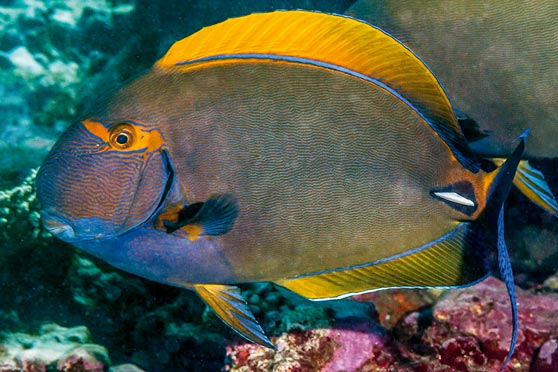
In its native range this colourful, quintessentially tropical species inhabits coral reefs and is also known as Dussumier's surgeonfish, Hawaiian surgeonfish, ornate surgeonfish, and palani.
This species of surgeonfish is found in both the Indian and Pacific oceans, from Africa in the west to Hawaii in the east. The most northern populations occur in Japan and the southern edge of their range is New South Wales in Australia.
Within their native range eye-stripe surgeonfish occur from shallow coral reef crests to deep reef slopes (from 4m to 131m), where they can often be seen grazing on the algal films and diatoms that grow on the reefs they inhabit. In New Zealand, eye-stripe surgeon fish have been found from North Cape down to White Island and are often seen schooling with juvenile parore and snapper.
So how do you know if the tropical fish you spotted during your dive or fishing trip was an eye-stripe surgeonfish? Firstly, all species in the family Acanthuridae have sharp ‘blade-like’ spines on their caudal peduncle (the narrow part between the fish's body and the tail fin), hence the common name 'surgeonfish'.
Eye-stripe surgeonfish are generally a yellowish-brown colour, and as the name suggests, mature fish have a bright orange band running across their eye. Juveniles of the species tend to lack the distinctive eye-stripe, but they do have a bright blue stripe along the edge of their anal fin and a yellow band on the caudal peduncle at the base of the tail fin.

All of the eye-stripe surgeonfish recorded in New Zealand have been juveniles ranging in length from 2.5cm to 10cm. Juvenile eye-stripe surgeonfish are often very shy and flighty, but will usually stay within a small home range. These juveniles currently don’t survive our winters, which means eye-stripe surgeonfish are not breeding in New Zealand waters.
Within their native range most eye-stripe surgeonfish encountered are around 35cm, but they can grow to a maximum size of 54cm. They will live for up to 30 years and reach reproductive maturity, or breeding size, at around 20cm in length.
So where are the eye-stripe surgeonfish we are seeing in New Zealand coming from? The most likely source populations for juvenile Eye-stripe surgeonfish are Lord Howe Island, Norfolk Island and southern parts of eastern Australia.
Eye-stripe surgeonfish larvae drift on ocean currents for 50 to 85 days, which is a relatively long time in the fish world and more than long enough for them to cross large areas of open ocean to New Zealand.
It is likely that we will continue to see pulses of juvenile eye-stripe surgeonfish arriving in New Zealand waters, facilitated by prevailing ocean currents and storm events. If ocean temperatures continue to increase in New Zealand, we may also see these juveniles start to overwinter and reach breeding size.
If eye-stripe surgeonfish do establish populations here, they may compete with native species like parore and moki for food, so it’s important for us to keep an eye out for this species. If you think you have spotted an eye-stripe or any other surgeonfish in New Zealand waters, send a photograph to WhatsThatFishNZ or a fish taxonomist to confirm the identity. We are particularly interested in photos of larger specimens!
|
|
This article is reproduced with permission of |

Recent Forum Posts Visit Forum

Trailer wheel clamp
in The Boat Shed17 minutes ago
610gc
Hey teamI have a wheel clamp like the one below on the boat trailer. its getting harder and harder to unlockI've sprayed it with CRC on...

Shane Jones
in Fisheries Management23 hours ago
Tzer
Far cry to the twats at Liegasea/NZSFC were proposing of 5 Tarakihi person in their submission for the central management area and this is what our...

Bluefin Tuna at the cavs.
in The Briny Bar43 hours ago
smudge
Despite my years of fishing I haven't really fished many places, my focus has always been on Auckland's west coast and out toward Great Barrier. I...
Casting gloves
in Popper and Topwater Fishing88 hours ago
Mc Tool
100 bucks for a lure 😬. Watching one of them flying over the horizon without the line attached would be " character building " for sure...
I thought Id post some nice photo's , join...
in The Briny Bar139 hours ago
Alan L
That is a very cool pic Krow.The Far North is very cool, the Far far North even cooler. Mint looking day.Alan...

Mc Tools berley mincer
in The Briny Bar146 hours ago
SaltyC
Good size, they scrap well. Got an 18kg one up in Vava'u back a few years ago fishing off squeaky Going's boat. That was quite a...

Out with the "Twelves"
in Fishing Reports200 hours ago
Pcj
I should be able to get out end of October. The nephew been out virtually every weekend over winter and has done well. It seems the...
Manukau Harbour & West Coast fishing
in Fishing Reports208 hours ago
smudge
Nice work Schecter, I think snapper may be around sooner than you think. Well I am hoping so...

Whangarei Harbour report.
in Fishing Reports640 hours ago
krow
180 +m is where I've had to be lately. A lot less low foul around these parts and some of it shallower that looks like Tarakihi...
Whangarei Harbour Scallops
in Fisheries Management750 hours ago
Pcj
Reopening WhangÄ쳌rei Harbour to recreational scallop fishingTÄ“nÄ쳌 koeFisheries New Zealand is seeking feedback from tangata whenua, stakeholders, and the public on whether WhangÄ쳌rei Harbour should be...

Popular Articles

Softbait Fishing - Part 1 - gear selection
John Eichlesheim writes an article about selecting the right equipment for softbait fishing... Read More >
Softbait fishing Pt 2 - tips and tricks
Techniques, tips and tricks of softbait fishing – getting the most from your soft baits.... Read More >

Surfcasting - setting yourself up
Gary Kemsley helps sort out the necessary gear for intending surf fishers.... Read More >

Squid - How to catch them
Squid fishing is a rapidly growing aspect of fishing - Paul Senior shares some hints and tips to get started.... Read More >
Fishing Reports Visit Reports
Outer Hauraki Gulf Fishing Report 17/09/26
Spring wind the handbrake. Spring is starting to make its presence felt in the outer... Read More >
Top of the South Fishing Report - 17/09/26
Early snapper in Tasman Bay. Well, spring is finally here, and the days are getting... Read More >
Bream Bay Fishing Report - 17/09/26
Good snapper catches reported. After Tangaroa turned off the fish tap for a month or... Read More >
Bay of Islands Fishing Report - 17/09/26
Pacific bluefin tuna for the lucky few. The last fortnight has seen more fishable days... Read More >
Comments