
Eating bait fish

The period from late summer to early autumn sees ‘baitfish’ thriving in our waters, which suits me, as I love targeting these little fish to put on my plate!
Not only are these silvery morsels numerous and readily accessible from the shore or small boat, they are tasty, healthy and sustainable – a winning combination in my opinion. Best of all, I have never really grown up, so still love the thrill of baitfish zipping around on a sabiki rig fished off the wharf. Overseas, small ‘bait’ fishes have been eaten for hundreds of years, so many mouthwatering traditional recipes are easily found on the internet, especially from countries such as France, Spain and Italy.
Most baitfish species honestly taste great and offer a reasonable alternative to whitebait, which are under increasing environmental pressure and unbelievably expensive to buy.
Catching baitfish
Baitfish can be easy to catch, often in big numbers, which makes getting the kids along to help a good option. Constantly hooking fish and remaining engaged are important for kids, and lots of useful fishing skills are learned in the process. No doubt many highly competent anglers cut their teeth by catching the humble sprats off wharves and jetties.
The key to good baitfishing is to concentrate them in your area, which is easily achieved by a berley pot. However, it is important to only disperse small amounts of finely-ground-up berley while fishing or they will become sated and lose interest in your offerings. I generally use the orange berley cages filled with a berley sausage available from most fishing shops and petrol stations; they are simple to set up and highly effective.
Warm, settled weather produces the best baitfish fishing, with many areas fishing best on the high tide. The other important thing is to use small hooks. I like to use sabiki rigs with size 14 hooks; small hooks will vastly improve your catch rate.
The rigs are best tied to light line and deployed with long, sensitive rods. Such rods help to minimise the hooks pulling out of fragile mouths – and are more fun to use!
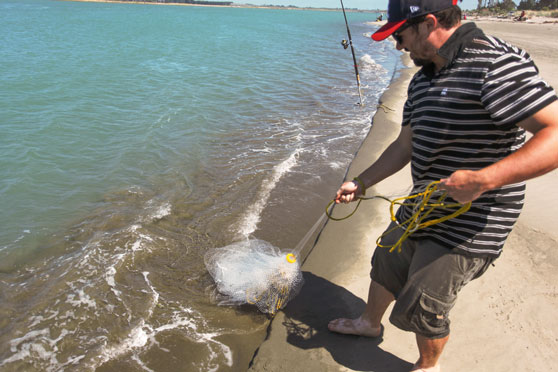
Or you can try throw-netting over the gathered baitfish; a basic but effective throw-net costs around $80. (Set-nets can also be used to catch baitfish, but there are a lot of regulations involving this method.) Throw- netting can seem a bit like repeatedly throwing a shot-put – but you get something to eat (or use for bait) for your efforts. This activity tends to be done around a beach or estuary, and is best done on a hot summer’s day.
While dispensing berley for baitfish, it pays to put a livie out, and maybe have another bait out wide on heavier gear, as the concentration of baitfish often attracts larger fish. But let’s get back to the focus of this article… KEY BAITFISH SPECIES
Yelloweyed mullet/sprats
The yelloweyed mullet (YEM for short), also known as sprats or herrings, is the most widespread and common baitfish species in many of our estuaries and harbours.
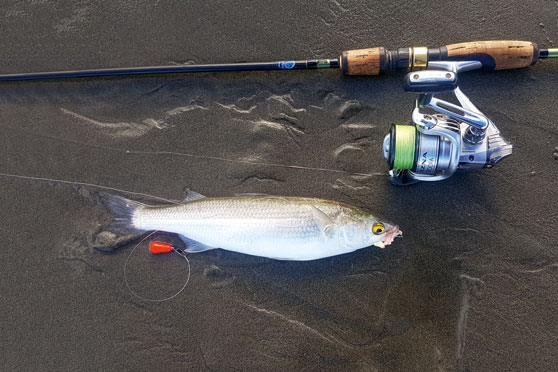
Smaller fish, once gutted, are ideal for grilling whole, turning golden and crunchy. They can also be filleted, with the fillets soaked in white vinegar for six hours, then preserved in olive oil, Spanish style. Larger mullet should be cleaned and filleted (the skin left on), coated in flour, egg and breadcrumbs, then fried in a mix of butter and olive oil. Large mullet are also great smoked.
Jack mackerel/ yellowtail
Juvenile jack mackerel or yellowtail are common in harbours from the Marlborough Sounds north. They are larger than yelloweyed mullet and put up a brisk fight on sabiki rigs. They also respond very well to berley.
Possessing a high oil content and being larger on average than YEMs, they are great for splitting whole then hot smoking. With care, the flesh can be pulled off the frame and the smaller bones avoided.
Pilchards
A more northern inshore baitfish found in large shoals from the Marlborough sounds north, pilchards are best caught using size 16 hooks. They are outstanding when fresh, scaled, gutted and then grilled whole in olive oil with coastal herbs (such as Italian parsley). Although very tasty, pilchards have a brief shelf life (due to very high oil content), so are best eaten within a day or so of catching. They are definitely a favourite.
As they have a small mouth, pilchards can be fickle to catch on baited hooks, but sabiki rigs armed with little flies are frequently effective, as are throw-nets or fine-meshed setnets.
Garfish/piper
A fun fish to catch, especially early in autumn when they are present inshore in large numbers. Garfish love estuaries and shallow harbours with eel-grass beds, and are often caught in bait nets set over mudflats at high tide.
Garfish are readily attracted to berley, and then effectively targeted with a float trailing a trace rigged with light split-shot and small long-shanked hooks. They are fun to catch this way, and kids love them because they look like mini marlin.
Garfish are often of a reasonable size and provide firm, white fillets with a very sweet, delicate flavor. Their oil content is lower than the other baitfish already mentioned.
After capture they are best gutted, then rolled with a bottle to flatten them out, enabling you to carefully pull away the backbone. The butterflied fish is then coated in seasoned flour and fried in butter.
Summary
Other baitfish – such as large spotties, flying fish (for those venturing offshore), freshwater smelt and blue maomao – also provide top eating. In all cases, once you catch them, place them straight into a chilly bin with a saltwater ice slurry, keeping them in prime condition until you can process them. All baitfish species are best washed in salt water to retain their full flavour.
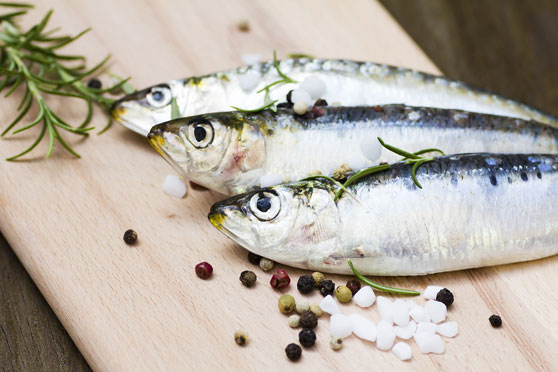
It makes sense to eat baitfish for their often sweet and concentrated flavour, as well as to take some pressure off other fish stocks (by eating lower down the food chain).
Baitfish are readily accessible, and catching them is a great option for kids, as well as being a good way to secure a feed if the big boys do not turn up. Just make sure to choose a warm sunny day for best results.
|
|
This article is reproduced with permission of |

Recent Forum Posts Visit Forum

Shane Jones
in Fisheries Management15 hours ago
Tzer
Far cry to the twats at Liegasea/NZSFC were proposing of 5 Tarakihi person in their submission for the central management area and this is what our...

Bluefin Tuna at the cavs.
in The Briny Bar34 hours ago
smudge
Despite my years of fishing I haven't really fished many places, my focus has always been on Auckland's west coast and out toward Great Barrier. I...

Casting gloves
in Popper and Topwater Fishing79 hours ago
Mc Tool
100 bucks for a lure 😬. Watching one of them flying over the horizon without the line attached would be " character building " for sure...
I thought Id post some nice photo's , join...
in The Briny Bar130 hours ago
Alan L
That is a very cool pic Krow.The Far North is very cool, the Far far North even cooler. Mint looking day.Alan...

Mc Tools berley mincer
in The Briny Bar138 hours ago
SaltyC
Good size, they scrap well. Got an 18kg one up in Vava'u back a few years ago fishing off squeaky Going's boat. That was quite a...

Out with the "Twelves"
in Fishing Reports192 hours ago
Pcj
I should be able to get out end of October. The nephew been out virtually every weekend over winter and has done well. It seems the...
Manukau Harbour & West Coast fishing
in Fishing Reports199 hours ago
smudge
Nice work Schecter, I think snapper may be around sooner than you think. Well I am hoping so...

Whangarei Harbour report.
in Fishing Reports632 hours ago
krow
180 +m is where I've had to be lately. A lot less low foul around these parts and some of it shallower that looks like Tarakihi...
Whangarei Harbour Scallops
in Fisheries Management742 hours ago
Pcj
Reopening WhangÄ쳌rei Harbour to recreational scallop fishingTÄ“nÄ쳌 koeFisheries New Zealand is seeking feedback from tangata whenua, stakeholders, and the public on whether WhangÄ쳌rei Harbour should be...
SNA1 Recc fishing cops the blame.
in Fisheries Management838 hours ago
Tzer
What Liegasea won’t tell you is that some of their own fisheries contractors were co-authors of this study for fear of being called hypocrites, one of...
Popular Articles

Softbait Fishing - Part 1 - gear selection
John Eichlesheim writes an article about selecting the right equipment for softbait fishing... Read More >
Softbait fishing Pt 2 - tips and tricks
Techniques, tips and tricks of softbait fishing – getting the most from your soft baits.... Read More >

Surfcasting - setting yourself up
Gary Kemsley helps sort out the necessary gear for intending surf fishers.... Read More >

Squid - How to catch them
Squid fishing is a rapidly growing aspect of fishing - Paul Senior shares some hints and tips to get started.... Read More >
Fishing Reports Visit Reports
Outer Hauraki Gulf Fishing Report 17/09/26
Spring wind the handbrake. Spring is starting to make its presence felt in the outer... Read More >
Top of the South Fishing Report - 17/09/26
Early snapper in Tasman Bay. Well, spring is finally here, and the days are getting... Read More >
Bream Bay Fishing Report - 17/09/26
Good snapper catches reported. After Tangaroa turned off the fish tap for a month or... Read More >
Bay of Islands Fishing Report - 17/09/26
Pacific bluefin tuna for the lucky few. The last fortnight has seen more fishable days... Read More >
Comments