
Drone Fishing

Live baiting
How many times have you deployed a live bait from the rocks, only to find it swimming as fast as it can right back to the shore? It’s probably running from that predatory kingfish hovering out a little deeper. Imagine how freaked out that tasty kahawai will be when it finds itself dropped 100 metres from shore, right in front of the eyes of the same hungry kingie – not to mention the kingfish’s delight upon seeing a delicious meal dropped from the skies!
With a drone, deploying live baits can now be much more precise, and you can get them out further than before, too. When setting up for live-bait deployment, bear in mind the bait fish will be flapping around, so make sure that the line from the reel is not taut, and don’t risk the drone getting pulled around by the fish before take-off. Using a normal live-bait trace is fine on your standard setup; simply add a loop of mono at the swivel to connect it to the drone so it can be pulled out.
If you want a more elegant solution that allows for the use of a balloon at your swivel connection, get some rigging floss and tie a loop to your trace around a metre from the hook (see below). To tie this, take a half-metre length of floss and fold it in half, leaving a loop of around 5-6cm, and then tie 8-10 alternating half hitches onto the leader with each of the two tag ends. Trim the remaining floss and you are ready to attach the loop to the drone’s release mechanism.
Alternatively, just tie a dropper loop in the middle of your live-bait trace; if using a balloon, add a small 1/2oz ball sinker at the top of the loop, so that the balloon is held down when in the air, and cannot get blown up into the propellers!
One way to prevent the live bait flapping on the ground is to place it into a small bucket of sea water located just behind the drone.
Lure fishing
Lure fishing is another possibility using a drone. Sending out a plastic-skirted tuna/marlin lure is as easy as tying an overhand knot in one of the rubber tassels and attaching it to the release mechanism. For other lures, such as spinners, soft-baits, hard-bodied lures, kaburas etc – use the same floss method as when live baiting, or simply place one of the lure hooks over the release mechanism.
During your drone fishing adventures, bear in mind that drones have an approximate flight time of 15 to 20 minutes per battery, so don’t expect to make 20 or 30 drops. However, because of the increased distance/range and better placement the drone provides, you should get more hook-ups, so may not need to send it out that many times. Carrying a spare battery or two never hurts, and will extend your drone-fishing fun.
Surfcasting
It’s easy to send out single- or double-hooked rigs off a beach using a surfcasting rod or long overhead rod. As with normal surfcasting, you want an extra bit of height to lift the line above the waves breaking on shore, preventing your line from being dragged around. Height also means people walking on the beach don’t accidentally walk into your line. A tall rod holder can also help in this regard.
Set up your trace as you normally would for fishing from a beach, using a breakaway sinker of 4-6oz as needed. Tie an extra piece of mono to your sinker, with a loop in the tail end of it. Use this loop to attach to the drone’s release mechanism.
When surfcasting this way, you can easily take your gear over sandbars or out further into more productive depths, and accurately drop baits into likely-looking areas. Another worthwhile benefit is that without the sudden velocity and water impact that typically occurs during casts, there’s no need to worry about the bait being ripped off the hook.
Longlines
Using a drone is a great way to send out a longline; having the ability to retrieve your expensive hauling device straight away after deploying the baits means your system is unlikely to get snagged, lost or stolen while out fishing.
Setting up a short or full-length longline, depending on your needs, is easy and practical. A five-hook rig is very efficient and also easy to deploy with minimum preparation. We use traditional longline traces with longline hooks and Sea Harvester clips to attach to the main trace. Traces around 500mm long are perfect for this type of fishing.
To make your own five-hook backbone, take 12 metres of 150-200lb mono trace, put a loop in one end (crimps are easy to use when making these up), then place crimps or stopper knots every metre along the backbone. Not every section is going to have a hook on it, as you want to leave an empty section between each hook so they cannot tangle with each other. Then, at the other end of the line, form another loop and crimp this, too.
Now tie a double of some sort in your reel’s line, whether using mono or braid (a Bimini Twist or Aussie Plait works great). After that, attach a decent quality ball-bearing snap-swivel using a Cat’s Paw Loop or with a Uni knot using both strands of the double line.
You need to place a sinker of 2-8oz (depending on the currents present) on the first and last stoppered sections. Bait up the hooked traces and attach them to every second section of the backbone.
Once you are all baited up, clip the lead loop onto your snap swivel and the end loop onto the drone.
Making a longer backbone with more hooks involves simply increasing the backbone’s length, allowing around two metres of backbone per hook, and always leaving an extra couple of metres for the sinkers and loops to be attached.
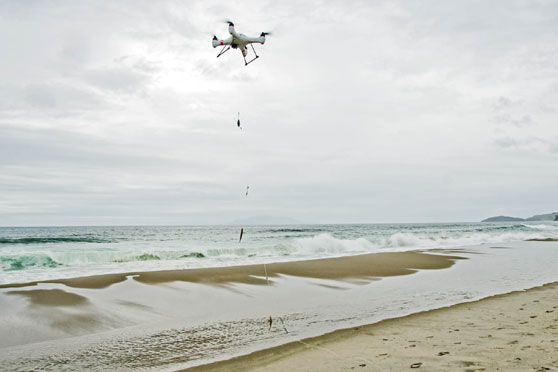
Clear for takeoff!
Whichever fishing method you choose to use, make your flight preparations for your drone before checking that the area is clear. Take off carefully, making sure you go slightly forward at the same time as lifting to avoid possibly tangling the traces or lures. Now fly the drone out to the desired location and pause for a little, taking time to check that the area is clear enough to drop your gear. Once you are satisfied with this, toggle the switch and drop the bait(s) before flying the drone back. (Alternatively, if your drone is equipped with a ‘return to home’ switch, press that and let it take care of itself.)
At no stage of the flight put the controller down, as you don’t know when something might go wrong or someone might walk into the landing area. You must be able to take manual control if necessary to keep everyone safe.
Now the fishing part begins: leave your baits to soak for a while if longlining; work that lure back to shore; or watch for tell-tale splashes showing your live bait is being harassed. But, most of all, enjoy the moment!
Recent Forum Posts Visit Forum

Shane Jones
in Fisheries Management1 hour ago
Fish Addict
The recreational sector can expect no favours from politicians. They know all too well who butters their bread and it ain't the recs. No different over...

Foton tunland v9
in The Briny Bar2 hours ago
Ho Dee
not fishing related and delete if required but was wondering if any has one of these or someone who has just wanting so e real world...

Trailer wheel clamp
in The Boat Shed2 hours ago
Pcj
Doesnt dry out like crc.I use it on my trailer lock...

Bluefin Tuna at the cavs.
in The Briny Bar48 hours ago
smudge
Despite my years of fishing I haven't really fished many places, my focus has always been on Auckland's west coast and out toward Great Barrier. I...
Casting gloves
in Popper and Topwater Fishing93 hours ago
Mc Tool
100 bucks for a lure 😬. Watching one of them flying over the horizon without the line attached would be " character building " for sure...
I thought Id post some nice photo's , join...
in The Briny Bar144 hours ago
Alan L
That is a very cool pic Krow.The Far North is very cool, the Far far North even cooler. Mint looking day.Alan...

Mc Tools berley mincer
in The Briny Bar152 hours ago
SaltyC
Good size, they scrap well. Got an 18kg one up in Vava'u back a few years ago fishing off squeaky Going's boat. That was quite a...
Out with the "Twelves"
in Fishing Reports206 hours ago
Pcj
I should be able to get out end of October. The nephew been out virtually every weekend over winter and has done well. It seems the...
Manukau Harbour & West Coast fishing
in Fishing Reports214 hours ago
smudge
Nice work Schecter, I think snapper may be around sooner than you think. Well I am hoping so...

Whangarei Harbour report.
in Fishing Reports646 hours ago
krow
180 +m is where I've had to be lately. A lot less low foul around these parts and some of it shallower that looks like Tarakihi...
Popular Articles

Softbait Fishing - Part 1 - gear selection
John Eichlesheim writes an article about selecting the right equipment for softbait fishing... Read More >
Softbait fishing Pt 2 - tips and tricks
Techniques, tips and tricks of softbait fishing – getting the most from your soft baits.... Read More >

Surfcasting - setting yourself up
Gary Kemsley helps sort out the necessary gear for intending surf fishers.... Read More >

Squid - How to catch them
Squid fishing is a rapidly growing aspect of fishing - Paul Senior shares some hints and tips to get started.... Read More >
Fishing Reports Visit Reports
Outer Hauraki Gulf Fishing Report 17/09/26
Spring wind the handbrake. Spring is starting to make its presence felt in the outer... Read More >
Top of the South Fishing Report - 17/09/26
Early snapper in Tasman Bay. Well, spring is finally here, and the days are getting... Read More >
Bream Bay Fishing Report - 17/09/26
Good snapper catches reported. After Tangaroa turned off the fish tap for a month or... Read More >
Bay of Islands Fishing Report - 17/09/26
Pacific bluefin tuna for the lucky few. The last fortnight has seen more fishable days... Read More >
Comments