
Dragging Lures While Drifting
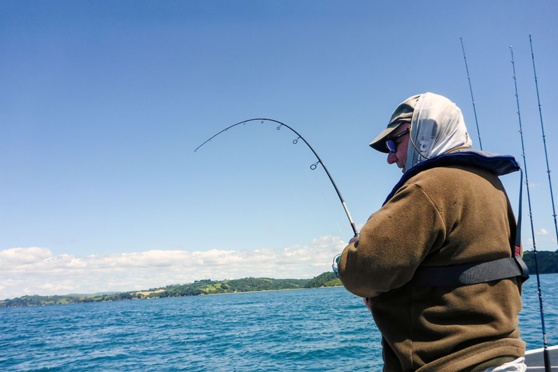
Sam Mossman is in semi-retirement mode, looking for a gentler pace of life, and that includes his fishing.
There is an ancient Chinese curse that goes ‘May you live in interesting times’, an ironic reference to the hazards of life under war, insecurity, and chaos. Pandemics and climate change, amongst other things, are certainly making the times of our lives interesting. Not that any of this is new or even surprising.
Those of you who read some history will know of epidemics like smallpox, bubonic plague, typhus, measles, yellow fever, whooping cough, Spanish flu, polio, malaria, encephalitis, HIV, Ebola, SARs, swine flu, avian flu and cholera, to name just a few. Wave after wave of these epidemics have swept the world through recorded history, killing hundreds of millions of people over the ages. Covid is just the latest in a lengthy line of diseases, now made more easily transmissible by fast international travel. In modern times, science has beaten most of them so successfully that their deadliness has faded from our collective consciousness – or at least that of the antivax mob.
Living the dream
Enough! Last year, between lockdowns I made good on a long-term plan, selling up and moving out of Auckland, semi-retiring and settling in a coastal township further north. After thirty years in the Big Smoke, I had had enough of the stresses of an increasingly sprawling, over-crowded, unliveable city and my partner and I are loving living in a small town with its slower pace of life.
During the most recent lockdown, as soon as permitted, we spent happy winter evenings throwing a line off a quiet local wharf that provided us with meals of fresh kahawai and gurnard while we sipped a coffee or wine and watched the sun go down. When Covid regulations eased further in the spring, I could launch my small boat a few minutes from home and have good, handy fishing in sheltered waters.
These days I mostly fish for the table. Feeding yourself and your family is the ultimate, unassailable justification for fishing in my opinion, but that doesn’t mean it can’t be fun and challenging. There are a good range of table fish in my local waters. Snapper are the primary species available but recent trips have seen gurnard, trevally, john dory, kahawai and kingfish regularly join the reds in the chilly bin.
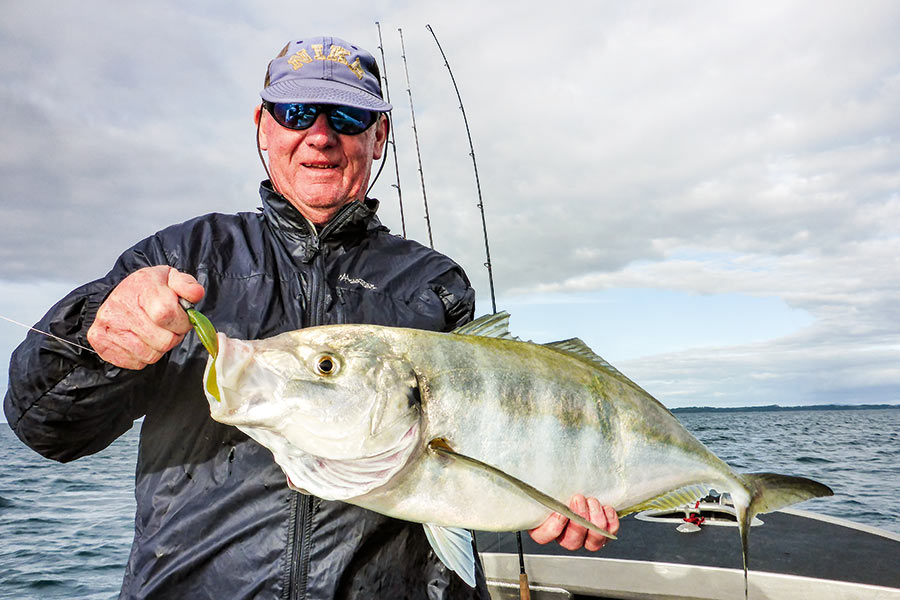
Trevally like soft-baits too. Mike Clay with a nice one.
Light tackle fun
The key to putting the fun and challenge into fishing is the tackle chosen. I have used light tackle most of my fishing life and remain convinced that within practical bounds (say three- to eight-kilo line and a matching rod and reel), lighter gear will provide better results when bread-and-butter coastal fishing than heavier gear will. It is more of a challenge and more fun too. The current popularity of soft-baiting and other small lure techniques has introduced many anglers to the joys of lighter tackle by default.
I try to be as kind to the fishery as I can. I don’t use methods that specifically target big snapper, although I still encounter a few decent specimens and I don’t complain when I do. However, I reckon the biggest snapper have proven their survival and growth abilities and we want them to remain in the gene pool. By the same token, with reduced bag limits, I want to be catching reasonable-sized fish to provide enough for our needs. When fishing for the table my preference (in snapper) is for medium-sized fish of around two-four kilos and I tailor my techniques to target them (we will get to this in a moment).
You can’t, of course, always avoid catching undersized or unwanted fish but I try to minimise potential damage to fish by using lures or circle hooks (when bait fishing – yes, I still do some) to avoid deep hooking. I also mostly fish in water less than thirty metres deep to avoid embolising fish and unsuccessful releases.
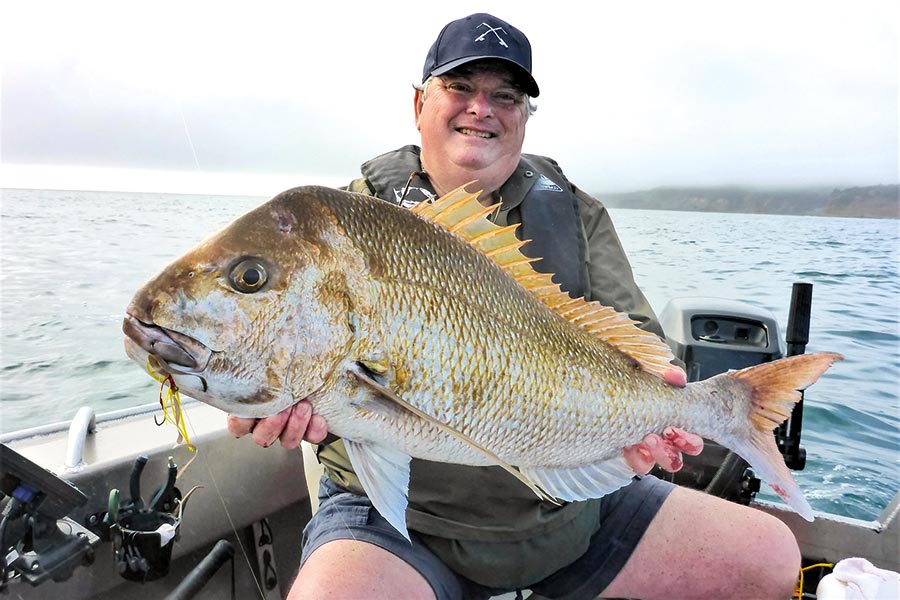
Sam doesn’t specifically target big fish these days, but still encounters a few decent specimens and doesn’t complain when he does.
Fishing techniques
I do a lot of lure fishing, for several reasons: I love the concept of fooling a fish with an artificial; I love sensing the take and hooking the fish; I tend to catch a better class of fish on lures than bait; there are no issues with refrigeration and thawing of bait and messing around with berley; the boat (and your hands) stay cleaner; and the fish are mostly mouth-hooked, allowing easier releases with less mortality.
Effective lure fishing is mostly done on the drift, with or without the use of a drogue to help control the drift speed, depending on the conditions. This allows the boat to cover the grounds, which in turn allows presentation of the lures to fresh fish on a regular basis. You are going to the fish instead of waiting for them to come to you and I like this exploring and hunting aspect, too. The use of a sounder/GPS lets me see what is going on under me and to repeat successful drift lines and relocate ‘hot-spots.’ I tend to work the channels and avoid the heavy foul to avoid snagging and lure loss. Best of all, I don’t have to pull up and reset the anchor every time I want to try another spot.
A tactic that has been highly successful has been a mix of casting a soft-bait and dragging a lure behind the boat with the rod in a holder. As you will all know, Roddy Holder is a damn good fisherman!
My favourite soft-baits, these days, are Z-Mans, largely because they are so robust, don’t dry out, and produce the goods. Often, just one tail will last several trips. I prefer natural colours – browns, greens, bruised banana, baitfish shades etc, and mostly use five-inch tails. Tails of this size tend to exclude a lot of the undersized fish but are small enough not to intimidate medium sized ‘pannies’ that can provide a useful addition to the catch.
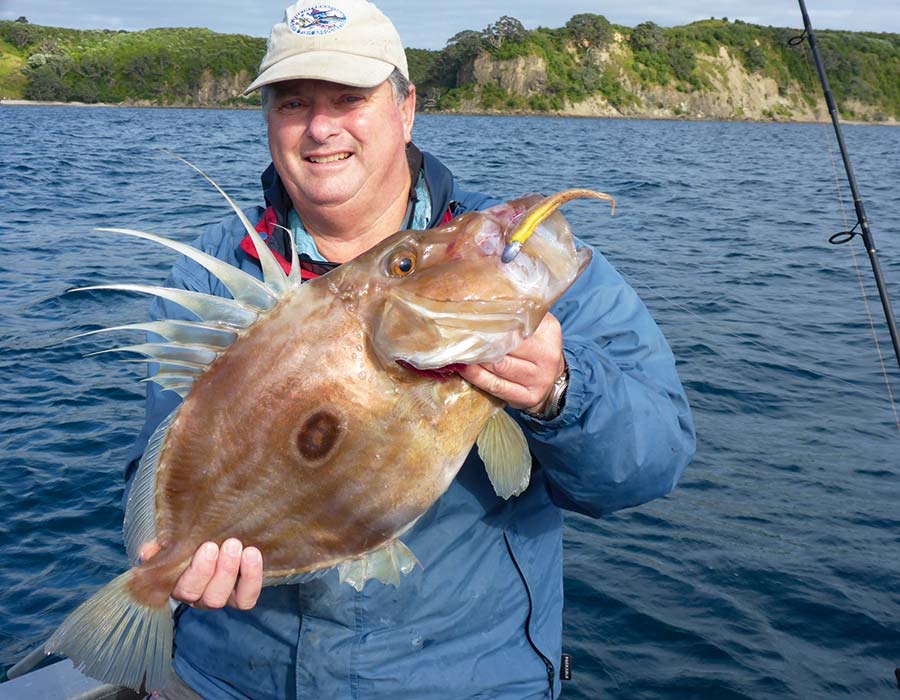
Delicious john dory are a regular by-catch of soft-baiting.
Not every offering works well every time. I have tried both cut bait and soft-baits on the drag rod over the years and although they both produce fish, they also have their downsides. The whole concept of a drag rod is that it should be a ‘set it and forget it’ method that allows me to cover the field and give the fish an alternative to my cast lure.
It should be a setup that doesn’t need much attention so I can concentrate on working a cast soft-bait. Cut baits on the drag rod can become washed out and less effective over time and fish can remove them without being hooked. Soft-baits can be disarranged on the jig head by a missed bite. Once this happens the lure will not swim properly and fish seldom take a soft-bait which is cork-screwing through the water. There is also a tendency for soft-baits to rise above the bottom if you are not paying attention to them by dropping back line and so on. A lot of the time fish are feeding head down hard on the bottom and will not see the lure if it is too far above them, with a subsequent reduction in results.
What I needed was a drag lure that would easily hold just above the bottom on the drift, had minimal drag through the water, and a subtle in-built action – and would keep working if a fish struck and missed. The fish should be able to nibble on it without being spooked and be able to hook itself easily.
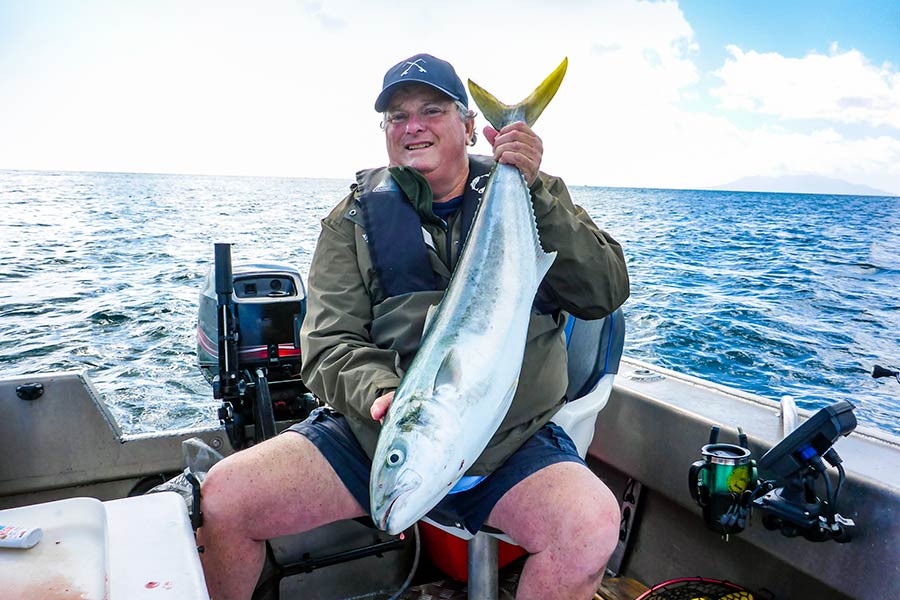
Modest but legal kingies, like this 85cm specimen that jumped a soft-bait, are great eating, especially as ceviche or sashimi.
My most successful drag lure to date has been the Catch Kabura, a slider-type lure, in 40 or 60g weights. In the shallower waters I prefer, these weights are quite sufficient to stay down and give a better action. Save the heavier weights for deeper water and faster currents.
I set it just above the bottom. The narrow profile of the head slides through the water easily, the tail has an enticing action, and the two hooks fitted are small, sharp, and strong. Fish tend to nibble away at the tails and hook themselves in the lip. Because the rod is in the holder, the angler is not tempted to give it a strike when the first tentative bites come, spooking the fish. Orange and black or yellow and brown are productive colours for me but others work too, as do other brands of slider-style lures.
I would say that I catch the bulk of the fish on the cast soft-bait, but often – very often – the drag rod will produce the best fish of the day.

February 2022 - Sam Mossman
New Zealand Fishing News Magazine.
Copyright: NZ Fishing Media Ltd.
Re-publishing elsewhere is prohibited
Recent Forum Posts Visit Forum

Trailer wheel clamp
in The Boat Shed5 hours ago
Mc Tool
either crc long life or 556 marine are way better ...

Shane Jones
in Fisheries Management10 hours ago
Tzer
From what I see too even commercial in WA aren’t getting any favours from politicians there. I think here our advocacy groups like Liegasea aren’t doing...

Foton tunland v9
in The Briny Bar20 hours ago
Ho Dee
not fishing related and delete if required but was wondering if any has one of these or someone who has just wanting so e real world...

Bluefin Tuna at the cavs.
in The Briny Bar67 hours ago
smudge
Despite my years of fishing I haven't really fished many places, my focus has always been on Auckland's west coast and out toward Great Barrier. I...
Casting gloves
in Popper and Topwater Fishing112 hours ago
Mc Tool
100 bucks for a lure 😬. Watching one of them flying over the horizon without the line attached would be " character building " for sure...
I thought Id post some nice photo's , join...
in The Briny Bar163 hours ago
Alan L
That is a very cool pic Krow.The Far North is very cool, the Far far North even cooler. Mint looking day.Alan...

Mc Tools berley mincer
in The Briny Bar170 hours ago
SaltyC
Good size, they scrap well. Got an 18kg one up in Vava'u back a few years ago fishing off squeaky Going's boat. That was quite a...

Out with the "Twelves"
in Fishing Reports224 hours ago
Pcj
I should be able to get out end of October. The nephew been out virtually every weekend over winter and has done well. It seems the...
Manukau Harbour & West Coast fishing
in Fishing Reports232 hours ago
smudge
Nice work Schecter, I think snapper may be around sooner than you think. Well I am hoping so...

Whangarei Harbour report.
in Fishing Reports664 hours ago
krow
180 +m is where I've had to be lately. A lot less low foul around these parts and some of it shallower that looks like Tarakihi...
Popular Articles

Softbait Fishing - Part 1 - gear selection
John Eichlesheim writes an article about selecting the right equipment for softbait fishing... Read More >
Softbait fishing Pt 2 - tips and tricks
Techniques, tips and tricks of softbait fishing – getting the most from your soft baits.... Read More >

Surfcasting - setting yourself up
Gary Kemsley helps sort out the necessary gear for intending surf fishers.... Read More >

Squid - How to catch them
Squid fishing is a rapidly growing aspect of fishing - Paul Senior shares some hints and tips to get started.... Read More >
Fishing Reports Visit Reports
Outer Hauraki Gulf Fishing Report 17/09/26
Spring wind the handbrake. Spring is starting to make its presence felt in the outer... Read More >
Top of the South Fishing Report - 17/09/26
Early snapper in Tasman Bay. Well, spring is finally here, and the days are getting... Read More >
Bream Bay Fishing Report - 17/09/26
Good snapper catches reported. After Tangaroa turned off the fish tap for a month or... Read More >
Bay of Islands Fishing Report - 17/09/26
Pacific bluefin tuna for the lucky few. The last fortnight has seen more fishable days... Read More >
Comments