
Do Released Snapper Survive?
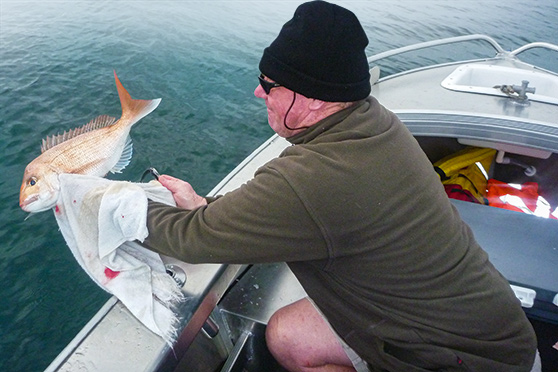
There has been debate for years about the survival rate of fish released after being caught. Everyone has an opinion, but what are the facts? Sam Mossman investigates what some of the research tells us.
Marine researcher Bruce Hartill of NIWA, along with co-authors John Holdsworth (Blue Water Marine Research), and Oliver Evans published a report called Recommended release mortality estimation methods for species commonly caught by recreational fishers in New Zealand.
This report, recently completed for Fisheries New Zealand, identifies species commonly caught and released by recreational fishers in New Zealand and proposes experimental methods that could be used to estimate release mortality rates based on domestic and international (mostly Australian) experience and published literature.
The authors identified the four high priority species that future research into recreational release mortality estimation should focus on: snapper, blue cod, kingfish and kahawai. This is an important report, not just for fisheries managers wanting to understand how research on recreationally released fish mortality may be carried out in the future, but to recreational anglers looking for ways to further reduce the mortality of released fish.
Given that snapper are easily the most important recreational species, making up over half of national recreational catches, it is the most studied of the ‘big four’ and has the most information to sieve through. Consequently, I will deal with this species on its own, and cover the other three in a follow-up story next month.
Recent surveys have estimated that recreational fishers currently land over 4000t of snapper annually – 40% of the total snapper catch of all sectors. Recreational release rates have steadily increased in most areas as larger minimum legal-size limits and smaller daily bag limits have been introduced in most management areas, meaning more undersized fish must be released, and larger specimens are preferred for the bin. Most of the snapper released by recreational fishers are below the minimum legal-size limit in force at that time, with the majority of this catch taken by rod and line fishing methods in water depths less than 30 to 40m.
Barotrauma
Recreational release mortality for snapper is often attributed to the barotrauma that a fish may experience when it is retrieved from depth.
Both the 2011–12 and 2017–18 National Panel Surveys have shown that the SNA 1 stock (north east coast of the North Island) supports New Zealand’s largest recreational fishery, based on the numbers of participants and numbers of fish harvested. Around 90% of the catch is taken from boats and 77% of the observed stationary boat fishing effort occurred in depths of 30m or shallower, with 89% of effort occurring in 40m or shallower. Although the percentage of the recreational catch that is released is broadly similar across all depths, two Australian studies suggest the mortality rate of snapper caught deeper than 30m can be much higher than in shallower water.
Australian studies have shown that the swim bladder of a snapper will almost certainly burst if it is pulled up from more than 14m, but the inner layer of the swim bladder will usually heal itself within 48 hours. Snapper caught in 30m depth or more may suffer additional barotrauma caused by gases forming bubbles when the fish is hauled to the surface.
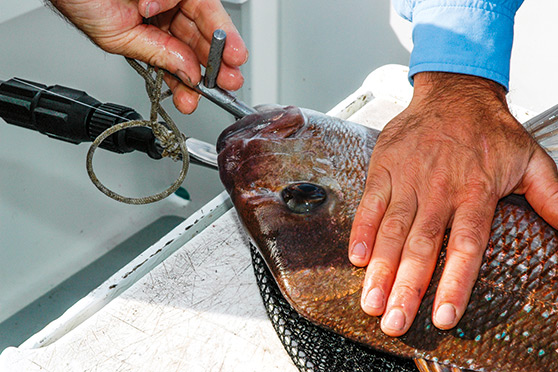
Deep hooked snapper have a much lower survival rate.
In another study from across the ditch, no mortalities were observed in fish caught in less than 21m depth, and only 2% of fish caught in less than 30m depth subsequently died. But mortality rates increased significantly beyond this depth, with 39% dying at 30–44 m and 55% dying at 45–59m. Depth of capture was by far the most important factor affecting release mortality in another set of data, which increased from 3.42% in shallow depths (5, 10, and 15m) to 69% for snapper caught in deeper waters (45 and 65m).
Short-term release mortality rates for snapper caught in less than 30m may be negligible if the fish are undamaged and can return to their capture depth unaided. Appreciable levels of release mortality can occur when snapper are taken from depths greater than 30m and they are unable to return to those depths. Larger fish are often more buoyant and may struggle to get back down to their capture depth, especially if they are exhausted when brought to the surface.
Reproductive stage was also an important barotrauma predictor, with immature and spent fish being less likely to exhibit signs of tissue damage. The reduced incidence of barotrauma damage to vital organs in these fish was attributed to there being more room in the body cavity to accommodate a distended swim bladder, which could put pressure on vital organs when hyperextended.
Hook wounding
Over 98% of the snapper catch reported during the NZ recreational catch surveys conducted in 2017–18 was taken by fishers using some form of rod and line fishing method, with either baited looks, lures or soft-plastic baits. Release mortality rates can vary considerably by fishing method because the damage caused by each type of fishing gear will differ.
In a 1995 Hauraki Gulf study, the mortality of ‘lip-hooked’ fish with the hook removed was in the order of 5–10% but it was 75–90% for gut-hooked snapper.
Several Australian studies have also shown that the mortality rate of deep/gill-hooked snapper is far higher than for lip-hooked fish. In one study about 52% of the gut-hooked snapper held in cages for three days died, but only 3% of lip-hooked fish died over the same period. Release mortality rates observed in another study were generally higher, with 92% of gut-hooked snapper and 34% of lip-hooked fish dying over four days, the mortality rate of the deeper hooked fish being three times that of lip-hooked fish.
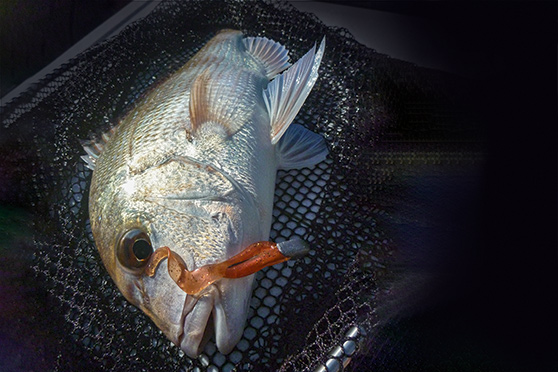
Lure-caught snapper are more likely to be lip hooked and have a better chance of survival.
Gut-hooking rates are usually much lower when lures are used because lures are less likely to be swallowed than baited hooks.
When snapper were gut-hooked, there was very little difference in the likelihood of these fish dying if the hook was removed or if the trace was just cut, both in terms of initial mortality and over the following days. Much of the damage associated with deep/gill-hooking probably occurs as the fish is being played back to the boat, especially in larger fish which are more likely to ingest a hook and resist capture for a longer period, leading to greater damage.
Most of the fish that died during the Australian studies did so within the first three days, which suggests that most hook related mortality that did occur during these studies was due to physical damage rather than infected wounds.
When a hook is not removed from a gut-hooked snapper and the fish survives for a few days, it will probably eject or pass the hook soon after. In one study, 108 snapper that had ingested hooks were held in aquarium tanks for six weeks, with 77% of the 81 surviving fish ejecting their hooks over an average period of nine days.
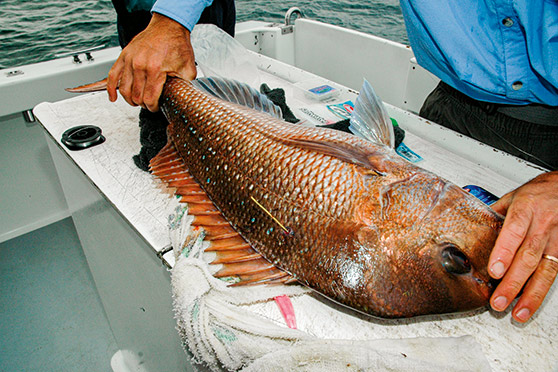
A recaptured snapper from one of several research programs in the Hauraki.
Venting
Most snapper with hyper-extended swim bladders are retrieved from depths greater than 14m, and any venting (using a needle to release gas from the gut cavity) of snapper may result in needless damage and infection to vital organs. Venting by fishers may improve the survival of released fish that are excessively buoyant, but there are other methods that are less likely to further injure these fish, such as the use of release weights (weights that are attached to a fish to aid its return to depth, which can be detached from the fish by jigging the line it is attached to). One study vented every second snapper caught and found no significant difference between the survival rates of vented and unvented fish, which supports the conclusion of another review that the practice of venting should be discouraged.
However, when the swim bladder bursts and the stomach protrudes from the mouth, the fastest way to release that pressure is making a small hole in the stomach. The venting of everted snapper stomachs through the mouth was studied, with 64% of vented stomachs healing within three days. Barotrauma-related damage to vital organs can also have a sublethal effect on recreationally-caught snapper.
Stress
A laboratory study in 2014 visually assessed reflex impairment and blood chemistry to evaluate the potential long-term impact of simulated angling (manual chasing) and air exposure durations on snapper survival following release. The authors concluded that “The findings of this study add to the growing body of evidence suggesting that snapper are resilient to angling stress when caught in shallow water and hooked in the mouth or jaw. Although physiologically demanding, strenuous exercise and air exposure associated with typical angling of sub-legal snapper are not likely to be a direct cause of mortality.”
Predation
There is plenty of anecdotal evidence of small snapper being vulnerable to seabirds, mainly shags, as they attempt to return to depth. Fish that are unable to escape the surface or are deep/gill-hooked with internal damage will be more susceptible to scavenging (generally by gulls). The vulnerability of a released snapper to predation is hard to assess because this may occur at depth some distance from the boat.
Handling
One study found that landing method (knotless net/knotted net/no net), restraint method (wet hand/dry hand/towel/no restraint) and air exposure (under 15/16–30/31–60 seconds) were not significant predictors of mortality. This result is consistent with the results of the 1995 New Zealand study in which the mortality rate of fish caught by a group of fishers, who were trained to handle their fish with care, was not significantly different to that of fish caught by untrained fishers, for lip hooked fish.
Although most snapper released by recreational fishers are likely to be released quickly, and without suffering excessive handling related damage that is not hook-site related, some fish may be handled and exposed to the air for a substantial period of time when an angler has trouble removing the hook from the fish, or when the angler has caught a large fish that is weighed and or photographed before release. The survival of most of these fish may have already been compromised if they have gut and gill-hooked injuries.
The few studies that have attempted to assess the impact of handling practice on fish survival suggest there are other factors that better explain mortality rates in released snapper.
Conclusions
All the evidence available suggests that the two primary likely causes for snapper release mortality are hook damage and some form of barotrauma. Past studies have all shown that snapper that become injured when they ingest a hook have a high probability of dying from hook damage to the gills, oesophagus, and other vital organs, although the incidence of deep hooking is low, relative to lip-hooking rates, and can be reduced by using circle hooks or fishing with lures.
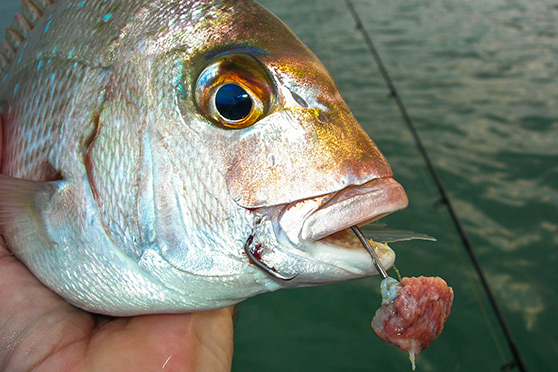
Using good-sized circle hooks greatly increases the chance of lip hooking.
A hyperbaric chamber study showed that although a snapper’s swim bladder is likely to burst if a fish is retrieved from 14m or more, there is a high probability of the fish surviving and healing quickly if it can quickly return to depth to recompress.
|
|
This article is reproduced with permission of |

Recent Forum Posts Visit Forum

Trailer wheel clamp
in The Boat Shed4 hours ago
krow
I like the SAS wheel clamp. I've had no issues with the lock....

Shane Jones
in Fisheries Management6 hours ago
Fish Addict
The recreational sector can expect no favours from politicians. They know all too well who butters their bread and it ain't the recs. No different over...

Foton tunland v9
in The Briny Bar6 hours ago
Ho Dee
not fishing related and delete if required but was wondering if any has one of these or someone who has just wanting so e real world...

Bluefin Tuna at the cavs.
in The Briny Bar53 hours ago
smudge
Despite my years of fishing I haven't really fished many places, my focus has always been on Auckland's west coast and out toward Great Barrier. I...
Casting gloves
in Popper and Topwater Fishing98 hours ago
Mc Tool
100 bucks for a lure 😬. Watching one of them flying over the horizon without the line attached would be " character building " for sure...
I thought Id post some nice photo's , join...
in The Briny Bar149 hours ago
Alan L
That is a very cool pic Krow.The Far North is very cool, the Far far North even cooler. Mint looking day.Alan...

Mc Tools berley mincer
in The Briny Bar156 hours ago
SaltyC
Good size, they scrap well. Got an 18kg one up in Vava'u back a few years ago fishing off squeaky Going's boat. That was quite a...

Out with the "Twelves"
in Fishing Reports210 hours ago
Pcj
I should be able to get out end of October. The nephew been out virtually every weekend over winter and has done well. It seems the...
Manukau Harbour & West Coast fishing
in Fishing Reports218 hours ago
smudge
Nice work Schecter, I think snapper may be around sooner than you think. Well I am hoping so...
Whangarei Harbour report.
in Fishing Reports650 hours ago
krow
180 +m is where I've had to be lately. A lot less low foul around these parts and some of it shallower that looks like Tarakihi...
Popular Articles

Softbait Fishing - Part 1 - gear selection
John Eichlesheim writes an article about selecting the right equipment for softbait fishing... Read More >
Softbait fishing Pt 2 - tips and tricks
Techniques, tips and tricks of softbait fishing – getting the most from your soft baits.... Read More >

Surfcasting - setting yourself up
Gary Kemsley helps sort out the necessary gear for intending surf fishers.... Read More >

Squid - How to catch them
Squid fishing is a rapidly growing aspect of fishing - Paul Senior shares some hints and tips to get started.... Read More >
Fishing Reports Visit Reports
Outer Hauraki Gulf Fishing Report 17/09/26
Spring wind the handbrake. Spring is starting to make its presence felt in the outer... Read More >
Top of the South Fishing Report - 17/09/26
Early snapper in Tasman Bay. Well, spring is finally here, and the days are getting... Read More >
Bream Bay Fishing Report - 17/09/26
Good snapper catches reported. After Tangaroa turned off the fish tap for a month or... Read More >
Bay of Islands Fishing Report - 17/09/26
Pacific bluefin tuna for the lucky few. The last fortnight has seen more fishable days... Read More >
Comments