
Do Released Fish Survive?

Previously, Sam Mossman looked at the research that had been done on the mortality rates of snapper released by recreational anglers. Here, he looks at what is known about the three other most important species: blue cod, kingfish and kahawai.
In July of 2020, marine researcher John Holdsworth of Blue Water Marine Research, along with co-authors Bruce Hartill and Oliver Evans, published a report called “Recommended release mortality estimation methods for species commonly caught by recreational fishers in New Zealand.” This report, recently completed for Fisheries New Zealand, identifies species commonly caught and released by recreational fishers in New Zealand and proposes experimental methods that could be used to estimate release mortality rates, based on published literature.
Hopefully, in the future, we will see the results of the research proposed by this report but in the meantime, recreational anglers (and fish) can benefit from the report and the information it contains by learning more about ways recreational anglers can reduce the mortality of released fish.
The authors identified the four high priority species that future research into recreational release mortality estimation should focus on: snapper, blue cod, kingfish and kahawai. Last month we focused on the species that the most research had been done on – snapper. This month we will look at the other three main species.
Blue cod
Blue cod are most-commonly caught off the lower North Island and around the South Island and are a popular recreational table fish. The most recent recreational harvest estimate for blue cod (in 2017-18) was 293 tonnes, less than 15% of the total national blue cod catch in that year. Recreational blue cod release rates are high, with 55% of the catch reported released during creel surveys and 38% of the reported charter boat catch being released (2017-18 figures).
Blue cod are endemic to New Zealand so there was no overseas research to consider. Three studies have been published in New Zealand with some reference to recreational blue cod release-mortality: Davidson (2001) fished with baited 2/0 hooks to monitor changes in the size, distribution and behaviour of blue cod caught in and outside the Long Island Kokomohua Marine Reserve in the Marlborough Sounds. He records that a small percentage of the fish died (under 3%), “most of which had bled profusely from hook-damaged gills.”
Carbines (1999) contrasted the use of baited, barbed 1/0 straight shanked and 6/0 kahle hooks to catch sub-legal (under 33cm) blue cod. These fish were then held in cod pots at 20m deep for two weeks so their survival could be regularly monitored. A control group of fish were also caught in commercial cod pots and held at the same depth for the same period. The sample size for each treatment was 40 fish. All the control fish and those caught with 6/0 hooks survived, but 25% of the 40 cod caught on 1/0 hooks died (three of the five gut-hooked, and seven of the eight gill-hooked fish succumbed within 26 hours). None of the fish caught on the larger kahle hooks were gut- or gill-hooked and all survived.
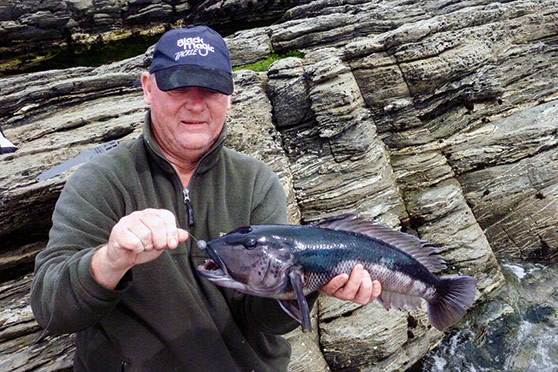
Deep-hooked blue cod have a high mortality rate.
In addition, two fish handling treatments were assessed: handling fish with cotton gloves out of direct sunlight vs. with bare hands in direct sunlight. There was no statistical difference between the mortality rates for these two handling treatments. As Glen Carbines said to me when we discussed his study on the phone a few years ago, “blue cod are as tough as old boots.”
Regarding barotrauma, it seems that while larval blue cod have a functional swim bladder that provides buoyancy during their larval phase, it is not used to regulate buoyancy during later bottom-dwelling life stages. It seems that blue cod have no difficulty getting under the surface when released and should not, therefore, experience any prolonged damage from barotrauma associated with a ruptured swim bladder.
They are, however, susceptible to predation by shags that have learnt to wait by boats that are fishing and pick up fish that have been released. The same may be true of another blue cod predator, barracouta.
Kingfish
The most recent recreational harvest figures (2017-18) equate to 74% of the estimated harvest of kingfish taken by all sectors. This is as it should be, approximating the recreational quota allocation. Release rates are high; ramp surveys of recreational fishers report 63% of the kingfish catch was released, while charter boat skippers reported 79% release rates.
During a 2014-15 kingfish ageing study, 68% of fish were released from private and charter boats. All fish were measured, and the proportion of legal-sized kingfish caught on dead baits or live baits and released was 63%, with the remainder of the released catch being caught on jigs or lures. Deep/gill-hooking occurs mainly for fish caught on baits.
An interesting study in Australia used two approaches to assess post-release survival of kingfish caught by rod and line anglers: a holding cage trial and a biotelemetry study.
With the holding cage trial, 54 kingfish (60-75 cm) were caught by volunteer anglers who mostly used baited, barbed J-hooks, but a small number of fish were also caught on treble hooks, barbless hooks, or lures. The volunteer anglers were asked to record the line strength used; hook type; bait type; time of capture; approximate retrieval and air exposure times; type of landing net; how the hook was removed (bare hands, pliers, cloth); if the fish was dropped on the deck; if it bled from the hook wound; and the hooking site.
Most of the 54 fish caught were lip-hooked (74.1%), but eleven were hooked in the gill arches (20.4%) and three were hooked deeper in the gut (5.3%). For all hooking locations, 33.3% of fish showed signs of bleeding, and hook-related tissue damage was evident in 48.1% of the fish.
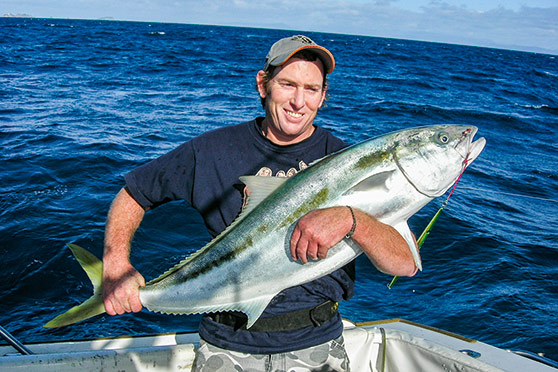
Kingfish caught on lures are nearly always lip-hooked.
Eight of the fish caught by volunteer anglers died during the monitoring period (14.8%), and seven of these were gill-hooked (63.6% of all gill-hooked fish). Six of the seven gill-hooked fish that died were bleeding when first caught. All the gill-hooked fish that died did so within 60 minutes of capture. Other fish that died all did so within four hours. The only significant factor in mortality amongst all of those recorded was hook location.
In another study, ten gill-hooked and twelve jaw-hooked kingfish were caught by rod and line and tagged with acoustic tags. With the gill-hooked fish, the hook was left in place and the line was cut to minimise bleeding and improve the chances of the fish surviving. The hook was removed from all jaw-hooked fish. None of the jaw-hooked fish bled, but all gill-hooked fish showed signs of bleeding. There were some equipment issues, but the data suggest that survival rates for the gill-hooked fish over the next 15 days were reasonably high, with all fish displaying variable depth swimming behaviour similar to that detected from jaw-caught fish. The apparent higher survival rate of these gill-hooked fish in this second experiment could have been because the hooks were not removed from the gills, with the trace being cut off short instead.
The other common bugbear with released fish, barotrauma, is considered unlikely to be an issue with kingfish as they can vent their swim bladder rapidly when changing depth. They have a membranous opening at the roof of their swim bladder that leads to a flattened tube which exits below the gill plate. Venting through this flattened tube begins when the swim bladder has inflated to approximately double its initial volume and ceases when neutral buoyancy is achieved. A kingfish should therefore be able to return to a comfortable depth soon after it is released, without rupturing its swim bladder or suffering tissue damage.
Kahawai
Although kahawai is the second most commonly caught fish by recreational fishers in New Zealand, no work has been done on recreational release mortality for this species. Fishers interviewed during boat ramp interview surveys in 2017-18 released 39% of their reported kahawai catch, and charter boat skippers reported 18% release rates.
It is thought that kahawai are probably not susceptible to angling-induced barotrauma because this pelagic species has most likely developed a swim bladder venting mechanism similar to that seen in kingfish. Kahawai are also often targeted and caught from surface schools, rather than pulled from the depths, but many anglers will have seen kahawai that have been hooked on bottom rigs run straight to the surface and start jumping.
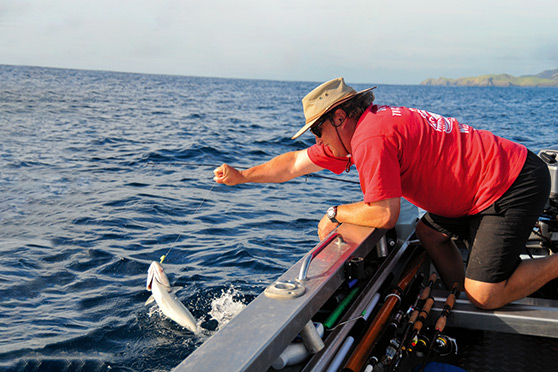
Kahawai are a commonly caught recreational species, but no research has been done on their release mortality.
This species may be more susceptible to handling damage and infection because it has softer flesh than kingfish and larger scales that are more easily dislodged (which would expose the skin to infection). If carefully handled and released, kahawai may well be reasonably robust. One study, not related to release mortality, successfully kept about 100 rod-and-line caught kahawai in a 35 cubic metre recirculated saltwater tank for over a year without losing any fish to injury or disease.
Hopefully, anglers will take on board this information, as well as that from the first part of this series on snapper, and use it to adjust their fishing tactics to help reduce the mortality levels of released fish.
Tips For Improved Release Survival
Blue cod
• Hook position has the greatest effect on mortality.
• Lip hooked fish nearly always seem to survive; gill or gut hooked fish mostly die.
• Small hooks (1/0 ‘J’ hooks) often result in deep hooking.
• Larger hooks (6/0 kahle and by inference, circle) mostly result in lip hooking.
• Barotrauma does not seem to be an issue but predation by shags and barracouta may be.
Kingfish
• Hook location is the main factor in kingfish mortality.
• Kingfish that are gill hooked or bleeding when caught have a high mortality (around two-thirds) rate.
• The release mortality rate for gut-hooked kingfish has not been studied to date.
• Kingfish that are deep hooked are mostly caught on baits rather than lures.
• Kingfish that are gill hooked and have the trace cut short without an attempt at hook removal seem to have an improved survival rate over those where the hook is removed.
• Barotrauma is not an issue with kingfish as they can vent their swim bladders.
Kahawai
• No studies have been done on kahawai recreational release survival.
• It is reasonable to assume that deep hooked and bleeding fish have a low survival rate.
• Barotrauma does not seem to be an issue as kahawai can probably vent their swim bladders.
• Kahawai may be more susceptible to handling damage and infection than kingfish because of softer flesh and larger scales that are more easily dislodged.
|
|
This article is reproduced with permission of |

Recent Forum Posts Visit Forum

Trailer wheel clamp
in The Boat Shed49 minutes ago
krow
I like the SAS wheel clamp. I've had no issues with the lock....

Shane Jones
in Fisheries Management3 hours ago
Fish Addict
The recreational sector can expect no favours from politicians. They know all too well who butters their bread and it ain't the recs. No different over...

Foton tunland v9
in The Briny Bar3 hours ago
Ho Dee
not fishing related and delete if required but was wondering if any has one of these or someone who has just wanting so e real world...

Bluefin Tuna at the cavs.
in The Briny Bar50 hours ago
smudge
Despite my years of fishing I haven't really fished many places, my focus has always been on Auckland's west coast and out toward Great Barrier. I...
Casting gloves
in Popper and Topwater Fishing95 hours ago
Mc Tool
100 bucks for a lure 😬. Watching one of them flying over the horizon without the line attached would be " character building " for sure...
I thought Id post some nice photo's , join...
in The Briny Bar146 hours ago
Alan L
That is a very cool pic Krow.The Far North is very cool, the Far far North even cooler. Mint looking day.Alan...

Mc Tools berley mincer
in The Briny Bar153 hours ago
SaltyC
Good size, they scrap well. Got an 18kg one up in Vava'u back a few years ago fishing off squeaky Going's boat. That was quite a...

Out with the "Twelves"
in Fishing Reports207 hours ago
Pcj
I should be able to get out end of October. The nephew been out virtually every weekend over winter and has done well. It seems the...
Manukau Harbour & West Coast fishing
in Fishing Reports215 hours ago
smudge
Nice work Schecter, I think snapper may be around sooner than you think. Well I am hoping so...
Whangarei Harbour report.
in Fishing Reports647 hours ago
krow
180 +m is where I've had to be lately. A lot less low foul around these parts and some of it shallower that looks like Tarakihi...
Popular Articles

Softbait Fishing - Part 1 - gear selection
John Eichlesheim writes an article about selecting the right equipment for softbait fishing... Read More >
Softbait fishing Pt 2 - tips and tricks
Techniques, tips and tricks of softbait fishing – getting the most from your soft baits.... Read More >

Surfcasting - setting yourself up
Gary Kemsley helps sort out the necessary gear for intending surf fishers.... Read More >

Squid - How to catch them
Squid fishing is a rapidly growing aspect of fishing - Paul Senior shares some hints and tips to get started.... Read More >
Fishing Reports Visit Reports
Outer Hauraki Gulf Fishing Report 17/09/26
Spring wind the handbrake. Spring is starting to make its presence felt in the outer... Read More >
Top of the South Fishing Report - 17/09/26
Early snapper in Tasman Bay. Well, spring is finally here, and the days are getting... Read More >
Bream Bay Fishing Report - 17/09/26
Good snapper catches reported. After Tangaroa turned off the fish tap for a month or... Read More >
Bay of Islands Fishing Report - 17/09/26
Pacific bluefin tuna for the lucky few. The last fortnight has seen more fishable days... Read More >
Comments