
Do fish see UV?

 Darwin’s theory states, in part, that if a biological function is not used, function becomes a burden and will be lost.
This means a species of fish with no use for eyes will slowly lose them over time.
We know many deepwater fish species (bluenose for example) have large eyes and live in very deep water, where there is a very little or even no visible light. Why then, do these fish have eyes? Researchers are discovering that some fish seem to be able to see UV light, which penetrates much further into the water than visible light. If this is the case, it may explain why deepwater species have kept their eyes.
UV light is short wavelength, high-frequency energy, mostly from the sun, invisible to us, but visible to some of the fish species scientists have tested so far.
UV light from the sun arrives in the form of the rays that can also cause sunburn and damage to your skin. It is a powerful form of light, especially here in New Zealand, where the hole in the ozone layer above our country is thought to be responsible for the high UV levels present.
Visible light from the sun is not good at penetrating into the depths. Depending on surface conditions, some light is reflected away at the water surface, with more turbulence meaning more reflection. Beneath the surface, light may be scattered or absorbed by solid particles such as plankton or sediment. As a rough rule of thumb, by 10m down in inshore waters, only 20% of the original surface light is still visible. At 150m, there is hardly any visible light available for fish to see (except for that generated by light-emitting organisms) by human standards. However, UV light can penetrate much deeper than visible light – up to 700m deep in ideal conditions.
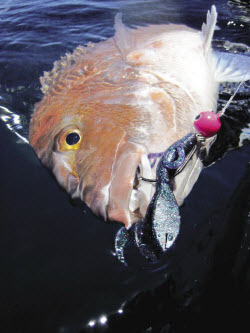
So if the fish you’re hoping to catch can see UV light (the research has yet to be done on NZ fish but it seems likely they can), it makes sense to have UV-reflective paint on your lure so it’s more visible to any UV-seeing fish, potentially enabling more fish to be caught. Better still, there are now UV-reflective paints designed to be used on fishing lures.
However, keep in mind that this quality isn’t necessarily restricted to deep water; any fish capable of seeing UV light will also see it in shallow water or at the ocean’s surface. It therefore makes sense to have UV reflective paint on lures fished at any depth. In fact, there was quite a bit of discussion about using UV reflective paint on lures and baits at the recent ICAST fishing trade show in the USA, and there were even a few gamefishermen playing around with UV reflection on their trolling lures.
As one of the hottest topics around right now, several companies are exploring the potential of UV-reflective coatings, and there are already some lures utilising UV-reflective paint available overseas. Results in testing and on-the-water use are reportedly very positive.
Although New Zealand fish such as snapper, blue cod, kingfish and hapuku have yet to be tested for visual UV sensitivity, to me, using UV-reflective paint is a very exciting concept, especially as anything that may give you an edge has to be worth trying. It’s certainly something I will be trying on the lures I manufacture – it could well be the next big thing…
Paul Senior co-owns Pacific Ocean Distributors, manufacturers of Cyclops Lure heads.
 |
This article is reproduced with permission of |
Recent Forum Posts Visit Forum

Trailer wheel clamp
in The Boat Shed5 hours ago
krow
I like the SAS wheel clamp. I've had no issues with the lock....

Shane Jones
in Fisheries Management7 hours ago
Fish Addict
The recreational sector can expect no favours from politicians. They know all too well who butters their bread and it ain't the recs. No different over...

Foton tunland v9
in The Briny Bar7 hours ago
Ho Dee
not fishing related and delete if required but was wondering if any has one of these or someone who has just wanting so e real world...

Bluefin Tuna at the cavs.
in The Briny Bar54 hours ago
smudge
Despite my years of fishing I haven't really fished many places, my focus has always been on Auckland's west coast and out toward Great Barrier. I...
Casting gloves
in Popper and Topwater Fishing99 hours ago
Mc Tool
100 bucks for a lure 😬. Watching one of them flying over the horizon without the line attached would be " character building " for sure...
I thought Id post some nice photo's , join...
in The Briny Bar150 hours ago
Alan L
That is a very cool pic Krow.The Far North is very cool, the Far far North even cooler. Mint looking day.Alan...

Mc Tools berley mincer
in The Briny Bar157 hours ago
SaltyC
Good size, they scrap well. Got an 18kg one up in Vava'u back a few years ago fishing off squeaky Going's boat. That was quite a...

Out with the "Twelves"
in Fishing Reports211 hours ago
Pcj
I should be able to get out end of October. The nephew been out virtually every weekend over winter and has done well. It seems the...
Manukau Harbour & West Coast fishing
in Fishing Reports219 hours ago
smudge
Nice work Schecter, I think snapper may be around sooner than you think. Well I am hoping so...
Whangarei Harbour report.
in Fishing Reports651 hours ago
krow
180 +m is where I've had to be lately. A lot less low foul around these parts and some of it shallower that looks like Tarakihi...

Popular Articles

Softbait Fishing - Part 1 - gear selection
John Eichlesheim writes an article about selecting the right equipment for softbait fishing... Read More >
Softbait fishing Pt 2 - tips and tricks
Techniques, tips and tricks of softbait fishing – getting the most from your soft baits.... Read More >

Surfcasting - setting yourself up
Gary Kemsley helps sort out the necessary gear for intending surf fishers.... Read More >

Squid - How to catch them
Squid fishing is a rapidly growing aspect of fishing - Paul Senior shares some hints and tips to get started.... Read More >
Fishing Reports Visit Reports
Outer Hauraki Gulf Fishing Report 17/09/26
Spring wind the handbrake. Spring is starting to make its presence felt in the outer... Read More >
Top of the South Fishing Report - 17/09/26
Early snapper in Tasman Bay. Well, spring is finally here, and the days are getting... Read More >
Bream Bay Fishing Report - 17/09/26
Good snapper catches reported. After Tangaroa turned off the fish tap for a month or... Read More >
Bay of Islands Fishing Report - 17/09/26
Pacific bluefin tuna for the lucky few. The last fortnight has seen more fishable days... Read More >
Comments