
Do Fish Remember Lures?
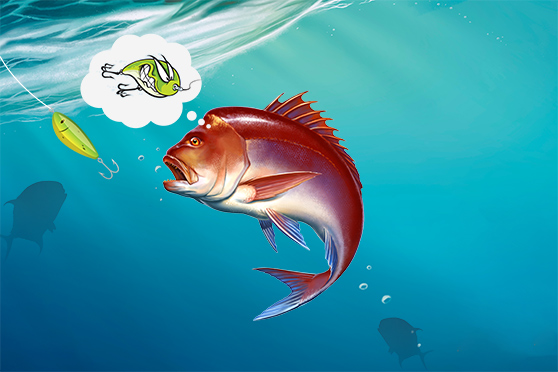
A pertinent question is whether fish remember being hooked; and better yet, whether predatory marine fish, such as snapper and kingfish, remember lures – and then learn to avoid them. After chatting to charter captains, marine biologists and doing a fair bit of research, Ethan Neville offers a few humble answers to these lingering questions…
In 1997, biologist Culim Brown collected adult crimson-spotted rainbowfishes from a creek in Queensland. He relocated these fish into three large tanks, placing about forty in each. Soon after, he started his testing. Three males and two females were taken at random from their tanks and placed in an experimental tank fitted with a pulley system which allowed a vertical net – the trawl – to be pulled along the length of their new habitat. In the middle of this trawl net was one hole big enough for the fish to escape through, providing the rainbows with an opportunity to evade capture. The trawl was dragged through the tank five times, with two-minute intervals between each run. The first fishes to suffer through this experiment panicked during the first run, crazily darting into the corners to try and escape the slowly approaching, ominously meshed trawl. Most of them were not successful. By the fifth trial, however, every single one of the five fish had found and remembered the bigger hole in the net and calmly avoided capture.
Nearly one year later, the experiment was run again with the same fish. They all escaped on their first run.
Nothing New
For many Kiwi fisherman, fish having the cognitive capacity to remember experiences for a year is not new information. I have travelled north with three mates for a bi-annual trip to the Karikari Peninsula for the last seven years. The first year, we spent most of our time jigging in a kingfish frenzy – if there wasn’t a quad hook-up, we’d consider moving spots. Every year since, results have been steadily getting worse, culminating with a trip earlier this year in which we landed no legal kingfish in the bay. The easiest explanation is that the area is now devoid of fish, but the sounder has always indicated something is down there balling up baitfish. It was confirmed by one of the local tackle shop operators that many locals have experienced something similar. Jig sales are down as most anglers have now taken up live-baiting to get consistent results.
So what happened? Are fish avoiding lures because they remember pain from being hooked? – and/or that their friends who attack the shiny metal things don’t come back?
These questions are important. If true, there would be obvious repercussions for the recreational fishing industry: will results from all lures experience a slow demise as fish remember they are harbingers of pain? As such, I took a serious approach to finding answers, starting with trying to get the science right. If fish don’t have the cognitive capacity to remember lures for any significant period of time, then this discussion is all but over – we’d have to put these patterns down to coincidence or find a completely new hypothesis. In this regard, the story this article opened with is anything but unique.
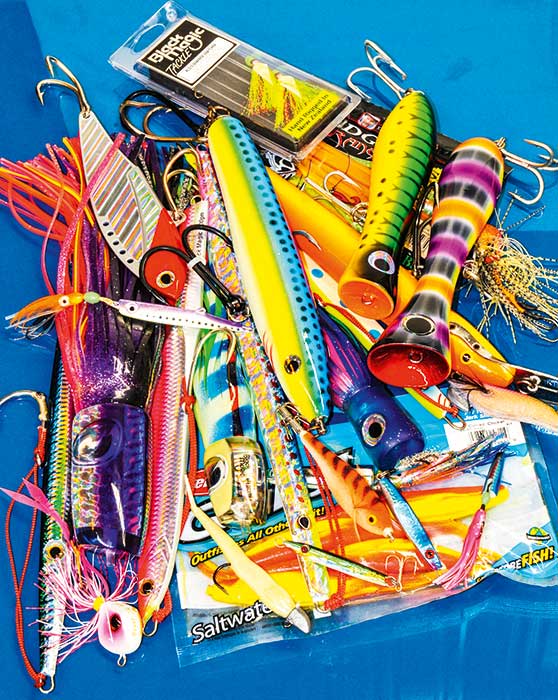
Lures might have all the bling in the world, but chances are fish will become wary of them.
The Science
Have you ever seen small fish jumping between rock pools? The frillfin goby, a small fish residing on both the eastern and western Atlantic shores, like to hang out in small isolated pools when the tide is out. These pools, however, aren’t free from predators and at times gobys need to make a hasty escape. They achieve this by jumping between pools.
This doesn’t sound like an amazing feat, until you take into consideration that there is no way for them to see over the rim of their current pool, and if their jump misses the mark, their short lives will come to an even shorter end. Yet they jump, and land in water, and keep surviving.
Their secret: they memorise the topography of the intertidal zone at high tide, identifying where future pools will form. This near miraculous feat of cognitive mapping was soon tested in controlled conditions and proved to be even more astounding than initially believed. These fish only needed to swim over a location, at high tide, once to be able to jump between pools at low-tide with a 97% success rate. But get this: they still remembered their escape route forty days later. As biologist Stéphan Reebs writes, “For almost every feat of learning displayed by a mammal or a bird, one can find a similar example in fishes.”
Fish aren’t dumb. That’s confirmed. In fact, in another experiment in which the problem solving skills of fish and primates was compared (each animal was given two food sources and had to work out which one needed to be eaten first for the biologist to let them finish their meal), the fish came out on top time and time again.
But how, you may ask, does this relate to more predatory species like the ones we find in New Zealand? Good question.
In 1908, a professor named Jacob Reighard fed dead sardines to “predatory snapper fishes.” Some of these sardines were dyed red, others were not. The snapper, of course, were happy to eat both. Reighard then sewed medusa (stinging jellyfish) tentacles into the red sardines’ mouths which quickly discouraged the snapper from eating them. Twenty days later, the snapper still wouldn’t go near the red ones. On this, Jonathan Balcombe, New York Times best-selling author and ethologist, comments that “This experiment not only demonstrates a snapper’s memory, but also his capacities to feel pain and to learn from it.”
Still, this was in America. What about New Zealand snapper and similar predatory species?
It is here the concrete research runs dry. What we can make, however, are reasonably confident inferences based on data produced elsewhere in relation to similar species. If smaller fish are remembering escape routes for a third of their life, what colours to eat and not eat, and solving basic problems with a higher success rate than primates, then the proposition that kingfish will remember the pain from being hooked from jigs – and perhaps even the pattern of their friends being abducted by shiny things – is far from unreasonable.
Given that I am underqualified to make such inferences, however, I got in touch with Professor John Montgomery, a Marine Scientist from Auckland University. “With kingfish,” he explains, “resident animals clearly become wary of lures and even live baits.” “I’d agree,” he continues, “with the proposition that kingies could well become averse to shiny metal jigs.” The science checks out.
We cannot be 100% sure of course, but all sources so far point in the direction that New Zealand predatory fish species have the capacity to remember lures and subsequently learn to avoid them. This hypothesis, however, needs to be tested. Thankfully, fishermen across NZ have been testing this hypothesis for years without knowing it, so I contacted a few of the most experienced NZ anglers to let them have their say on the issue.
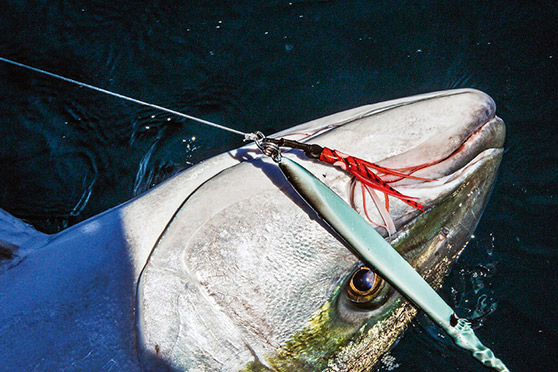
Jigs have been very effective for kingfish in the past, but in hard-fished 'hot-spots' their effectiveness can drop away.
The Field Research
The response was quite simple: not many changes have been observed with snapper – which makes sense as, particularly in the Hauraki, schooling snapper are nomadic – but all have experienced the dwindling interest of kingfish in jigs. Rick Pollock, the most experienced of us all, is resolute on this point: “There’s absolutely no doubt in my mind that where once jigging was lethal on kingfish, now except for rats, they reject them like the plague!”
He recalls how jigs used to out-fish live-baits when they first came on the scene before, in his words, “almost as if a switch was flipped, their effectiveness waned.”
For Rick, the current situation is no better, or has even possibly worsened in the most heavily fished kingfish destinations such as White Island, the Alderman Islands, Bay of Islands, Three Kings, Ranfurly Bank, Fisherman’s Rock, Mana Island and North Cape.
Nick Jones, another charter captain, confirms a similar trend. While he hasn’t noticed any reduction of the effectiveness of soft-baits or slow-jigs in the Hauraki, he remembers mechanical jigging “being far more productive” in the past. And these are just a couple of stories among many.
While I’m sure there are others out there with contrary stories, it’s clear that jigging for kingfish is not what it used to be. Before we resolutely conclude that this is due to fish remembering jigs, however, there is one more factor worth our consideration.
The Lazy Ones
In 1970, a study was undertaken in an Illinois lake to test whether largemouth bass learn to avoid hooks. For five years fish were caught and released regularly with every catch recorded. When the testing period finished, the results were extremely surprising. Some fish couldn’t get enough of the hooks, with one being caught fifteen times in one year – the angler’s dream fish. Others, however, weren’t fooled by the hook even once in the entire five-year period – an angler’s worst nightmare.
This result, of course, has some serious repercussions for the proposition that fish learn to avoid lures. In this experiment, memory appeared to have very little effect on catch-rate; the disposition of individual fish was clearly the driving factor. Thankfully, biologists quickly got to the bottom of this conundrum.
They rightly hypothesised there could be an underlying trait that makes certain fish more susceptible to taking hooks. In an effort to select this trait, they segregated two sets of fish, placing those fish which had never taken a hook in one pond, and those who had taken a hook four or more times in another. The fish bred with those that shared their pond and after another three or four years, their offspring were placed in a new pond.
They then repeated this process two more times – the testing period now stretching out to 14 years. The results were clear: each generation was even more extreme than their parents. They had a pond full of fish that wouldn’t touch hooks, and a pond full of fish that found them irresistible.
So what was the difference between these two groups of fish? The biologists discovered that, in layman’s terms, one group of fish were lazy – they are your mate who installed a mini fridge next to his couch so he doesn’t have to walk to the kitchen for a beer. The fish that were hard to catch had a slower metabolic rate compared to those who loved taking baits, and they also didn’t exhibit the rapid movements typical of fish when they’re surprised by a predator. These fish were chill, and their energetic, hungry counterparts were at the opposite end of every one of these metrics.
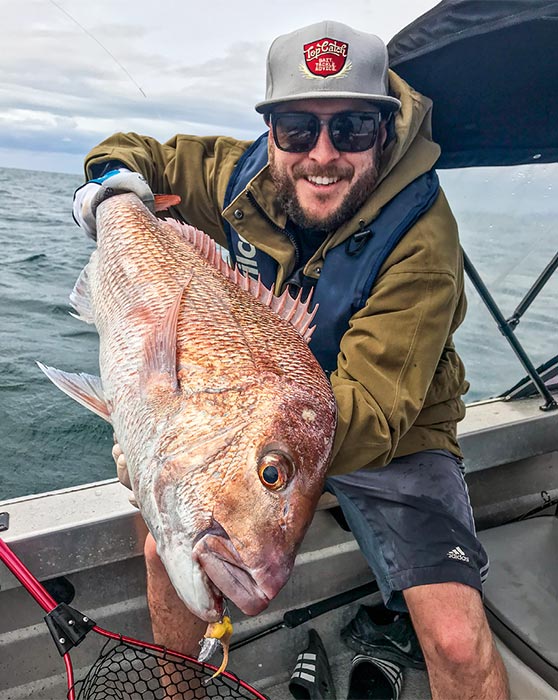
Scientists have discovered there are two kinds of fish - active and lazy - the more active, the more likely they are to attack a lure.
What does this mean for our present inquiry?
What if we have caught all the proactive, hungry kingfish living at popular pinnacles and reefs (and other go-to spots), leaving only the lazy guys who can’t be bothered chasing jigs? And what if these lazy fish have bred – which is likely because they live longer – creating even lazier, jig-averse children? If you put a thrashing, helpless livebait in front of these fishes’ face, they might still give it a go; but they wouldn’t be caught dead chasing a jig (pun somewhat intended).
One story that may support such a conclusion comes from New Zealand jigging guru Chris Wong. He tells of a busy morning at the Three Kings in 2006 where he and a crew were jigging in the white water. On their first drift, they caught kingfish non-stop until the current had taken them out into the bay and away from the fish. They restarted the drift with high expectations but, to their surprise, got absolutely no hook-ups. Not even a touch.
We cannot know the precise reason for this, of course, but this story would fit with the hypothesis that Chris and his mates quickly emptied the spot of its active fish in the first drift, leaving only the disinterested ones behind. It could also be that the fish which were released, despite being proactive, remembered the pain and avoided the jigs, thus bringing the feeding frenzy to an end. The two theories are not always mutually exclusive.
So, fish can remember. For the average fish, it is plausible, if not likely, that the memory of past jigs is preventing them from biting. It appears, however, that some fish are so hungry and excitable that this doesn’t bother them – they will eat anything. And then there are the lazy ones which will never take a jig no matter what the context – assuming, of course, that New Zealand species exhibit similar qualities to their cousins across the ocean.
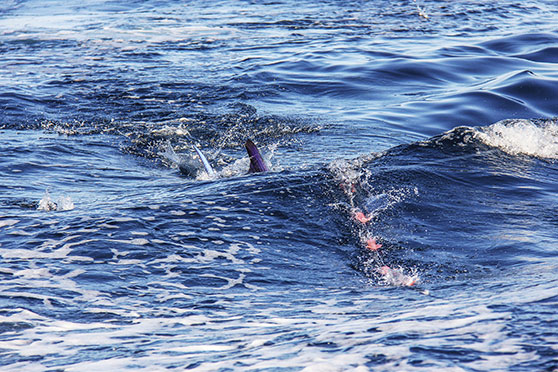
Recapture data shows that some billfish, electronically tagged and released, will quickly head away from the area they were caught in.
In conclusion
So what does this all mean for New Zealand recreational anglers?
Practically, unless you are a marine scientist or lure manufacturer, it doesn’t matter whether the kingfish are avoiding your jigs because of a natural predisposition or because they remember them; the important thing is you know not to persist with jigging for too long if there is sign but you’re not enticing any bites. In such situations, get the live-bait in the water – and let’s just hope fish don’t work out that biting the bait fish with the big hook through the back of it means they will soon take an involuntarily trip to the surface.
In terms of schooling snapper and kingfish around workups, we don’t have much to worry about for now. These fish move enough to not have exacerbated their lazy gene or remember the pain of jigs. For those of us who soft-bait in close where we are most likely targeting resident fish, however, there may come a time soon where the effectiveness of lures begins to wane.
For now, keep fishing what works; in the future, be ready to innovate because fish are a hell of a lot smarter than most of us thought.
|
|
This article is reproduced with permission of |

Recent Forum Posts Visit Forum

Trailer wheel clamp
in The Boat Shed5 hours ago
krow
I like the SAS wheel clamp. I've had no issues with the lock....

Shane Jones
in Fisheries Management7 hours ago
Fish Addict
The recreational sector can expect no favours from politicians. They know all too well who butters their bread and it ain't the recs. No different over...

Foton tunland v9
in The Briny Bar7 hours ago
Ho Dee
not fishing related and delete if required but was wondering if any has one of these or someone who has just wanting so e real world...

Bluefin Tuna at the cavs.
in The Briny Bar54 hours ago
smudge
Despite my years of fishing I haven't really fished many places, my focus has always been on Auckland's west coast and out toward Great Barrier. I...
Casting gloves
in Popper and Topwater Fishing99 hours ago
Mc Tool
100 bucks for a lure 😬. Watching one of them flying over the horizon without the line attached would be " character building " for sure...
I thought Id post some nice photo's , join...
in The Briny Bar150 hours ago
Alan L
That is a very cool pic Krow.The Far North is very cool, the Far far North even cooler. Mint looking day.Alan...

Mc Tools berley mincer
in The Briny Bar157 hours ago
SaltyC
Good size, they scrap well. Got an 18kg one up in Vava'u back a few years ago fishing off squeaky Going's boat. That was quite a...

Out with the "Twelves"
in Fishing Reports211 hours ago
Pcj
I should be able to get out end of October. The nephew been out virtually every weekend over winter and has done well. It seems the...
Manukau Harbour & West Coast fishing
in Fishing Reports219 hours ago
smudge
Nice work Schecter, I think snapper may be around sooner than you think. Well I am hoping so...
Whangarei Harbour report.
in Fishing Reports651 hours ago
krow
180 +m is where I've had to be lately. A lot less low foul around these parts and some of it shallower that looks like Tarakihi...

Popular Articles

Softbait Fishing - Part 1 - gear selection
John Eichlesheim writes an article about selecting the right equipment for softbait fishing... Read More >
Softbait fishing Pt 2 - tips and tricks
Techniques, tips and tricks of softbait fishing – getting the most from your soft baits.... Read More >

Surfcasting - setting yourself up
Gary Kemsley helps sort out the necessary gear for intending surf fishers.... Read More >

Squid - How to catch them
Squid fishing is a rapidly growing aspect of fishing - Paul Senior shares some hints and tips to get started.... Read More >
Fishing Reports Visit Reports
Outer Hauraki Gulf Fishing Report 17/09/26
Spring wind the handbrake. Spring is starting to make its presence felt in the outer... Read More >
Top of the South Fishing Report - 17/09/26
Early snapper in Tasman Bay. Well, spring is finally here, and the days are getting... Read More >
Bream Bay Fishing Report - 17/09/26
Good snapper catches reported. After Tangaroa turned off the fish tap for a month or... Read More >
Bay of Islands Fishing Report - 17/09/26
Pacific bluefin tuna for the lucky few. The last fortnight has seen more fishable days... Read More >
Comments