
Diving in marine estuaries - fish nurseries
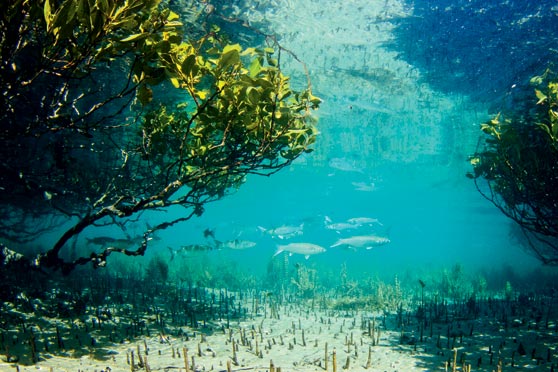
Have you ever thought what it would be like to live in the ocean from a fish’s perspective? Can you imagine how perilous and terrifying it would be growing up in an environment where everything wants to eat you?
The vast majority of fish never make it to adulthood because something slightly larger thinks they look really tasty. Let’s just say it’s a dog-eat-dog world in the ocean and only the fittest, luckiest or cleverest survive.
I guess as a fish you’d want to have some strategies so that at least some of your kids make it to adulthood and the family line carries on. You’d probably also need some favourable conditions and safe places to grow up in.
One of New Zealand’s best-loved fish, the snapper, uses a strategy of mass spawning, where huge aggregations of fish come together, with each female releasing millions of eggs. (Snapper may spawn a number of times between October and March.) It’s pretty clever: having so many eggs ensures that a small percentage (but still good numbers) of snapper hatchlings make it through to adulthood.
Against impossible odds – it must be like running the gauntlet – where the chances are stacked seriously against them, the first 28 days of a snapper’s life are spent drifting at the mercy of ocean currents, unable to swim, while fish, birds and other plankton feeders, including whales, pick off their fair share.
Once they reach about 12mm in length, they’re finally strong enough to swim towards shore and find somewhere to hunker down and hopefully grow as quickly as they can.
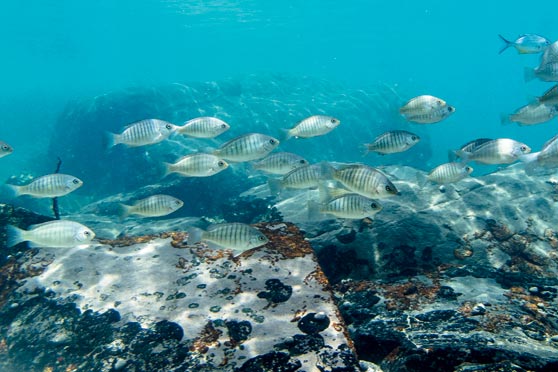
Harbours and estuaries provide a vital home for this next stage – but not just any estuary or harbour; snapper seem to be pretty snobbish about their accommodation! For example, I find it mind blowing to think that with so many west coast harbours to choose from, over 95% of west coast snapper grew up in just one harbour – the Kaipara!
We all know that where there are little fish there will be bigger predators not too far away hoping to eat them – john dory, kahawai, kingfish, trevally, to name just a few... Heck, I bet even bigger snapper hoover up the odd little one down!
Two really important survival strategies for juvenile snapper are: to have somewhere to hide so they don’t get eaten, and ensuring they have plenty to eat. The Kaipara has ticked these boxes historically, with its extensive sea-grass beds enabling these tiny snapper to hide from marauding predators – and there’s also plenty of food to aid their rapid growth. Once they get to about 65mm they start spreading around the open coastline away from the harbours.
However, some of the Kaipara’s seagrass beds are disappearing due to increased sedimentation, which is cause for concern.

Invasive Japanese mantis shrimp, which grow to over 350mm, have taken up residence in the harbour in recent years and may prey on juvenile snapper. Some people are excited about having these critters in the harbour as bigger fish love eating them, but they could potentially be one of the most lethal predators of the lot when it comes to eating our baby native fish!
I’d never go snorkelling in the Kaipara, as it’s a bit of a mud bath, but my local estuary is an epic place to see a nursery first hand, as it offers some of the clearest water on the coast. It’s the most bizarre thing: while shooting for an episode of Young Ocean Explorers, we started filming just outside the harbour, where the visibility was about 6m; then, as we moved inside the harbour, the visibility became an awesome 18m! What the…? This was exactly the same body of water as outside with 6m vis!
Here we were, witnessing firsthand a very graphic illustration of Nature’s pool pump in action: the ‘dirtier’ water coming into the harbour passes over the hundreds of thousands of filterfeeding pipis and cockles, which suck it in and spit out a cleaned-up version. My local estuary is the last harbour near Auckland with healthy beds of cockles and pipis and which enjoys this phenomenon. Amazingly, each pipi can filter about one litre of water every hour!
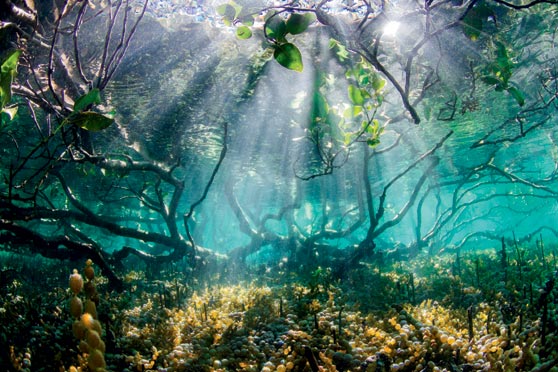
The small fish obviously enjoy this clean environment, with perfectly camouflaged schools of tiny snapper, barely visible amongst the ripples of the white sand, hovering near any obstacle they can hide behind. Baby parore, feeding on tiny particles of food in the water, quickly dart to the cover provided by Neptune’s necklace seaweed whenever danger is sensed. There are also schools of little trevally which race about in perfect synchronicity, each doing its best to survive the gauntlet, hoping to win the lottery and make it to adult life.
Healthy harbours are vital for the survival of our favourite fish, so looking after the places where baby fish grow will help ensure our kids have fish to catch in the future.
Estuaries are fantastic places to take kids snorkelling. The best times to snorkel are:
- After a calm period with little rain
- Just before high tide and during the slack tide, so there is minimal current. It’s also the time the water is normally the clearest, as the filter feeders have been cleaning the water as it comes in and the dirty water from further up the estuary hasn’t come out yet.
Use a dive flag, but still be aware of what boats are doing around you – it’s unbelievable how many people disregard dive flags and the safety of others – and ask a local dive shop for the best and safest estuary locations to try.
|
|
This article is reproduced with permission of |

Recent Forum Posts Visit Forum

Offshore Power Boats - Gulf Harbour 17 Oct
in The Briny Bar66 hours ago
Phantom Menace
The course goes anti-clockwise and turns around the little island (Kotanui / Frenchmans Cap) just off Gulf Harbour. That turn should make for interesting viewing -...

Manukau Harbour & West Coast fishing
in Fishing Reports101 hours ago
smudge
Thats a great catch Schecter, big fish. I'll post up a report from off the coast a bit later on...


Garmin vs Lowrance
in The Boat Shed194 hours ago
Roscoe C
Hi folksI'm looking at upgrading the electronics on my Stabi 1450. I've currently got a Lowrance Eagle 7 which I'm not especially impressed with. In particular...

Shimano 3500 baitrunner
in Buy Sell Trade or Exchange330 hours ago
0nlanders_Nz
Hello, I have come across to on the cash converters website search fishing reels $35 on there...
Manu bay boat ramp
in The Boat Shed335 hours ago
610gc
Hey teamhas any one tried the Manu bay boat ramp since the repairs?Is it any better to use?thank you ...

Out with the "Twelves"
in Fishing Reports339 hours ago
Telecaster
Popped out at about 3:30pm yesterday with a mate, usual zone and method. 10 snapper and 5 gurnard. The biggest snap we got (55cm) was definitely...
Wanted 10500 fin-nor reel
in Buy Sell Trade or Exchange386 hours ago
0nlanders_Nz
I am looking for a fin-nor 10500 fishing reel if any one has, please message me...
Wanted to Buy
in Buy Sell Trade or Exchange409 hours ago
honestbruce
Seen your post and that would work but its not up my alley or ability to make one. Dont have the means to manufacture here in...
Popular Articles

Softbait Fishing - Part 1 - gear selection
John Eichlesheim writes an article about selecting the right equipment for softbait fishing... Read More >
Softbait fishing Pt 2 - tips and tricks
Techniques, tips and tricks of softbait fishing – getting the most from your soft baits.... Read More >

Surfcasting - setting yourself up
Gary Kemsley helps sort out the necessary gear for intending surf fishers.... Read More >

Squid - How to catch them
Squid fishing is a rapidly growing aspect of fishing - Paul Senior shares some hints and tips to get started.... Read More >
Fishing Reports Visit Reports
Manukau/West Coast Fishing Report - 15/10/26
Big spring snapper in 60 metres. The El Niño weather pattern isn’t going to be... Read More >
Rotorua Fishing Report - 15/10/26
Solid start to the season! The Rotorua lakes have all started the season well, and... Read More >
Tutukaka Fishing Report - 15/10/26
Big snapper in shallow. Things remain relatively quiet on the fishing front out of Tutukaka,... Read More >
Tauranga Fishing Report - 15/10/26
Bait and temperature on the rise. It’s been great to get out and see some... Read More >
Comments