
Dealing with Barotrauma
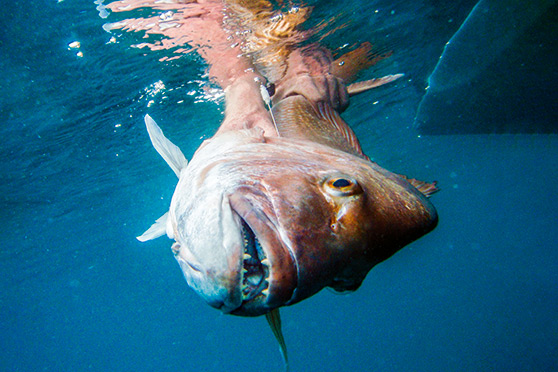
Changes to American fisheries regulations brought into law in mid-July make it mandatory for all fishers targeting deepwater species off its South Atlantic coastline to use offset circle hooks and carry release weights. Managing editor Grant Dixon reviews the law changes and asks some prominent Kiwi anglers if such regulations should be introduced here…
Anglers fishing for snapper and grouper species off America’s South Atlantic coast are now required to have a descending device rigged and ready to use.
The requirement is for all vessels – commercial, charter and private – to have the devices onboard to ensure the highest possible survival rates of returned fish caught at depth.
The initiative has come after recreational fishers lobbied the National Oceanic and Atmospheric Administration (NOAA) for the requirements. When deep water fish are brought rapidly to the surface, they can experience barotrauma – a condition where a build-up of gas pressure in their bodies makes it difficult or impossible for them to swim back down.
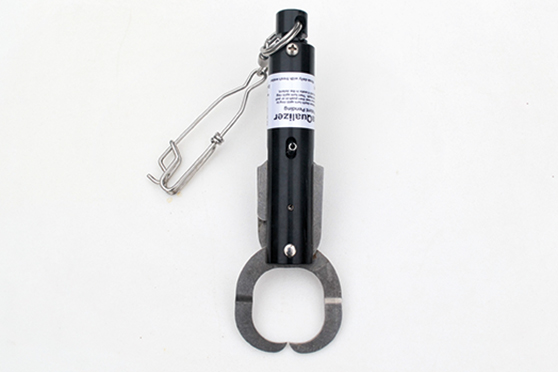
If an angler releases the fish – sometimes necessary due to the USA’s size, seasonal or bag limit restrictions – and the fish does not survive, this is a dead discard or wasted fish. A descending device is a weighted hook, lip clamp, or box that holds the fish while it is lowered to a sufficient depth where the pressure of the surrounding water returns internal gas to equilibrium, which allows the fish to be released with a much higher likelihood of survival.
“It is encouraging that so many anglers were already taking it upon themselves to find ways to properly release fish to increase survival and better conserve these resources,” stated Pat Murray, president of the USA lobby group Coastal Conservation Association (CCA).
“This requirement will not only enhance those efforts to eliminate all sources of discard and bycatch mortality but should motivate federal fisheries managers to assess those gains and translate them into longer seasons for anglers.”
The latter is a case for recreational interests benefiting from their efforts to conserve and enhance a stock.
Another requirement introduced at the same time is the mandatory use of galvanised steel circle hooks when targeting deepwater species.
NOAA’s best fishing practices include the use of non-offset and non-stainless-steel circle hooks when fishing for snapper-grouper species with hook-and-line gear and natural baits.
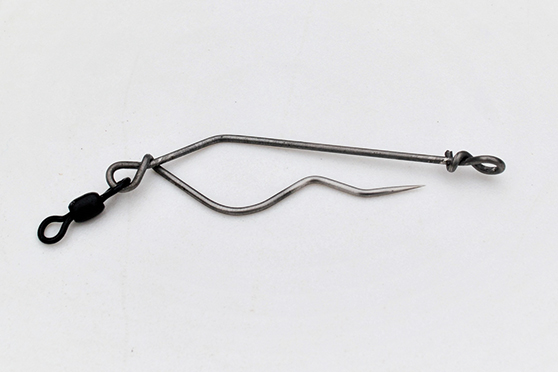 Two American release devices - the Shelton (above) and the Seaqualizer (below).
A Kiwi perspective
So, what do some of our prominent recreational anglers and fisheries researchers think of the American legislation and best-practice release methods?
Sam Mossman – angler and author
NZ Fishing News’ long-standing associate editor and well-published author Sam Mossman has extensively researched the subjects of venting and deep releasing fish, resulting in numerous articles. He has uncovered one thing for certain – there is a lot of misunderstanding on a variety of aspects.
The first myth to be busted is around stainless hooks. Sam says studies have shown that while stainless hooks can take longer to shed, they cause much less mortality in fish.
“The coatings on plated hooks usually contain heavy metals such as tin, nickel and cadmium – the latter banned in some places now. These enter the bloodstream of fish and cause weakening and fatalities.
“But stainless steel is inert and causes no harm (apart from possible obstruction in feeding – same as plated hooks) and are often used in human surgical procedures where pins, plates and screws are left inside the body.”
Sam suggests that if anything, plated hooks are the ones that should be banned.
Regarding venting, Sam says he has tried it with large bore needles obtained from a veterinary supplies outlet years ago.
“I found it was moderately effective against barotrauma so the fish can get down again, but not necessarily a long-term survival tool. The Americans made it compulsory in some areas for a while, then, with more research, quickly did an about face, removing the regulation.”
Sam had hoped that venting might be the answer to deep water issues, but that does not seem to be the case.
“I don’t use venting needles anymore.”
He says that for any bottom fish caught much below 35m and released, it seems there is a reasonable mortality rate, getting worse with increasing depth.
“This is why there is no minimum size for fish like hapuku, bass and bluenose – deep water fish survival is pretty low. The answer is: keep what you catch, and when you have enough for your needs, stop fishing.”
John Holdsworth – marine scientist and fisheries consultant
Blue Water Marine scientist John Holdsworth, in association with colleague Bruce Hartill, has just completed a report for MPI on the mortality of recreationally released fish.
It is in the process of being reviewed so John can’t go into detail until it is published.
“Firstly, we looked at how release mortality estimates could be used, and one of those areas was educating and changing behaviours and possibly measuring reductions in release mortality,” he says.
They looked at the species with the largest recreational catch and largest proportion released to identify the priority species for research and management.
Not surprisingly snapper, blue cod and kingfish came out on top. Hapuku and bass came down the list because so few are released.
“We made recommendations about the type of experiment that could be used to estimate the proportion of these fish that survived catch and release and the factors that might affect that.
“But to scale up the survival or mortality of individuals to a total mortality estimate requires a good number of recreational fishers providing information on the size and condition of fish they release.”
John had started to get feedback from fishers by putting some questions onto a simple NIWA App platform and sharing it with LegaSea volunteers, but COVID-19 got in the way.
The bottom line? John thinks descender rigs are a good way of minimising harm and returning fish to a safe depth where they can recompress away from predators.
“There is enough information around to educate and do a better job of releasing fish – a win-win-win for the fish, the stock, and angler – but it needs to be tailored to our species in our conditions.
“We could improve our knowledge and help refine this with some catch and release experiments. It’s a lot harder to get a good estimate for management purposes of the total weight of a species in an area that die on release.”
Pete Saul – marine scientist and former MFish researcher
Pete Saul, a partner in Bluewater Marine Research with John Holdsworth, has been involved with a couple of investigations into release mortality rates, and agrees it is a difficult subject to research.
One programme conducted over 20 years ago saw the scientists catch and release 100 hapuku in 130 metres of water out from Tutukaka. The fish were caught on droppers and slowly brought to the surface by hand where they were placed in a tank of running water. Here they were vented using a hypodermic needle and then injected with tetracycline before being tagged and released.
The fish were attached to a sash weight via a small sprat hook and when the crew though they had reached somewhere near the bottom, the line was given a yank, straightening out the hook and releasing the fish.
The tetracycline, an antibiotic used by vets, had the side effect of colouring the fish’s bones. When the fish were eventually re-caught, and around 10% of them were, scientists could determine their growth rate by examining the skeleton, in particular the otolith bone.
Pete believes snapper caught from the deep – 40 metres and beyond – would benefit from being released back at depth. He suggests getting them down past 10 metres, where the pressure is double that at the surface, is most critical.
That is why fish caught in relatively shallow depths – 20 metres or so – will often still display the effects of barotrauma, he suggests.
Pete said anglers would more likely buy into deep releasing their fish, rather than having to insert needles into their flanks, which “can be a bit tricky to get right.”
“It is like all procedures, if you do them often enough you will get good at it. To throw back blown fish is not an option.”
Tony Orton – Offshore Adventures charter skipper and guide
Tony says he is no expert on this matter. The only deep releasing he has done was in Mexico on cubera snapper and the odd bigger snapper here in NZ.
“To be honest, every fish I have done this to I was sceptical as to their long-term survival prospects. The venting I have done was only on fish that showed minor issues with barotrauma. They swam away fine at the time but again, I was left feeling unsure what the ultimate survival rate might be.”
Tony says he is prepared to go out on a limb, and question whether deep water releasing would work that well in New Zealand.
“Hapuku, bass and bluenose would most likely never be released, and our snapper seem way too fragile to weight back down in most circumstances over 40 metres.
“I believe most of the fatal injuries have already been done on the way up. The only time I have weight-released snapper was in less than 25m of water and they seemed okay at the time and never floated back to the surface.”
Tony and his clients catch many deep water snapper, often a bycatch when targeting kingfish with livebaits in depths down to 140 metres plus.
“It’s hard to imagine that sending a snapper that has its eyes bulging and guts hanging out its butt and mouth back down to the bottom is going to cure its problems in a hurry. Just catch what you need and move on!”
Tony says he has no proof of domestic species surviving deep releasing.
“And I don’t just mean swimming off after release. It would be a bit of a shame to see it introduced and then have rec fishos bombing all their undersized fish back to the bottom thinking they are all okay – out of sight out of mind – only to have them die and become fish fodder.”
He says kingfish are another story. This species can handle being caught and released.
He only uses circle hooks in his charter operation which almost always roll into the corner of the fish’s mouth, making them easy to release and causing minimal harm.
Matt Watson – fishing show host and former charter crewman
One of recreational fishing’s strongest advocates for venting fish suffering barotrauma is Matt Watson.
Over the years Matt has written ‘how to’ articles and produced instructional video footage on venting techniques. He even went so far as to import, at his own cost, a large supply of venting needles for distribution among recreational anglers.
The project hit a snag but is still bubbling away under the surface and may still come to fruition.
“We have all the material for how to use the venting needle put together by the LegaSea team, and our instructional video has had over two million views – there’s a want; we just need supply, distribution and some education,” Matt says.
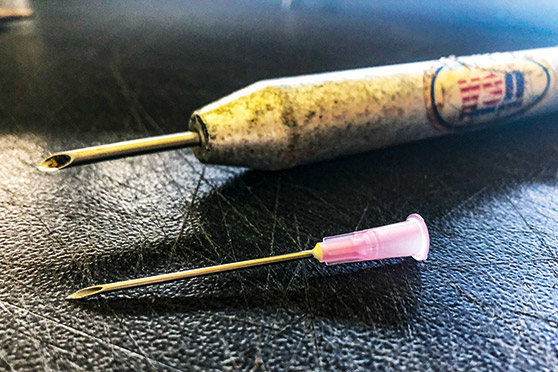
A couple of venting tools.
“We hate seeing dumped snapper behind trawlers, but we turn a blind eye to trails of snapper floating out behind recreational boats – with some of the worst offenders found among the charter boats.”
He says it takes two seconds using a device that costs five cents to deflate a fish – “There is no excuse not to do it.”
Matt has filmed ‘puka being released out of 250m 15 years ago with release weights. They had a diver at 45 metres who filmed them swimming away beautifully. Like several of the others canvassed for this article, Matt believes the deep water species – hapuku, bass and bluenose – are less likely to be released.
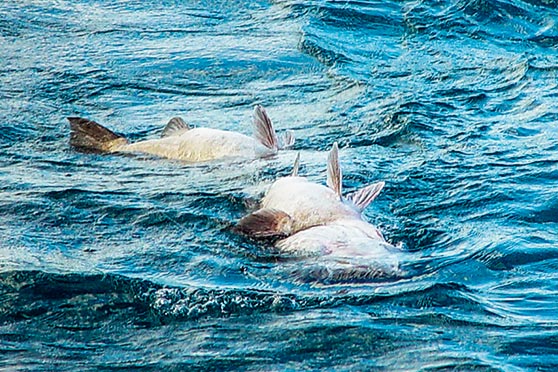
The cellar dwellers such as hapuku and bass are particularly prone to barotrauma.
“The attention needs to be where anglers are fishing and releasing snapper in 25-50 metres of water,” Matt concluded.
Matt suggests snapper are hardier than they are given credit for. He recalls an instance when filming an episode of The ITM Fishing Show around the NIWA tagging programme in the Hauraki Gulf where he personally released a snapper which had not been treated with the care it deserved.
“It was pulled up from 46 metres, thrown about four metres by the decky, missing the tank, ending up flapping on the concrete deck for about a minute. It had swallowed a circle hook that had caught in the throat and was bleeding, but not from the gills.
“I cut the line, vented and tagged it before releasing it. Several months later some fellas were out testing Gulp! soft-baits at Kawau Island when a snapper with a tag in it was caught. Sam Mossman was there to record the event and consequently publish an account and a photo in this magazine.”
Matt says NIWA vented every single fish in the tagging program and there were many recaptures.
In conclusion
While there are several opinions expressed and no definite conclusions, the consensus is that it is difficult to assess the survival stats, and consequently the value of the various practices.
For my ten cents worth, a fish is not going to survive if left ‘barotraumatised’ and floating on the surface for the seabirds and sharks to pick over. Either give it a chance by venting it or releasing it at depth, or put it in the bin on ice and move away once you have what you need.
DIY Release weight
The writer created his own release weight using a large ‘puka bomb’ lead weight, long-shanked hook, screw, cable tie and swivel.
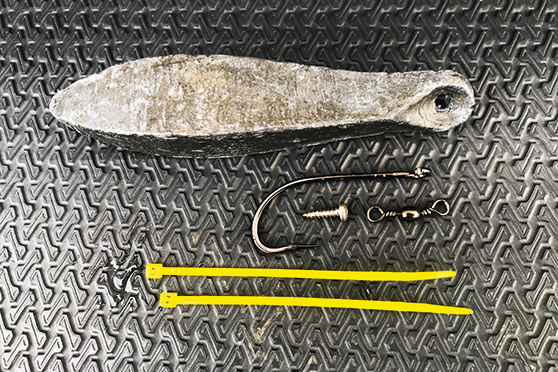
Step 1: Take your hook and file off or crush the barb.
Step 2: Drill a pilot hole into the sinker. Use a screw through the eye of the hook to secure it to the weight. You may need to open the eye a little to accept the screw.
Step 3: Use one or two cable ties to secure the shank of the hook against the sinker.
Step 4: Take a suitably sized swivel and place it onto the hook, crushing the end to hold it in place. For added security, you could tie it in place with waxed rigging thread.
To use, attach a line to the swivel, place the hook lightly through the lip of the fish and drop the weight and the fish to the bottom. When at the desired depth, give the line a good pull to free the hook and release the fish.
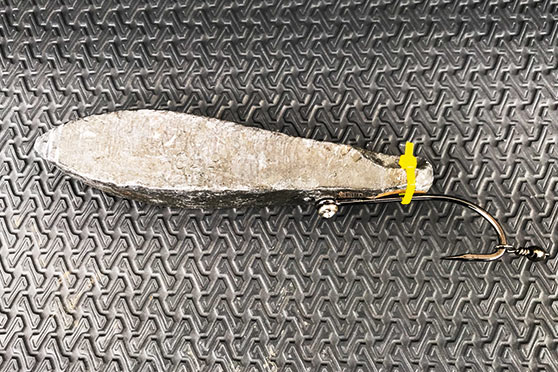
A simple release weight made from a 'puka 'bomb'. A hook, stainless screw swivel and cable tie are the only materials needed.
|
|
This article is reproduced with permission of |

Recent Forum Posts Visit Forum

Trailer wheel clamp
in The Boat Shed1 hour ago
krow
I like the SAS wheel clamp. I've had no issues with the lock....

Shane Jones
in Fisheries Management4 hours ago
Fish Addict
The recreational sector can expect no favours from politicians. They know all too well who butters their bread and it ain't the recs. No different over...

Foton tunland v9
in The Briny Bar4 hours ago
Ho Dee
not fishing related and delete if required but was wondering if any has one of these or someone who has just wanting so e real world...

Bluefin Tuna at the cavs.
in The Briny Bar51 hours ago
smudge
Despite my years of fishing I haven't really fished many places, my focus has always been on Auckland's west coast and out toward Great Barrier. I...
Casting gloves
in Popper and Topwater Fishing96 hours ago
Mc Tool
100 bucks for a lure 😬. Watching one of them flying over the horizon without the line attached would be " character building " for sure...
I thought Id post some nice photo's , join...
in The Briny Bar147 hours ago
Alan L
That is a very cool pic Krow.The Far North is very cool, the Far far North even cooler. Mint looking day.Alan...

Mc Tools berley mincer
in The Briny Bar154 hours ago
SaltyC
Good size, they scrap well. Got an 18kg one up in Vava'u back a few years ago fishing off squeaky Going's boat. That was quite a...

Out with the "Twelves"
in Fishing Reports208 hours ago
Pcj
I should be able to get out end of October. The nephew been out virtually every weekend over winter and has done well. It seems the...
Manukau Harbour & West Coast fishing
in Fishing Reports216 hours ago
smudge
Nice work Schecter, I think snapper may be around sooner than you think. Well I am hoping so...
Whangarei Harbour report.
in Fishing Reports648 hours ago
krow
180 +m is where I've had to be lately. A lot less low foul around these parts and some of it shallower that looks like Tarakihi...
Popular Articles

Softbait Fishing - Part 1 - gear selection
John Eichlesheim writes an article about selecting the right equipment for softbait fishing... Read More >
Softbait fishing Pt 2 - tips and tricks
Techniques, tips and tricks of softbait fishing – getting the most from your soft baits.... Read More >

Surfcasting - setting yourself up
Gary Kemsley helps sort out the necessary gear for intending surf fishers.... Read More >

Squid - How to catch them
Squid fishing is a rapidly growing aspect of fishing - Paul Senior shares some hints and tips to get started.... Read More >
Fishing Reports Visit Reports
Outer Hauraki Gulf Fishing Report 17/09/26
Spring wind the handbrake. Spring is starting to make its presence felt in the outer... Read More >
Top of the South Fishing Report - 17/09/26
Early snapper in Tasman Bay. Well, spring is finally here, and the days are getting... Read More >
Bream Bay Fishing Report - 17/09/26
Good snapper catches reported. After Tangaroa turned off the fish tap for a month or... Read More >
Bay of Islands Fishing Report - 17/09/26
Pacific bluefin tuna for the lucky few. The last fortnight has seen more fishable days... Read More >
Comments