
Connecting Leader to Lures
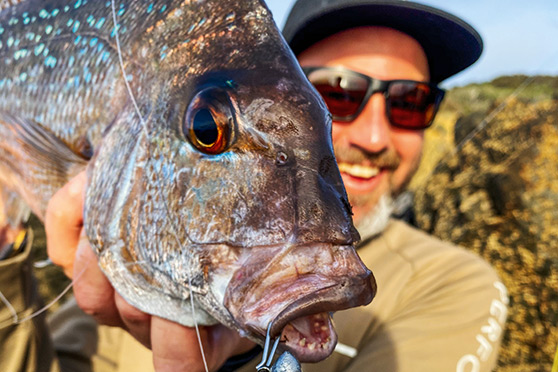
Over the years, Grant Dixon has experimented with many options for connecting leader to lures – in particular soft-baits and slow-jigs. In this feature, he shares his ideas on the best ways of making the connection between trace and the lure of choice, as well as canvassing the thoughts of some prominent anglers on the subject.
You know that sickening feeling when part way into a scrap with a decent fish the line goes slack. You wind it in, full of trepidation as to the cause of your angst. Was it a simple matter of the hook pulling, or the more sinister knot failure denoted by the pig-tail end to the mono? Did the mainline or trace fail, or was it a connecting clip that let you down?
Having encountered all those scenarios over the years, the most devastating one personally was when a Genie Clip failed and what was potentially a major tournament winning snapper swam away.
We were soft-baiting at the Mokohinaus when I came up tight on what was a great snapper. I had caught several to eight kilos that day, so knew when I was attached to ‘the one’ that might possibly see my name etched on the Furuno Snapper World Cup – a personal goal!
After surviving several blistering runs in 50 metres of water, I had the fish under control and well on its way to the chillybin. It made one last attempt at freedom and I can only surmise it turned in such a way as to reverse the eye of the hook out of the clip. To say I was gutted was an understatement. So close, but so far away.
I have never used this style of clip ever again and have since heard similar stories from other anglers suffering the same fate, some of which are shared further on in this feature.
There are several connection options available to anglers, from sophisticated Mustad Fastach clips through to conventional knot options, snap swivels and the humble split ring.
Below are my thoughts on each, followed by the opinions from some competent anglers on the subject…
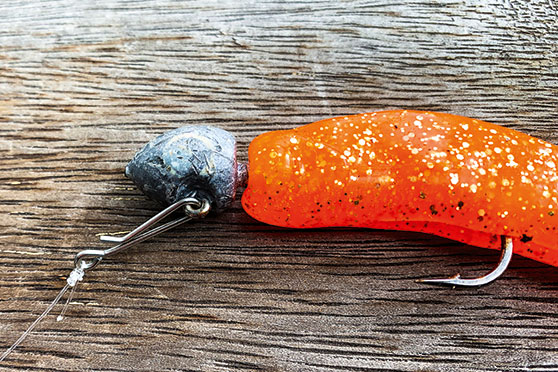
Genie clips: Having outlined my experience with them above, these are my least favourite way of connecting line to lures. While they are a little bulky and a bright metal colour, they do have the advantage of convenience when it comes to changing out lures and jigheads. They won’t wear through as a knotted loop connection can. I don’t recommend them, especially in a situation where you might encounter bigger snapper and kingfish.
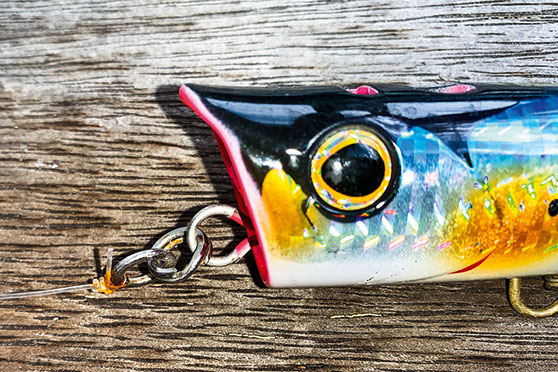
Split rings: These are a little less convenient and like Genie clips, they won’t suffer damage from contact with the hook’s eye. A pair of split ring pliers are required when changing lures but despite the need for such a tool, split rings are still high on the convenience list. They are also less conspicuous than Genie clips and don’t impact on the lure or jighead movement, allowing them to move reasonably freely. This is the connection method many jig fishers targeting kingfish with 200-400g+ lures use.

Fastach clips: These are available in several sizes and come with or without suitably sized swivels attached. My preference is to use the clip alone, as I believe these are less obvious and won’t tangle. Fastach clips are convenient, generally easy to use and not likely to fail, even if crushed in a snapper’s jaws. Of all the clips, these are my choice and having used them regularly over the years, have not had one let go. They can be a bit fiddly to manipulate, especially with wet, cold fingers, but once in place they stay there. I have experienced decent snapper ‘chewing’ on them during a fight and while they were a little mangled, none let go. While a snapper chomping down on mono will likely crush and break it, a Fastach clip will withstand the abuse.

Snap swivels: To the novice angler, these may seem like a logical choice – only a clinch- or uni-knot is required to tie the trace to the swivel, but any advantage of convenience is countermanded by its bulkiness and lack of discretion. Learn to tie a loop knot!

Conventional knots: By this I mean using an improved clinch- or uni-knot to tie the trace directly on to the lure or jighead. These require some basic angling competency to tie, but not a lot. Tied properly, they offer high line strength retention, but as they close around the attachment point, they can restrict lure movement a little, especially if heavier trace is used.
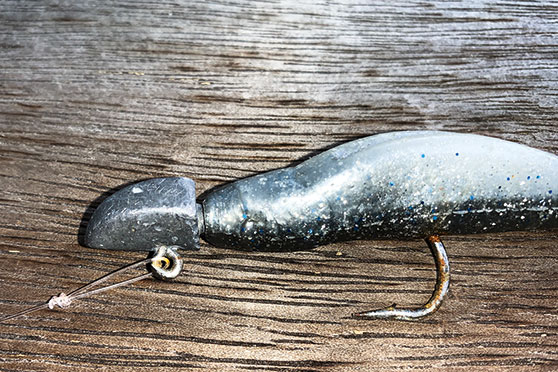
Specialist knots: Of these, the Rapala or Lefty’s Loop is the most popular and it’s not a complicated knot to tie. It has good knot strength, is a compact knot and allows the lure or jighead to move freely. This last advantage can also be its downfall as it is prone to rubbing at the point it contacts the attachment point. It pays to re-tie this frequently, especially in a hot bite on big fish. The loop itself needs to be kept relatively small to prevent it fouling the jighead.
To sum up, my go-to connection is the loop knot, followed closely by the Mustad Fastach. I don’t trust Genie clips and if you are going to use conventional knots, you may as well learn to tie a loop knot – it is almost as easy and just as quick to tie.
Split rings, while they cannot come undone, need pliers and a snap swivel is just too obvious, bulky and prone to tangling.
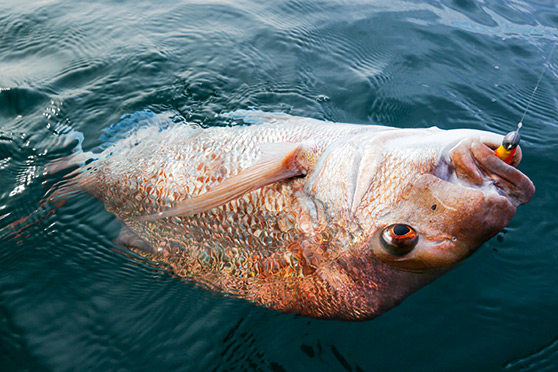
Many anglers favour a well-tied loop knot to secure their lures.
I canvassed the thoughts of several competent anglers on the subject and here is what they had to say…
Michael Walkley’s #1 go-to connection is a loop knot, followed by a clinch knot. Genie clips are at #3, with split rings, Fastach clips and snap swivels trailing the field.
He says any extra connection point is a fail or potential entanglement point.
“I personally trust my knots and don’t mind re-tying as needed. Clips for me are fine but the connection point is then reliant on a metal clip that may or may not open on a big fish, which worries me,” he says.
“I’ll avoid all other connection points other than possibly the option of a split ring that will not open.”
Ben Francis is a keen ‘bottom-basher’ who tends to fish baits over lures, but will often mix the two styles up. His go-to connection is the standard uni-knot tied straight to the hook eye, but with a bit of a twist.
As a bit of an ‘in between’ approach, Ben doesn’t pull his uni-knots up tight against the jig head, but rather uses his thumb nail to act as a stopper so that the knot is tight but with an added loop.
“This means for my initial casts there is that freedom for the jig head to move freely as with a loop knot, but with any significant pressure from a hook-up, all that will happen is that the knot will tighten against the jig head. I would probably term this a lazy man’s loop knot.”
Ben will sometimes use a small Black Magic snap swivel to attach soft-baits or small hard body lures.
“A snap swivel is so versatile and allows me to switch between my different modes of fishing quickly. I will often use a soft-bait rod for targeting gurnard or tarakihi and if the bite is slow, I will quickly switch to flicking a soft-bait around for a while and vice versa.”
He has also found Genie clips great for their ease of use but often wonders about the security of the attachment point. He can recall losing several fish when the clip has unthreaded itself from the hook eye.
Josh Darby rates the Lefty’s Loop, developed by internationally recognised salt fly exponent Lefty Crey to attach the leader to his flies, as his go-to connection for soft-baiting and fishing slow-pitch jigs.
“This is my preferred method for soft-bait fishing as it avoids the introduction of terminal tackle to your set up – a potential failure point – and is quick to tie.”
He says a loop knot allows additional movement for the jighead, providing the most natural presentation. Disadvantages include needing to cut your leader every time you want to change jighead sizes – which I overcome by having multiple setups – and they’re also a weak point to be aware of if you tend to lift fish in by the leader. Use a net!
Josh’s #2 option is the standard uni-knot.
“This is a great allrounder as it is very easy to tie quickly and does not reduce line integrity too much. I tend to use it when attaching slow jigs, especially Sliders.”
Josh tends not to use any type of clip as he prefers the more natural presentation of the Lefty’s Loop.
“However, the Fastach clips can be beneficial for slow-jigs as they encourage experimentation given you can keep your leader intact when changing lure type and/or weight.
“This is important as these factors can be the difference between catching fish or not. They may also be useful in a scenario if you are restricted to one set-up and do not wish to cut your leader every time you want to change your jighead size.”
Josh rates Genie clips behind the Fastach option as like the writer, he questions their reliability, having had several fail over the years.
Regarding snap swivels, Josh says they do encourage experimentation, but finds the combination of the swivel and attachment system unnecessarily bulky given the other options available.
Aaron Styles, creator of the Just Another Fisherman lifestyle clothing brand, is an avid angler who loves his soft-baiting and lure fishing.
Genie clips and uni-knots are his go-to connections, depending on the situation.
“If I am on a trip where I need to make lots of changes quickly, I find a Genie clip is best, otherwise I tie the leader directly to the connection point with a simple uni knot.”
Aaron says he has used the loop knot but does not notice any difference in catch rates between the two.
“With a Rapala knot, if the loop is not tied small enough, it can catch over the jig head.”
He has a little trick he uses with the Genie clip, and that is to close it up firmly with his pliers.
“I have had the leader free itself from the Genie clip resulting in lost fish, but I have never had one open up. I have had more hooks bend out or break than had clips fail me.”
A good example of the strength of the Genie clips occurred on a recent landbased trip to Great Barrier, where, soft-baiting off the bricks, he landed a respectable snapper which was only hooked through the lip with a clip.
If allowed just one connection, Aaron says it would be the uni knot tied directly to the jighead or lure, followed by the Genie clip.
Aaron has used the Fastach clips, but sometimes finds them a bit difficult to manipulate when using the smaller sizes.
Rob Parker, a Far North snapper guide and angler of some note, has probably been associated with more 30lb trophy snapper captures than anyone else in New Zealand.
He does not favour any form of clip – Genie, Fastach, split ring of snap swivel – preferring to tie a knot.
“Fishing from small 3-5 metre boat platforms is always a challenge in all weather conditions, so connecting soft-baits, slow-jigs and other metal jigs needs to be simple, but reliable,” Rob suggests.
Rob uses just two knots – a double uni-knot with the main line doubled for the mainline to trace connection and a loop knot for the trace to jighead connection. He uses a uni-knot to tie on his jigs.
“Competency in tying two simple knots quickly has been the shot for me. You don’t want to lose good fish through bad knots.”
In conclusion
Judging by the above, there is no consensus as to the best way to connect leader to terminal tackle. Perhaps the best advice is to give all the key methods a try, find the one that works best for you, and stick with it.
|
|
This article is reproduced with permission of |

Recent Forum Posts Visit Forum

Shane Jones
in Fisheries Management2 hours ago
Tzer
From what I see too even commercial in WA aren’t getting any favours from politicians there. I think here our advocacy groups like Liegasea aren’t doing...

Trailer wheel clamp
in The Boat Shed10 hours ago
krow
I like the SAS wheel clamp. I've had no issues with the lock....

Foton tunland v9
in The Briny Bar12 hours ago
Ho Dee
not fishing related and delete if required but was wondering if any has one of these or someone who has just wanting so e real world...

Bluefin Tuna at the cavs.
in The Briny Bar59 hours ago
smudge
Despite my years of fishing I haven't really fished many places, my focus has always been on Auckland's west coast and out toward Great Barrier. I...

Casting gloves
in Popper and Topwater Fishing104 hours ago
Mc Tool
100 bucks for a lure 😬. Watching one of them flying over the horizon without the line attached would be " character building " for sure...
I thought Id post some nice photo's , join...
in The Briny Bar155 hours ago
Alan L
That is a very cool pic Krow.The Far North is very cool, the Far far North even cooler. Mint looking day.Alan...

Mc Tools berley mincer
in The Briny Bar163 hours ago
SaltyC
Good size, they scrap well. Got an 18kg one up in Vava'u back a few years ago fishing off squeaky Going's boat. That was quite a...

Out with the "Twelves"
in Fishing Reports217 hours ago
Pcj
I should be able to get out end of October. The nephew been out virtually every weekend over winter and has done well. It seems the...
Manukau Harbour & West Coast fishing
in Fishing Reports224 hours ago
smudge
Nice work Schecter, I think snapper may be around sooner than you think. Well I am hoping so...
Whangarei Harbour report.
in Fishing Reports657 hours ago
krow
180 +m is where I've had to be lately. A lot less low foul around these parts and some of it shallower that looks like Tarakihi...
Popular Articles

Softbait Fishing - Part 1 - gear selection
John Eichlesheim writes an article about selecting the right equipment for softbait fishing... Read More >
Softbait fishing Pt 2 - tips and tricks
Techniques, tips and tricks of softbait fishing – getting the most from your soft baits.... Read More >

Surfcasting - setting yourself up
Gary Kemsley helps sort out the necessary gear for intending surf fishers.... Read More >

Squid - How to catch them
Squid fishing is a rapidly growing aspect of fishing - Paul Senior shares some hints and tips to get started.... Read More >
Fishing Reports Visit Reports
Outer Hauraki Gulf Fishing Report 17/09/26
Spring wind the handbrake. Spring is starting to make its presence felt in the outer... Read More >
Top of the South Fishing Report - 17/09/26
Early snapper in Tasman Bay. Well, spring is finally here, and the days are getting... Read More >
Bream Bay Fishing Report - 17/09/26
Good snapper catches reported. After Tangaroa turned off the fish tap for a month or... Read More >
Bay of Islands Fishing Report - 17/09/26
Pacific bluefin tuna for the lucky few. The last fortnight has seen more fishable days... Read More >
Comments