
Composite Developments - 40 Year Anniversary

Many great Kiwi companies started out flying by the seat of their pants, using a great deal of ‘number eight wire’ can-do philosophy and attitude to get them through their formative years.
Once such company in the tackle industry is Composite Developments Ltd (CD). Started by Marty and Sue Johanson, CD began life as a freshwater fly rod manufacturer, but now builds a far wider range of renowned rods, and is also the distributor of several major brands in New Zealand, including its flagship marque Okuma. This year Composite Developments celebrates 40 years in business.
NZ Fishing News managing editor Grant Dixon talked to Marty and the Johanson family about the business’ history, current position and its future. It has certainly been an interesting ride spanning four decades.…
GD: What is the early history of CD – who was involved and what did it look like in its formative years?
Marty: Composite Developments was started by Sue and I with financial assistance from the Development Finance Corporation (DFC) and a United States partner Richard Kantner, the latter already involved in the manufacture of carbon fibre products such as tennis rackets, golf shafts, fishing rods and the like.
Richard’s technology was a carry-over from his involvement in the making of the U2 spy plane back in 1945-1960s. It saw him travelling every Monday in a ‘blindfolded aircraft’ into the desert to return on Friday afternoon to his family. Sue and I were living in the U.S.A. from 1975 through until 1980 where I worked for NZ Breweries, attending a university there and then setting up the Steinlager brand for distribution. The idea to enter this business was hatched among the team, along with DFC, which was based in San Francisco.
We set up in New Zealand originally to assist Richard’s supply to the American market; however, that began to change with the advent of the cheaper labour markets in Taiwan and Korea, leaving us in a precarious position. We could see we would need to get other sales sources if we were to survive.
Wynrod in Rotorua was a fishing rod tackle wholesaler who had some good agencies and their own line of fly rods but they sourced from offshore and were very expensive. We become partners – I would supply the blanks and they would finish the rods. In those early days we could only afford to manufacture the blanks, so it worked well. We were selling them fast and at the same time opening the overseas markets in South Africa, Holland, Germany, Australia and of course the USA.
This led to making finished rods for other companies such as Daiwa, Abu Garcia, Redington in the USA, Cortland USA, several Australian companies, Phoenix USA, Talon USA, Shablin Rods Russia (which we still supply today), and several South African companies over the years.
We then became agents for Abu Garcia in N.Z. and in those days it was a great agency, especially in the South Island with the awesome salmon fishery back then. Progressively we took on more related agencies. We even considered the Shimano agency, but at the time couldn’t make it work. Douglas Johnson then took it on and did a great job.
GD: What did the tackle trade look like in those days compared to the way you operate today?
Marty: Kilwell were the biggest supplier to the market in those days along with Brittain Wynyard (Daiwa), Thompson Walker (Penn and Jarvis Walker), R.A. Conaghans, Bronsons and a few others in the South Island such as Alexto Sports.
Kilwell had the only licences for carbon fibre in those days so naturally they made it very hard for others to get permits to import – such a hassle back then with officialdom.
The market was dominated by very large companies with a large variety of products (lots of reps), little specialisation and they usually ran out of stock during the season, with shipments being slow and infrequent.
In terms of operating today, the leaders in the market look very different. Technology and data have changed the game. Where wholesalers and local producers were logistically necessary in the past, to be successful now you need to ensure you add value to the supply chain and ultimately the consumer. The passion and, in some cases, the great people are the same, but customers can see what is available all over the world and even source it cost effectively in small numbers from anywhere.
This has also worked in our favour with export opportunities as the push for specialised design and innovation in our product has not changed.
However, we have had to be smarter locally about the business case around what we do and making sure we can provide the whole package to those that we supply to. Retailers and consumers expect to have the best service and be able to replenish product quickly. While custom repairs may not be an efficient option anymore (it used to take four weeks and cost as much as a full rod), we also don’t believe the right thing to do is wasting a whole rod. Instead, when we manufacture rods, we analyse our history and figure out how many whoopsies we think there will be with car doors and the like, and we make spare sections to suit for all our models.
GD: What were your first key product lines and what came first – wholesaling or manufacturing?
Marty: Manufacturing was first. Probably the first three to five years was 100% making blanks and playing around making rods for a few custom builds as I built the machinery required to finish the rods. I was a fitter-turner by trade, so those skills came in handy. This all took time and money which of course was pretty sparce as we were bringing up a young family with Sue also working in the business!
We also ventured into other products such as rudder shafts for racing yachts (Stars and Stripes was a biggie for us), golf shafts, tubular parts for cars, bikes and the likes, but that really was taking our eye off the main line so really didn’t go far and, again, finance was the big issue for us.
Fly rod blanks were definitely the key as we got onto making a superior product than the rest of the world’s parabolic ‘wimpy noodles’, as we used to call them. The helical wind of pure graphite (resin included of course) was a revolution to the product as it made for a lighter rod than the glass/graphite rods.
Our process was labour intensive and relied on the team being skilled and consistent. It would have easily turned into a disaster if shortcuts were made in the application of the helical 45-degree wind up and down the mandrel.
This technology eventually led to us making saltwater rods using 100% graphite, then we introduced the utilisation of uni-directional T-glass, meaning the fibres were 100% straight thus allowing us to place them in the directions we needed to, to produce strong, well actioned rods for all facets of fishing.
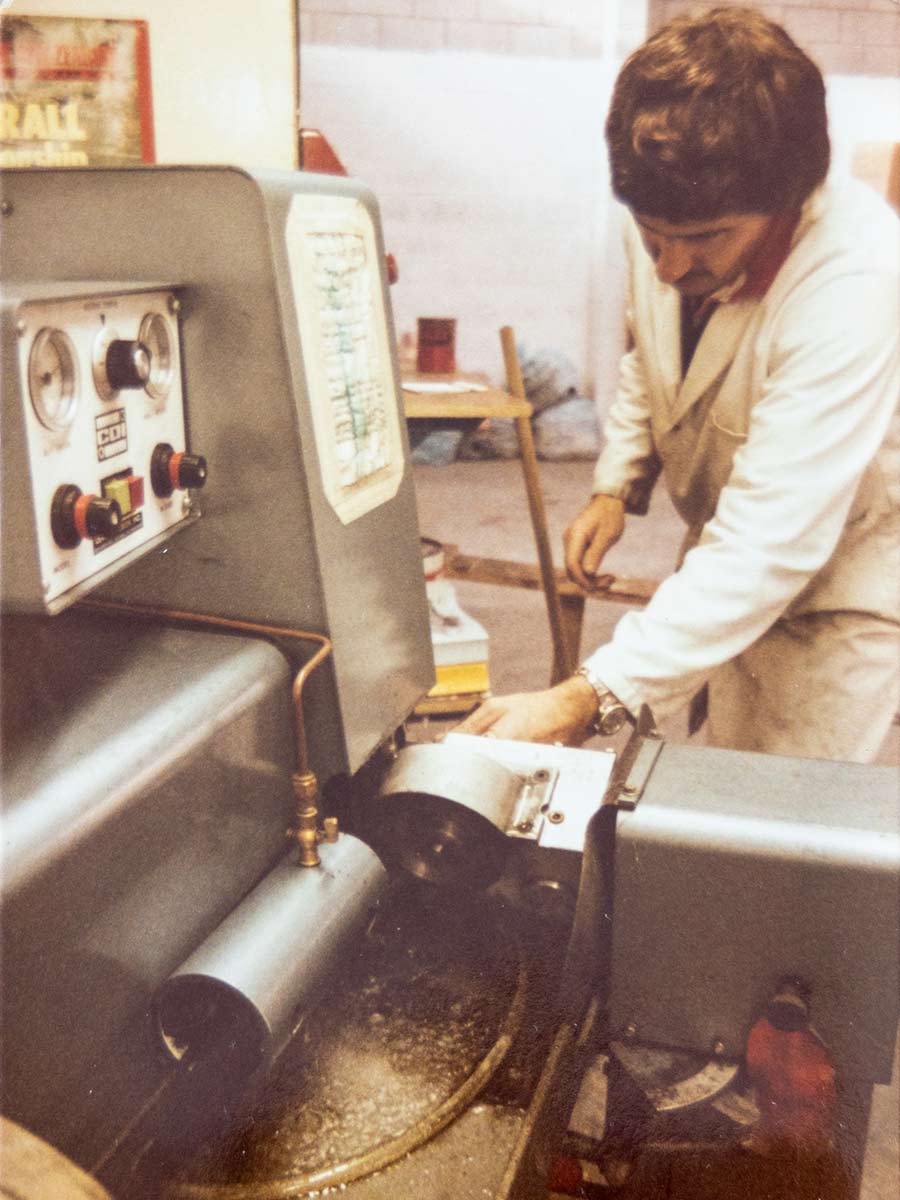
Marty’s background as a fitter and turner helped with the initial setups.
GD: Tell us about the rod manufacturing side of the business. How many staff were employed in this aspect? Who was doing your rod design? What made your rods different from others on the market?
Marty: Rod design initially started using Richard’s technology and recipes but, as mentioned, these were not what was required in the marketplace here, especially for fly rods which was our market.
His baitcasters, however, were accepted here (sold as our River Runner series back then) and in Australia for barramundi fishing. I guess fly rods were very much my design along with assistance from some awesome fisherman out there. John Milner, who at the time owned the Anglers Paradise in Turangi, old friends who got me into fishing in my youth, Reg Edwards from Longburn near Palmerston North and his associates were all my testers back in the day.
When we got involved with Wynrod it was a big turning point for CD and production, giving us a regular cashflow. They were selling the heck out of our blanks made into their rods back then – they were the only opposition to Kilwell.
We then needed to involve in the team more qualified people such as Sam Mossman (NZ Fishing News special projects editor) who was instrumental in the saltwater side and in the finishing of the rods with his knowledge of components/colours/finish etc. This led to many enthusiastic colleagues coming aboard as testers and contributors of designs. Richard Baker helped us with landbased fishing rods; Simon Carter and Mark Kitteridge (former NZ Fishing News editor and current contributor) were influential with the boat series; surf casting was very much Gary Kemsley (another former NZ Fishing News contributor) down in the Hawkes Bay; then in the south people such as Malcolm Bell and David Tipple were very much involved in the blanks for the salmon and river mouth fisheries.
In our heyday, we had close to 50 people working for us in the factory and offices. During this period, we had a very big contract with Redington in the U.S.A. and of course we were also in the ski business with all products covered, so we were a busy place back then in the early 90s.
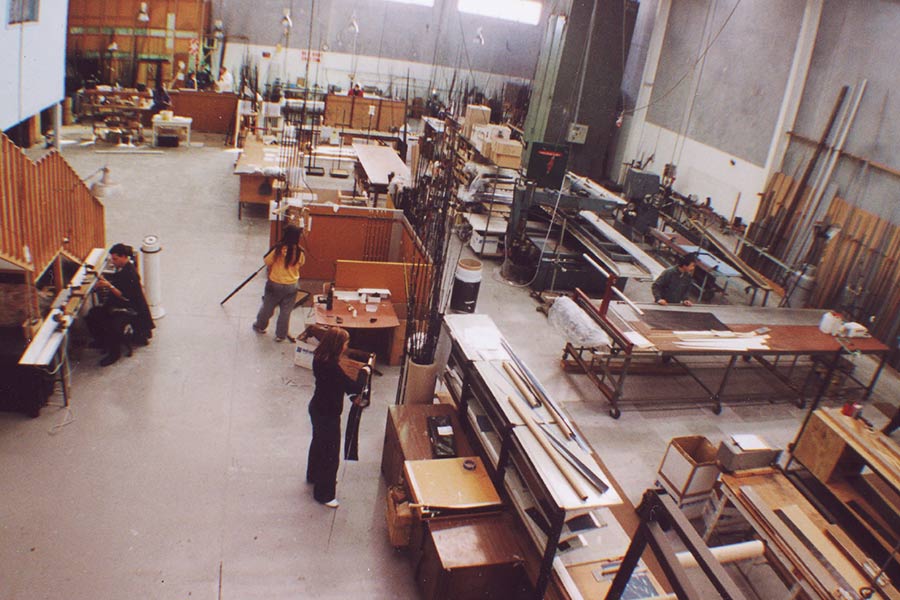
CDs employed up to 50 staff when production was at its peak.
GD: How important was the overseas markets to you in the earlier days? Where did you export to?
Marty: After approximately 2-3 years, we aggressively started looking for other export markets supported by Government grants and export incentives, which for us were game breakers.
We partnered up with another local company, Anglers Accessories out of Christchurch, which was a great fit. They made beautiful native timber fishing nets and accessories, so we did two primary shows each year – one in the States (Fly Tackle Dealers Show) and one in Europe (EFFTEX). We were very much a “down under” booth/display, but this did get people’s attention as many in those days didn’t even know about our little country.
We highlighted the beauty of New Zealand, especially our rivers, to get their attention and in many cases, they later made trips to New Zealand to fish and often became customers, importers and distributors.
In 2003-4 we decided to move the manufacturing off-shore in a joint venture with Svendsens Sports out of Denmark. The factory in China was a big investment, as well as a commitment to production as the capability of this factory was five times the daily production that we were capable of here. We simply could not get staff who wanted to do production work on the North Shore and I would say it’d be even harder today based on staffing issues fellow manufacturers have had in the area.
Production today has changed to where we now have a joint venture with a factory that allows us our very own exclusive designs – all Okuma and CD rods are designed by us here in New Zealand, specific to our requirements, but with a team of awesome engineers utilising machinery and facilities we could only have dreamed about back in 1980.
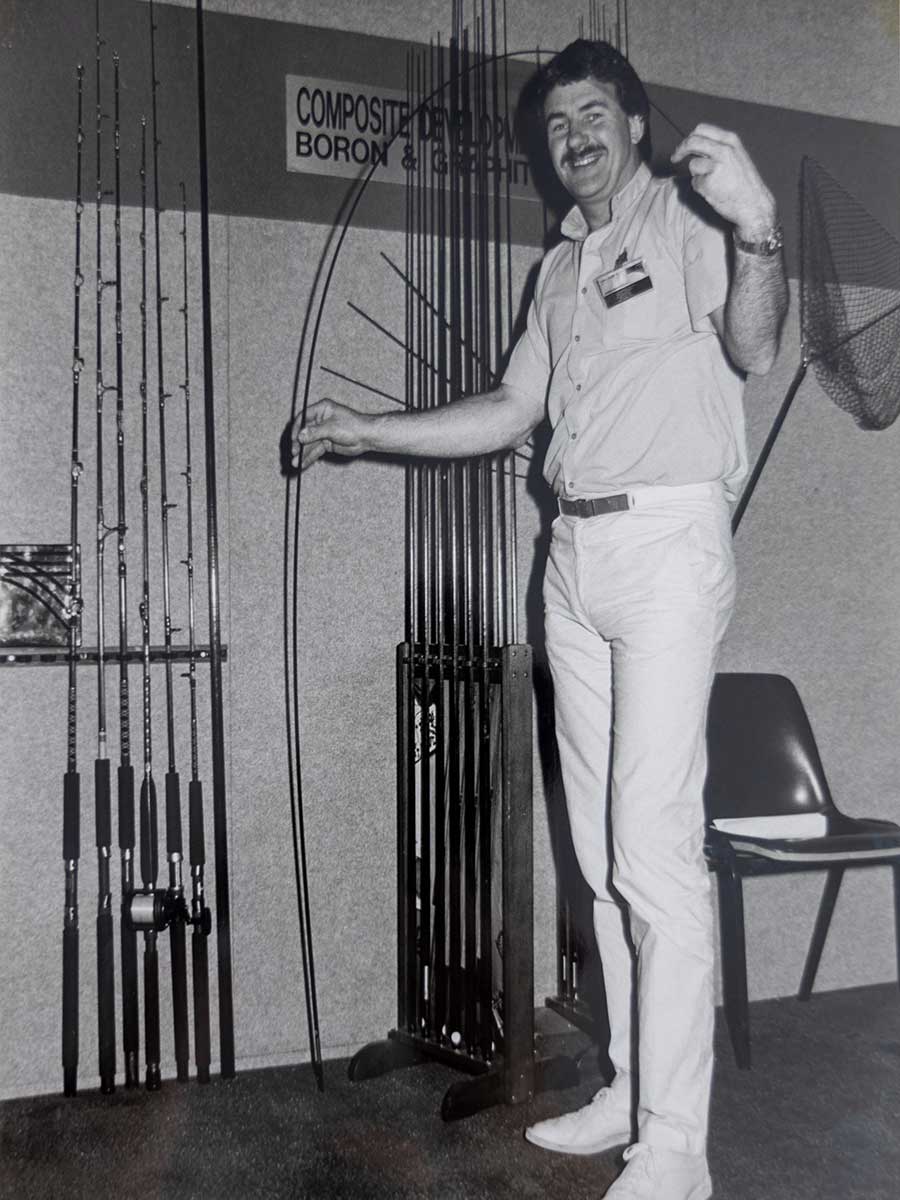
In the early days Marty travelled to the key trade shows promoting the Composite Development graphite blanks
GD: CD was involved for a while in the ski industry. How did that go?
Marty: We saw an opportunity when the public listing of some key companies fell to pieces. We picked up the Rossignol agency as we struggled in the winter with cashflow. This worked out to be a great idea until the bad winters and then the mountain began erupting!
The result was that after 18 years, we got out of the ski business to concentrate 100% on fishing, picking up some strong agencies such as Okuma, Savage, Flambeau, Pakula, Perfect Image, Toadfish Products, Platypus Lines out of Australia, Pro-Cure bait scents and T.T. Lures.
GD: What have been some of your stand-out products?
Marty: Albagraph rods have been a success story, and this originated from Sam Mossman and others’ expertise. The call was for a light, strong, fast-actioned rod specifically designed for the Hauraki Gulf’s snapper and kingies. We now are on our seventh generation of this wonderful series and are getting better with each one too!
Our big success story in game fishing was with the Tyrant rod, created before we had uni-directional T-glass. I got with a company in Gisborne called Pultron Industries which was making electric fencing standards. They were able to supply me with a tapered solid glass mandrel which I applied epoxy uni-directional graphite to. Then we finished it with triple wrapped guides etc, making this one of the toughest stand-up rods in the world. We sold thousands of them, and it was a big brand builder for us in the game fishing area.
At the same time our fly rods still led the charge domestically and overseas with the Downunder Series (still going today), GHRs, Black Magic and quite a few house brands for different companies.
Over the last few years, with son Tom and the teams’ input, we have created the TRYCD range and have redesigned the CD rod range. TRYCD was born out of the frustration around not being able to easily take (or sneak it in on family holidays!) good quality fishing gear on our adventures. The design started with reinventing a flyrod case and continued to grow from there until we had the ultimate all-access solution for whatever the ocean or river throws at you.
We spent several years analysing all the best parts of our rods and strategically released a renewed and condensed range over two years. The sales and feedback have been incredible, so we are hopefully on the right track there!
GD: You have several long-serving crew, obviously starting with yourself and Sue?
Marty: Sue was involved right from the start, on the floor assisting with production through to running the office/administration, filling in for me when I was overseas, not to mention raising a family.
Cameron Thorpe, who today heads up our warehouse/logistics, has been with us for over 21 years and he works with Maurice Baldwin who has been with us just under 18 years. Our journey is in a large part thanks to several key people over the years. A good example is Greg McKinney who worked with us for 16 years and is now a Hunting & Fishing store co-owner in Masterton, and many others who did well over 10 years with us in the manufacturing and wholesaling side of the business. We still stay in touch and enjoy it when they drop in for a beer. Just like in the early days and throughout, we could not do what we do without an incredible bunch of CD pro teamers – our extended family! Their passion, testing ability and feedback is how we design the very best equipment. Mig and Scott as hosts of the Fishing and Adventure series are a great partner and we have even designed specific gear for them. The list is almost too long to list and in fear of missing some out I’d hate to try.
The other key aspect is the experience within our own team. We only hire equally passionate people and between our sales and marketing team, have a great spread across all our local fisheries.
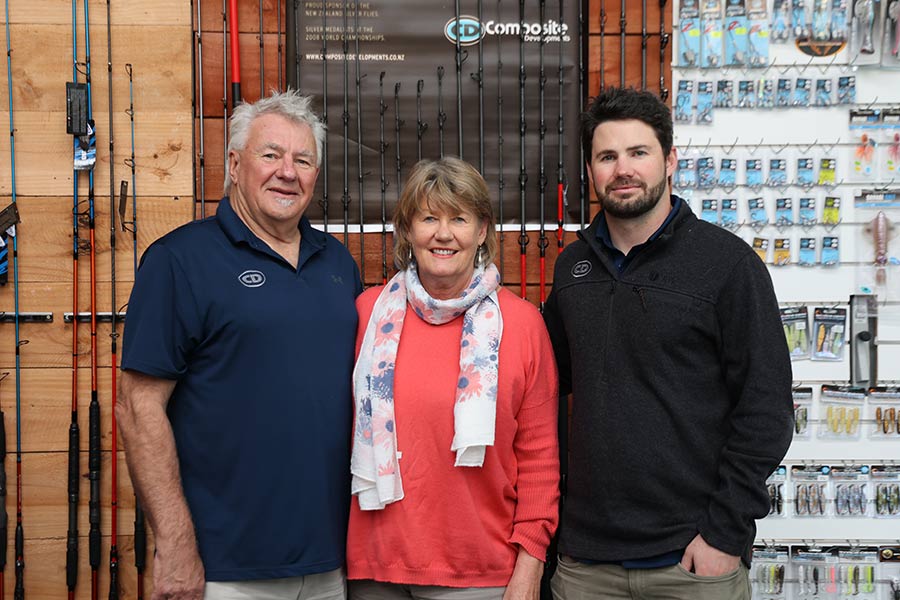
Marty, alongside wife Sue and son Tom lead the business today.
GD: How long does it take to bring a product to market from concept to hitting the shelves? What is the process for something like a new rod?
Marty: This has changed a lot over the last 18 months. This process used to take around 12 months but has now stretched out to well over 18 months. We typically have a two-year plan which is why we were able to produce so many great new products over such a crazy period.
The process usually starts with an idea or a suggestion (pro teamers, store staff, consumers – range of sources), and then the full team discusses and debates each idea (we check history, approximate pricing etc) with the goal of prioritising and narrowing down the spec of each idea. This meeting can take over two days in some cases, and can get really heated as we all champion our ideas. Tom leads these meetings and then it is his job to figure out what we produce. He works with myself and the engineers at the factory to turn the ideas into rod samples we can use. Once we have samples, we usually spend 6-12 months of testing and refining (often over 2-3 lots of samples) before mass production gets underway. In normal years, this would involve four or five two-week trips to the factory but due to COVID this has been all done with more sample runs and video calls.
The CD team design and spec all the Okuma rods you see in NZ. Our angling styles are unique, and we felt early on that the key to Okuma’s success here would be ensuring the product is purpose built for our environment. Us Kiwis are picky fishermen so we wanted to make sure we did it right.
Producing locally was something we did for 25 years. Unfortunately, as carbon blank production capabilities developed in Asia, we simply could not be competitive in any significant scale while manufacturing in Auckland. Instead, we partnered with the right people and focused our New Zealand efforts on design and testing. The result is that now we can produce more and significantly better products than we were able to before. The quality control and consistency of our manufacturing facility is second to none.
Okuma has been an interesting journey for CD. It has come from very much an ‘entry level’ product in its infancy in NZ to now having top-of the-range and competitive reels such as the Makaira.
A fishing reel involves around USD$1million in set up costs so it is not a small task to mass produce your own reel. Like the design of rods locally, we have a similar worldwide meeting with reels, and we work together to improve our offering (approx. a three to five year pipeline). What is unique about Okuma is that it owns all its rod and reel factories, so the development is internal and just keeps getting better.
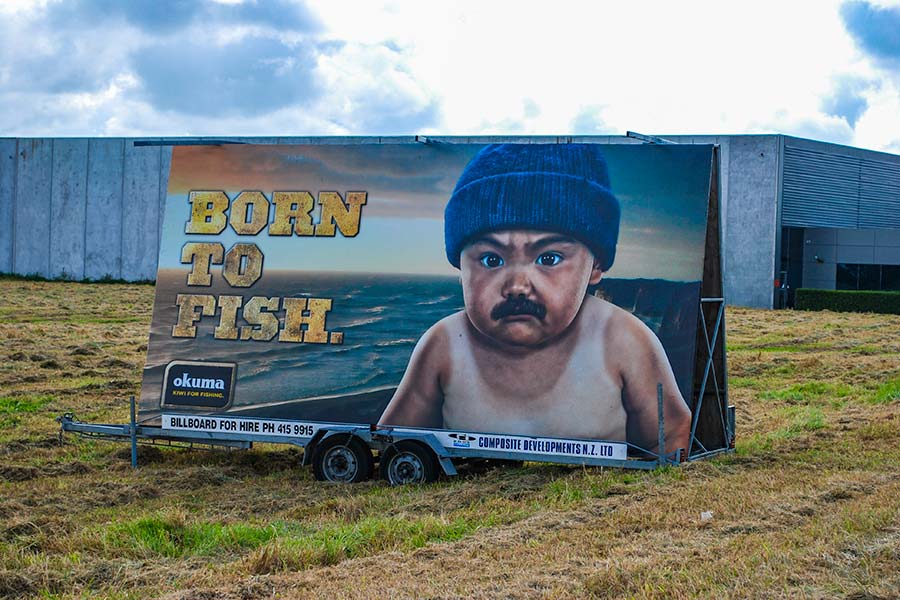
Composite Developments are the NZ distirbutor for Okuma – the infamous fishing-baby ads were the work of Adam Johanson alongside a creative agency.
GD: How has the COVID-19 pandemic changed the way you do business?
Marty: First there were factory closures and then the demand for outdoor recreational equipment worldwide surged, followed by significantly decreased shipping capabilities. As many have said, it has been a perfect storm. Fortunately for us, we have built up some very long-term relationships and Tom has carried this on. Couple this with our own factories and we have been able to make sure we get supply. Regarding the long-term effects, we have had to get smarter with ordering and work together with our retail partners to make sure we can make this sustainable.
GD: What does the future of recreational fishing and product development look like?
Marty: Fishing is literally prehistoric and something a lot of people want to do. While we don’t see that changing, the future of recreational fishing is not certain and is something we all need to work together to protect. Organisations like LegaSea are out there doing their bit on our behalf but do need our support.
The team at CD are more excited about the future than ever. There is a lot of room for further innovation in local products, but we are driven to take our ideas to the world. NZ is literally the ultimate fishing and adventure testing ground, and we are excited to continue innovating hardware to better enjoy and access these adventures.
Consumers too need to consciously continue supporting locally based businesses in our industry. New Zealand is relatively small and if we don’t support the local magazines, charter operations, stores and companies designing product here, we will lose our voice with regards to environmental issues and commercial fishing.

November 2021 - Grant Dixon
New Zealand Fishing News Magazine.
Copyright: NZ Fishing Media Ltd.
Re-publishing elsewhere is prohibited
Recent Forum Posts Visit Forum

Shane Jones
in Fisheries Management2 hours ago
Fish Addict
The recreational sector can expect no favours from politicians. They know all too well who butters their bread and it ain't the recs. No different over...

Foton tunland v9
in The Briny Bar2 hours ago
Ho Dee
not fishing related and delete if required but was wondering if any has one of these or someone who has just wanting so e real world...

Trailer wheel clamp
in The Boat Shed3 hours ago
Pcj
Doesnt dry out like crc.I use it on my trailer lock...

Bluefin Tuna at the cavs.
in The Briny Bar49 hours ago
smudge
Despite my years of fishing I haven't really fished many places, my focus has always been on Auckland's west coast and out toward Great Barrier. I...
Casting gloves
in Popper and Topwater Fishing94 hours ago
Mc Tool
100 bucks for a lure 😬. Watching one of them flying over the horizon without the line attached would be " character building " for sure...
I thought Id post some nice photo's , join...
in The Briny Bar145 hours ago
Alan L
That is a very cool pic Krow.The Far North is very cool, the Far far North even cooler. Mint looking day.Alan...

Mc Tools berley mincer
in The Briny Bar152 hours ago
SaltyC
Good size, they scrap well. Got an 18kg one up in Vava'u back a few years ago fishing off squeaky Going's boat. That was quite a...
Out with the "Twelves"
in Fishing Reports206 hours ago
Pcj
I should be able to get out end of October. The nephew been out virtually every weekend over winter and has done well. It seems the...
Manukau Harbour & West Coast fishing
in Fishing Reports214 hours ago
smudge
Nice work Schecter, I think snapper may be around sooner than you think. Well I am hoping so...

Whangarei Harbour report.
in Fishing Reports646 hours ago
krow
180 +m is where I've had to be lately. A lot less low foul around these parts and some of it shallower that looks like Tarakihi...
Popular Articles

Softbait Fishing - Part 1 - gear selection
John Eichlesheim writes an article about selecting the right equipment for softbait fishing... Read More >
Softbait fishing Pt 2 - tips and tricks
Techniques, tips and tricks of softbait fishing – getting the most from your soft baits.... Read More >

Surfcasting - setting yourself up
Gary Kemsley helps sort out the necessary gear for intending surf fishers.... Read More >

Squid - How to catch them
Squid fishing is a rapidly growing aspect of fishing - Paul Senior shares some hints and tips to get started.... Read More >
Fishing Reports Visit Reports
Outer Hauraki Gulf Fishing Report 17/09/26
Spring wind the handbrake. Spring is starting to make its presence felt in the outer... Read More >
Top of the South Fishing Report - 17/09/26
Early snapper in Tasman Bay. Well, spring is finally here, and the days are getting... Read More >
Bream Bay Fishing Report - 17/09/26
Good snapper catches reported. After Tangaroa turned off the fish tap for a month or... Read More >
Bay of Islands Fishing Report - 17/09/26
Pacific bluefin tuna for the lucky few. The last fortnight has seen more fishable days... Read More >
Comments