
Coastlines under Siege
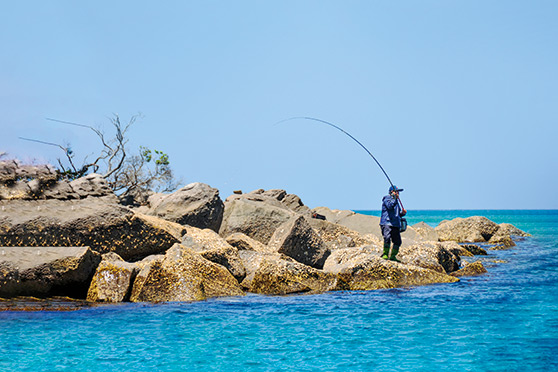
Auckland contributor John Eichelsheim is lucky enough to live close to the beach on the North Shore and most days he and his wife walk around the coast from Milford to Takapuna. While they enjoy the fresh air and wonderful coastal vistas, they have also noted the plastic waste thrown up on the beach, the ongoing scourge of sewage-contaminated stormwater polluting our lovely shores and burgeoning numbers of fishers and foragers scrambling over the intertidal zone…
After living in the area for more than 30 years, I’ve come to know North Shore’s coastline rather well. I have explored most of it as an angler, fishing from small boats and kayaks or from the shore. During this time, I have noticed some major changes in the fishing and coastal environment.
For example, 30 years ago, we didn’t see masses of worm cases thrown up on the beaches after a storm as we do now because invasive Chaetopterus worms hadn’t then become established. These worms build paper-like tubes up to 20cm long, the tubes forming thick carpets on the seabed, smothering other seabed organisms. Since first being discovered in the 1990s, these tube worms have spread far and wide, devastating scallop beds in the Hauraki Gulf and elsewhere.
That so many are thrown up onto the beaches after a storm would seem to indicate the seabed is thick with them, to the detriment of the rest of the seafloor community. It may be that Chaetopterus worms are food for snapper and other fish, but so are scallops, crabs and the other benthic organisms the worms have displaced.
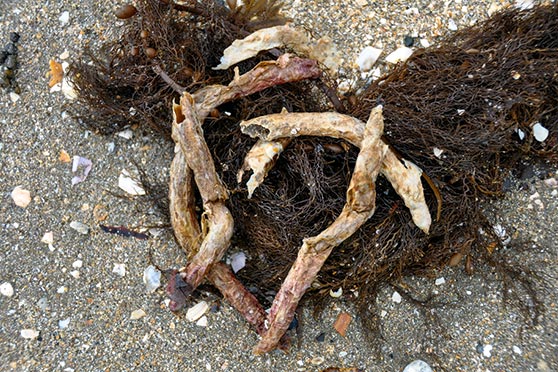
Chaeopterus cases washed up onshore.
Kelp still washes up on the beaches after every easterly blow, but it appears there is much less of it than there used to be. According to divers, our coastal kelp forests are in steep decline, and the kelp-eating kina (sea urchins) numbers are exploding. Kina are preyed upon by large snapper and crayfish, both of which are now rare inside the inner Hauraki Gulf (in the case of crayfish ‘functionally extinct’), so the natural check on kina numbers is gone, resulting in ‘kina barrens’ of bare rock covered in kina and the type of algae that kina don’t eat. Unless something changes, it’s likely kina numbers will continue to grow unchecked until they run out of kelp to eat.
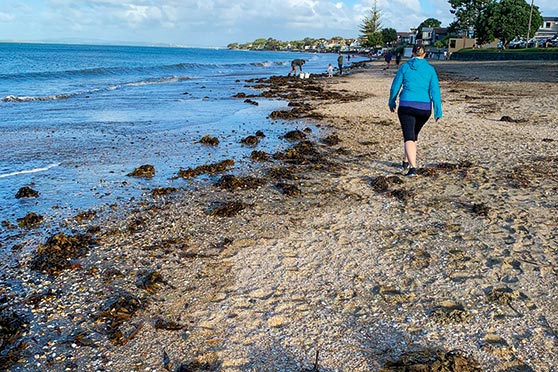
Kelp still washes up on the writer's local beaches after a decent blow.
And while it’s still possible for shore-based anglers to catch snapper along East Coast Bays, the quality of the fishing is a far cry from what many North Shore Surfcasting Club members experienced in the 1960s and 1970s. There are now far more anglers fishing from the shore, with virtually every accessible rocky point occupied by people fishing singly or in groups whenever the weather is good enough.
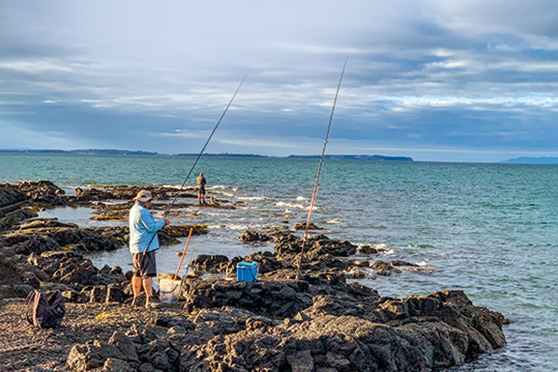
The writer's local stretch of coast sees plenty of angling pressure.
The same is happening right around the region, including inside marinas and estuaries, on breakwaters and anywhere else there is easy access to the water.
Many of these anglers are recent arrivals in New Zealand. In general, they’re not targeting legal-sized snapper, kahawai or kingfish, but rather piper, yellow-eyed mullet (‘sprats’), paketi and pretty much any small fishes they can catch.
The gear – long poles with fixed lines and floats or spinning rods rigged with multiple small hooks – is optimised to catch small fish. That’s fine if it’s piper or mullet they’re after, but some anglers are taking everything they catch, regardless of species, including undersize specimens of fish with a minimum legal size limit like snapper and trevally. And the same, mostly elderly fishers, often speaking little or no English, are fishing day after day, filling their buckets with small fish.
And then there are the foragers: family groups on weekends with hand nets, buckets, bins and knives digging pipi and cockles from our beaches, scraping oysters from the rocks, overturning boulders to collect crabs and molluscs (leaving the undersides of the rocks exposed to sun and air), netting shrimps and blennies in the rock pools and generally stripping the intertidal zone of anything alive.
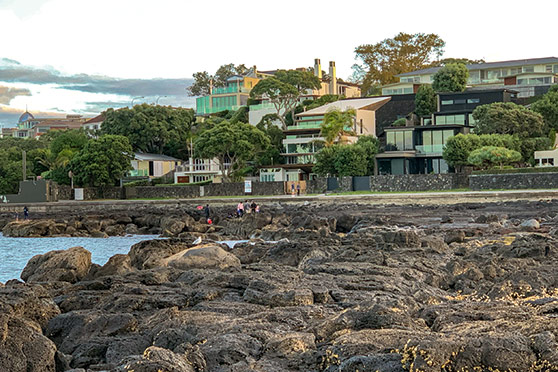
The perpetrators are seemingly prosperous, and appear oblivious to the effects they are having on local ecosystems.
The perpetrators are also generally recent arrivals from East Asia, usually well dressed and seemingly prosperous, who appear oblivious to the effects they are having on local ecosystems. Clearly, this kind of behaviour can’t go on, but is it an education issue or one of better fisheries regulations enforcement?
I have never seen a fisheries officer patrolling the short stretch of urban coastline that I frequent, while the response to calls reporting anglers keeping undersize fish have been so slow, the guilty party has invariably scarpered by the time an officer arrives.
For education to work, it has to be undertaken through the right channels – what is currently in place is clearly not working. The message needs to be disseminated through a range of languages and media for adults and through our schools for the children. Sadly, school visits to the rocky shore are now rare, especially for urban schools, in part because so many rocky shores are bereft of anything for the children to study! Onerous health and safety requirements also make such trips difficult to organise, and many schools have put field trips of any sort into the ‘too hard’ basket.
That’s a shame because caring for the environment, practising “look, don’t touch” and carefully replacing rocks you have disturbed are all a part of the rocky shore science programme for primary school kids.
Apart from the real damage being done to the coastal ecosystem by uncontrolled and excessive food gathering, I can’t help wondering about the health implications for the gatherers, given all the signs telling people not to gather shellfish and other seafood due to coastal pollution. These signs are in other languages as well…
There is a permanent ‘No Swimming’ sign at the mouth of Wairau Estuary due to concerns around water quality. With often dangerously high levels of E. coli contamination, gathering seafood is, of course, prohibited.
But for the most part, swimmers (and fishers) ignore the signs, with kids regularly swimming in the estuary outlet at high tide. Beaches right around Auckland experience similar pollution spikes after rain.
Is the coastal pollution situation worse than it was in years gone by? It’s hard to say. I would suggest it’s probably better than it was 60 years ago, when septic tanks were commonplace and industry showed little regard for the natural world. Until relatively recently, abattoirs, tanneries, wool scourers, dyers, chemical plants, paint manufacturers, steel mills, farms and businesses of every stripe discharged waste into New Zealand’s rivers, lakes and seas. Municipal authorities did the same with urban sewage.
On the other hand, Auckland’s rampant urban development, especially infill housing, much of which piggybacks on the city’s ageing combined sewage-stormwater infrastructure, means more wastewater overflow events than ever before. In many parts of Auckland, our over-stretched sewerage network discharges sewage-contaminated stormwater into local waterways every time it rains. It all ends up in the sea.
When completed, Auckland Council’s massive Northern Interceptor stormwater project should partially address the overflow issue for northwest and west Auckland, but North Shore beaches will see little improvement for at least ten years, probably longer.
We can give them a break by collectively pressuring local government to make eliminating coastal pollution a priority. As individuals, we can voluntarily refrain from collecting kaimoana from the most vulnerable coastlines.
We can also work to educate people about what’s acceptable and what is not. Where the rates of abuse are especially high, more stringent enforcement of fisheries regulations may be appropriate.
|
|
This article is reproduced with permission of |

Recent Forum Posts Visit Forum

Shane Jones
in Fisheries Management2 hours ago
Fish Addict
Yes the announcement by the Fisheries Minister in late 2025 certainly blindsided a few of the pros.Whilst Legasea may have its flaws the big plus is...
Trailer wheel clamp
in The Boat Shed8 hours ago
Mc Tool
either crc long life or 556 marine are way better ...

Foton tunland v9
in The Briny Bar23 hours ago
Ho Dee
not fishing related and delete if required but was wondering if any has one of these or someone who has just wanting so e real world...

Bluefin Tuna at the cavs.
in The Briny Bar70 hours ago
smudge
Despite my years of fishing I haven't really fished many places, my focus has always been on Auckland's west coast and out toward Great Barrier. I...
Casting gloves
in Popper and Topwater Fishing115 hours ago
Mc Tool
100 bucks for a lure 😬. Watching one of them flying over the horizon without the line attached would be " character building " for sure...
I thought Id post some nice photo's , join...
in The Briny Bar166 hours ago
Alan L
That is a very cool pic Krow.The Far North is very cool, the Far far North even cooler. Mint looking day.Alan...

Mc Tools berley mincer
in The Briny Bar173 hours ago
SaltyC
Good size, they scrap well. Got an 18kg one up in Vava'u back a few years ago fishing off squeaky Going's boat. That was quite a...

Out with the "Twelves"
in Fishing Reports227 hours ago
Pcj
I should be able to get out end of October. The nephew been out virtually every weekend over winter and has done well. It seems the...
Manukau Harbour & West Coast fishing
in Fishing Reports235 hours ago
smudge
Nice work Schecter, I think snapper may be around sooner than you think. Well I am hoping so...

Whangarei Harbour report.
in Fishing Reports667 hours ago
krow
180 +m is where I've had to be lately. A lot less low foul around these parts and some of it shallower that looks like Tarakihi...
Popular Articles

Softbait Fishing - Part 1 - gear selection
John Eichlesheim writes an article about selecting the right equipment for softbait fishing... Read More >
Softbait fishing Pt 2 - tips and tricks
Techniques, tips and tricks of softbait fishing – getting the most from your soft baits.... Read More >

Surfcasting - setting yourself up
Gary Kemsley helps sort out the necessary gear for intending surf fishers.... Read More >

Squid - How to catch them
Squid fishing is a rapidly growing aspect of fishing - Paul Senior shares some hints and tips to get started.... Read More >
Fishing Reports Visit Reports
Outer Hauraki Gulf Fishing Report 17/09/26
Spring wind the handbrake. Spring is starting to make its presence felt in the outer... Read More >
Top of the South Fishing Report - 17/09/26
Early snapper in Tasman Bay. Well, spring is finally here, and the days are getting... Read More >
Bream Bay Fishing Report - 17/09/26
Good snapper catches reported. After Tangaroa turned off the fish tap for a month or... Read More >
Bay of Islands Fishing Report - 17/09/26
Pacific bluefin tuna for the lucky few. The last fortnight has seen more fishable days... Read More >
Comments