
Circle hooks for live baiting

As a sport-fishing angler, when I hook a good fish I sure as hell do not want to lose it, and if I plan to release a fish I’ve just caught, I want it to swim away with the best-possible chance of survival.
For the past seven or eight years I have been using in-line circle hooks for all my live-bait fishing exclusively. Provided the correct fishing technique is used, the hook-up rate is just as good as when using the old-fashioned offset circle and J-style hooks. And, even better, once predatory fish are hooked on these modern circle hooks, it’s damn hard for them to be shaken free, leaving it up to the angler as to whether the fish is destined for the table or to be set free.
This parallels what’s happening elsewhere in the sport-fishing world, with more and more tournaments featuring release categories that ban the use of offset circle and J-hooks. All fish caught on dead or live bait must be taken on IGFA-approved in-line circle hooks.
As a fishing guide, it is vital to our business that all fish released have the highest chance of survival so our fish stocks are maintained. The incorporation of in-line circle hooks in our rigs see 90 to 95% of the fish we catch hooked in the jaw area, leaving a small number of injured fish remaining for us to eat. (Compare these stats with J-hook and offset circle hook styles, where the injury/mortality rates are much higher!)
Over the years we have learnt from our mistakes and picked up a few tips and tricks along the way. It has been interesting to learn different ways to attach the hook, rig the bait, and set the hook. Most of our testing has been done on a busy charter boat, giving us a perfect platform for comparing different ideas and techniques with many anglers.
Tips and tricks
Attaching the hook to the leader
Over the years I was convinced that snooding/snelling a circle hook was the best way to attach it to the leader. I also thought that the direction a snelled leader left the hook’s eye aided the hook rolling into the corner of the ?sh’s mouth – but now my view on this has changed. For well over a year we compared snelled hooks to free-swinging circle hooks on my boat, with the results stacking up slightly in favour of the free-swinging hook. This was just enough for us to change all our circle-hook rigging to swinging, especially as the live bait is also able to swim more freely on such rigs, enabling it to stay alive a lot longer and apparently attract more bites as a result. There is less leader damage with a swinging hook, too (the line always failed where it bent through the hook’s eye with a snelledhook rig), enabling us to drop down in leader diameter, which also helped us get more bites.
Which knot?
I use two different connections for attaching the free-swinging hooks to the leader:
- For 30-150lb (13-70kg) leader we use the Lefty’s Loop knot. This knot is very simple to tie and very strong.
- For 80-400lb leader we use crimps as the connection. If ? shing for species like tuna, marlin or sword?sh, where a prolonged ? ght is likely, we incorporate cha? ng tube to help protect the leader from wear.
Match the hook to the bait
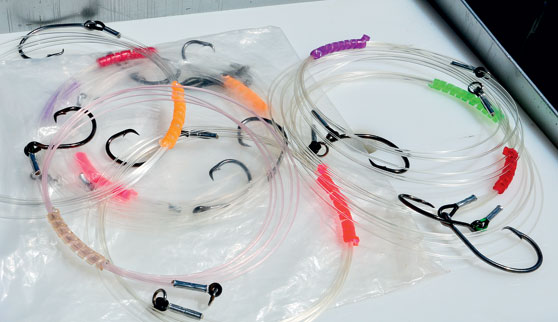
I believe selecting the right hook size to suit the bait is the key to success. Putting a large 18/0 hook through a medium-sized jack mackerel is simply not going to work, nor is rigging a large skipjack tuna with a small 8/0 hook. We want the bait to look as natural as possible, so the hook and leader should match the relative size of the livie. A great tip involves having sealed bags with pre-made rigs ready to go, so it’s possible to quickly adapt to the different baits at our disposal. For instance, I have: 100lb leaders with 8/0 and 9/0 hooks crimped on, ready to go for medium and large jack macks as king?sh baits; 150lb leaders with 12/0 hooks for XXL jack mackerel and kahawai baits for king?sh and marlin; and my heavy rigs incorporate 220lb leader with 16/0 hooks when live-baiting skipjack tuna for marlin.
Fluorocarbon is also a key to success, as it’s less visible to the ?sh and has far superior abrasion resistance compared to mono?lament, enabling leader diameter to be kept to a minimum, resulting in better live-bait presentation and more bites.
Do not strike!
If I had a dollar for every time I’ve said these words, I’d be a very wealthy man. Striking in response to a bite with a circle hook is the worst thing an angler can do, with a sudden strike only succeeding in bouncing the hook clean out of the fish’s mouth. Instead, a gradual increase in drag pressure, with the rod tip pointing towards the bait, will see the circle hook rolling nicely into the corner of the fish’s mouth.
Know your drag
Knowing the amount of drag set on your reel is important. Only modest drag pressure is required to set the hook, and then the drag can be increased up to fighting-drag pressure. Three different types of reels can be used, and all work well with in-line circle hooks, but different techniques are required to set the hook.
Lever-drag reels: These reels enable anglers to easily set circle hooks, so are the most popular style of reel for live baiting. Once a fish is running with the bait, all that’s required is a gradual slide of the lever drag up to a point that the hook is set. The lever’s position on the quadrant provides an easy visual reference for everyone to see how much drag is being applied.
Star-drag reels: A simple hook-setting technique for this style of reel involves pre-setting the drag to the pressure required to seat the hook, and then knowing how many half-turns of the star-drag wheel will take you to fighting-drag pressure.
Spinning reels: We have the bail-arm closed with no drag set on the reel when fishing for kingfish, enabling the fish to run with the bait and swallow it. At this point, knowing the reel’s drag settings is a major key to eventual success. For example, on our Shimano Stella reels we know it’s only two half-turns of the drag knob from free spool to enough drag to set the hook, and then just one more half-turn to full fighting drag.
Bridle rigging
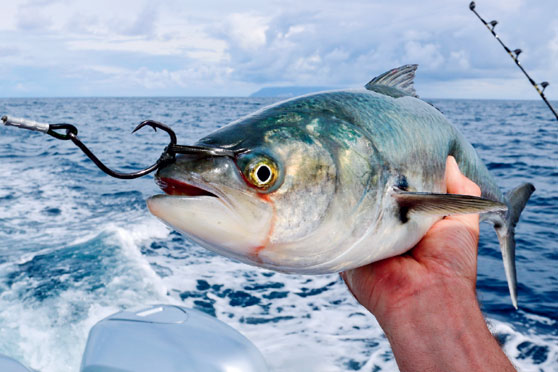
For smaller baits like jack mackerel, placing the hook through the nose is fine, as enough of the hook remains exposed to roll into the fish’s mouth, but for larger baits like kahawai and small tuna, bridle rigging works much better. Over the years we have gone away from using braid or Dacron for bridle rigs, and now use size 32 rubber bands. For small baits we use just one band and for bigger baits we double them up. The three main reasons I prefer rubber bands for bridle rigging are as follows:
- I find them very quick and easy to use when rigging them up, as there is no need for different-sized bridles for variously sized baits.
- The bridle rig can stretch, restricting the fish much less when it’s swimming, so it lasts longer and swims more naturally, resulting in more bites.
- On setting the hook in the fish’s mouth, the stretch in the rubber band helps the circle hook to steadily roll into the corner of the fish’s mouth.
Two more useful rubber band tips
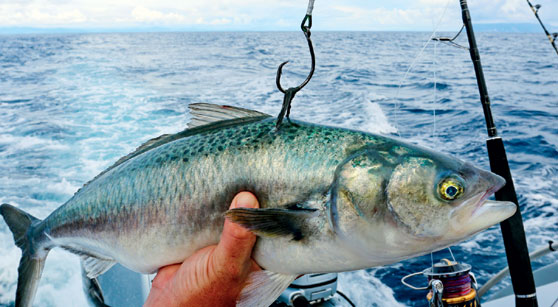
- When fishing for kingfish, we have also found that you do not need to let the kingie swallow the whole bait, as the hook can stretch away from the bait and still set. This one advantage is so important when fishing in shallow areas: you can apply drag a lot more quickly to reduce the risk of being busted off on the reef below.
- When rigging a live bait under a balloon, the hook is often placed in the fish’s back so it swims down. However, positioning a circle hook into the bulky back of the fish prevents the hook’s design from doing its job, so reduces hook-up success. That’s why we now also use rubber bands to bridle-rig the circle hook to the fish’s back, providing an improved hook-up rate.
LIVE-BAIT FISHING is one of the oldest and purest forms of fishing. The ability to find and catch your own bait is rewarding, as is then targeting and landing specific predators on those baits – it gives you a real feeling of success and satisfaction.
|
----- Advertisement -----
|
This article is reproduced with permission of |

Recent Forum Posts Visit Forum

Trailer wheel clamp
in The Boat Shed41 minutes ago
610gc
Hey teamI have a wheel clamp like the one below on the boat trailer. its getting harder and harder to unlockI've sprayed it with CRC on...

Shane Jones
in Fisheries Management24 hours ago
Tzer
Far cry to the twats at Liegasea/NZSFC were proposing of 5 Tarakihi person in their submission for the central management area and this is what our...

Bluefin Tuna at the cavs.
in The Briny Bar44 hours ago
smudge
Despite my years of fishing I haven't really fished many places, my focus has always been on Auckland's west coast and out toward Great Barrier. I...
Casting gloves
in Popper and Topwater Fishing88 hours ago
Mc Tool
100 bucks for a lure 😬. Watching one of them flying over the horizon without the line attached would be " character building " for sure...
I thought Id post some nice photo's , join...
in The Briny Bar139 hours ago
Alan L
That is a very cool pic Krow.The Far North is very cool, the Far far North even cooler. Mint looking day.Alan...

Mc Tools berley mincer
in The Briny Bar147 hours ago
SaltyC
Good size, they scrap well. Got an 18kg one up in Vava'u back a few years ago fishing off squeaky Going's boat. That was quite a...

Out with the "Twelves"
in Fishing Reports201 hours ago
Pcj
I should be able to get out end of October. The nephew been out virtually every weekend over winter and has done well. It seems the...
Manukau Harbour & West Coast fishing
in Fishing Reports209 hours ago
smudge
Nice work Schecter, I think snapper may be around sooner than you think. Well I am hoping so...

Whangarei Harbour report.
in Fishing Reports641 hours ago
krow
180 +m is where I've had to be lately. A lot less low foul around these parts and some of it shallower that looks like Tarakihi...
Whangarei Harbour Scallops
in Fisheries Management751 hours ago
Pcj
Reopening WhangÄ쳌rei Harbour to recreational scallop fishingTÄ“nÄ쳌 koeFisheries New Zealand is seeking feedback from tangata whenua, stakeholders, and the public on whether WhangÄ쳌rei Harbour should be...

Popular Articles

Softbait Fishing - Part 1 - gear selection
John Eichlesheim writes an article about selecting the right equipment for softbait fishing... Read More >
Softbait fishing Pt 2 - tips and tricks
Techniques, tips and tricks of softbait fishing – getting the most from your soft baits.... Read More >

Surfcasting - setting yourself up
Gary Kemsley helps sort out the necessary gear for intending surf fishers.... Read More >

Squid - How to catch them
Squid fishing is a rapidly growing aspect of fishing - Paul Senior shares some hints and tips to get started.... Read More >
Fishing Reports Visit Reports
Outer Hauraki Gulf Fishing Report 17/09/26
Spring wind the handbrake. Spring is starting to make its presence felt in the outer... Read More >
Top of the South Fishing Report - 17/09/26
Early snapper in Tasman Bay. Well, spring is finally here, and the days are getting... Read More >
Bream Bay Fishing Report - 17/09/26
Good snapper catches reported. After Tangaroa turned off the fish tap for a month or... Read More >
Bay of Islands Fishing Report - 17/09/26
Pacific bluefin tuna for the lucky few. The last fortnight has seen more fishable days... Read More >
Comments