
Chasing Wild Game in the Willows
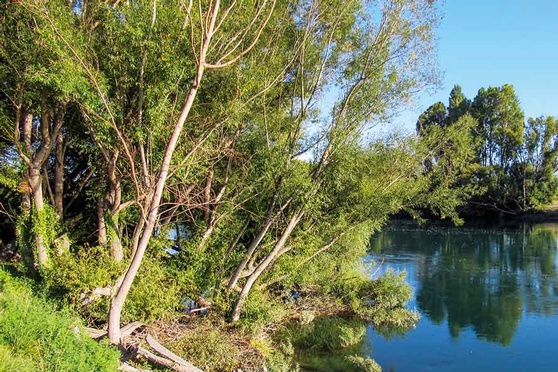
Central Otago and willow trees go hand in hand Greg Morton says, providing opportunities for both anglers and hunters.
The region is a dry province so trees that survive here are either super hardy or, in the case of willows, line most waterways. Looking down from my house on Bridge Hill in Alexandra, two rivers, the Clutha and the Manuherikia, are lined with mature willow trees crowded alongside each other. They are big trees; I believe the full name is the crack willow, and if you are under them on a windy day you will realise the name is very apt.
These deciduous trees are unkempt looking, growing at all sorts of strange angles and prone to squeaking, creaking, groaning loudly and splitting violently in high winds. I am never too happy parking my vehicle or caravan underneath them for shade as willow debris is everywhere under the groves of trees. They can grow to about twenty five metres in height, with branches often being partly submerged or hanging out over the water. Often cut up for firewood, they are average in that capacity as they burn quickly, spark often and create a lot of ash. A major plus for anglers, however, is that willow leaves are popular with moths which lay small willow grubs. Emerging grubs often end up in the water, and this seasonal summer bonanza is hoovered up by trout. The trees also provide new shoots and shelter for land based wild game such as rabbits and deer. You would be surprised how many red and fallow deer hide in willow-lined river beds.
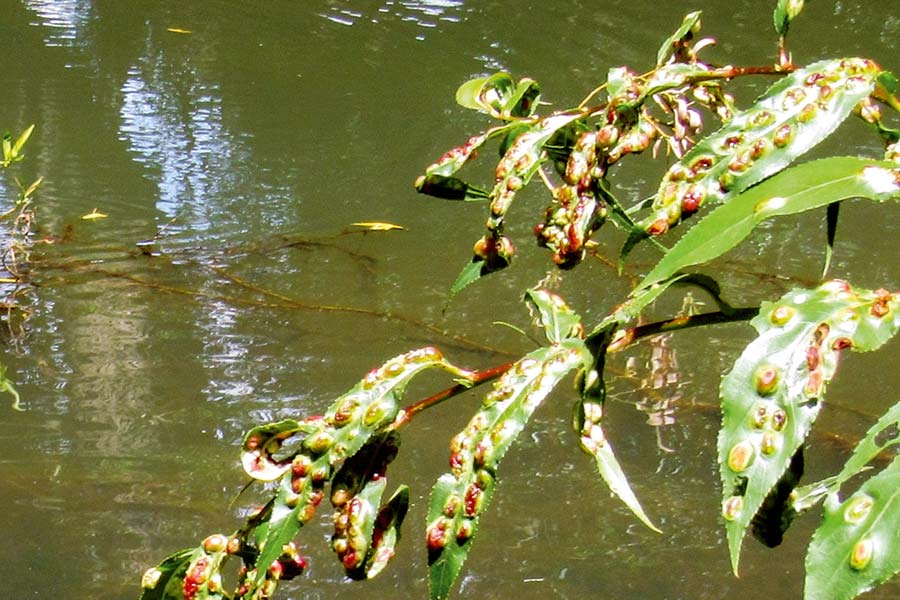
Moths lay small willow grubs which fall in the water and are hoovered up by trout.
As an Otago resident, I spend a lot of time in the realm of willows and on a recent visit to a friend’s property backing on to the middle reaches of the Clutha River, I arrived with fly rod and rifle on board. Trout were certain to be seen but there was also the possibility of stumbling on a hungry fallow deer. It was a day trip only so time constraints meant I would have to carry both rod and rifle at the same time.
After catching up with my friend, I headed through a few paddocks to where the Clutha rumbled through the willows. My fly rod is a four piece so I had broken it down and carried it in its rod bag inside my pack. The .308 rifle was over my shoulder and a walking stick would act as either a wading or shooting stick. Ammo, binos, knife and my cell phone were in a waist bag while gear connected to the rod like the reel, flies, line and net were in or attached to the pack.
The most important piece of fishing gear was a fly container holding some Stu Tripney willow grub yellow/black nymphs. Grubbing trout can be very fussy and unless your offering ‘looks, drifts and acts’ like the real thing you are relegated to the role of spectator.
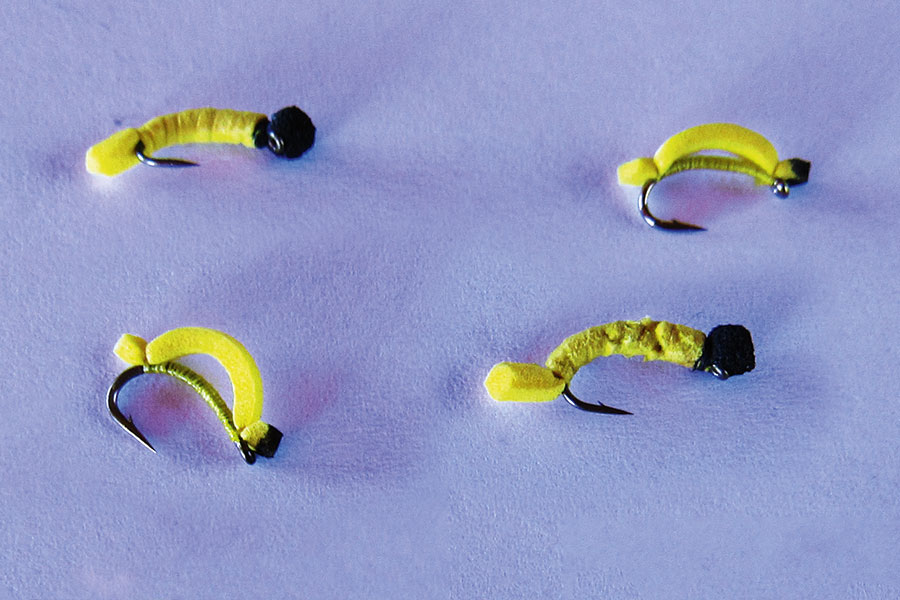
Willow grub imitations - if you don't have them, you are not in the game.
My mate had suggested I target a backwater just off the main river as it was quieter water and was surrounded by a lot of willows. I snuck into a viewing position under a tree and watched for action. Grubbing trout either tend to park up in a current feed lane back from food producing willows and move rapidly as grubs drift past or cruise slower water checking out overhanging trees for falling grubs.
Sure enough, there were at least three medium size trout cruising the backwater occasionally snaffling grubs floating just under the surface. The secret is to land your imitation near the active fish and in my case, hope Stu’s nymph does the rest. This backwater was very cramped so I resorted to an old favourite tactic which is the bow and arrow cast. Holding the grub in the left hand, the rod is lifted and bent away from the grub holding hand. Once tension is tight, the grub is released and hopefully flicks out to where the cruising trout will pass. Hooking a finger is the biggest obstacle.
Fishing for willow grubbing trout can be the definition of frustration as they can regularly ignore ‘nearly good enough’ imitations. However, this day was not one of those days and over a couple of hours I snared two of the cruisers I had spotted. They saw the nymph, changed their path, opened their mouth, sucked it in and carried on cruising till I struck. Both were about 1.5kg and since I didn’t need any more weight on my back, they were released.
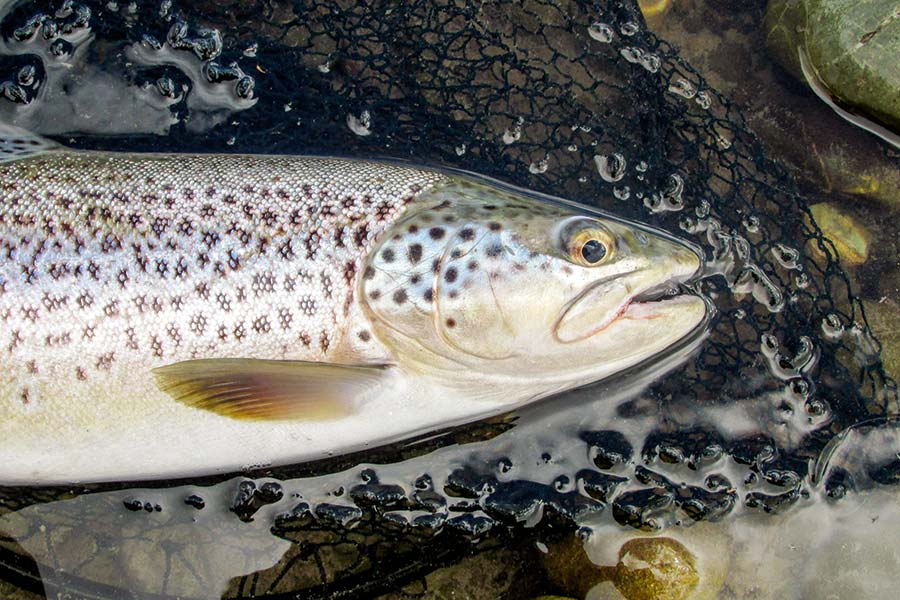
When trout are feeding on the willow grubs, they will rarely show interest in anything but a grub imitation.
I then left the backwater and began walking in a loop back to the truck. This involved skirting the Clutha shoreline under the willows. I began to notice deer tracks in the mud where animals had left the surrounding scrub and come down to drink and reach up to nibble on willow shoots.
The rod was put away, and I slipped into hunting mode. The best time to hunt is the magic hour prior to dark but being a one day adventure I wanted to be on the way home well before then. I decided to back-track the deer prints, looking into bush gully heads as I headed up to the vehicle. Sneaking along a ridge, I encountered some curious cattle so edged into the trees to evade them. Glancing down, I saw a small clearing on the path down to the river and just as I looked that way, a fallow deer walked into it to feed. ‘Never let a chance go by,’ popped into my head, so I eased to the ground, got the rifle off the shoulder and quietly worked up a bullet from the magazine. The deer collapsed to the shot, never even aware I was there. A startled second deer rocketed away as the gunshot rang out.
The willows had certainly produced, providing two fine trout and an orange-coloured fallow deer spiker which was destined to fulfil BBQ requirements.

April 2021 - Greg Morton
New Zealand Fishing News Magazine.
Copyright: NZ Fishing Media Ltd.
Re-publishing elsewhere is prohibited
Recent Forum Posts Visit Forum

Foton tunland v9
in The Briny Bar11 minutes ago
Ho Dee
not fishing related and delete if required but was wondering if any has one of these or someone who has just wanting so e real world...

Trailer wheel clamp
in The Boat Shed42 minutes ago
Pcj
Doesnt dry out like crc.I use it on my trailer lock...

Shane Jones
in Fisheries Management27 hours ago
Tzer
Far cry to the twats at Liegasea/NZSFC were proposing of 5 Tarakihi person in their submission for the central management area and this is what our...

Bluefin Tuna at the cavs.
in The Briny Bar47 hours ago
smudge
Despite my years of fishing I haven't really fished many places, my focus has always been on Auckland's west coast and out toward Great Barrier. I...

Casting gloves
in Popper and Topwater Fishing91 hours ago
Mc Tool
100 bucks for a lure 😬. Watching one of them flying over the horizon without the line attached would be " character building " for sure...
I thought Id post some nice photo's , join...
in The Briny Bar142 hours ago
Alan L
That is a very cool pic Krow.The Far North is very cool, the Far far North even cooler. Mint looking day.Alan...

Mc Tools berley mincer
in The Briny Bar150 hours ago
SaltyC
Good size, they scrap well. Got an 18kg one up in Vava'u back a few years ago fishing off squeaky Going's boat. That was quite a...
Out with the "Twelves"
in Fishing Reports204 hours ago
Pcj
I should be able to get out end of October. The nephew been out virtually every weekend over winter and has done well. It seems the...
Manukau Harbour & West Coast fishing
in Fishing Reports212 hours ago
smudge
Nice work Schecter, I think snapper may be around sooner than you think. Well I am hoping so...

Whangarei Harbour report.
in Fishing Reports644 hours ago
krow
180 +m is where I've had to be lately. A lot less low foul around these parts and some of it shallower that looks like Tarakihi...

Popular Articles

Softbait Fishing - Part 1 - gear selection
John Eichlesheim writes an article about selecting the right equipment for softbait fishing... Read More >
Softbait fishing Pt 2 - tips and tricks
Techniques, tips and tricks of softbait fishing – getting the most from your soft baits.... Read More >

Surfcasting - setting yourself up
Gary Kemsley helps sort out the necessary gear for intending surf fishers.... Read More >

Squid - How to catch them
Squid fishing is a rapidly growing aspect of fishing - Paul Senior shares some hints and tips to get started.... Read More >
Fishing Reports Visit Reports
Outer Hauraki Gulf Fishing Report 17/09/26
Spring wind the handbrake. Spring is starting to make its presence felt in the outer... Read More >
Top of the South Fishing Report - 17/09/26
Early snapper in Tasman Bay. Well, spring is finally here, and the days are getting... Read More >
Bream Bay Fishing Report - 17/09/26
Good snapper catches reported. After Tangaroa turned off the fish tap for a month or... Read More >
Bay of Islands Fishing Report - 17/09/26
Pacific bluefin tuna for the lucky few. The last fortnight has seen more fishable days... Read More >
Comments